AI Publishing Agents That Find Signals, Build The Plan, And Draft The Campaign
Narrareach coordinates four publishing agents: Signals finds current opportunities, Strategy builds a focused campaign, Content prepares voice-matched drafts, and Growth plans distribution and the next cycle. Start with a reader, niche, or publishing question, then review the complete package before scheduling it.
Agent cycles: Audience Builder · US$19.99/month, billed monthly · View plans
Summary
Narrareach publishing agents help writers decide what is worth creating before producing another draft.
- Signals finds current questions, conversations, and opportunities around your niche.
- Strategy turns the strongest opportunity into one focused campaign.
- Content prepares the coordinated articles, Notes, and social drafts.
- Growth plans distribution and carries the results into the next cycle.
You receive the evidence, plan, drafts, and proposed schedule in one reviewable package.
Start with a reader problem, not a blank prompt
Suppose you write for independent consultants and want to know whether pricing anxiety deserves a campaign. Narrareach can examine current searches and conversations, compare the opportunity with your niche and previous content pillars, and identify a focused question worth answering.
From there, the agents build one campaign around that question. The package can include a central article, supporting Notes, social adaptations, suggested timing, and the evidence behind the direction.
The workflow stays visible as it moves through four stages:
- Signals identifies a reader question worth pursuing from current search activity, audience context, and earlier content performance.
- Strategy turns that question into one campaign idea, the intended audience, and the formats that can carry it.
- Content prepares the central article and the supporting Notes, social posts, or video drafts.
- Growth recommends timing and distribution so the approved pieces can move into the publishing queue.
This is a connected editorial sequence. Each stage receives the accepted work from the stage before it, so the final drafts follow the same reader need and campaign idea.
Find the questions that are gaining attention now
Signals looks beyond a list of generic topics. It examines current search interest, relevant conversations, fit with your audience, and the themes already present in your work.
The useful output is a clear opportunity: the reader problem, why it matters now, the angle Narrareach recommends, and the source material supporting it. Weak or repetitive ideas can be left out before they consume a drafting cycle.
Turn one opportunity into a campaign with a point of view
Strategy defines what the campaign should help the reader understand or do. It establishes the central argument, the progression across pieces, the useful examples, and the action each format should invite.
That prevents the article, Notes, and social posts from becoming disconnected summaries. Every piece has its own job while contributing to the same editorial direction.
Prepare the writing and distribution as one package
Content uses the accepted opportunity, strategy, sources, and writer profile to prepare the campaign drafts. Growth then places those pieces into a practical distribution plan across supported channels.
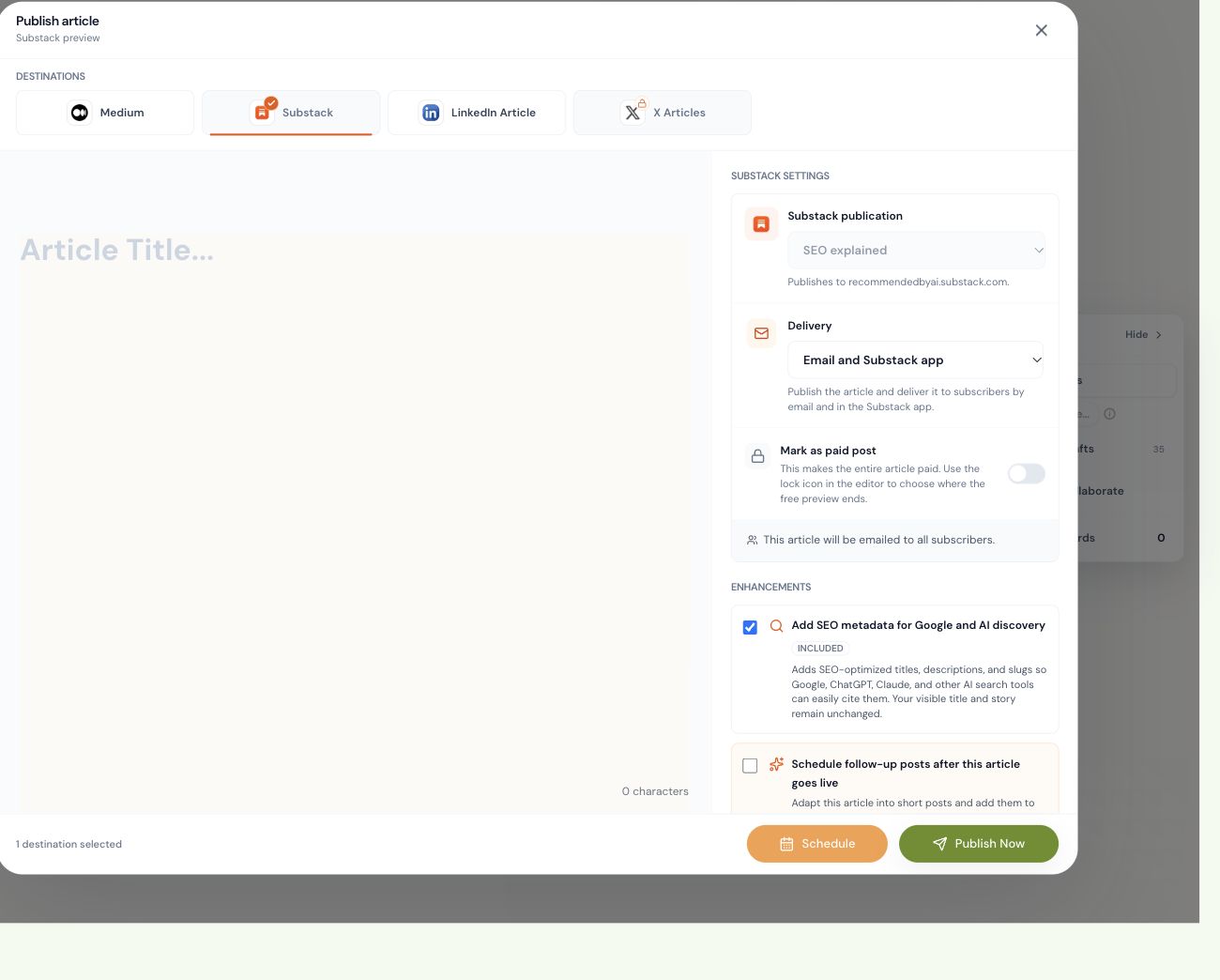
The package can carry a full article, short-form adaptations, destination choices, and proposed timing. Open any piece in Narrareach to refine the voice, add a current example, or adjust how it fits the channel before it enters the queue.
Use the response to shape the next campaign
After publication, review the available results by content, topic, format, and destination. A strong article may reveal a content pillar worth expanding. A short post may surface a question that deserves a deeper guide.
Narrareach uses your niche, current searches, and content-pillar performance to suggest the next ideas worth exploring. The system keeps the research, publishing work, and learning connected from one campaign to the next.
Use agents when the decision matters as much as the draft
| General writing chat | Narrareach publishing agents |
|---|---|
| Begins with the context placed in one prompt. | Begins with your niche, audience, current signals, and existing publishing context. |
| Produces an isolated response. | Produces an evidence-backed campaign package. |
| Leaves the writer to coordinate formats and destinations. | Connects the article, short-form drafts, distribution, and learning. |
| Stores the result in the conversation. | Keeps the work visible in the Narrareach publishing system. |
Questions writers ask
What are AI publishing agents?
They are specialized agents that handle different parts of a connected editorial workflow. Narrareach uses Signals, Strategy, Content, and Growth agents to move from a current opportunity to a reviewable campaign.
How are publishing agents different from an AI writing assistant?
An AI writing assistant responds to the task you give it. Narrareach publishing agents coordinate research, campaign strategy, drafting, distribution, and learning as one sequence.
What does the Signals agent use?
Signals considers your niche, intended audience, current searches, relevant conversations, and the performance of existing content pillars when developing opportunities.
What does a completed agent cycle produce?
It produces the opportunity evidence, campaign direction, coordinated drafts, and proposed distribution plan created during that cycle.
Can the agents create different formats?
Yes. A campaign can include articles, Notes, social posts, and other supported formats chosen for the editorial plan.
Can I edit the finished package?
Yes. The campaign returns to Narrareach as reviewable work that you can refine and schedule through the normal publishing workflow.
Which plans include publishing-agent cycles?
Audience Builder includes two agent cycles a month, Revenue Writer includes seven, and Full Agentic Mode includes 20. Full Agentic Mode also adds the intelligent content engine, Research Desk, expanded automation, API access, and webhooks.
Turn one reader question into a complete editorial campaign
Choose the audience and subject. Narrareach will find the opportunity, build the plan, and prepare the campaign for review.
Agent cycles: Audience Builder · US$19.99/month, billed monthly · View plans