AI content repurposing

AI Content Repurposing That Creates New Angles, Not Thin Copies

Narrareach provides AI content repurposing for writers and content teams. It turns articles, newsletters, Notion pages, public URLs, and documents into reviewable Notes and social drafts while preserving the source and the writer's final approval.

At a glance

AI content repurposing for articles and newsletters

Import an article or open an existing draft, extract the strongest standalone ideas, adapt them for supported channels, and schedule only the versions worth publishing.

  • Narrareach can start from imported articles, connected Notion pages, public URLs, files, or existing drafts.
  • The same workflow can generate short-form drafts, preserve the long-form source, and schedule selected variants.
  • Writers can compare performance and subscriber evidence before producing more content from the same theme.

What this page covers

What is AI content repurposing?Import the source without losing structureTurn one article into a useful distribution campaignUse performance to choose the next format

Import a source, review the extracted angles, and schedule only the drafts you approve.

The problem

The manual version gets old fast.

Weak repurposing reduces an article to a summary, swaps a few words, and publishes the result several times. That creates volume without giving an existing reader a reason to pay attention again.

Strong repurposing finds ideas that can perform a different job. One post may explain the central claim, another may show the example, another may address the strongest objection, and another may ask the question the article leaves open.

Narrareach keeps those new drafts connected to the source. The writer can inspect whether each selection stands alone, edit it for the destination, and schedule a campaign without losing the original article or the evidence that informs the next decision.

Quick answer

What Narrareach does for you

AI content repurposing works when it preserves the source idea, creates genuinely different angles, adapts each draft to its destination, and keeps a writer in control. Narrareach connects that editorial work to scheduling and performance review.

Workflow

  1. 1Import or open the source article and identify the claims, examples, stories, and questions worth developing.
  2. 2Generate several standalone angles with enough context to make sense without the original article.
  3. 3Edit each version for Substack Notes, LinkedIn, X, Bluesky, Threads, or another supported destination.
  4. 4Schedule the approved set and use available results to decide which angle deserves a full follow-up.

What Narrareach adds

  • Narrareach can start from imported articles, connected Notion pages, public URLs, files, or existing drafts.
  • The same workflow can generate short-form drafts, preserve the long-form source, and schedule selected variants.
  • Writers can compare performance and subscriber evidence before producing more content from the same theme.

Limits to know

  • A densely argued section may need added context before it can stand alone as a useful post.
  • Repurposing creates distribution leverage, but publishing many shallow paraphrases can weaken trust and audience interest.

Inside Narrareach

Review generated Notes before they enter the queue

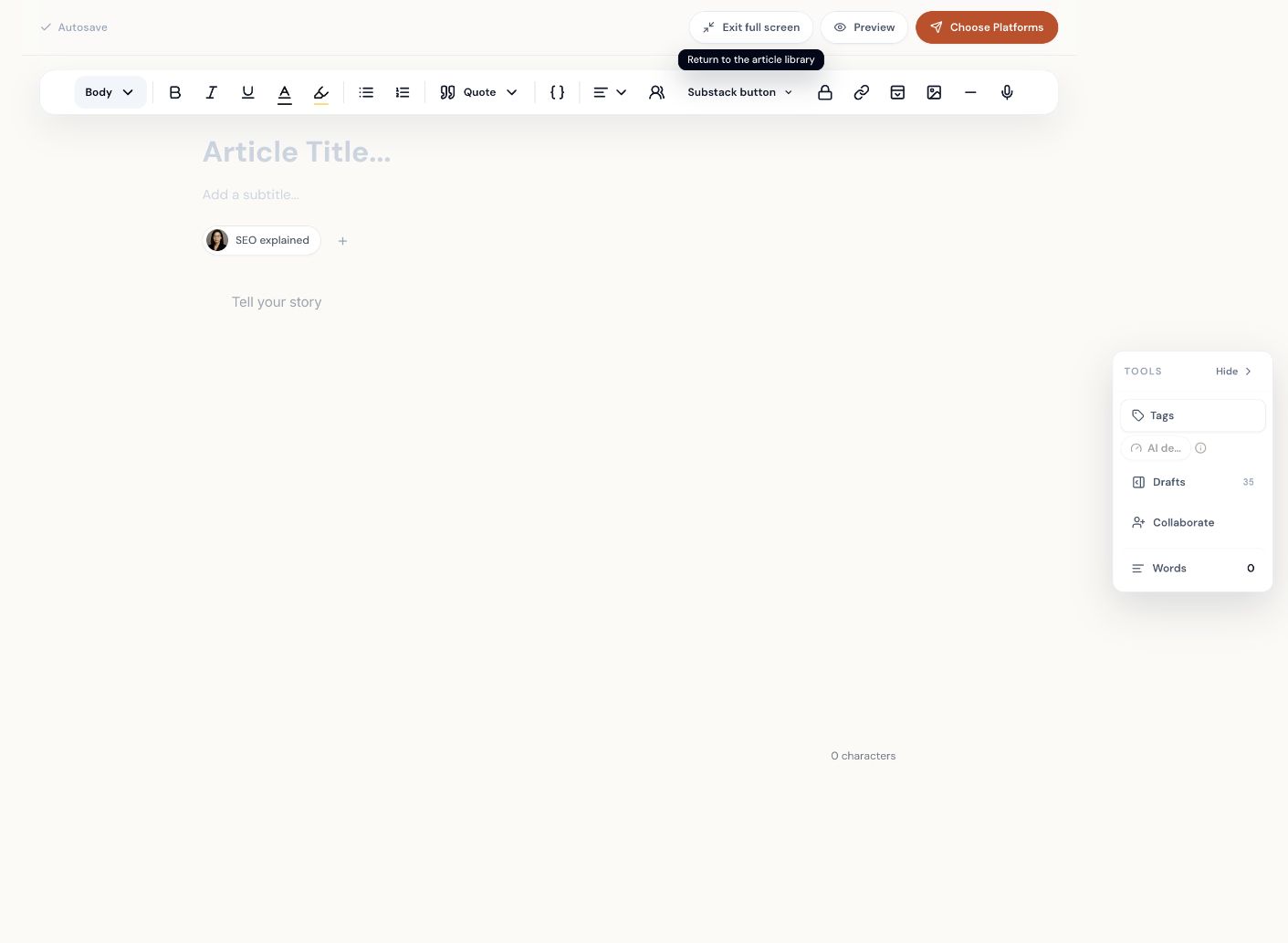
Narrareach keeps generated short-form drafts editable so the writer can strengthen context, voice, links, and platform selection before scheduling.

Narrareach Notes editor showing a reviewable short-form draft and publishing controls
Repurposing is an editorial workflow: generation creates candidates, and the writer decides what is useful enough to publish.

What is AI content repurposing?

AI content repurposing uses a model to analyze existing material and prepare new formats or angles from it. The source may be a published article, a draft, a newsletter issue, a connected Notion page, a document, or a public URL that the writer has permission to reuse.

The useful output is not a pile of synonyms. It is a set of drafts that preserve factual meaning while changing the editorial job, context, and format. A short post needs enough explanation to stand alone, while a long-form adaptation may need a new introduction, examples, and conclusion for its destination.

Narrareach treats generated output as drafts. Writers can reject weak angles, correct claims, restore voice, choose platforms, and decide whether the source should produce a short campaign or a deeper follow-up article.

  • Use source material you own or are authorized to adapt.
  • Ask for angles with different jobs instead of several summaries.
  • Check every extracted number, quotation, and causal claim against the source.

Import the source without losing structure

A repurposing workflow improves when the source arrives with headings, links, lists, quotes, and images intact. Narrareach can import from connected Notion pages, public article links, Word and Markdown files, HTML, supported feeds, and existing drafts in the article library.

Notion to Substack is useful when the editorial source lives in a workspace rather than on a public site. The writer selects shared pages, previews the import, and brings them into Narrareach as drafts before choosing Substack or another supported article destination.

After import, review complex embeds and temporary images. Destination editors do not support every source block in the same way, and preserving meaning is more important than pretending the conversion is perfect.

  • Preview imported pages before generating follow-up content.
  • Use descriptive headings because they help both readers and angle extraction.
  • Replace temporary or inaccessible media before scheduling.

Turn one article into a useful distribution campaign

Begin by identifying the audience promise and the strongest evidence in the article. Then extract candidate units: a surprising claim, a specific example, a practical sequence, a misconception, a quotation with context, and a question that invites an informed response.

Select only the units that can stand alone. Add the missing setup, preserve the source link where useful, and prepare a version for each destination. The schedule Substack Notes workflow can hold the short-form set while the content distribution platform keeps article and social delivery connected.

An AI publishing assistant can accelerate the first pass, but the writer should decide whether the new draft adds value for someone who already read the article. If it does not teach, demonstrate, challenge, or extend the idea, it is probably not ready.

  • Prefer three strong angles over fifteen shallow paraphrases.
  • Give every post a complete thought and a reason to exist.
  • Space related posts according to the campaign, not an arbitrary automation quota.

Use performance to choose the next format

Repurposing should create a learning loop. A useful Note may reveal that one example deserves a full article. A LinkedIn version may bring qualified traffic. A short post may earn replies that expose the next objection the writer should address.

Narrareach can bring supported destination results and subscriber evidence back beside the campaign. The writer can distinguish direct subscriber attribution from source attribution, same-period correlation, and unknown traffic before deciding which result is meaningful.

The next request can then be specific: turn the example that brought qualified readers into a deeper tutorial, create two variations that answer the most common reply, or retire an angle that received attention but produced no relevant downstream signal.

  • Define the expected outcome before publishing the campaign.
  • Compare formats and topics without claiming causation from timing alone.
  • Use reader responses as source material for the next original piece.

How Narrareach solves it

Keep the publishing system close to the writing.

Multi-source imports - so repurposing can begin with the writer's real article or workspace draft

Angle generation - so each draft can teach, demonstrate, challenge, or extend the source

Platform adaptation - so approved ideas fit Substack, LinkedIn, X, Bluesky, Threads, and other supported channels

Campaign feedback - so the next article or variation can respond to available results

Repurposing approaches compared

CapabilityManual copy and pasteGeneric AI rewriterNarrareach
Source preservationManualPrompt-dependentSource article remains attached to the workflow
Distinct anglesWriter-createdOften paraphrasesReviewable angle and format drafts
Notion and document importsManual exportTool-dependentConnected pages, URLs, and supported files
SchedulingSeparate toolsOften absentSelected drafts enter the publishing queue
Outcome reviewManualUsually absentSupported publishing, traffic, and subscriber evidence

Start here

Turn one strong article into a campaign readers can still learn from

Import a source, review the extracted angles, and schedule only the drafts you approve.

Repurpose an article

Questions writers ask

What is the difference between repurposing and cross-posting?

Cross-posting distributes a version of the same asset to another destination. Repurposing creates a new format or angle from the source. A campaign can use both, but the editorial work is different.

What content can Narrareach import?

Narrareach supports connected Notion pages, public article URLs, Word, Markdown, HTML, supported feeds and archives, and existing Narrareach drafts, subject to access and format limits.

Can Narrareach turn articles into Substack Notes?

Yes. Writers can generate several standalone Note drafts from an article, review them, choose destinations, and add the approved set to the publishing queue.

How do I keep repurposed content from sounding repetitive?

Choose different editorial jobs, restore missing context, change the opening for the destination, and reject any draft that merely summarizes what readers already saw.

Does AI repurposing change the original article?

No. Generated Notes and platform versions are separate drafts. The source article remains available for review and does not need to change.

Can I use performance data to repurpose content?

Yes. Supported analytics and subscriber evidence can help select a promising topic or format. The writer should still distinguish direct attribution from correlation and uncertainty.

Is AI-generated repurposed content safe for search?

Search systems evaluate usefulness and quality rather than granting value simply because content is AI-generated. Publish accurate, original, reader-focused adaptations and avoid scaled pages that add no value.

Narrareach LLM connector

Connect Claude, ChatGPT, or any MCP-compatible agent to read drafts, schedule posts, and automate Substack, Medium, LinkedIn, X, Bluesky, and Threads workflows.

Read the docs