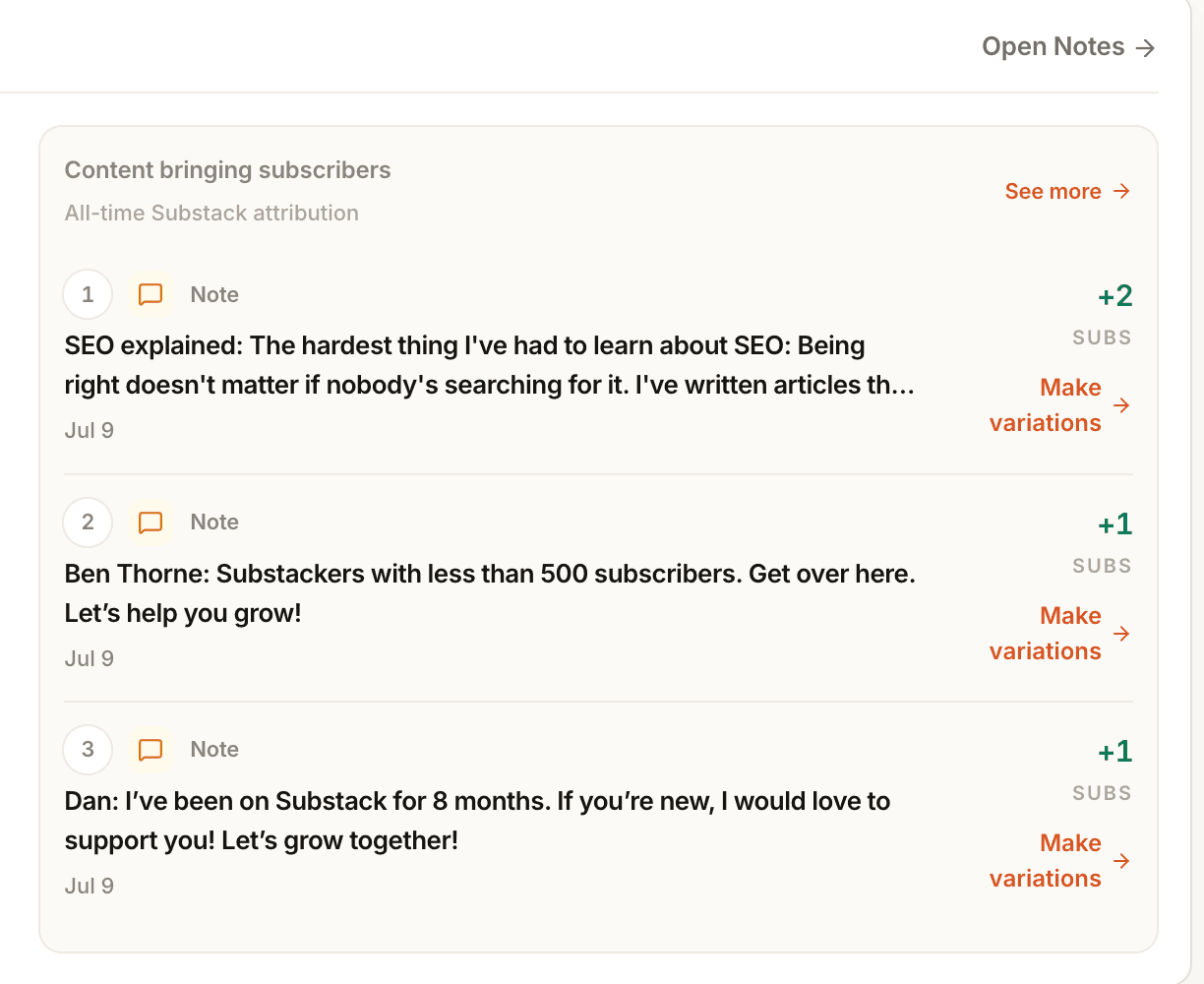
Subscriber attribution tracking
See Which Substack Notes And Articles Actually Drive Subscribers
Narrareach correlates your publishing activity with subscriber growth so you can see which content converts readers — not just which content gets views.
Connect your Substack publication and see attribution data within your first week.
- 1
- Substack scheduler that tracks subscriber outcomes per post, not just views
- 36 hr
- Attribution window used to correlate posts with subscriber spikes
- 2
- Attribution tiers tracked: free subscriber events and paid conversions
- 0
- Other schedulers that show which specific post drove 18 new subscribers
The problem
The manual version gets old fast.
Substack's native analytics shows views and open rates. It doesn't tell you which specific Note drove 18 new subscribers last Tuesday, or which article you published in March has been converting readers to paid subscriptions for months.
Most schedulers track when posts go out. Narrareach tracks what they produce. Attribution data changes how you plan content — instead of guessing which topics work, you know.
Quick answer
What this workflow should solve
Narrareach tracks which specific Notes and articles drove new subscriber sign-ups, letting you see which content generates growth — not just engagement.
Workflow
- 1Connect your Substack publication in Narrareach (standard setup).
- 2Enable attribution tracking from the analytics settings panel.
- 3Narrareach correlates subscriber spikes with published Notes and articles automatically.
- 4Review the attribution dashboard weekly to see which content types and topics convert best.
What Narrareach adds
- Most schedulers only track post timing; Narrareach tracks subscriber outcomes per post.
- See which Note drove 18 new subscribers and which article converted 3 paid subscribers.
- Attribution data helps you write more of what works and less of what gets views but not subscribers.
Limits to know
- Attribution uses correlation between publish time and subscriber events — direct click-through tracking requires UTM links.
- Accurate attribution improves over time as more data accumulates in your account.
Why subscriber attribution changes your content strategy
Most Substack writers optimize for the wrong metrics. High view counts feel good but don't pay for subscriptions. Strong open rates indicate loyalty from existing readers but don't reveal what attracts new ones. The metric that actually determines growth is subscriber conversion: which content caused a reader to go from "maybe someday" to "subscribed."
Attribution tracking answers this question by correlating publishing events with subscriber spikes. When you publish a Note on Tuesday afternoon and subscriber sign-ups jump 40% over the next 36 hours, attribution tracking flags that Note as a conversion driver. Over time, patterns emerge: certain topics consistently drive subscriptions, certain formats (stories vs. observations vs. data) convert at different rates, and certain cross-post destinations reliably send new subscribers.
Writers who use attribution data report making fundamentally different content decisions. They write more of the specific topics that convert, they repurpose high-attribution articles into Notes series, and they allocate cross-posting effort toward platforms that drive actual subscriptions rather than just views.
- Review attribution data weekly, not daily — subscriber patterns take a few days to fully manifest
- Tag your Notes by topic in Narrareach so you can see attribution by topic category, not just individual posts
- Compare attribution across platforms to see whether LinkedIn or X drives more Substack subscribers from cross-posts
- Use high-attribution posts as templates — study what made them convert and replicate the structure
How Narrareach solves it
Keep the publishing system close to the writing.
Post-to-subscriber correlation - so you see which specific Notes and articles coincide with subscriber growth events
Cross-platform attribution - so you know whether new subscribers came from Substack, LinkedIn, X, or another platform
Topic-level attribution - so you can identify which content categories convert best — not just which individual posts
Unified analytics dashboard - so subscriber data, post performance, and scheduling history are in one view
Stop guessing what grows your Substack
Connect your Substack publication and see attribution data within your first week.
Questions writers ask
How does subscriber attribution work technically?
Narrareach correlates your post publish times with subscriber growth events from your connected Substack account. It uses time-window analysis to flag posts that likely drove sign-up spikes.
Can I see which posts drive paid subscriber conversions?
Yes. Narrareach tracks both free subscriber attribution and paid conversion events separately so you can distinguish content that grows your list from content that converts it.
Does this work for cross-posted content on LinkedIn and X?
Yes. Narrareach can attribute cross-platform subscriber events to the originating post when the cross-post drives traffic back to your Substack subscribe page.
Is this feature available on the free plan?
Basic attribution (post-to-subscriber correlation) is available on all plans. Advanced attribution with cross-platform breakdown and topic-level grouping is available on Pro and higher.
How is Narrareach attribution different from Substack's built-in analytics?
Substack's native analytics shows total subscriber count, open rates, and click rates. It does not correlate specific posts with subscriber events. Narrareach attribution specifically answers "did publishing this Note on Tuesday cause 22 new sign-ups over the next 36 hours?" — a question Substack's dashboard cannot answer.
Can I export attribution data to a spreadsheet?
Yes. Attribution data is exportable as CSV from the Narrareach analytics panel. The export includes post title, publish time, platform, subscriber count before and after, estimated attributed sign-ups, and paid conversion events.
Does attribution track which cross-post platform drove the most Substack subscribers?
Yes, with cross-platform attribution enabled. When the same Note is cross-posted to LinkedIn and X alongside Substack, Narrareach measures subscriber events correlated with each platform's publish time to estimate which distribution channel is driving sign-ups.
How accurate is the attribution model?
Narrareach uses time-window correlation — it flags subscriber increases in the 36 hours after a post as likely attributed to that post. This is a strong signal but not deterministic. For exact click-through attribution, adding UTM parameters to links in your Notes provides a more direct measurement.
Narrareach LLM connector
Connect Claude, ChatGPT, or any MCP-compatible agent to read drafts, schedule posts, and automate Substack, Medium, LinkedIn, X, Bluesky, and Threads workflows.