content scheduler

A Content Scheduler For Articles, Newsletters, And Social Posts

Narrareach is a content scheduler for writers, newsletter operators, and content teams. It schedules full articles, newsletters, Substack Notes, and platform-specific social posts across supported destinations including Substack, Medium, LinkedIn, X, Bluesky, and Threads while keeping the source, queue, publishing state, and available results in one content distribution workflow.

At a glance

Content scheduler for writers and content teams

Plan full articles, Substack Notes, newsletter promotion, and platform-specific social posts in one reviewed publishing queue, then use performance and subscriber signals to decide what deserves another run.

  • The same workspace handles long-form articles, Substack Notes, and platform-specific social posts instead of reducing every asset to one caption field.
  • Writers can schedule individually, prepare recurring queues, import CSV-based Note batches, or connect approved API and MCP workflows.
  • Publishing state and available performance signals remain close to the source content, making the next editorial decision easier to explain.

What this page covers

What is a content scheduler?Schedule articles, newsletters, Notes, and social postsSchedule one item, a batch, or a repeatable publishing queueKeep platform timing, metadata, tags, images, and drafts separate

Use native scheduling for one-off work. Use Narrareach when the whole publishing system needs to stay connected.

The problem

The manual version gets old fast.

A publishing calendar becomes difficult to operate when the source article lives in one editor, newsletter drafts live in another, social posts sit in a spreadsheet, and each destination has its own scheduling screen. The calendar may show dates, but it does not preserve how the article, its promotional posts, and the resulting audience signals relate to one another.

Native schedulers solve an important but narrow problem: publish one supported item later on that platform. Substack documents native scheduling for Notes, Medium supports scheduled stories, and LinkedIn supports scheduled posts and newsletter articles in specific workflows. A writer distributing one idea across several destinations still has to coordinate platform-specific copy, metadata, images, drafts, timezones, and follow-up posts.

Narrareach provides the operating layer around those destinations. It is designed for people whose core asset is writing, not for teams primarily managing social inboxes, paid campaigns, or hundreds of client profiles. The goal is a reviewed queue that connects long-form work to short-form distribution and useful evidence about what happened next.

Quick answer

What Narrareach does for you

Narrareach is a content scheduler for writers and content teams that need to plan full articles, newsletters, Notes, and platform-specific social posts in one reviewed queue. It adds batch workflows, cross-posting, delivery state, and performance context around the native scheduling available inside individual platforms.

Workflow

  1. 1Create or import the source article, newsletter issue, Note, or prepared batch that should enter the publishing calendar.
  2. 2Choose the supported destinations and review the title, body, image, tags, metadata, draft status, and timing that each destination accepts.
  3. 3Schedule one item or a coordinated sequence, then keep upcoming work visible in the same queue before it publishes.
  4. 4Review destination results, traffic, engagement, and subscriber evidence before deciding which topic or format deserves the next variation.

What Narrareach adds

  • The same workspace handles long-form articles, Substack Notes, and platform-specific social posts instead of reducing every asset to one caption field.
  • Writers can schedule individually, prepare recurring queues, import CSV-based Note batches, or connect approved API and MCP workflows.
  • Publishing state and available performance signals remain close to the source content, making the next editorial decision easier to explain.

Limits to know

  • Native platform scheduling may be enough when a writer publishes occasionally to only one destination.
  • Supported content types, metadata, metrics, and scheduling windows differ by destination and can change when a platform changes its interface.
  • Scheduling improves execution, but it does not replace editorial judgment, fact-checking, or active audience participation after a post goes live.

Inside Narrareach

Review the scheduled queue before the next Note publishes

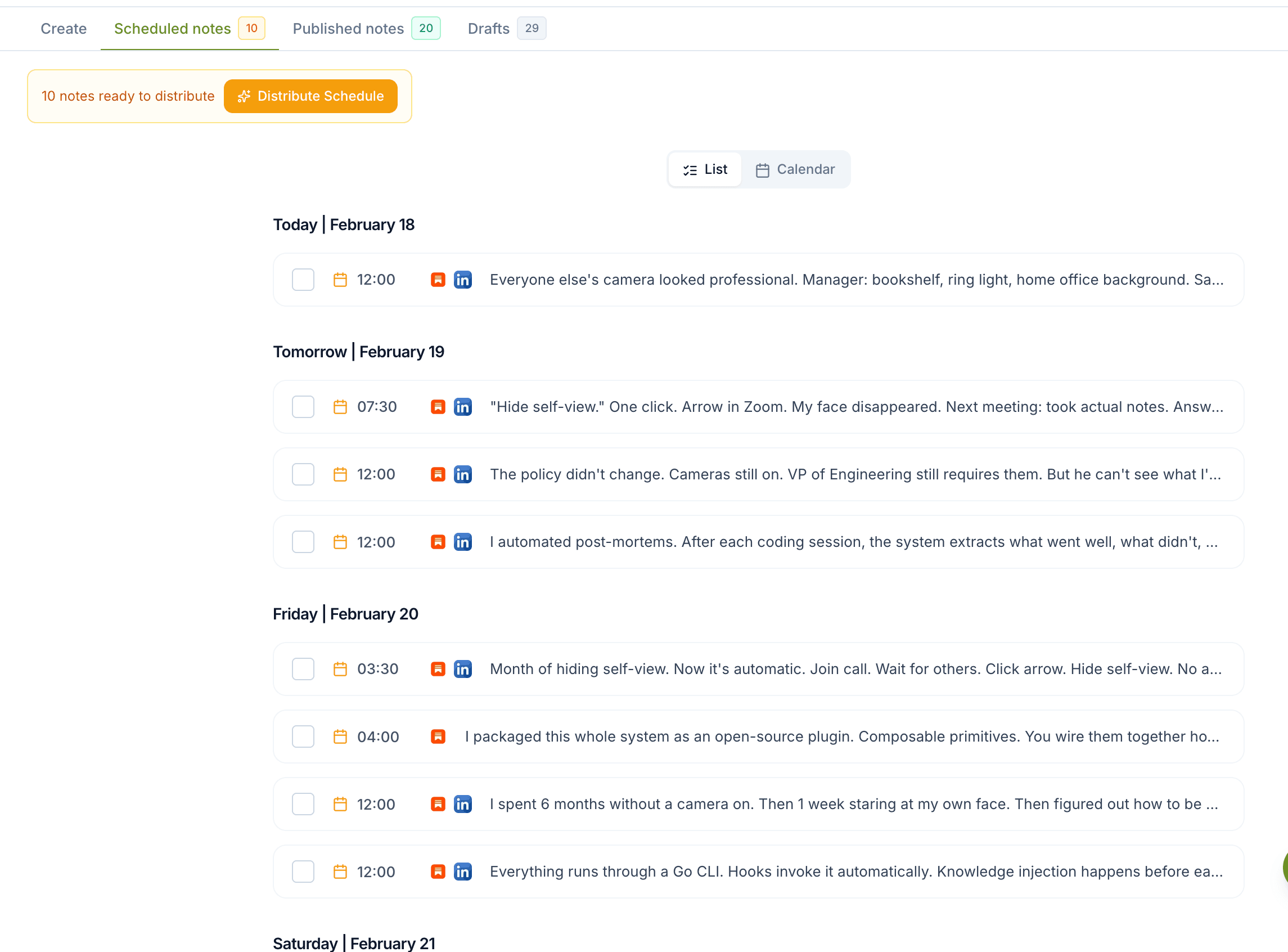
The Narrareach scheduled queue keeps upcoming Notes, destination icons, publish times, review actions, and calendar access in one operating view.

Narrareach content scheduler showing a reviewed queue of scheduled Substack Notes and social posts
A real Narrareach queue: scheduled content remains visible and reviewable before destination publishing runs.

What is a content scheduler?

A content scheduler is software that prepares content to publish at a chosen date and time. A useful scheduler records more than the timestamp: it keeps the source draft, destination, timezone, content type, media, tags, metadata, review state, and eventual publishing result attached to the scheduled item.

For a writer, the scheduled unit may be a full article, newsletter issue, Substack Note, LinkedIn post, or a short adaptation for another social feed. Those formats should not be forced through one generic caption field. Each destination needs the fields and version that fit its readers while the original article remains unchanged.

Narrareach combines that scheduling layer with an article library, Notes queue, cross-platform distribution, available analytics, and AI-assisted follow-up work. A writer can see what is prepared, what is scheduled, what published, and what deserves attention without reconstructing the campaign from separate browser tabs.

  • Choose a scheduler that supports the content types you publish, not only the largest number of network logos.
  • Confirm how the tool represents drafts, scheduled items, failures, and destination URLs before moving a real calendar.
  • Keep the original article as the factual source of truth while adapting the presentation for each destination.

Schedule articles, newsletters, Notes, and social posts

Long-form and short-form publishing create different operational requirements. An article may need a headline, subtitle, canonical decision, SEO title, description, slug where supported, tags, image, publication selection, and draft or publish state. A Note or social post may instead need a concise opening, image, link treatment, platform choice, and exact posting window.

Narrareach keeps those destination settings attached to the relevant version. Writers can publish to Medium and Substack from the same source workflow, prepare LinkedIn article or post versions where supported, and schedule shorter adaptations for X, Bluesky, Threads, and other connected destinations without changing the visible source story.

This matters most when the article and its distribution campaign should move together. The article can publish first, a Note can introduce one useful claim later, and social versions can follow at their own times. The calendar remains coordinated without requiring every channel to receive identical text at the same moment.

  • Set the primary article destination before deciding how republished versions should handle canonical URLs.
  • Review generated metadata and tags before scheduling because destination support differs.
  • Give every short-form version enough context to be useful even when a reader does not click the article.

Schedule one item, a batch, or a repeatable publishing queue

Occasional publishing should remain simple. A writer can create one item, choose its destination and time, and add it to the queue. Higher-volume workflows can prepare a week of Notes, import a CSV-based Note batch, turn an article into reviewed follow-up posts, or reuse a saved cadence without moving work that should remain untouched.

The newsletter automation layer becomes useful when every new issue creates the same set of operational tasks. Instead of rebuilding that checklist manually, the writer can prepare the article, schedule its related Notes and platform versions, preserve destination-specific fields, and review the complete sequence before anything publishes.

Teams and developer-led products can use the content scheduling API, MCP tools, and webhooks for eligible workflows. Those interfaces feed work into the same visible scheduling system rather than creating a hidden second queue. Human review, source traceability, and destination state remain available even when another tool initiates the job.

  • Test one real source-to-destination sequence before importing a large batch.
  • Save cadences only after checking timezone, active days, same-day spacing, and the effect on existing scheduled work.
  • Treat an accepted scheduling request as a queued job, not proof that the destination has already published it.

Keep platform timing, metadata, tags, images, and drafts separate

A multi-platform calendar is only reliable when it respects destination differences. Medium, Substack, and LinkedIn do not expose identical article fields. Social destinations also differ in text limits, media behavior, scheduling windows, account requirements, and the metrics returned after publication.

Narrareach stores platform-specific publishing options with the scheduled work. Search metadata can be prepared where the connected destination supports it; slugs are applied only where supported; tags and images follow the relevant publishing path; and a writer can choose a draft workflow when editorial review should continue inside the destination.

The visible queue also needs to distinguish scheduled, published, delayed, failed, and review-needed work. That state is more useful than a calendar square alone because it tells the writer whether the content merely has a date or has actually completed the destination workflow.

  • Do not assume one destination accepts another destination's metadata or media fields.
  • Use draft publishing when a destination editor or publication owner needs a final review.
  • Refresh an expired platform connection when Narrareach flags it instead of repeatedly resubmitting the same item.

Use performance and subscriber evidence to plan the next batch

A scheduler should help answer what to publish next, not only what publishes next. Narrareach brings available article growth metrics, Notes performance, publishing activity, traffic sources, and subscriber movement close to the queue so the writer can compare the topic, format, destination, and timing behind a result.

Subscriber attribution is strongest when a supported tracked source directly connects content to a subscription. Traffic-source evidence and timing correlations can still be useful, but they should remain labeled separately. Narrareach preserves those distinctions instead of assigning every new subscriber to the most recent post.

Reach AI can use the source writing and strongest observed signals to suggest another article, a sharper Note, or platform-specific variations. The recommendation is a reviewed next action, not an automatic claim that one metric proves causation. Writers keep the final decision and can inspect the evidence that informed the suggestion.

  • Compare direct attribution, source evidence, and correlation before changing the editorial calendar.
  • Repeat the winning topic, tension, or format rather than copying the original post word for word.
  • Use AI suggestions as a starting point and verify every factual claim before scheduling.

When a native scheduler or social media suite is the better choice

A native scheduler is usually enough when one person publishes occasionally to one platform and does not need to coordinate related articles, Notes, or social versions. It keeps the workflow close to the destination and avoids adding another system for a simple job.

A broad social media management suite may be better for agencies that primarily need shared inboxes, paid campaign tools, social listening, approval hierarchies across many client accounts, or reporting centered on social profiles. Those products are designed around a different operational center.

Narrareach is the stronger fit when articles, newsletters, and the ideas inside them are the source assets. Writers and content teams use it to coordinate long-form publishing, short-form distribution, queue state, and the feedback needed to decide what the next piece should be. Read what Narrareach is for the wider product definition and current workflow boundaries.

  • Use the smallest system that reliably covers the real publishing workflow.
  • Evaluate one complete campaign rather than comparing only feature checklists.
  • Confirm current destination support and plan access before migrating an editorial calendar.

How Narrareach solves it

Keep the publishing system close to the writing.

Long-form and short-form scheduling - so articles, newsletters, Notes, and social adaptations can share one reviewed calendar without sharing one generic format

Batch and recurring workflows - so writers can prepare individual items, CSV-based Note batches, follow-up sequences, and reusable cadences

Destination-specific publishing fields - so metadata, tags, images, draft state, and timing follow the capabilities of each supported platform

Performance-informed next actions - so traffic, engagement, publishing history, and subscriber evidence can inform the next reviewed article or post

Content scheduling options solve different publishing jobs

Choose according to the source content, number of destinations, review requirements, and feedback loop you actually need.

CapabilityNative schedulerGeneric social schedulerNarrareach
Schedule one destination itemStrong fitStrong fit for social postsSupported within a wider queue
Full articles and short-form distributionLimited to that platformUsually social-post firstConnected long-form and short-form workflow
Platform-specific metadata and draftsNative fields onlyVariesPreserved for supported article destinations
CSV, API, MCP, and webhook pathsUsually limitedVaries by vendorAvailable for eligible Narrareach workflows
Subscriber-aware next actionsOwn-platform reportingUsually engagement-ledPublishing and subscriber signals near the queue

Platform capabilities and Narrareach plan access can change. Confirm current destination support and available fields before moving a production calendar.

Start here

Put every article and follow-up post on one clear schedule

Use native scheduling for one-off work. Use Narrareach when the whole publishing system needs to stay connected.

Start scheduling free

Questions writers ask

What is the best content scheduler for writers?

The best content scheduler depends on the source material and destinations. Narrareach is designed for writers and content teams whose workflow starts with articles, newsletters, or Notes and expands into platform-specific distribution, scheduling, and performance review.

Can I schedule blog posts with Narrareach?

You can schedule full articles to supported publishing destinations and coordinate the Notes and social posts that distribute them. Narrareach is not a general WordPress administration tool, so confirm the current destination list when the website CMS itself is the required publishing target.

Can I schedule Substack, Medium, and LinkedIn articles?

Narrareach supports long-form publishing workflows for connected article destinations, including Substack, Medium, and LinkedIn paths where available. Fields, draft behavior, metadata, scheduling support, and required account access differ by platform.

Can each platform publish at a different time?

Yes. Destination versions can be prepared and scheduled separately so an article, Note, LinkedIn post, or other supported adaptation does not have to publish simultaneously or use identical copy.

Does Narrareach generate SEO metadata and tags for scheduled articles?

Eligible Narrareach plans can prepare SEO-focused titles and descriptions for supported article destinations, plus a slug where the destination supports one. Tags and metadata remain platform-specific and should be reviewed before scheduling.

Can I import content from a CSV or existing publication?

Narrareach supports CSV-based Notes workflows and selected article import paths. Available imports depend on the source and content type, and imported items remain reviewable before they enter the schedule.

Does scheduling change my visible article title or story?

No. Platform-specific search metadata can be prepared separately where supported. Your visible title and article body remain the source content unless you explicitly edit them.

How is a content scheduler different from a content scheduling API?

A content scheduler is the product workflow writers operate directly: editors, queues, calendars, destination settings, and results. A scheduling API lets an external application, script, or agent create and manage work programmatically inside that system.

Can Narrareach show which scheduled content brought subscribers?

Narrareach surfaces direct content-to-subscriber evidence when a supported tracked source establishes the path. It separately presents traffic sources, subscriber movement, and activity correlations when direct attribution is not available.

Narrareach LLM connector

Connect Claude, ChatGPT, or any MCP-compatible agent to read drafts, schedule posts, and automate Substack, Medium, LinkedIn, X, Bluesky, and Threads workflows.

Read the docs