What Is Resonating: How to Read Engagement Signals
You spent ten hours on a newsletter, hit publish, and opened the dashboard a day later. Three new subscribers. Eleven likes. Nothing that tells you whether...
By Ian Kiprono
You spent ten hours on a newsletter, hit publish, and opened the dashboard a day later. Three new subscribers. Eleven likes. Nothing that tells you whether the idea was weak or the channel was.
That's the worst kind of data: enough to feel like a verdict, not enough to learn from. Writers respond to it in one of two ways. They abandon an idea that was fine, or they paste it onto LinkedIn and X unchanged and hope a different room claps louder.
Reading engagement properly is a skill. It starts with accepting that a post's numbers describe three things at once: the idea, the format, and the room it landed in.
Why Your Best Posts Can Look Like Failures
Three traps turn a good post into what looks like a failure, and they tend to arrive together.
- Judging by likes. A like costs the reader a fraction of a second and commits them to nothing. It records approval of a sentence, not interest in an argument.
- Judging by raw impressions. Reach tells you the feed served the post. It says nothing about whether anyone read past the first line.
- Comparing one post across platforms. A percentage on LinkedIn and a percentage on X sit on top of different audiences, formats and habits, so the smaller number isn't automatically the worse result.
Strip those away and the question gets simpler. Resonance is an audience response that leads to a next action: a reply that asks something back, a follow, a subscription, a click through to the full piece. Applause is not resonance. Movement is.
The 2024 Edelman-LinkedIn B2B Thought Leadership Impact Study makes the case with a survey of nearly 3,500 management-level professionals across seven countries. It found that 23% of buyers whose research was prompted by thought leadership went on to buy from or work with the organization that published it. The same study reports that 73% of buyers treated thought leadership as a more trustworthy basis for judging a company's capabilities than traditional marketing materials.
Nobody arrives in that 23% by accident. They read something that named a problem they recognized, and then they acted. That behavior is what "what is resonating" should mean.
The Signals That Show a Post Is Resonating
Rank the signals before you read them. Some engagement is evidence; some is noise with a chart attached.
| Signal | What it tells you | Strength as evidence |
|---|---|---|
| Replies that ask a follow-up question | The idea made the reader want more | Strong |
| Restacks, reposts or shares | The idea traveled beyond your existing audience | Strong |
| New subscribers from the post link in its first week | Attention turned into commitment | Strong |
| Clicks to the full article | Curiosity beyond the hook | Medium |
| Saves or bookmarks | The reader expects to return to it | Medium |
| Follows gained from the post | Awareness is growing | Medium |
| Likes alone | Quick approval with little commitment | Weak |
| Raw impressions | Reach, not interest | Weak |
The responses that cost a reader the most sit at the top of the pyramid below, and the ones that cost nothing sit at the bottom.
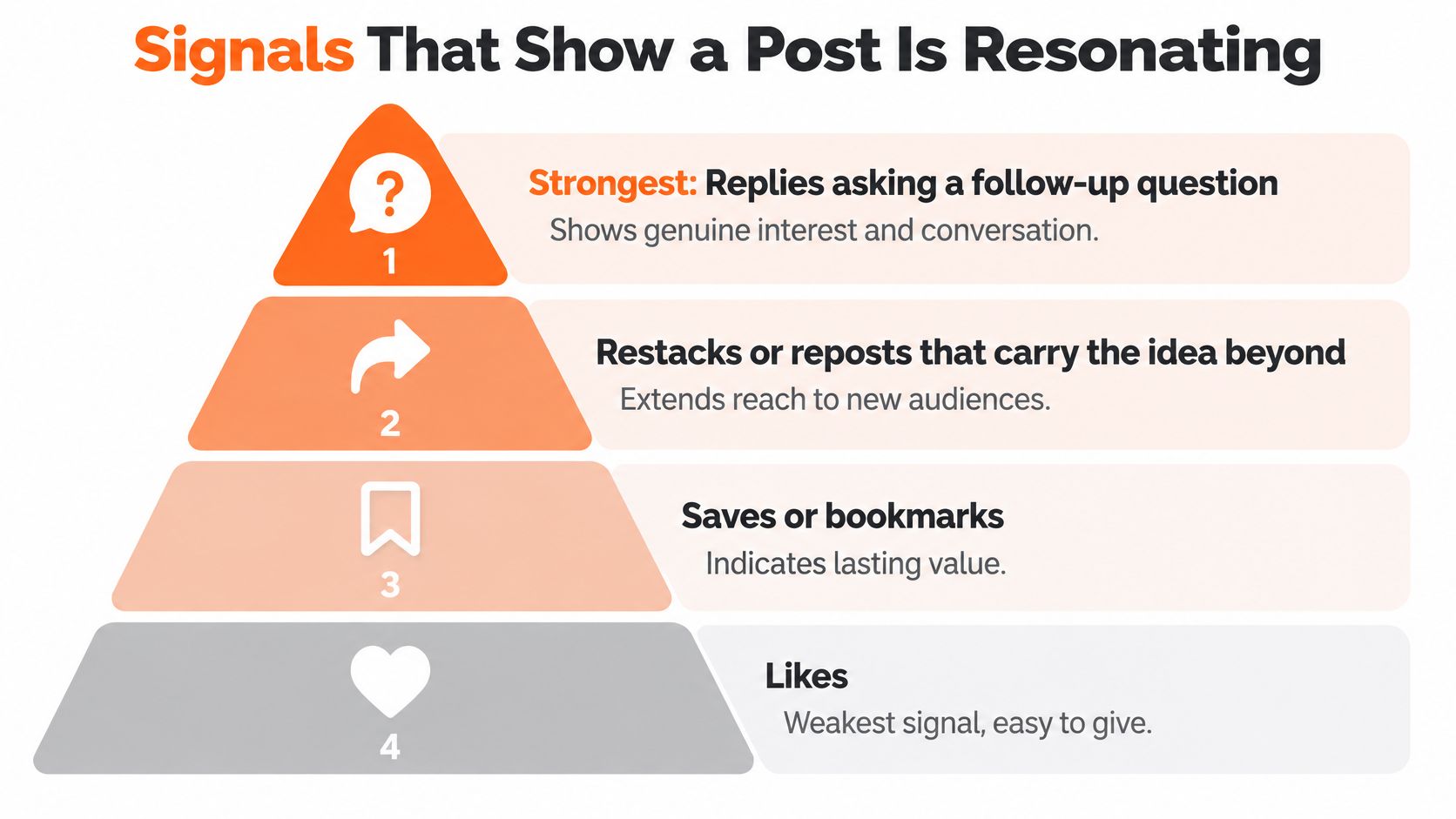
Replies that ask a follow-up question are the strongest evidence a single post can give you. The reader finished the argument, accepted enough of it to build on, and spent their own time asking for more. "Great post" is a like with extra characters. "How does this work when the list is under 500?" is a conversation, and it usually tells you what to write next.
Restacks, reposts and quote shares carry the idea into someone else's audience, which is the only mechanism that moves a post past the people who already follow you.
New subscribers in the first week convert attention into commitment. Substack treats following and subscribing as separate actions: a subscription signs a reader up for a publication's emails, while following lets them see your Notes in their feed before committing (Substack's help centre explanation of following). Rising follows means awareness is growing. Rising subscriptions means conversion. Blur the two and both look better than they are.
The middle row is quieter. Clicks show curiosity that survived the hook. Saves say the reader expects to come back. Follows say the audience is widening. Likes alone record quick approval, and raw impressions record that the feed did its job.
Set two posts side by side and the ranking does the work. One earns 40 replies, nearly all praise. The other earns 12 replies, three of them questions, plus 3 restacks and 4 subscribers. The first wins the scoreboard. The second tells you which idea deserves the next draft. The same ranking applied to a single network is in this breakdown of LinkedIn post engagement, where reach is easy to rent and replies aren't.
Then keep one sheet. For every post, log the top three signals within seven days and nothing else. After twenty posts the sheet answers the question a dashboard can't: which kind of idea keeps producing replies, and which format keeps producing subscribers.
If you'd rather hear the distinction between reach and response explained aloud, the walkthrough below covers it.
Comparing Engagement Across Platforms Fairly
A writer posts the same argument on LinkedIn and on X. Both come back at 3% engagement. The rates match. The stories do not.
That shared 3% is divided by different audiences, on different surfaces, under different habits of interaction. The two networks do not even agree on what counts as engagement. Treating the rates as one score works like comparing a restaurant's table turnover with a hotel's occupancy. Both are ratios, and both can describe a full room, but a busy lunch service is not a sold-out night.
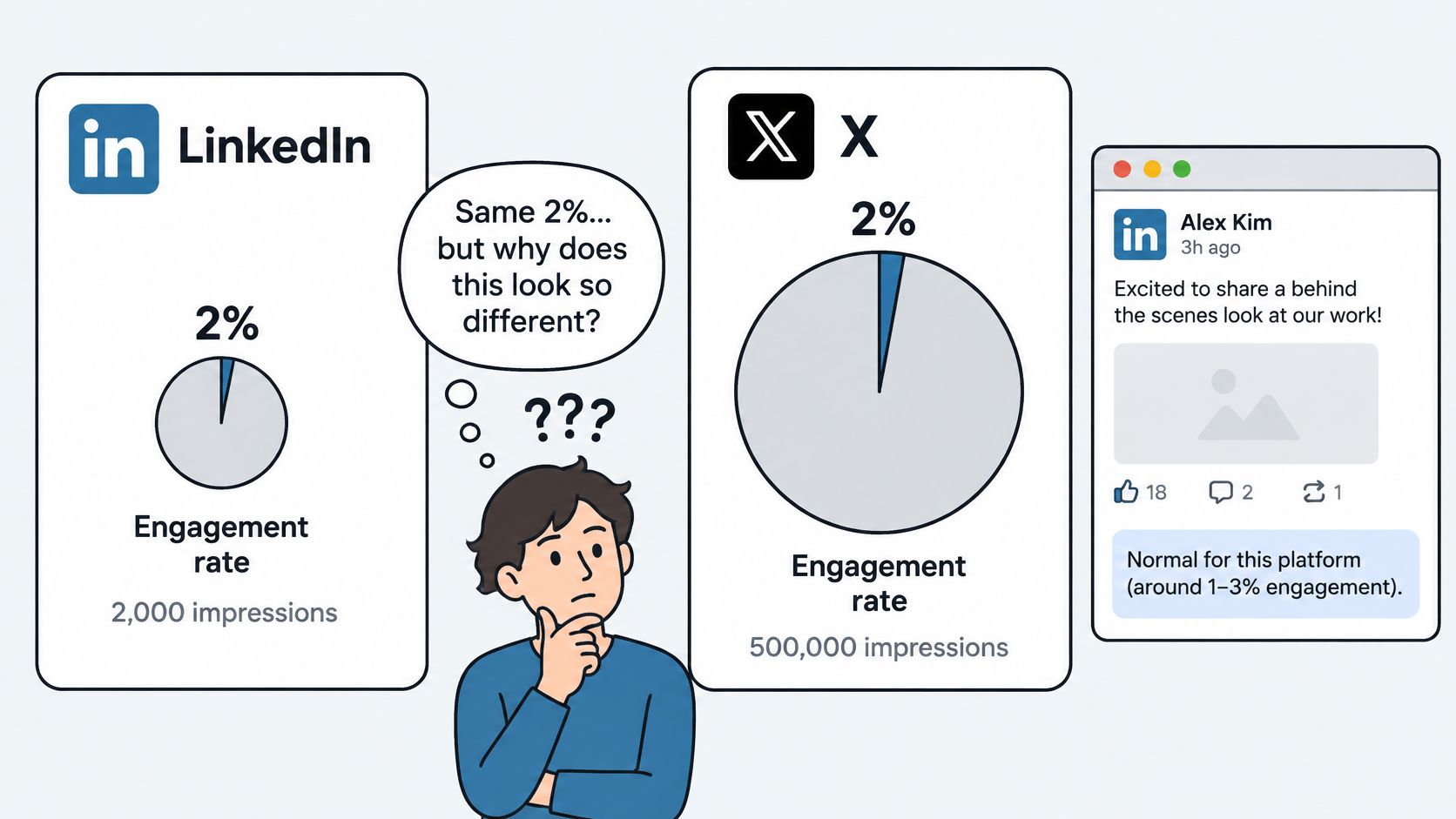
Published medians move too, and they do not move together. Across recent cross-platform reporting, LinkedIn's typical engagement has sat well above X's, while the two trends have pointed in different directions. Exact levels change from report to report, so use them as a map of the field, not as your score. The practical split looks like this.
| Platform | Where the same modest rate usually sits | Repurpose or leave behind |
|---|---|---|
| Often below that platform's own normal | Leave the post behind unless it beats your LinkedIn baseline | |
| X | Often above that platform's own normal | Carry the idea forward only after it clears your X baseline |
Two consequences follow. A 3% post on LinkedIn can be a soft result for that network, while the identical 3% on X can be a strong one. And "repeat your top posts" is unreliable advice, because a shift in the platform's own normal changes what the same result means. The channel may have caused the spike. The idea may have had nothing to do with it.
Build the comparison from your own posts instead. On each platform, take a recent run of posts, find the median engagement rate for that platform, and score every new post against its own median. Only after both scores are set against their own baselines can you compare platforms at all. A like, a view, or a blended rate still cannot carry that decision alone. Once you are choosing what to publish again, what the post did for the audience and for the time you spent matters more than the rate by itself.
A low median is not automatic failure either. 85% of the popular news influencers Pew Research Center analyzed had an account on X, making it their most common platform (Pew Research Center). A crowded, high-volume feed pushes typical rates down by design. That is the channel at work.
The rule to apply this week: a modest post that beats its own platform baseline deserves a second look, even when the raw number looks small. Repurpose that idea. Leave behind the result that only looked large because the platform's normal was low.
Know When a Signal Is Too Small to Trust
A baseline built from fewer than 20 published posts gives a provisional reading, not a verdict. Label every score drawn from it provisional and keep logging. Three checks decide whether a signal is big enough to act on.
- Count the sample. Under 20 posts on a platform, your median is a guess with a number attached.
- Count the events. One subscription or one restack from a single post is an anecdote. A pattern across three or more posts that share the same relevance label is evidence.
- Compare like with like. A 12-reply post and a 40-reply post compare fairly only when both went out on the same platform in the same period.
Say a writer has 9 Substack posts and 2 X posts. The Substack numbers can support a provisional trend read. The X numbers can't support anything yet, so the first X result gets retested over the next two weeks before it changes a decision.
Sheet rule: when a signal count falls below three, write "insufficient data" instead of a verdict. A blank cell invites an honest second look; a confident guess invites a bad decision.
The same caution applies to choosing which numbers to track at all, and the industry-standard metrics worth tracking are the ones that survive a small sample.
Telling a Durable Idea from a Platform Spike
A post gets strong reactions on LinkedIn, then barely travels on X. The idea may still be sound; the channel, audience, or format may be doing the work. To tell the difference, check whether the response holds when you change the container.
| Pattern | Likely cause | Test before repurposing |
|---|---|---|
| Strong on LinkedIn, flat on X | Platform audience or format mismatch | Repost the same claim in X's short format and compare reply quality |
| One spike, no repeat | A timing or news hook rather than the idea | Publish a second angle on the same thesis within two weeks |
| Low reach, many quality replies | Distribution limits, not a weak idea | Check subscriber conversion before dropping the idea |
| Strong subscriptions, weak likes | Practical value that readers act on | Keep the format and expand the argument |
The first pattern is easy to misread. A claim that prompts a long LinkedIn discussion may get little response on X because the audience and format have changed. That difference is evidence about the channel, not proof that the idea itself has weakened.
The relevance label test
A topic alone rarely explains why people respond. In a six-study program involving more than 3,000 participants, perceived self-relevance and social relevance increased intentions to share across topics and media formats. Asking people to explain why a message mattered to them or someone they knew raised sharing intention further, according to ScienceDaily's report on the relevance research.
Give each promising post one dominant relevance label:
- Self-protection: the reader avoids a loss or mistake.
- Self-improvement: the reader gets better at something they value.
- Professional identity: the reader sees themselves, or the colleague they want to be, in the argument.
- Belonging: the reader recognizes their group.
- Helping others: the reader can pass the idea to someone specific.
Then compare the label across formats or platforms. If it still fits, the idea may travel beyond its original channel. If the response appears only in one context, the channel could be the stronger explanation. Either way, the label gives you a more useful test than likes alone.
Reach is a separate signal. A sound idea can receive limited distribution, so low views do not automatically mean readers found it irrelevant. Look at the quality of replies and whether readers take a meaningful next step, such as subscribing. For newsletter context, see HubSpot's State of Newsletters research.
The decision rule: repurpose an idea when its relevance label holds in another format and the response remains meaningful. If it does not, set it aside rather than treating one spike as proof of lasting demand. The idea can be revisited when a different channel or audience suits it better.
Once an idea shows signs of durability, evergreen content recycling can help keep it circulating on a schedule.
How to Repurpose a Winner Without Repeating It
Repetition taxes reach. Post the same wording, hook and format to Substack, LinkedIn, Medium and X, and you widen exposure while making yourself redundant to anyone who follows you in more than one place. Research on social-network users maps the mechanism: highly similar or repetitive information reduces perceived novelty and informational value, which raises boredom and perceived misfit, which pushes readers toward withdrawal. The study is cross-sectional, so treat it as a plausible mechanism rather than proof of cause, and that mechanism is precisely what you need when a fourth repost goes quiet.
The fix isn't to drop the idea. It's to change the job the idea does on each surface.
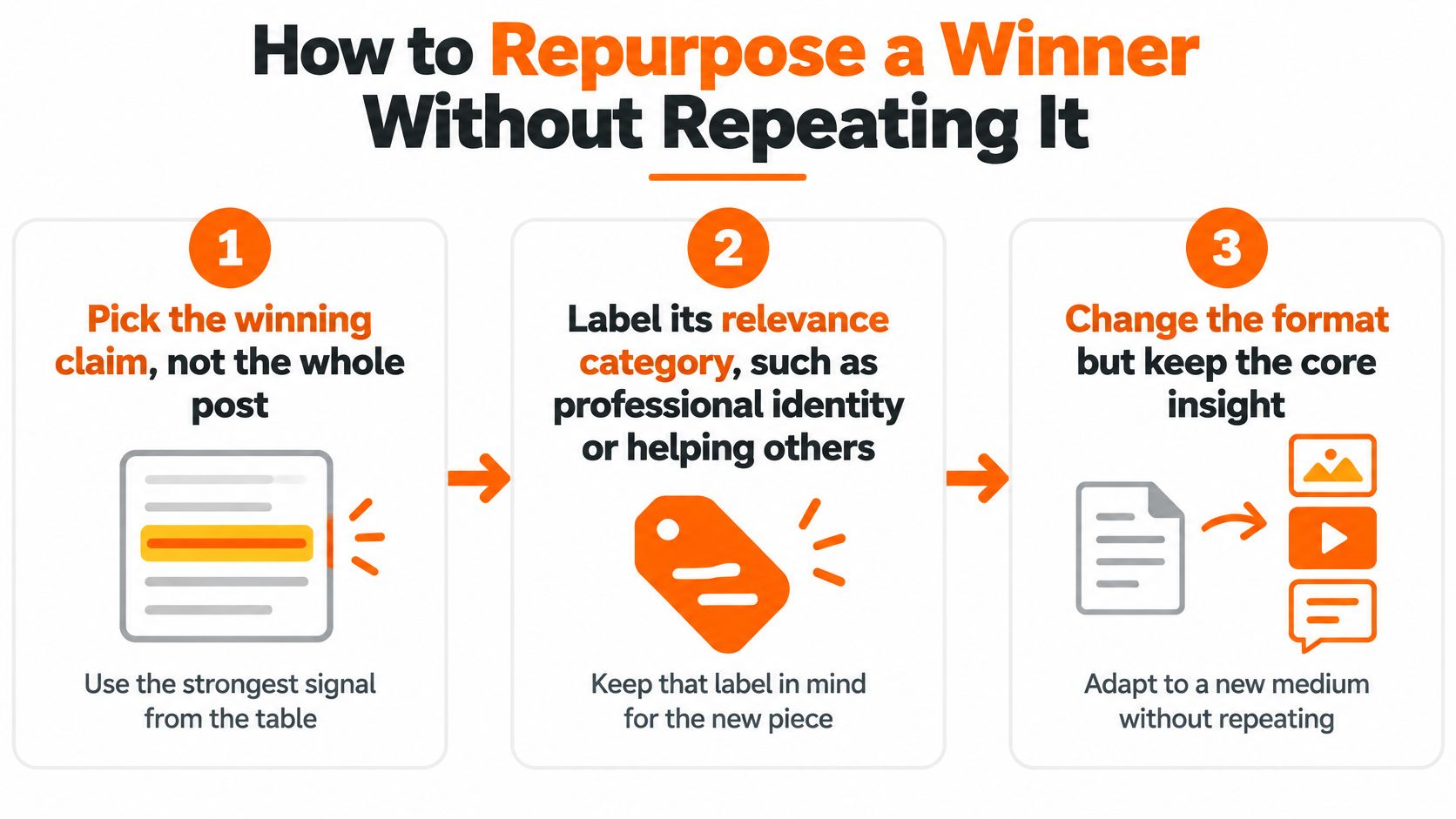
Seven moves, in order
- Pull the claim, not the post. Use the strongest signal in your table to identify which sentence did the work, and take that sentence rather than the whole piece.
- Name its relevance category and write it somewhere you'll see it. Professional identity, helping others, self-protection, belonging, self-improvement. The label travels with every version.
- Test it as a Note first. Substack recommends using Notes to preview upcoming posts, test ideas, gauge interest and obtain quick feedback before publishing a full article (Substack's getting-started guide to Notes), so publish the claim as a Note and watch what comes back.
- Give each surface a different job. The newsletter carries the full causal explanation. LinkedIn foregrounds the professional implication. X isolates one surprising claim or a counterexample. A short Note invites a concrete reader response. Same insight, four jobs.
- Rewrite the hook every time. Varying the function isn't enough if the first line is identical. Open on a different consequence, a different example, a different objection. Copied wording is what makes a follower feel marketed at.
- Track quality per platform. Saves, replies, profile visits, clicks and subscriber conversions, not aggregate impressions. One version dying on X while subscribers arrive from the newsletter is a result, not a failure.
- Decide on the evidence. Expand where the quality signals hold, refresh where they fade, retire where the relevance label refuses to travel.
The rule that keeps this honest: if two versions of an idea need near-identical wording to work, you're looking at one format with two hosts, not one idea with two lives.
That division of labor matches where attention sits now. The Reuters Institute's 2025 Digital News Report, drawing on 48 markets, found six online networks each reaching more than 10% of respondents weekly for news, against two networks a decade earlier. No single channel carries an argument alone anymore.
One mechanical point about Notes: they appear in the Home feed of subscribers, followers and the wider Substack network rather than arriving in anyone's inbox, so a Note extends discovery but doesn't replace the email announcement when you launch a format (Substack's Notes collaboration and growth guide). Plan both, on different days.
Narrareach uses performance evidence to help writers decide what to make next, while the writer keeps the final angle, language, review and publishing decision. For the mechanical version of moves one to seven, this guide to how to repurpose content walks through the sequence.
A Worked Example From One Newsletter Idea
Here's the whole procedure run once, start to finish. The numbers are illustrative rather than a reported result; the point is the sequence.
The thesis: a rising reader count doesn't prove a newsletter is working. Week one, the claim goes out as a Substack Note, framed as a question. It draws 14 replies, 5 of them asking a follow-up question, and 3 restacks. That's enough signal to justify the article.
Week two, the full newsletter publishes the causal explanation, and the link in the post brings 3 new subscribers. The LinkedIn version foregrounds the professional implication for people who run content teams and earns 2 profile visits from people in the writer's field. Small and useful: profile visits are how strangers check whether you're worth following. The X version isolates the counterexample and gets almost nothing.
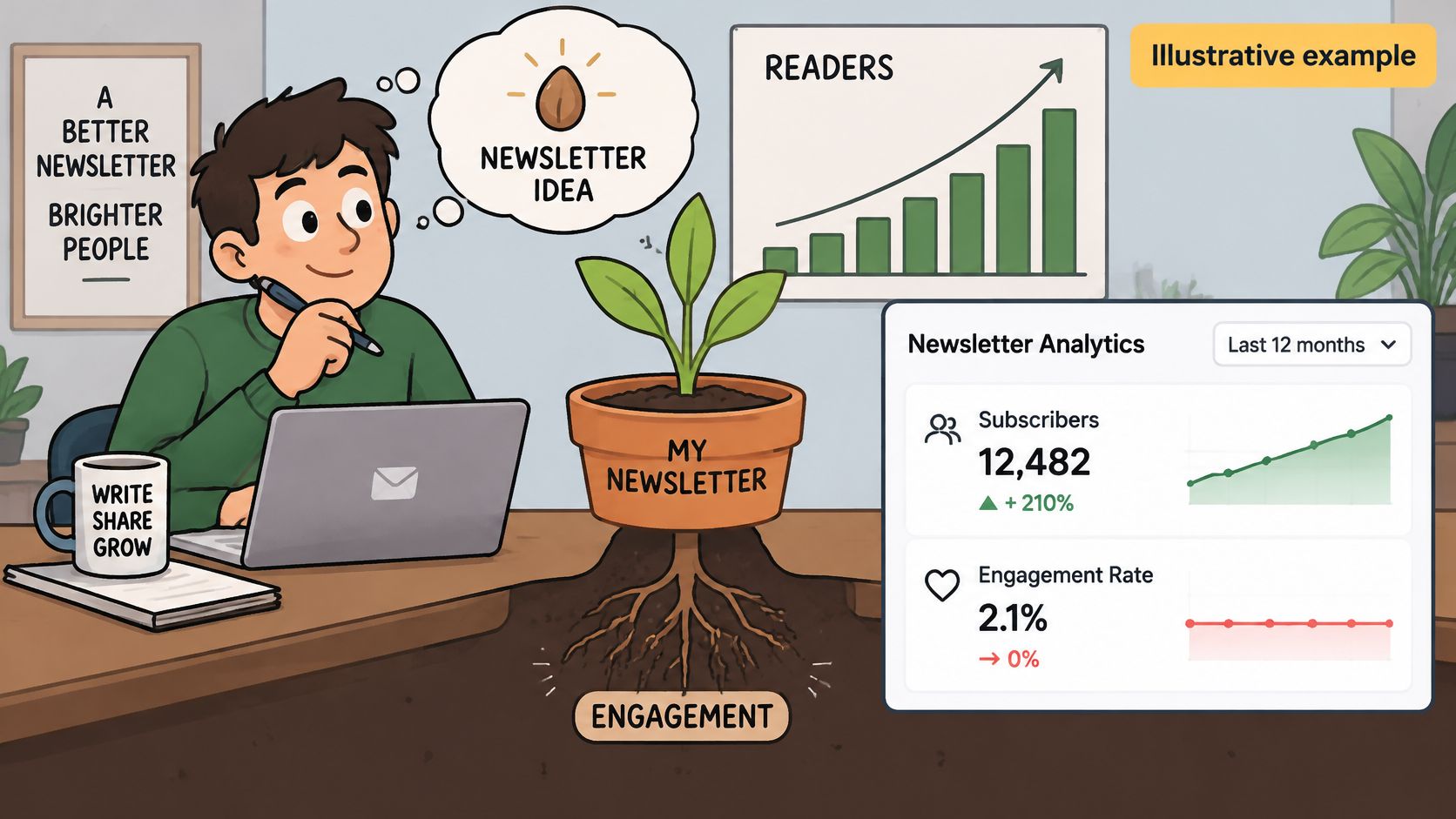
Verdict: the idea is durable. Its relevance label, professional identity, survived on Substack and LinkedIn and died on X.
So the writer repurposes the newsletter and LinkedIn versions, rewrites the X version as an open question instead of a counterexample, and parks the counterexample itself. Reading those outcomes per channel rather than in one blended total is what makes the call obvious, which is why a content analytics dashboard earns its place once you're publishing in more than two places.
One lesson carries across to your own numbers: the platform that failed didn't kill the idea. It showed you a format the idea shouldn't wear.
Confirm Your Winner and Schedule the Next Post
Three steps close the loop.
- Check the three strongest signals for your top post: replies with questions, restacks, and subscribers from the post link in week one. If all three are present, the idea earned a second life.
- Confirm the relevance label survives a second platform. Same category, different format, still producing replies.
- Schedule the next round around that idea, one core claim with a different job on each surface, and note which response you're watching for.
That's the whole decision. Everything else is bookkeeping.
If you're ready to act on it: Narrareach schedules Substack Notes, Medium articles, LinkedIn posts and X content from one dashboard, recirculates approved articles and Notes on the schedule you choose, and compares articles, Notes, topics, formats, channels, timing, replies, clicks and subscriber outcomes in granular detail. Set up scheduling for your next three posts inside Narrareach and check the current trial terms before you start.
If you'd rather keep watching first: follow your favourite newsletters and join the Substack Notes feed, where short claims get tested before they become articles. Watching a handful of tests run is a legitimate way to learn the pattern before you change anything about your own workflow.
After 30 days, success looks unglamorous: more replies per post, follows that keep ticking up, and a rising share of subscribers arriving from Notes and articles rather than from a single launch.
Narrareach is built for the part that comes after the diagnosis: it learns your voice from your own posts, fits each piece to each platform, and keeps approved articles and Notes recirculating on the schedule you set. It also compares what happened across articles, Notes, topics, formats and channels, so the next post starts from evidence instead of a hunch. Take your three best-performing ideas and find out which ones travel: Narrareach.