How to Recycle Evergreen Content Without Repeating Yourself
How to find your best-performing posts, score them honestly, label why they worked, and write fresh versions instead of reposting the same text.
By Ian Kiprono
Quick answer: To recycle evergreen content without repeating yourself, keep a shortlist of your best-performing posts with their numbers. Write down why each one worked, then reuse the structure, not the text: same hook pattern or format, new opening line, newer example, a few weeks apart. Reposting identical text annoys returning readers and breaks rules on platforms like X. Narrareach keeps that shortlist as an Evergreen library ranked by likes, comments and restacks, and opens any item as a fresh draft.
Every writer who posts regularly has a handful of notes that did far better than everything around them. Three months later they are buried under everything posted since. The only way to find them is to scroll back through your own feed and guess which one got the replies.
That is a waste of your best evidence. Those posts are proof of what your audience responds to. This guide covers how to keep them, how to rank them honestly, and how to reuse them without becoming the account that posts the same thing every Tuesday.
What counts as evergreen content?
Evergreen content stays true and useful after the week it was posted. A take on this morning's news is not evergreen. A lesson about how you price your work, a framework for planning a week of posts, or a question that always starts a good conversation usually is.
For short posts like Substack Notes, LinkedIn posts or X posts, the evergreen part is often not the topic but the format. A contrarian opening followed by a short list. A recurring series with a fixed name. A question at the end that invites people to share their own example. Those shapes keep working long after the specific post is forgotten.
Why not just repost the same text?
Three reasons:
- Your returning readers notice. The people most likely to see a repost are the ones who engaged the first time. They are your best readers, and a repeat tells them you ran out of things to say.
- Some platforms forbid it. X's automation rules do not allow duplicate or substantially similar posts, and scheduling tools are expected to respect that.
- The original is not the best version anymore. You know more now. You have a better example, a sharper first line and a clearer view of which part of the post did the work.
Recycling well means starting from proof and writing something new. That is slower than hitting repost, and much better.
How do you decide which posts are your best?
Raw likes are a weak signal on their own. A like costs a reader half a second. A comment means they had something to say. A restack or repost means they were willing to put the post in front of their own audience. Those are not equal, so do not count them equally.
A simple score that works:
score = likes + 2 × comments + 3 × restacks
It is crude, and that is the point. You can compute it in your head, it rewards conversation and sharing over passive approval, and it is consistent enough to compare posts across months.
Here is what that looks like in my own Narrareach account, which ranks saved posts with this exact formula:
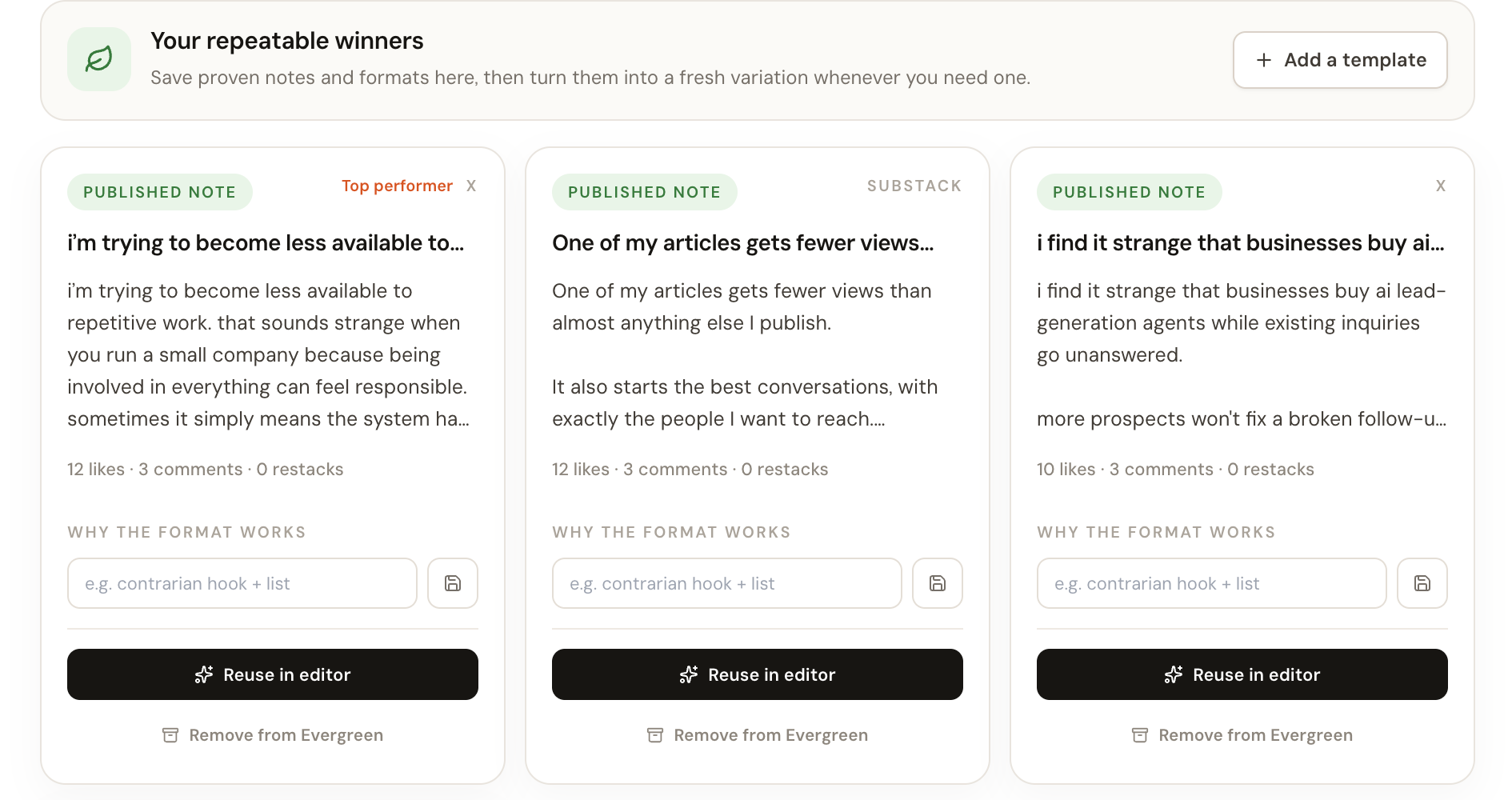
My top three saved notes have 12 likes and 3 comments, 12 likes and 3 comments, and 10 likes and 3 comments. They score 18, 18 and 16. The two 18s tie: a note on X about becoming less available to repetitive work, from October 13, and a Substack note about one of my least-viewed articles, from October 5. The more recent one gets the Top performer badge. None of them has a restack yet, which tells me these conversations happened in replies rather than reshares. That is useful to know before I write the next version.
Two practical notes on scoring:
- Wait until a post has settled. A note saved on its first day undercounts the replies that arrive later. Save it once the replies slow down, or save it again later to refresh the numbers.
- Compare like with like. A post on a platform where you have 10,000 followers will outscore one where you have 500. Rank within a platform, or at least keep that difference in mind.
Write down why each one worked
This is the step almost everyone skips, and it is the one that makes the library useful. A month from now you will not remember why a note took off. Write a short label next to each saved post, describing the structure, not the topic:
- "contrarian hook + three-item list"
- "personal admission, then the general lesson"
- "weekly series + open question to readers"
A good label still makes sense for a completely different subject. Once you have ten labelled winners, patterns appear. If four of your top cards share the same structure, that structure is your house format, and you have the numbers to show it.
In Narrareach each saved card has a Why the format works field for exactly this, up to 120 characters.
How do you reuse a winning post without repeating it?
Treat the original as a brief, not a draft. For each new version:
- Change the first line every time. It is the part returning readers recognise.
- Swap the example. Use something that happened since the original, or a different reader's situation.
- Keep the shape. If the original was a hook and a list, the new one is a hook and a list. That is the part you know works.
- Change the ending. A new question or a new conclusion keeps it from reading as a rerun.
- Leave a few weeks between versions of the same format, so your feed does not look like a template.
In Narrareach, Reuse in editor opens the saved post in the composer as a new draft, with the text filled in and the original platform selected. You rewrite it there, then schedule it like any other note. Nothing is reposted automatically. That is deliberate: the library tells you what to write next, and you still do the writing.
Where should evergreen ideas come from besides old posts?
Your long-form work is the biggest source. A strong article holds five or six ideas that each work as a short post, and those go evergreen too once they prove themselves. Turning Substack articles into Notes is a good way to test which ideas from an article stand on their own. The ones that earn replies go into the library.
You can also keep formats you have not posted yet. Narrareach's library takes custom templates you write yourself, and includes a set of built-in note formats with labels describing why each tends to work.
How often should you prune the library?
Every month or two. When a format stops earning replies two or three times in a row, take it off the shelf. Your audience changes, and a library full of formats that worked a year ago is just a history lesson. Removing a card does not delete the original post; it just stops you reaching for it.
Frequently asked questions
What is evergreen content recycling?
Reusing proven posts or formats after their first run. Done well, it means writing a fresh version of something that already worked, not reposting the same text.
Is it okay to repost the exact same post?
It is risky. Returning readers notice, and X's automation rules prohibit duplicate or substantially similar posts. Rewrite the opening, update the example and leave a gap of a few weeks.
How do I find my best-performing posts?
Score them by likes plus twice the comments plus three times the restacks or reposts, and rank within each platform. Narrareach's Evergreen library does this for the posts you save.
Does Narrareach repost evergreen notes automatically?
No. Evergreen is a library, not a repost queue. Reuse in editor opens a post as a new draft for you to rewrite and schedule.
How many evergreen posts should I keep?
Enough that the top of the list is obvious, and few enough that you read it before you write. For most writers that is somewhere between ten and thirty.
Start from proof, not a blank page
The posts that already worked are the best brief you will ever get about your audience. Keep them, score them honestly, write down why they landed, and write the next version instead of repeating the last one. If you post through Narrareach, add your first note to Evergreen from the Published tab and see what rises to the top.