Newsletter Content Marketing: A Practical Guide for 2026
You've sent the edition, refreshed the dashboard, and watched almost nothing happen. The readers who already like your work are still there, but new...
By Ian Kiprono
You've sent the edition, refreshed the dashboard, and watched almost nothing happen. The readers who already like your work are still there, but new subscribers aren't arriving. Meanwhile, the argument you spent your evenings sharpening could work on LinkedIn, Medium, or Substack Notes, except adapting it for each platform feels like another writing job.
You're not short of ideas. You're short of a manageable way to decide which ideas deserve more distribution, publish those adaptations, and tell whether they bring readers back.
Why Consistent Sends Still Stall Your Growth
Say you spend ten hours on an edition. A day after sending it, you've gained three subscribers and a handful of likes. Those are hypothetical results, but the decision they create is familiar: write another edition, promote the last one, or squeeze both into an already crowded week.
Most writers choose the next edition because the task is clear. Distribution is less comfortable. You have to choose a channel, reshape the argument, make a subscription offer, and track what happens afterward.
Inbox competition makes that omission expensive. In Pew Research Center's survey of U.S. adults who receive news newsletters, only 3% subscribed to more than ten, according to its newsletter report. Publishing regularly doesn't automatically earn a place in someone's reading routine.
Fix the gaps around the writing
A workable newsletter content marketing system connects three decisions:
- Purpose: What useful change does the newsletter help its reader make?
- Production: What audience, format, and distribution choices can you sustain?
- Measurement: Which editions and adaptations bring subscribers who stay?
Consistency keeps a promise to existing readers. Distribution gives new readers a chance to discover that promise.
Sending more often isn't necessarily the fix. Choose a newsletter sending frequency that leaves room to promote and evaluate each edition.
The practical target is straightforward: sketch your audience, format, and distribution pillars; build a weekly workflow around a strong edition; and track whether your derivatives produce subscribers rather than just visible activity.
What Newsletter Content Marketing Is and Why It Pays
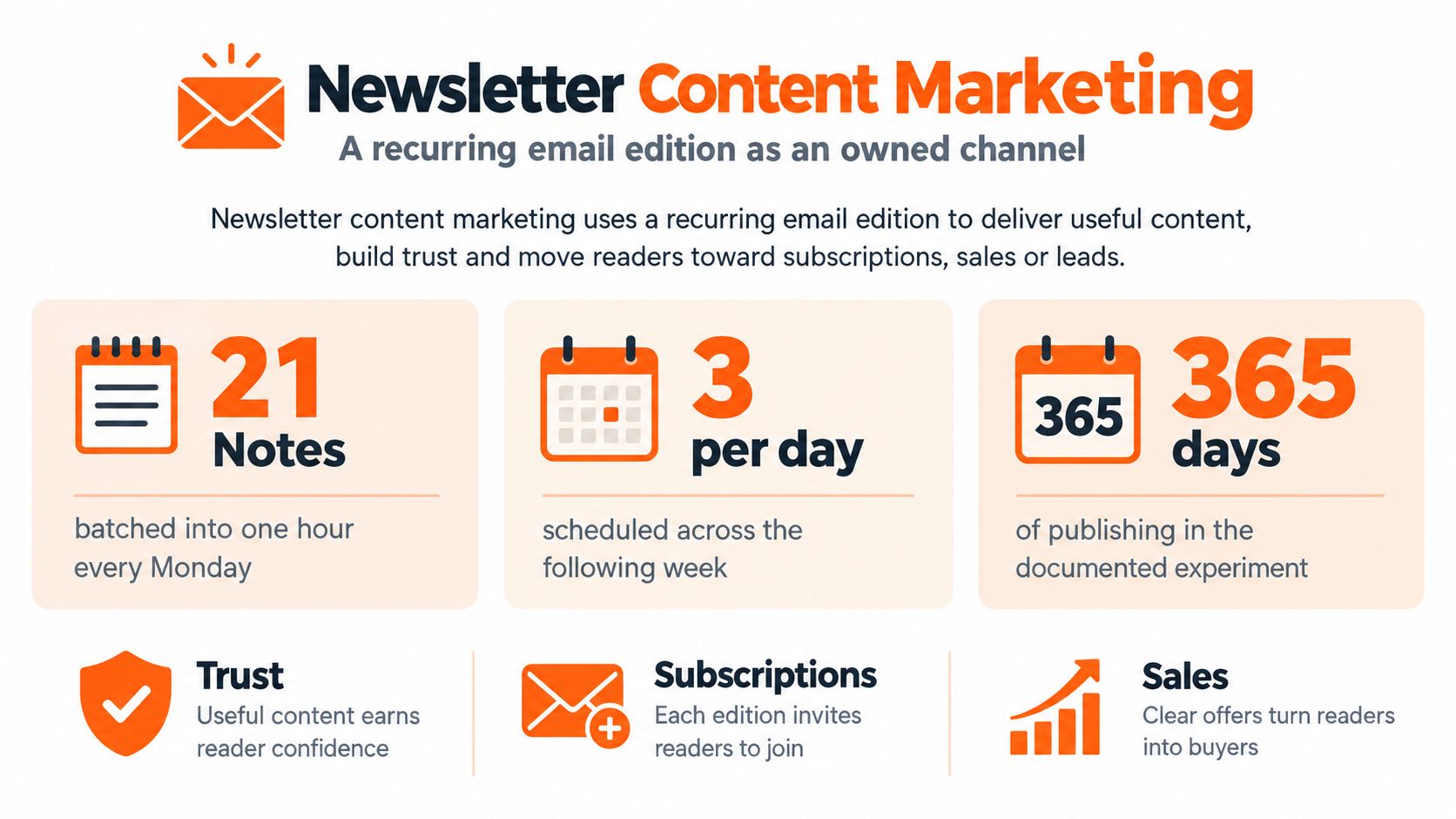
Newsletter content marketing uses a recurring email edition to deliver useful content, build trust, and move readers toward subscriptions, leads, or sales. The newsletter is your front porch: a place where people deliberately return. Social feeds are the busy street where potential readers first encounter you.
Owned doesn't mean unrestricted. Mailbox providers still affect delivery, and subscribers can leave whenever the promise stops matching their needs. What you control is the editorial offer, the permission-based relationship, and the destination you invite people to revisit.
A distribution channel with a business purpose
Among the primarily North American B2B marketers analyzed in the Content Marketing Institute's 2025 benchmarks, produced with MarketingProfs, 71% used email newsletters for distribution, compared with 89% using organic social media and 84% using corporate blogs; reported content-marketing outcomes included brand awareness at 87%, demand or lead generation at 74%, audience or subscriber nurturing at 62%, customer loyalty at 52%, and sales or revenue at 49%, while 58% rated their strategy moderately effective and only about one-third reported a scalable content-creation model.
Business outcomes reported from content marketing
| Outcome | Share of respondents |
|---|---|
| Brand awareness | 87% |
| Demand or lead generation | 74% |
| Audience or subscriber nurturing | 62% |
| Customer loyalty | 52% |
| Sales or revenue | 49% |
These are outcomes from content marketing overall, not isolated newsletter results. They establish the business context, not a promise that sending an email produces revenue.
For an independent writer, awareness means the right people recognize your point of view. Nurturing means they return, use your advice, and become more willing to act on your recommendations. Revenue requires an offer that fits that relationship.
The recurring edition connects those jobs.
Choose the action before the topic
An edition designed to attract subscribers needs a different ending from one designed to generate consulting inquiries. A subscription invitation should describe the next useful thing readers will receive. A sales invitation should make the offer, its fit, and the next step clear.
Don't give every issue competing commercial jobs. Pick the primary action, then write an edition that makes it reasonable.
A practical newsletter subscriber growth strategy connects discovery, signup, onboarding, and continued usefulness. Without that connection, you can publish excellent work and still leave interested readers unsure what to do next.
The Three Pillars of Audience, Format and Distribution
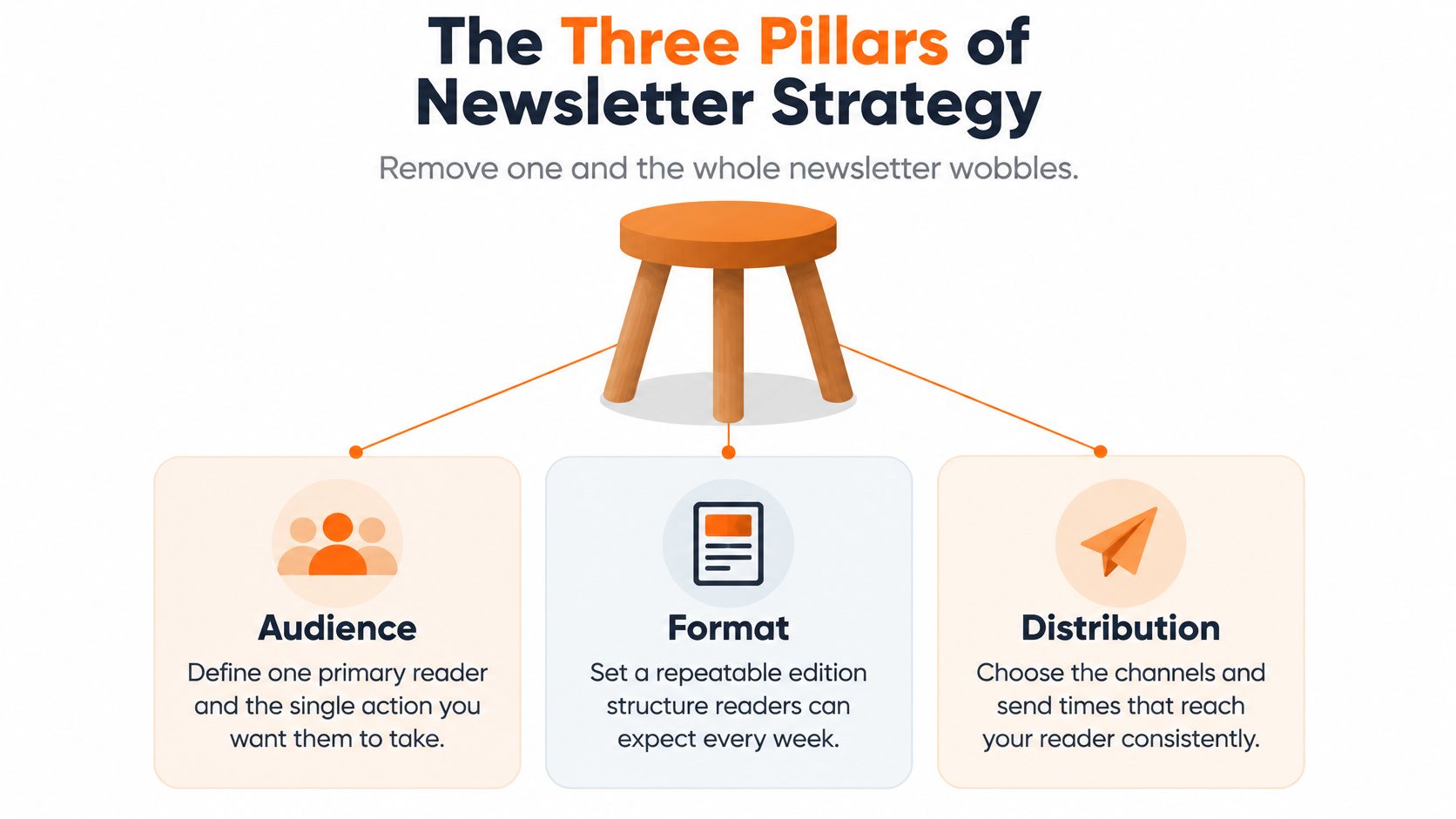
Audience, format, and distribution work like the legs of a stool. Remove one and the whole thing wobbles: a polished edition won't help if it reaches the wrong people, and broad exposure won't rescue an unclear promise.
Make a concrete decision for each pillar before adding more publishing commitments.
Audience starts with a job
Define the reader by what they're trying to accomplish. Independent consultants who need better proposal conversations is more useful than professionals interested in business.
Then choose the action your content should enable. Perhaps readers should diagnose a weak proposal, rewrite its opening, and use the revised version in their next sales conversation. That gives you an editorial filter: material that doesn't help that reader do that job probably belongs elsewhere.
Use behavior to refine the definition. Topic clicks and substantive replies are stronger signals than assumptions about what someone of a particular age or job title must want.
Format makes the promise repeatable
A dependable structure reduces production decisions without making every issue sound identical. Try a hook, a core argument, supporting points, and a dominant call to action.
The structure should fit the work. A teardown needs an example and a diagnosis; a field guide needs an ordered procedure; an opinion edition needs evidence and a fair account of the opposing view.
Keep the argument intact when you adapt the format. A social post can omit detail, but it shouldn't reverse your conclusion or strip away a qualification that makes the advice accurate.
Distribution starts before publication
Choose where the reader already looks for this kind of help. LinkedIn might suit a professional decision; Substack Notes might suit a conversation with adjacent writers; Medium might suit a self-contained explanatory article.
Consider a hypothetical writer with 2,000 subscribers, a four-part edition template, and two distribution platforms. That writer doesn't need a different topic for every channel. They need an edition worth expanding, plus distinct entry points into its argument.
- Audience test: Can you name the primary reader and their immediate job?
- Format test: Can you describe the edition's recurring shape in a sentence?
- Distribution test: Can you name where an unfamiliar reader will encounter it?
If any answer is vague, fix it before increasing output.
Metrics That Show Real Subscriber Growth
Open rate is a useful trend, not a verdict on editorial quality. Mailbox privacy systems can register opens without confirmed human reading, so an apparent improvement may not mean more people read the issue.
Start with delivery, then examine unique clicks, click-to-open rate, subscriber conversion, and retention by theme. Each answers a different question, and none should substitute for the others.
Separate attention from action
A Whop newsletter benchmark summary describes an analysis of 4.5 billion newsletters with a 38.7% average open rate and a 1.85% average click-through rate, while welcome emails averaged a 47% open rate.
For Notes, an analysis by Write Build Scale found that posts receiving at least 16 likes in their first three hours reached 50 likes 78% of the time, compared with 0.3% for posts with no early likes.
Newsletter and Note metrics with reference values
| Metric | What it tells you | Reference value |
|---|---|---|
| Open rate | Inbox attention, increasingly noisy | 38.7% average |
| Click-through rate | Whether readers act on the issue | 1.85% average |
| Welcome email open rate | Early onboarding attention | 47% average |
| Note likes in first 3 hours | Early signal for wider Note reach | 16+ likes gave 78% chance of 50 likes |
| Note with zero early likes | Low reach risk | 0.3% chance of 50 likes |
| Unique clicks per edition | Engaged readers, not total reach | Establish your own baseline |
| Subscriber conversion per edition | Downstream value of each theme | Confirmed signups attributed to the edition |
| Retention by content theme | Whether readers stay across topics | Track retained subscribers by acquisition theme |
The welcome-email comparison supports giving onboarding deliberate attention. Tell new readers what they joined, deliver any promised resource, and point them toward a representative edition.
The Notes comparison concerns later likes, not subscriptions. Treat early engagement as a screening signal, then check whether the resulting exposure produces qualified readers.
Practical rule: Use engagement to decide what deserves another test. Use subscriber conversion and retention to decide what deserves more production time.
Build a baseline you can trust
Run a four-week baseline before making several changes at once. Keep the signup destination stable, tag links by platform and derivative, and record the theme behind each edition.
Check delivery first because an undelivered message can't generate a meaningful click comparison. Count unique clickers rather than repeated clicks from the same person, and treat click-to-open rate cautiously because its denominator inherits open-tracking noise.
For subscriber conversion, record both the count and the rate from attributable visits. Then compare whether those subscribers remain engaged. A smaller acquisition source can be more useful if its readers consistently return.
Use a compact content marketing metrics dashboard rather than collecting every available number. Change a single variable, such as the opening or subscription offer, and compare like with like.
How to Build One Week of Content From a Single Edition
Start with an edition that has already produced a useful signal. That might be clicks on a practical resource, detailed reader replies, or subscriptions attributed to its public version.
Don't mistake convenience for validation. The easiest edition to split into snippets isn't necessarily the one worth promoting.
Use this workflow as a production checklist, not an obligation to fill every available slot.
Build the batch
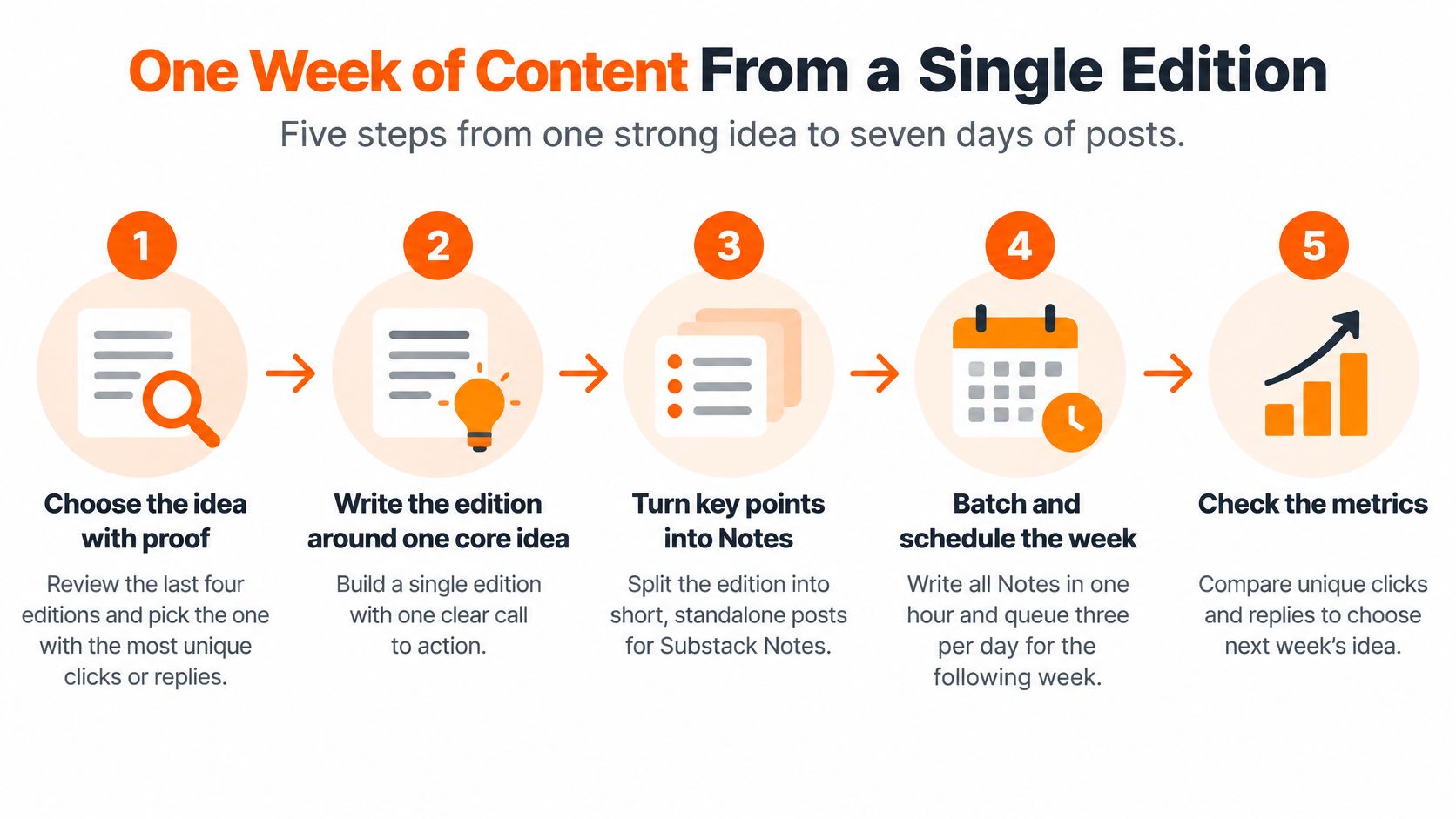
Choose the idea with proof. Review your last four editions and select the strongest relevant signal, preferably attributable subscriber activity or unique clicks, with replies as supporting context. Exclude unusual promotions or unrelated spikes so you don't build a week around an exception.
Write around a clear promise. Use a hook, a main idea, three supporting points, and a call to action as a working template. Keep the supporting points subordinate to the argument instead of turning the edition into several loosely connected essays.
Draft the derivatives while the argument is fresh. Try a 60-minute batch containing three Substack Notes, a LinkedIn post, and an X thread. Give each a different entry point, such as the mistake, the procedure, or the objection, rather than publishing the same summary repeatedly.
Space the scheduled Notes. As an initial test, leave two to three hours between releases when publishing several on the same day. This gives you a cleaner opportunity to observe each post instead of creating a simultaneous burst you can't easily interpret.
Review the early response. Check the first three hours for relevant replies and likes, then inspect the subscription path before commissioning another adaptation. An enthusiastic discussion among existing readers can be valuable without being an acquisition winner.
Log the outcome. Record the idea, platform, publication time, unique clicks, and attributable new subscribers in a spreadsheet. Compare the week with your four-week baseline, and note when the sample is too small for a confident decision.
Make each derivative useful on its own
Say your edition explains why consultants lose proposals by presenting deliverables before diagnosing the buyer's problem. A Note could give readers a diagnostic question; the LinkedIn post could contrast weak and strong proposal openings; the X thread could walk through the revision process.
Each piece should solve a small problem before inviting a subscription. Withholding the entire useful point behind a signup request usually makes the derivative less persuasive.
A content repurposing framework helps keep the argument consistent while changing its presentation. The work still requires editorial judgment: remove repetitive introductions, retain necessary caveats, and check that the call to action matches the landing page.
For a visual walkthrough of the publishing workflow, use the video below.
A calendar and spreadsheet are enough to run this system. Add scheduling software when transferring approved drafts between tools becomes the bottleneck, not before you know what deserves publication.
Scaling Reach Across Platforms Without Rewriting
In its newsletter survey, HubSpot reported that 52% of creators used LinkedIn and 50% used Facebook to distribute newsletter content, compared with 42% using traditional email. Those figures describe channel use, not which channel generates the most valuable subscribers.
The useful conclusion isn't to join every platform. Choose adaptations that fit the argument and the reader's behavior, then retain the ones that produce the outcome you need.
Give every adaptation a job
Repurposing map from one newsletter edition
| Source asset | Derivative | Starting rhythm | Job it does |
|---|---|---|---|
| Newsletter edition | Substack Notes series | Test 3 per day, 2–3 hours apart | Early engagement and profile visits |
| Strongest argument | LinkedIn post | Test 1–2 per week | Professional reach and comments |
| Data point or contrarian take | X thread | Test 1 per week | Shares and quote-posts |
| Full edition, reformatted | Medium article | Test 1 per edition | Long-term search discovery |
| Evergreen insight | Re-shared Substack Note | Test 1 per month | Reaches readers who missed the send |
These are starting schedules to test, not universal performance benchmarks. Reduce the cadence if the derivatives become repetitive or crowd out the source edition.
Medium needs a self-contained article with enough context for a reader arriving from search. LinkedIn needs an opening that makes the professional relevance clear. An X thread needs a progression worth following, not an article chopped at arbitrary character limits.
Before distributing an HTML edition, run an email rendering test from MailAdept to inspect the markup for issues. Also send yourself a test message and check that the subscription and offer links are usable on mobile.
Choose the publishing model that fits your workload
Real-time publishing works when the post depends on a current conversation and you can stay available to respond. Substack's native scheduler suits a focused Notes workflow. An external scheduler becomes more useful when you're coordinating several platforms.
For native scheduling, open Create, choose Note, write the post, select the calendar icon, choose the date and time, and save, following the process described in The Breakout Insights' Substack scheduling walkthrough.
Narrareach is another option: it schedules Substack Notes, Medium articles, LinkedIn posts, and X content from a shared dashboard, with AI-assisted repurposing designed to retain the writer's voice and format drafts for each platform. Review those drafts before scheduling, especially when your argument includes qualifications or examples that shouldn't be simplified.
To grow faster on Substack, use the queue to make successful ideas easier to repeat, not to automate indiscriminate volume. Compare posting slots using similar topics, distinguish new-reader responses from familiar-reader discussion, and keep the subscription invitation visible on your profile.
A useful content distribution strategy includes a stopping rule. If a derivative repeatedly produces activity without attributable subscribers, revise its promise or stop producing that format.
A Real Experiment in Substack Notes
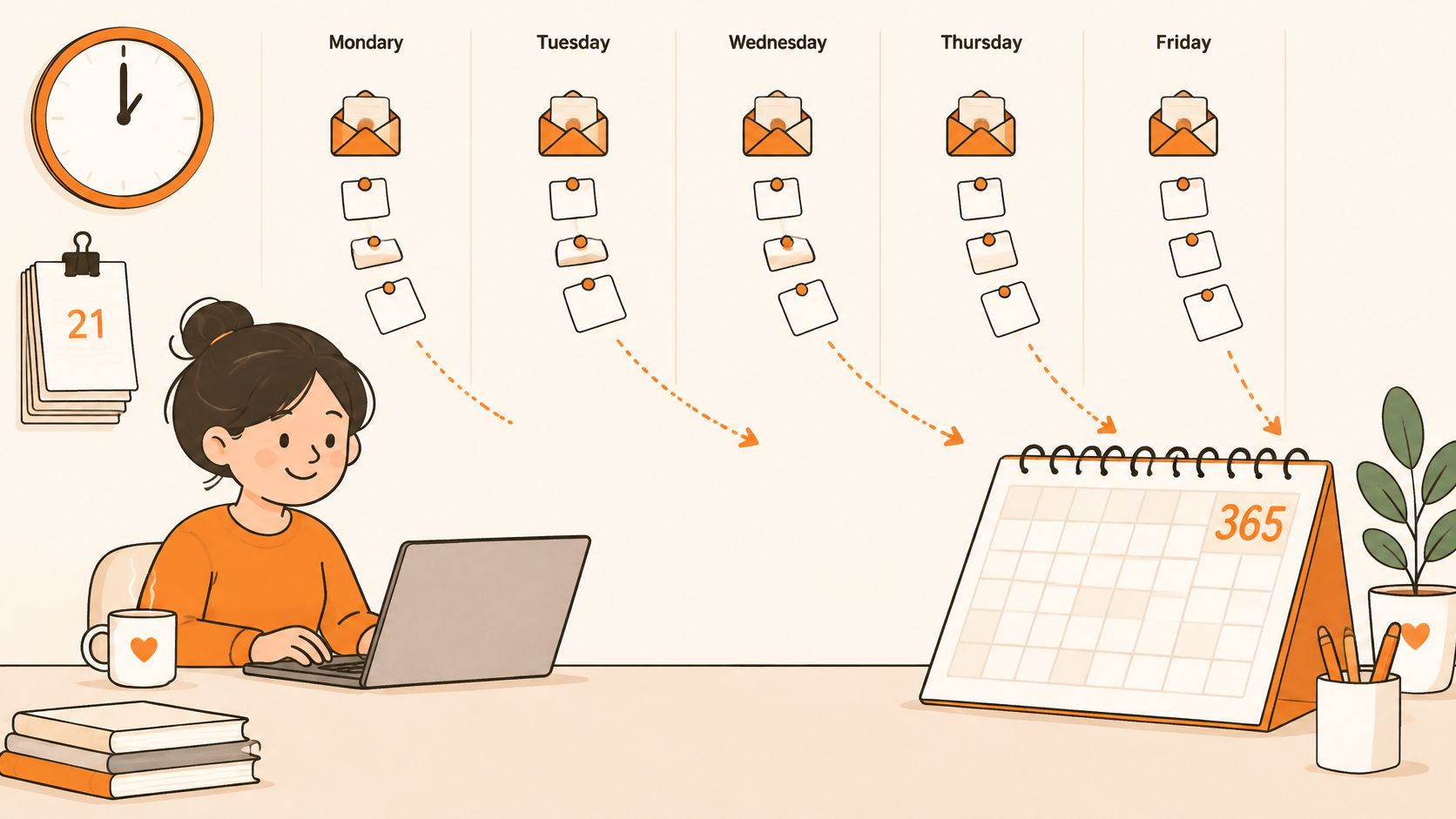
A documented publishing experiment makes the operating routine concrete. The creators behind Write Build Scale's account of publishing Notes reported batching 21 Notes in a one-hour session every Monday, scheduling three daily for the following week, and generating more than 10,000 subscribers directly through Notes after 365 days; their stated routine included at least one daily Note, three as the preferred cadence, plus 10 likes and five thoughtful comments on other creators' work.
Those figures are self-reported, not the results of a controlled test. The account combines publishing, participation, and accumulated audience exposure, so it doesn't isolate how much growth came from scheduling, posting frequency, topic choice, or existing reputation.
The batching method is still worth examining because it describes an actual operating commitment rather than merely recommending consistency.
Test a smaller version
Try 21 Notes over three weeks, using a one-hour weekly batching session. That's a proposed experiment, not a forecast of what the larger account's results will translate into.
Choose a narrow topic family so you can interpret the result. Keep the profile promise and signup destination stable, and record your existing acquisition pace before starting.
- Record the intervention: Save what you published, when it went live, and which edition supplied the idea.
- Record participation: Log your replies and comments separately from publishing so you don't attribute every result to the queue.
- Record the outcome: Track attributable new subscribers and subsequent engagement, not just reactions on the Note.
The account's explanation is that likes, comments, and restacks can expose a Note to people who don't follow the writer. Some then visit the profile and subscribe. That's a plausible pathway to measure, not a guarantee that a particular engagement routine will reproduce the result.
A useful experiment can fail to increase subscribers and still save you months of repeating the wrong format.
Success means a clear improvement in subscribers per week without an unsustainable increase in work or a decline in reader quality. If you gain more likes but acquisition stays flat, inspect the profile, the subscription promise, and the relevance of the audience you reached before increasing frequency.
Choose Your Next Step Before You Scale
Personalization has a production cost. In Validity's State of Email 2025 announcement, leading challenges included creating personalized content efficiently at 17%, collecting and analyzing the required data at 16%, and measuring performance effects at 15%; privacy compliance was a major operational challenge for 14%, rising to 23% among organizations with larger email budgets.
For an independent writer, the practical issue is maintaining relevant variations without multiplying editorial work. Reader-selected topics and broad engagement tiers are usually easier to explain and maintain than detailed behavioral profiles assembled from unnecessary personal information.
Add complexity only when it changes a decision
If you publish less than weekly, improve an edition and its distribution before adding audience variants. That isn't a demand to increase sending frequency. It's a recommendation to make the existing operation dependable before splitting it.
If you already sustain a weekly workflow, test a behavioral segment for four weeks. Readers who click growth-related material might receive a relevant follow-up module while everyone else receives the standard edition.
Use the same underlying argument where possible. Change the example, resource, or follow-up invitation rather than writing separate newsletters from scratch.
- Keep it lightweight: Collect preferences you'll use and let readers change them.
- Keep the comparison fair: Judge the segment against your baseline, accounting for its existing engagement.
- Keep the stopping rule: Remove a variation when its extra work doesn't produce a useful difference.
Your next step should match your bottleneck. If strong ideas already produce subscriptions but distribution consumes your week, a shared publishing queue is a reasonable investment. If you still don't know which themes attract the right readers, keep the workflow simple and use the metrics table as your tracking sheet.
You don't need a larger content operation to begin. You need a repeatable way to select a promising idea, publish a useful adaptation, and decide whether the resulting subscribers justify doing it again.
Ready to put that workflow into practice? Visit Narrareach to start an account and schedule your first week of Substack Notes and posts, with cross-platform repurposing and analytics to identify what brings subscribers. If you're not ready for a tool, stay connected through the newsletter for weekly metric breakdowns and use the tracking table to run your next experiment yourself.