
What Is Content Distribution: The Writer's 2026 Playbook
Content distribution is delivering one piece of content through multiple channels so it reaches audiences wherever they consume information. It combines...
By Ian Kiprono
Content distribution is delivering one piece of content through multiple channels so it reaches audiences wherever they consume information. It combines platform-specific formatting with strategic scheduling and performance tracking.
You publish a thoughtful Substack article, refresh the page, and wait for readers to arrive. A few people open it, most never see it, and your strongest ideas disappear beneath newer posts in feeds you don't control. The frustrating part isn't always the writing. It's the manual work after writing, copying passages, rewriting hooks, formatting posts, choosing channels, and trying to remember when everything should go live.
That workload pushes many writers into a poor choice. They either distribute inconsistently or publish the same text everywhere, even though each platform rewards a different kind of conversation. The result is predictable: good content gets limited exposure, and audience growth depends too heavily on luck.
The Problem With Publishing and Praying
A strong article can fail without being a bad article. It can fail because the author published it once, in one format, on one platform, then moved on before the right readers had a chance to encounter it.
I spent months treating distribution as clerical work. After finishing an article, I knew I should extract posts for LinkedIn, X, Medium, and Substack Notes, but the process felt like starting the writing task again. I would copy a paragraph, remove a link, rewrite the opening, adjust the tone, and postpone publication until the idea was no longer fresh.
That pattern creates a hidden cost. The writer doesn't only lose reach. They lose feedback that could have improved the next article. If nobody sees an idea, the author can't tell whether the topic was weak, the opening was unclear, or the distribution was missing.
Practical rule: Treat every article as a source asset, not a finished distribution event.
Content distribution means delivering one valuable idea through multiple channels, with each version adapted to its audience and format. A Substack article may provide the complete argument. A Note can test a personal observation. A LinkedIn post can isolate the professional implication. An X thread can turn the reasoning into a sequence of concise claims.
The content distribution tool guide is useful for seeing this distinction in practice, but you can build the underlying system with native platform tools and a simple spreadsheet. Record the core idea, each adaptation, the publication time, the channel, and the downstream action you want readers to take.
The change is small but important. You stop asking, “Where else can I paste this?” and start asking, “Which entry point would make this idea useful here?” That question protects your voice while giving the idea more opportunities to reach people.
Why Content Distribution Matters
A well-written article can still disappear when distribution is treated as clerical work. Writers copy the same link into a few channels, postpone the task, or publish only on their own site. That choice carries a hidden cost: without enough readers reaching the idea, there is no useful feedback on the topic, opening, format, or channel.
Audience discovery now happens across a network of feeds, recommendations, message threads, newsletters, and publishing sites. Readers may meet your argument in a short post or video before they ever see the full article. The Reuters Institute's 2025 Digital News Report found that six online networks reached more than 10% of people weekly for news, compared with only two networks a decade earlier. In its global sample, Facebook reached 36%, YouTube 30%, Instagram and WhatsApp 19% each, TikTok 16%, and X 12% for weekly news access. The same report found that 64% accessed news through platforms such as YouTube, Instagram, and TikTok.
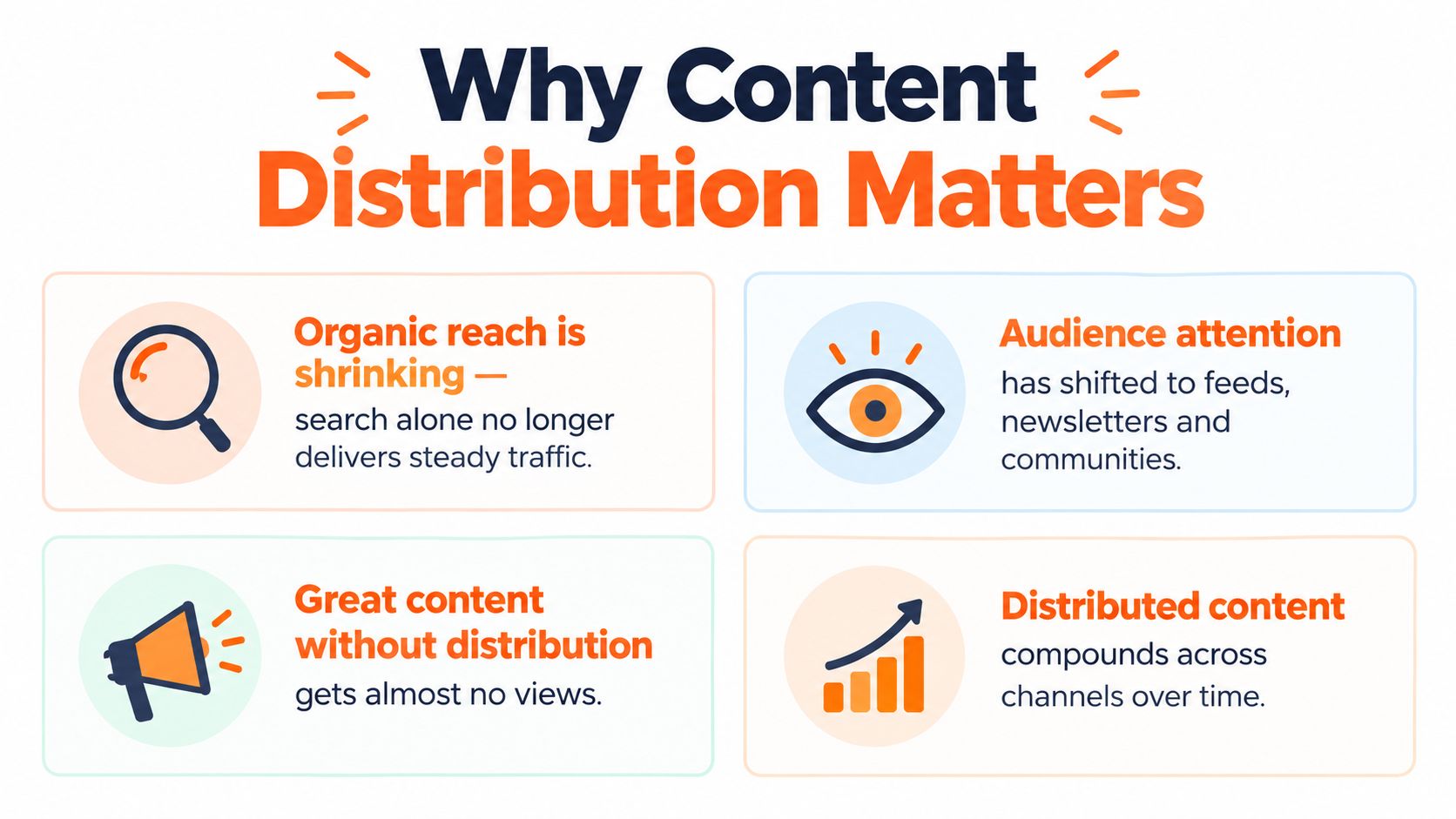
The scale of that system is clear in DataReportal's figures: 5.24 billion active social media user identities worldwide in February 2025, a 4.1% increase over the previous twelve months, and 97.3% of connected adults using at least one social network or messaging platform monthly. Its Digital 2025 social media analysis also cites social video consumption rising from 52% in 2020 to 65% in 2025, while consumption of any online video rose from 67% to 75%.
You do not need every platform. Choose a few where your readers already spend time, then adapt the idea rather than reposting it unchanged. Track reach, clicks, replies, and subscriptions as a feedback loop. Performance shows which topics and entry points deserve another article.
The SMB content distribution playbook offers a practical way to organize channels, formats, and measurement. Distribution determines whether an idea gets discovered, understood, remembered, and connected to a lasting reader relationship.
The Core Distribution Workflow
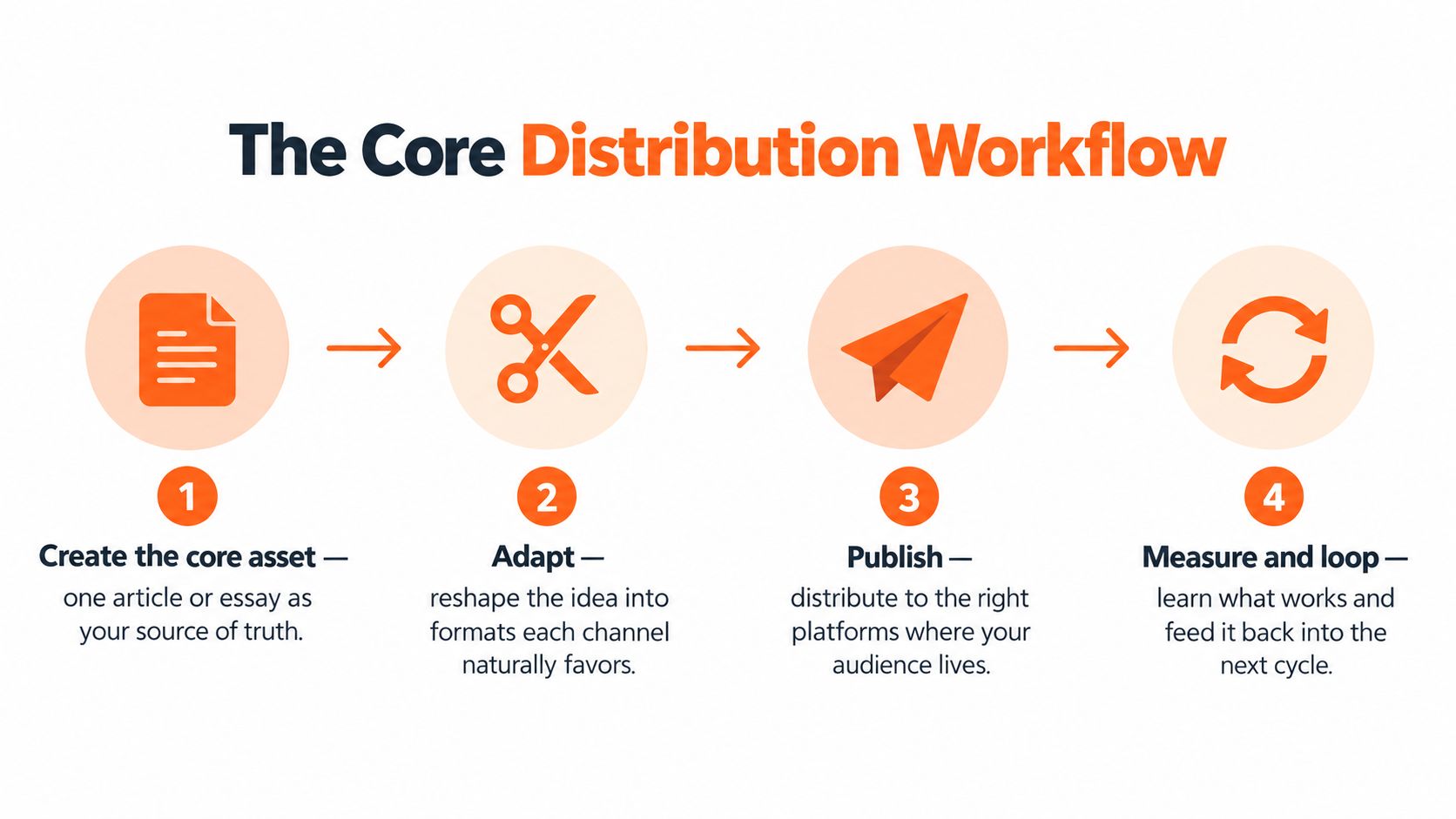
Distribution works when one strong idea becomes a set of deliberate entry points, then improves through measured feedback. The hidden cost of manual distribution is treating it like clerical work. Writers copy, paste, schedule, and move on, so weak openings and poorly matched formats keep returning. A repeatable system turns each publication into evidence for the next piece.
Start with the idea asset
Write the central claim in one sentence. Record the supporting example, the reader problem, and the action you want people to take. This keeps each adaptation connected to the same argument instead of producing disconnected fragments.
Choose channels where your audience can respond. A Substack article can carry the full explanation. A Substack Note can surface one observation. LinkedIn can focus on the practical implication, while an X thread can break the reasoning into short steps.
Adapt before you schedule
Do not paste the article into every composer. Write a distinct opening for each channel, remove context the platform does not need, and give readers a reason to continue there. A Note might open with a confession. A professional post might lead with a business problem. A thread might start with a counterintuitive conclusion.
Feed position changes outcomes too. A randomized experiment simulating Reddit's ranked feed found that moving a post from the top position to ranks 6 to 10 reduced its odds of engagement by approximately 40%. The experiment on ranked feeds supports testing timing, opening structure, recency, and native formatting instead of treating cross-posting as duplication.
Measure the iterative feedback loop
Track reach, clicks, saves, replies, shares, profile visits, subscriber conversions, and repeat visits. Reach shows exposure. Subscriber actions show whether the idea attracted the right audience. Use those signals to keep a promising topic, rewrite a weak opening, or retire a format that earns attention without reader action.
A multi-channel publishing workflow can organize the operational work, while the strategic decisions stay with you. The video walkthrough illustrates the same cycle from creation through measurement.
Distribution Channels Compared
Each channel gives the same idea a different job. Substack Notes can create short, conversational discovery around a newsletter. Medium supports a longer reading experience. LinkedIn favors professional interpretation, while X works well for live commentary, compact arguments, and threaded storytelling.
The mistake is ranking channels by popularity alone. Choose them by audience fit, the type of response you need, and how naturally your idea can be reshaped. A personal essay may work as a Note and a thread. A technical explanation may need the space of an article before it becomes a short post.
| Platform | Best For | Audience Behavior | Optimal Format |
|---|---|---|---|
| Substack Notes | Newsletter discovery and conversation | Readers browse short updates within a publishing ecosystem | Conversational observation, excerpt, question, or recommendation |
| Medium | Long-form discovery | Readers expect a complete article and clear topic framing | Edited essay with a strong title and readable sections |
| Professional insight and discussion | Readers scan for useful implications, opinions, and work-related lessons | Text post with a focused hook and one clear action | |
| X | Real-time commentary and idea sequences | Readers respond to concise claims, replies, and threads | Short argument, thread, or observation tied to a larger article |
Newsletter distribution also shows why channel choice should stay flexible. HubSpot's state of newsletters research reports that 52% of creators used LinkedIn and 50% used Facebook to distribute newsletter content, compared with 42% using traditional email. It also found that 62% believed web-based publishing platforms such as Substack and Beehiiv offered an advantage over an inbox-only strategy.
Those numbers don't make LinkedIn or Facebook universally right for every writer. They indicate that a newsletter can live beyond the inbox. A useful resource on working with external partners is this guide to an agency for branded influencer content, especially when a creator needs help extending ideas through relationships rather than just posting more often.
Use platforms for content marketing as a decision prompt, then test the channel against your own subscriber actions. The right platform is the one that produces qualified attention and gives you a sustainable way to keep publishing.
Repurposing and Scheduling Strategy
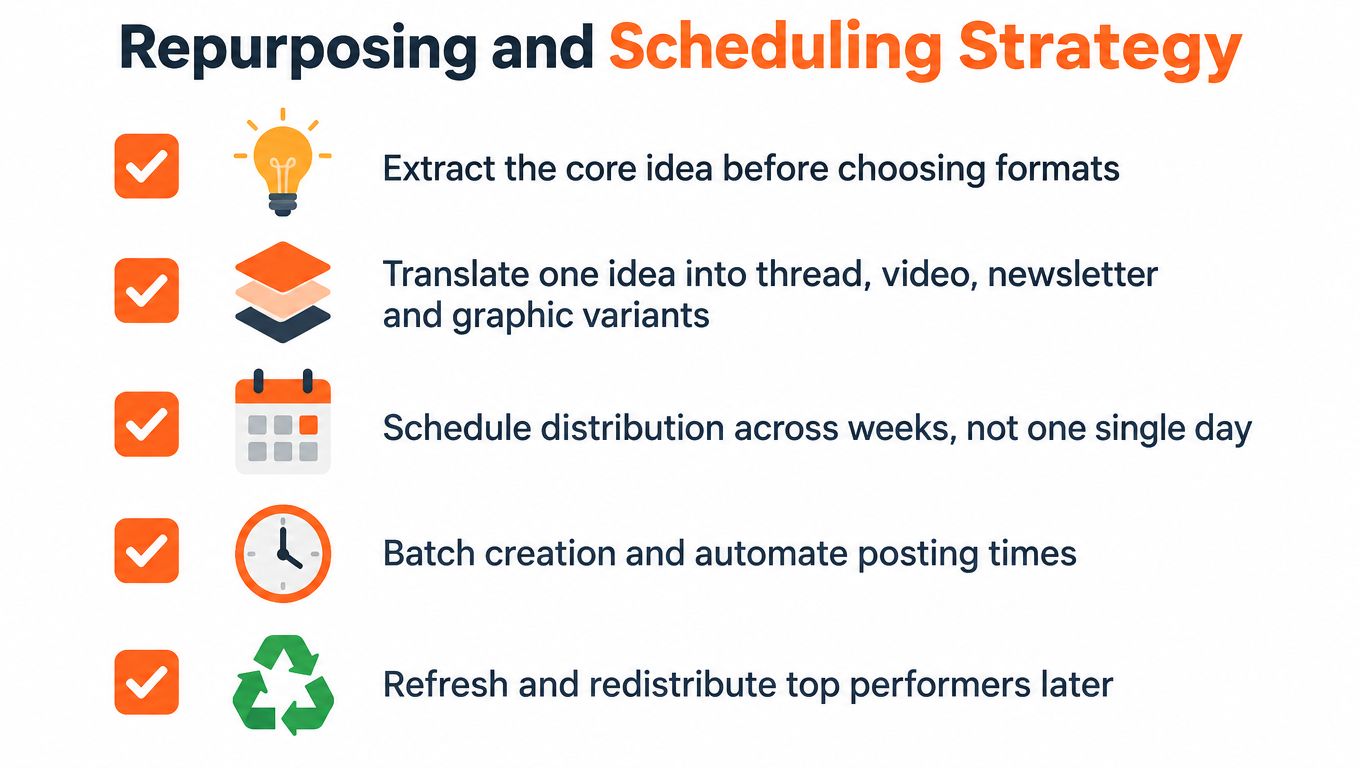
Repurposing works when you translate an idea, not when you duplicate a paragraph. The source article contains the full argument. Each derivative should offer a distinct reason to stop, read, reply, save, or subscribe.
Start by marking the strongest components of the source:
- Core claim: State the idea without the supporting detail.
- Useful tension: Identify the assumption the article challenges.
- Practical example: Extract the moment that makes the argument concrete.
- Reader action: Decide whether the adaptation should invite a reply, click, or subscription.
Then assign each component to a format. One article can become a reflective Note, a professional interpretation, a short thread, and a follow-up question. These versions should not all appear at once. Spacing them gives the idea several chances to enter a feed without making the audience read the same message repeatedly.
Substack supports scheduled Notes on the web, iOS, and Android. The writer selects the calendar icon on the web or chooses “Schedule” from the mobile three-dot menu. The selected time uses the writer's local time zone, and scheduled Notes remain in Drafts until publication, as explained in Substack's Notes scheduling announcement.
That feature supports a practical batch workflow. Extract several Notes from one article, assign slots, and review the queue before anything goes live. Keep a record of which version led to clicks or subscriptions, not only which one received reactions.
Algorithmic feeds create another reason to measure quality. Platforms estimate likely engagement, rank content, observe behavior, and refine recommendations. A post can receive strong emotional reactions without creating qualified traffic or durable audience value, so engagement rate alone is incomplete.
A large-scale analysis of more than 52 million social-media posts found that posting more can increase aggregate growth while reducing the share of the audience reached by each individual post, according to this analysis of social media engagement. Give every adaptation a clear angle, then judge the cumulative system without assuming each extra post will produce incremental reach.
How Narrareach Simplifies Distribution
Manual distribution becomes expensive when every article requires a separate round of copying, formatting, scheduling, and reporting. A practical distribution platform can reduce that repetition, provided the writer still reviews the hook, voice, audience fit, and call to action before publication.
Narrareach brings scheduling, cross-platform publishing, repurposing, and analytics into one workflow for writers and content teams. It supports Substack Notes, Medium articles, LinkedIn posts, and X content, allowing a writer to start with a long-form source and prepare destination-specific versions rather than maintaining disconnected drafts.
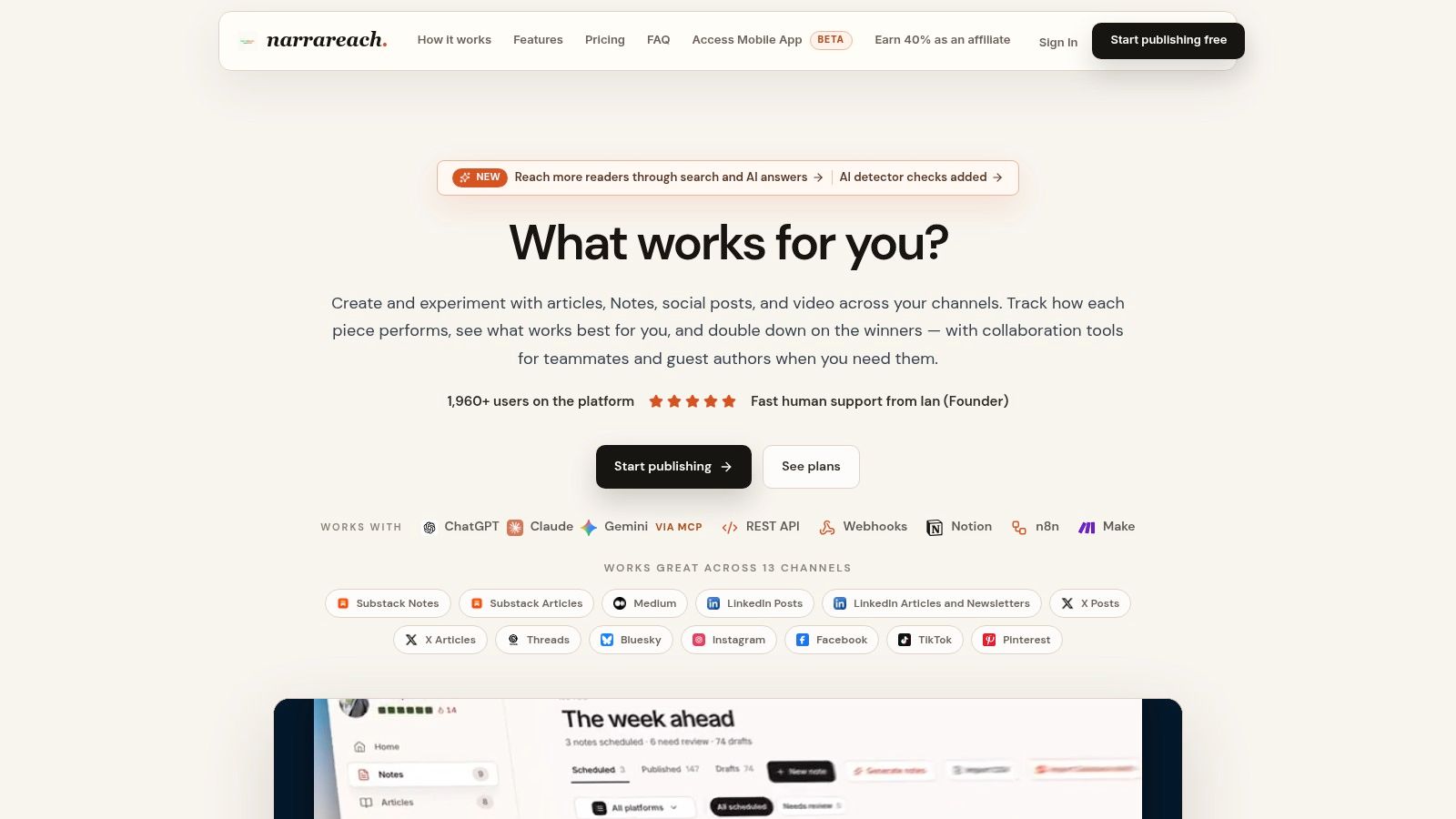
The useful distinction is between automation and abandonment. Automation can handle repeated mechanics such as moving content into a queue or applying a planned publishing time. It shouldn't decide that a formal LinkedIn insight and a conversational Substack Note deserve identical wording.
A workable review process looks like this:
- Select the source: Choose an article with a clear argument and useful supporting material.
- Generate adaptations: Create a Note, professional post, thread, or additional article from separate parts of the source.
- Review the voice: Remove generic phrasing and restore the specific language your readers recognize.
- Schedule the queue: Spread posts across suitable publishing slots instead of releasing every version together.
- Read the signals: Compare clicks, saves, replies, profile visits, subscriptions, and retention.
The Narrareach overview provides more detail about that workflow. Used carefully, a tool can give writers more time to develop ideas while keeping strong content active across relevant channels. It won't make a weak argument valuable, but it can prevent a valuable argument from being seen only once.
Your 7-Day Distribution Experiment
Run a small test with one article you already published. The purpose isn't to maximize output. It's to learn which adaptation and channel produce the strongest reader response.
Day one, choose the source. Select a Substack article, Medium essay, or blog post with a clear idea. Write down its central claim and the subscriber action you want to measure.
Day two, create three adaptations. Make one conversational Substack Note with a personal hook, one LinkedIn post focused on the practical implication, and one X thread built from the article's key points. Preserve the argument, but change the opening, structure, and call to action.
Day three, prepare the schedule. Put the three versions into a four-day publishing window. Use Substack's native scheduling option or a distribution platform, and avoid releasing every adaptation at the same moment.
Days four through six, observe without overreacting. Record profile visits, qualified replies, saves, clicks, and subscriber conversions. Impressions and likes can provide context, but they shouldn't decide whether the idea deserves another cycle.
Day seven, review the evidence. Compare the platforms and formats against your own baseline. Keep the strongest angle, revise the weakest opening, and decide whether the article deserves another adaptation or a related follow-up.
Research doesn't support a universal rule that publishing more frequently always increases engagement. A peer-reviewed analysis found no statistically significant relationship between posting frequency and engagement in its tested higher-education context across Instagram, Facebook, and Twitter, as reported in this study of social media publishing. Consistency and useful feedback matter more than chasing an arbitrary publishing quota.
Narrareach helps writers turn one strong article into platform-specific posts, schedule Substack Notes and other updates, and track which distribution choices drive subscriber actions. Visit Narrareach to start free without a credit card, or save this seven-day experiment and run it with your existing publishing tools.