
How to Grow Newsletter Subscribers in 2026
You publish every Sunday. The essays are thoughtful, edited, and useful. Yet the subscriber counter moves by four or five names a week, while the same post...
By Ian Kiprono
You publish every Sunday. The essays are thoughtful, edited, and useful. Yet the subscriber counter moves by four or five names a week, while the same post disappears from LinkedIn after a few hours and never reaches readers on Medium, X, or Substack Notes. You keep writing because writing is the part you can control, but the list still feels stuck.
That frustration usually isn't a quality problem. It's a distribution problem. I learned that after treating one strong essay as a finished product instead of a source for multiple conversations, then tracking which conversations brought readers back to the newsletter.
The Slow Growth Trap Most Newsletter Creators Get Stuck In
For nine months, I followed the familiar routine. I published a long-form issue every Sunday, shared it once on my personal LinkedIn profile, and waited for subscribers to arrive. The list grew by roughly four or five people a week, enough to prove that the newsletter had value but not enough to create momentum.
The gap was simple: publishing more didn't mean distributing more. I had built the newsletter as a destination. Readers had to discover the single link, decide they trusted the promise, and subscribe immediately. If they missed that LinkedIn post, the issue effectively didn't exist for them.
The lonely destination model
A newsletter now works better as a node in a wider content graph. The full issue can become a Substack Note, a LinkedIn argument, a Medium explanation, and an X thread. Each version gives a different audience a useful entry point, then points interested readers toward the email list.
My original workflow created a feedback loop:
- Few signups: A small list provided little visible social proof.
- Weak conversion: New visitors saw a promise without much evidence that other readers valued it.
- Less promotion: Slow growth made every new promotional post feel harder to justify.
- More isolated publishing: I wrote another Sunday issue instead of extending the previous one.
That loop can make a capable writer conclude that the topic is too narrow or the writing isn't strong enough. In many cases, the writer hasn't given each idea enough routes to travel.
Practical rule: Treat the newsletter issue as the source file, not the final asset.
The change began with one question: which parts of an issue could stand alone without becoming empty promotion? A sharp claim could open an X thread. A practical framework could become a LinkedIn post. A short observation could work as a Note. A fuller version could introduce the newsletter to Medium readers.
This is the useful answer to how to grow newsletter subscribers: make each good idea easier to encounter, understand, and share. The next step is to judge those efforts against real benchmarks rather than vague impressions.
What the 2026 Newsletter Market Actually Looks Like
A creator can publish a strong issue on Sunday and still see only a handful of new subscribers by Monday. The problem is rarely a lack of available readers. Global email users are projected to exceed 4.73 billion by 2026, compared with 3.7 billion in 2017. Daily email volume was estimated at more than 376 billion messages in 2025, according to recent email audience and volume benchmarks. An issue has to earn attention from a specific group, then make subscribing feel like the obvious next action.
Competition is rising across publishing platforms. The number of newsletters grew from 26,911 in 2023 to 52,809 in 2024, a 96.2% year-over-year increase. GetResponse's cited 2024 data placed newsletter-style email at a 40.08% open rate, compared with 34.18% for autoresponders and 35.01% for triggered emails. Those figures do not predict the results of an individual list. They show why recurring editorial value still matters in a crowded inbox, as summarized by newsletter market and engagement benchmarks.
A reference point for your own dashboard
Use benchmarks to find weak points, not to promise outcomes. A signup page below the broad form range may need a clearer offer. A newsletter with strong opens but weak clicks may be attracting curiosity without creating action.
| Metric | Typical Range | Top Quartile |
|---|---|---|
| Standard email-capture form conversion | 2% to 3.9% | Near 6.2% |
| Strong popup conversion | About 3.8% | Above 23.67% for the top 10% |
| Newsletter-style open rate | 40.08% benchmark | Compare cohorts, not averages |
| Average list growth rate | 2.5% benchmark | Improve source quality and retention |
The signup and popup figures come from email capture conversion benchmarks and examples. The list-growth figure comes from the global email benchmark cited above. A generic homepage form can sit below 1%, while a targeted landing page with a relevant lead magnet can reach 5% or more, according to the same capture benchmark. Track the page, offer, and traffic source together.
I keep one baseline sheet beside my editorial calendar. For each channel, I record visits, signups, first-email engagement, and replies. That separates a high-reach post from a useful one. A post can attract many clicks and still produce few qualified subscribers.
The wider distribution mix also matters. A strong article can feed Substack, Medium, LinkedIn, and X, while this guide to platforms for content marketing helps map the formats available to content teams. Growth becomes easier to diagnose when every entry point has its own numbers.
Finding the Readers You Can Actually Reach
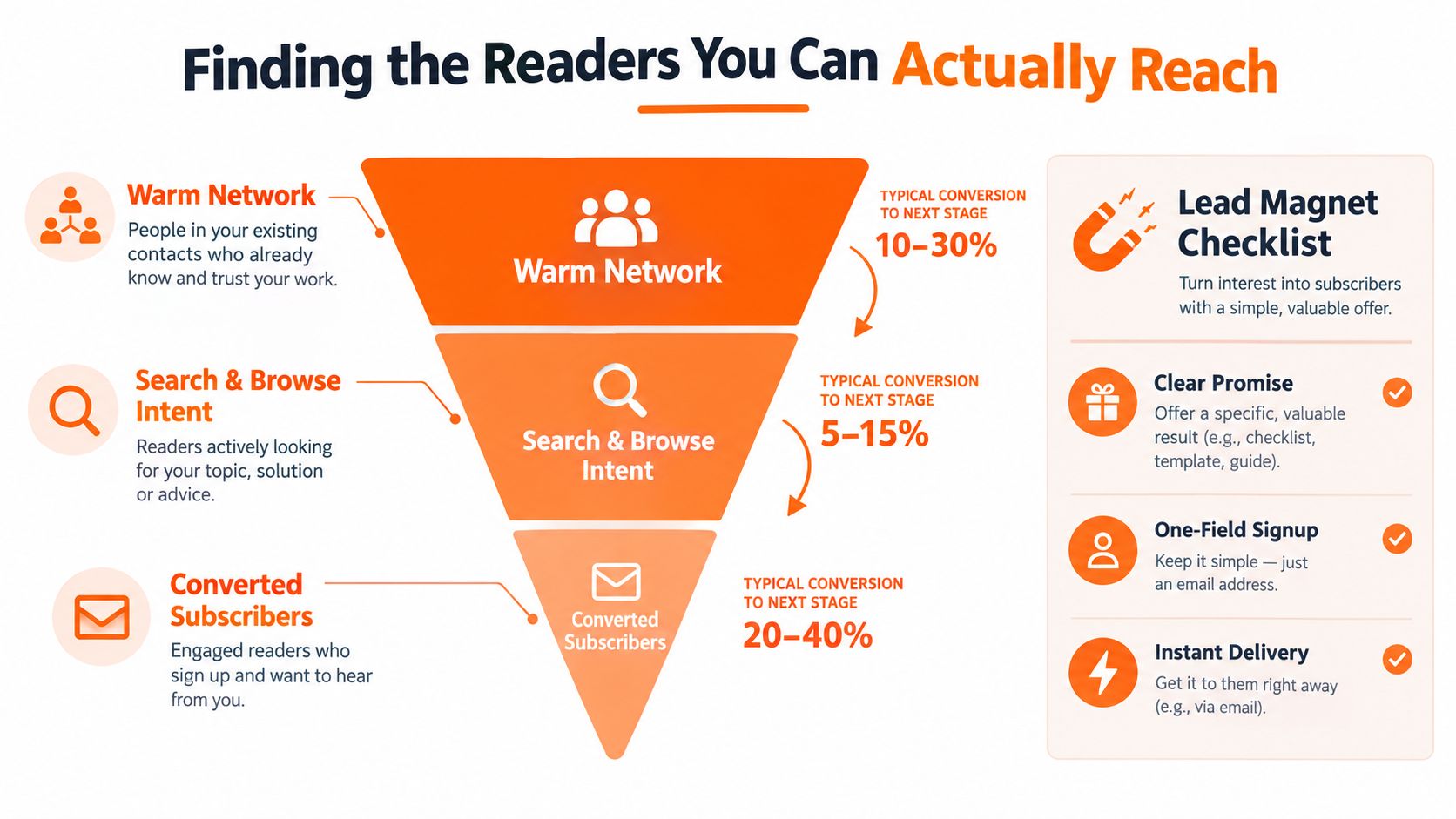
A post about turning one essay into platform-native updates brought me three kinds of visitors. Former colleagues recognized my name, adjacent newsletter readers recognized the problem, and strangers found the idea through LinkedIn, X, Medium, or search. Each group needed a different invitation.
Warm contacts already know my work. They include former colleagues, existing customers, people who reply to posts, and readers who have shared an essay. I give them a direct reason to subscribe, such as the next issue's practical checklist, rather than another introduction to my background.
Parallel readers follow related newsletters, authors, and communities. They may care about the problem without knowing me. A useful reply, collaboration, guest contribution, or relevant recommendation lets the newsletter enter an existing conversation without a cold pitch.
Cold readers meet the idea through distribution. A strong LinkedIn post, Medium explanation, X thread, or recommendation earns attention first. The signup page then needs a specific promise before asking for an email.
Mine the language before building the offer
I collect phrases from comments, replies, search suggestions, and repeated questions. When readers say, “I have ideas but never know what to post next,” a broad content-marketing ebook misses the problem. A weekly repurposing checklist fits better because it shows how to turn one essay into posts for Substack, Medium, LinkedIn, and X.
The lead magnet should solve one narrow problem quickly:
- Swipe file: Examples readers can adapt.
- Checklist: A repeatable process for inconsistent publishing.
- Curated roundup: A short path through resources readers struggle to evaluate.
- Template: A starting point when the blank page causes the delay.
Use the funnel as a calculation
A landing page converting at 4% and a lead magnet converting at 15% can produce a very different result from the same traffic. In the requested scenario, the gap represents 50 subscribers or 300 subscribers, depending on the offer and page. Those figures are an editorial example, not a universal benchmark.
The earlier benchmark range gives the test context. Standard capture forms average around 2% to 3.9%, top-quartile performance approaches 6.2%, and strong popups average roughly 3.8%, with the top 10% exceeding 23.67%. Mobile popups in that dataset converted at about 6.57%, compared with 3.77% on desktop. Treat those figures as comparison points, then measure each source, page, and offer separately.
Before building the asset, I check five things:
- Repeated wording: Do readers describe the problem in similar language?
- Immediate use: Can someone apply the asset without taking a long course?
- Single audience: Would the intended reader recognize the offer as written for them?
- Clear delivery: Can the resource arrive immediately after signup?
- Healthy sending: Have I reviewed an email deliverability guide before increasing acquisition?
For more focused audience research, use this guide on how to identify your target audience. The goal is a small, useful promise that attracts readers likely to open the next issue, not a large download that merely inflates the signup count.
Turning Your Best Post into a Multi-Platform Distribution Engine
I stopped asking, “What should I publish today?” and started asking, “Which existing idea already earned attention?” The source post is usually the essay with the strongest click-through rate, longest reading time, most thoughtful replies, or clearest evidence that readers understood the argument.
I rebuild that post four ways, while keeping the central claim intact.
Start with one source and four native formats
Substack Note: Strip the opening to about 200 characters. Keep one tension, observation, or unfinished question, then end with a curiosity loop such as, “The part most writers miss is what happens after publication.” The Note should stand alone, not read like an excerpt with half the context removed.
LinkedIn carousel script: Pull three standalone insights from the essay. Open with one line that names the reader's problem, give each insight one slide-sized explanation, and end with a CTA in the comments. Design for a vertical reading experience, with one claim per slide and enough contrast for a small screen.
Medium article: Rebuild the argument as a roughly 1,200-word explanation for a reader who hasn't seen the original. Add context, examples, and a natural link back to the complete Substack version. Don't paste the newsletter unchanged. Adapt the introduction and structure for discovery readers.
X thread: Reduce the contrarian claim to a seven-tweet sequence. Tweet one establishes the tension, tweets two and three develop the reasoning, tweet four carries the strongest screenshot or proof point, and the final tweet offers the newsletter as the place for the full argument.
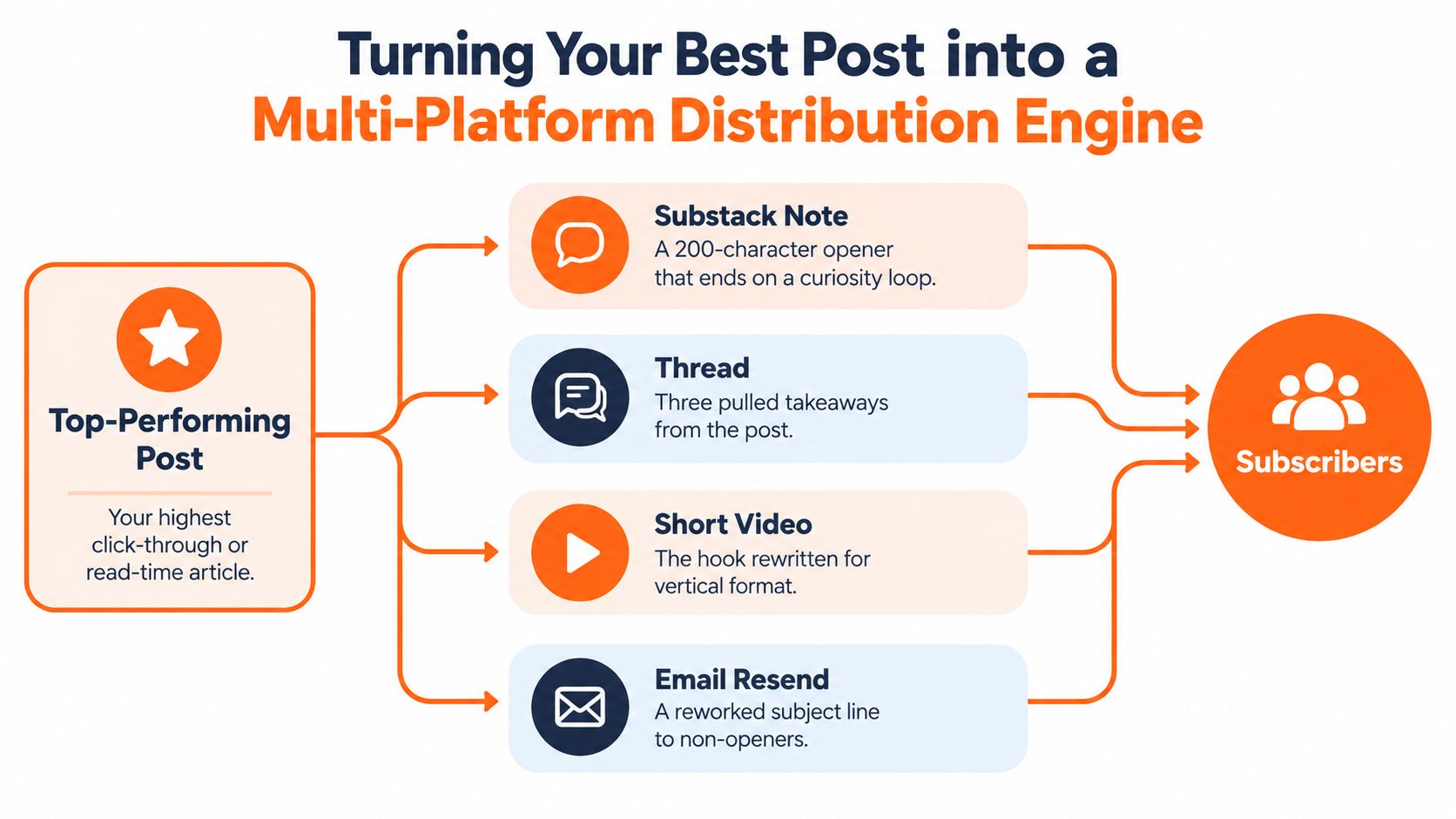
The formats work because they respect different reading behaviors. Notes reward brevity, LinkedIn rewards a clear professional takeaway, Medium supports a fuller explanation, and X rewards sequence and tension. The same idea can travel without becoming four copies.
Score every derivative before publishing
I use a three-part scorecard:
- Hook strength: Does the first line create a specific reason to continue?
- Standalone value: Would the reader gain something even without clicking?
- Backlink placement: Does the link appear after the useful insight rather than before it?
My 30-day calendar turns one essay into eight distribution assets:
| Timing | Asset |
|---|---|
| Day 1 | Full Substack issue |
| Day 3 | First Substack Note |
| Day 6 | LinkedIn insight |
| Day 10 | X thread |
| Day 14 | Medium adaptation |
| Day 18 | Second Note from a reader question |
| Day 23 | LinkedIn carousel script |
| Day 28 | Final Note pointing to the complete issue |
That cadence doesn't require eight new ideas. It requires one idea with enough depth to be useful in several contexts. For a fuller workflow, see how to repurpose content.
The test is straightforward. If a derivative gets attention but no newsletter visits, strengthen the bridge. If it earns clicks but few signups, inspect the landing-page promise. If it creates replies, turn those replies into the next source material.
Scheduling Substack Notes and Cross-Posting Without Burning Out
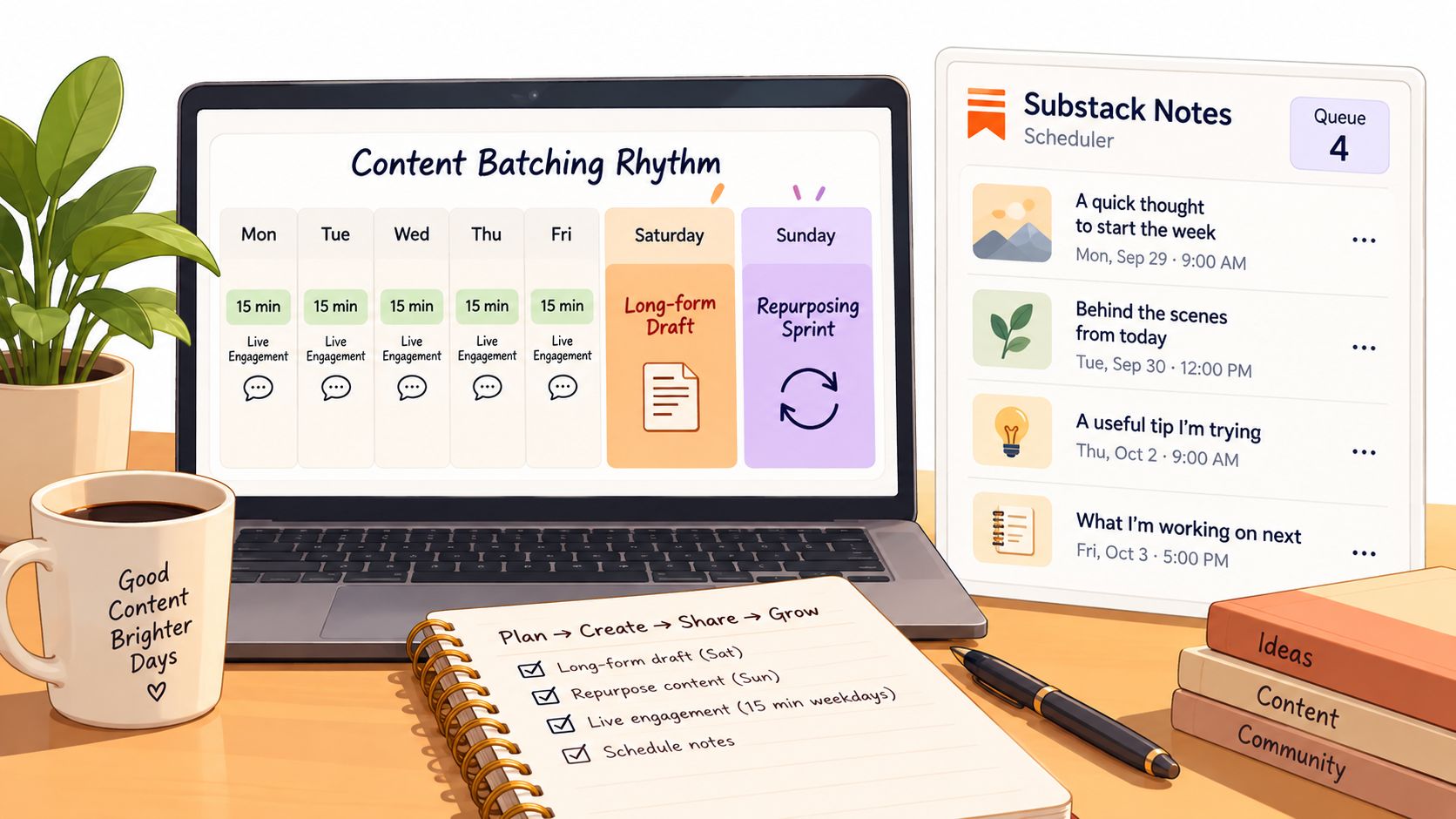
My sustainable week has three blocks. I draft the long-form issue on Saturday, run the repurposing sprint on Sunday, and reserve short weekday sessions for live replies and conversations. Without batching, every platform asks me to become a new person several times a day.
Substack Notes can be scheduled on web, iOS, and Android. On web, I use the calendar icon in the composer. On mobile, I open the three-dot menu and choose Schedule. Scheduled Notes remain editable in the Notes Drafts tab until publication, as described in Substack's scheduling announcement.
Build a queue with clear boundaries
A current scheduling guide reports that Notes can be queued up to three months in advance and confirms the desktop calendar and mobile three-dot workflows in this Substack scheduling guide. I don't fill the entire horizon. I queue enough material to protect the publishing rhythm, then leave room for timely observations.
My Note mix is 70/20/10:
- 70% original thoughts: Arguments, observations, and useful explanations.
- 20% curated material: Quotes or links with my own context.
- 10% issue promotion: A clear invitation to read the latest newsletter.
Those percentages are an operating choice, not a verified industry benchmark. The queue also needs an order. I publish the LinkedIn version at 8:30 a.m. local time, the X thread two hours later, import the Medium adaptation after 24 hours, and keep the Substack Note pinned for 72 hours when the platform allows it. These are workflow settings to test, not universal performance claims.
For LinkedIn-specific scheduling ideas, this LinkedIn post scheduler offers useful context. A simple Notion calendar remains the source of truth, while Buffer can handle LinkedIn and X scheduling. Narrareach can sit alongside that stack for cross-platform draft reuse, Substack Notes, Medium articles, LinkedIn posts, X content, and subscriber attribution in one workflow.
A scheduling queue should reduce decisions, not create a second job. I cap derivative content at three pieces per source post when the material is thin. A stronger essay can support more, but repetition becomes visible when every channel receives the same opening and CTA. The practical guide to scheduling Substack Notes in bulk is useful when batching becomes the bottleneck.
Onboarding Funnels and Referral Loops That Keep Subscribers
A new subscriber shouldn't have to guess what to do next. I design the first 14 days as a short sequence that moves from orientation to proof to participation.
On Day 0, the welcome issue gives one clear next action. On Day 3, a best-of digest shows the depth of the archive. On Day 10, a reply request creates a small conversation instead of another passive click.
Write the sequence before chasing more traffic
| Day | Subject line | Preview text | CTA |
|---|---|---|---|
| 0 | Start here, your first useful idea | One short way to get value from this newsletter today | Read the starting point |
| 3 | Three issues worth your time | The archive is deeper than the latest edition | Choose one issue |
| 10 | What are you working on right now? | Reply with the problem you want me to unpack | Reply with one sentence |
The subject lines above are working drafts, not performance guarantees. The sequence succeeds when each email has one job. The welcome message reduces uncertainty, the digest demonstrates consistency, and the reply ask gives me language for future issues.
I also separate acquisition from activation. A new subscriber who never opens, clicks, or replies isn't equivalent to a reader who forwards an issue or answers a question. One expert benchmark recommends treating roughly 50% or higher opens and 5% to 10% or higher clicks as healthy signals, while replies and poll participation can be stronger indicators than opens alone, according to this subscriber growth engagement framework.
Let engaged readers create the next loop
Substack's built-in referral program or a dedicated landing page can reward readers who bring friends. I place the reward behind genuine participation, such as a paid tier, a useful bonus, or a simple leaderboard, rather than making every signup equally valuable. The purpose is to encourage recommendations from people who understand the newsletter.
In the dashboard, I use three tracks:
- Activated: Opened and clicked or replied during the welcome sequence.
- Uncertain: Subscribed but hasn't shown a meaningful interaction.
- Re-engagement: Fell below a 30% open-rate floor, using the editorial rule in this workflow.
The 30% threshold is a quality gate for this system, not a universal standard. The broader benchmark source notes that healthy programs also target 30% to 45% open rates and 3% to 7% click rates as industry ranges, so I compare cohorts by source rather than treating one threshold as absolute.
Measuring Growth the Right Way and Choosing Your Next Step
The subscriber count is a lagging number. I use it as the outcome, then inspect the actions that created it. A useful weekly review takes 15 minutes and answers four questions: which source produced qualified signups, which new readers activated, which derivative reached fresh people, and which referral path created another conversation?
I tag every signup link with a source label. A Note, LinkedIn post, Medium article, and X thread should never share an indistinguishable URL if I want to know which one worked. I compare the current week with trailing averages, then choose one change for the next cycle.
Replace vanity totals with predictive signals
The requested operating targets below are planning targets, not verified industry benchmarks. They help define what “working” means before publishing begins.
| Metric | Vanity Version | Predictive Version | 2026 Benchmark |
|---|---|---|---|
| Qualified signup rate | Total signups | Signups from a relevant source | Planning target of 4% to 8% on a landing page |
| 30-day activation rate | New subscribers | Readers opening the second email | Planning target of 50% |
| Cross-platform reach | Followers or total impressions | Reach from one repurposed post | Planning target of 50,000 combined impressions |
| Referral coefficient | Referral clicks | New readers generated per subscriber | Planning target of 0.3 or more in 30 days |
I also flag onboarding emails with reply rates above 12% as candidates for replication. Again, that's a workflow threshold, not a verified market statistic. The point is to identify language that creates participation, then reuse the underlying question in a future issue or Note.
The broader evidence supports quality gates. One benchmark advises checking whether new cohorts keep opening, clicking, and responding, because raw list growth can hide declining engagement. Another summary of HubSpot's 2025 newsletter reporting says 42% of newsletter professionals rated direct recommendations from existing subscribers as the most effective growth strategy, as reported in HubSpot's newsletter industry coverage. That makes source-level tracking essential. A large acquisition channel isn't automatically a durable one.
For a practical way to organize these comparisons, use a content analytics dashboard. The weekly review should end with one decision, not a long list of possible improvements. Keep the lead magnet, change the landing page. Keep the topic, change the hook. Keep the channel, improve the onboarding. Small iterations compound when they follow evidence.
If you're ready to operationalize the workflow, Narrareach brings research, repurposing, scheduling, cross-platform publishing, and subscriber attribution into one place, including efficient Substack Notes and post distribution. If you're not ready for another tool, subscribe to a weekly operator's note and keep testing one source, one offer, and one onboarding improvement at a time.