
Content Repurposing Framework: A 90-Day Playbook
A strong Substack post goes live on Sunday night. Then the heavy lifting begins. You copy paragraphs into LinkedIn, shorten them for X, reshape them for...
By Ian Kiprono
A strong Substack post goes live on Sunday night. Then the heavy lifting begins. You copy paragraphs into LinkedIn, shorten them for X, reshape them for Medium, and abandon half the drafts because the process is taking longer than the original article. By the end, analytics sit across several dashboards, the same idea has been published without a clear sequence, and you still don't know which argument earned attention.
That cycle turns distribution into a weekly tax. The fix isn't producing more ideas. It's building a content repurposing framework that treats every strong article as a source asset, then routes its best insights through native formats and scheduled distribution waves.
The Distribution Trap Most Writers Fall Into
The usual workflow looks productive from a distance. A writer publishes a thoughtful article, shares the link once, creates a hurried social post, and moves on to the next topic. The article might contain several useful arguments, examples, and conclusions, but most of them never receive a second opportunity to reach the right reader.
The problem isn't a lack of effort. It's the timing and structure of that effort. Same-day reposting forces every platform to compete for attention at once, while manual rewriting makes distribution feel like a second writing career.
Practical rule: Your source article should be finished before distribution begins, but distribution shouldn't finish on publication day.
I spent a full operating cycle rebuilding this process around a simple sequence: pillar, atoms, formats, waves. The pillar is the substantial article or newsletter. Atoms are the standalone insights extracted from it. Formats package those insights for specific platforms. Waves release them gradually instead of publishing everything at once.
That distinction matters. A LinkedIn post shouldn't be a paragraph copied from Substack. An X thread shouldn't be a compressed table of contents. A Medium article shouldn't preserve every sentence just because the source already exists. Each output needs a new entry point, a platform-native rhythm, and a reason for the reader to continue.
The pressure to work this way is rising. HubSpot's 2026 state-of-marketing report says 35.08% of global marketers rank repurposing content across channels among their top trends, while Adobe-referenced research says 62% of more than 1,600 marketers saw content demand rise at least fivefold over two years. Those figures come from HubSpot's marketing trends report, and they point to a practical reality: publishing more from scratch isn't a sustainable answer to rising demand.
The framework is a replacement for the weekly copy-paste grind, not an extra layer on top of it. You create one strong source, identify what deserves another life, adapt it properly, and schedule the sequence far enough apart that each piece can teach you something.
Auditing Your Existing Content to Find Winners
Before writing a single derivative post, I would spend 48 hours building a content inventory. This isn't a creative exercise. It's a filtering operation designed to prevent weak source material from entering the pipeline.
Pull recent work from Substack, Medium, LinkedIn, and X into one spreadsheet. Use one row per source asset and record the platform, publication date, format, hook, 7-day engagement rate, read-through or dwell time, and click-through to the relevant call to action. If one platform doesn't expose an exact equivalent, record the closest available measure and label it clearly.
The scoring model should favor evidence of sustained attention over surface activity. A post with many impressions but little reading depth may give you a catchy opening, but it may not contain enough substance to support several useful atoms.
The scoring model
| Signal | Weight | Source | Threshold to Qualify |
|---|---|---|---|
| Dwell time or read-through | Highest | Platform analytics | Strong relative performance for the format |
| Engagement rate | Medium | Platform analytics | Above the account's recent baseline |
| CTA click-through | Medium | Platform or link analytics | Evidence of action beyond viewing |
| Evergreen value | Qualitative | Editorial review | Useful after the original publication window |
| Strategic fit | Qualitative | Editorial review | Supports a current audience or business priority |
Sort the inventory by a composite score, but don't pretend the formula is objective. The point is to make your judgment visible and repeatable. Mark the small group of genuine winners, then inspect why they worked. Was the hook unusually specific? Did readers respond to the process, the opinion, or the example? Could each insight stand alone without the original article?
Adobe's 2024 survey found that 70% of 517 small business owners had already repurposed content, and 54% said the main benefit was time savings, as reported in Adobe's content repurposing statistics. The same research found that 49% saw an 11% to 25% increase in engagement from repurposed content, while 35% estimated an 11% to 25% increase in conversions. Those figures don't prove that every asset deserves reuse. They reinforce the need to choose the right assets before investing in adaptation.
For a practical audit workflow, use this social media audit template as a starting point, then add the source-specific fields your team reviews. Skip thin pieces, stale announcements, and articles that failed because the underlying idea was unclear. Repurposing can't rescue an argument that never earned attention in its original form.
The Pillar to Atoms to Formats Pipeline
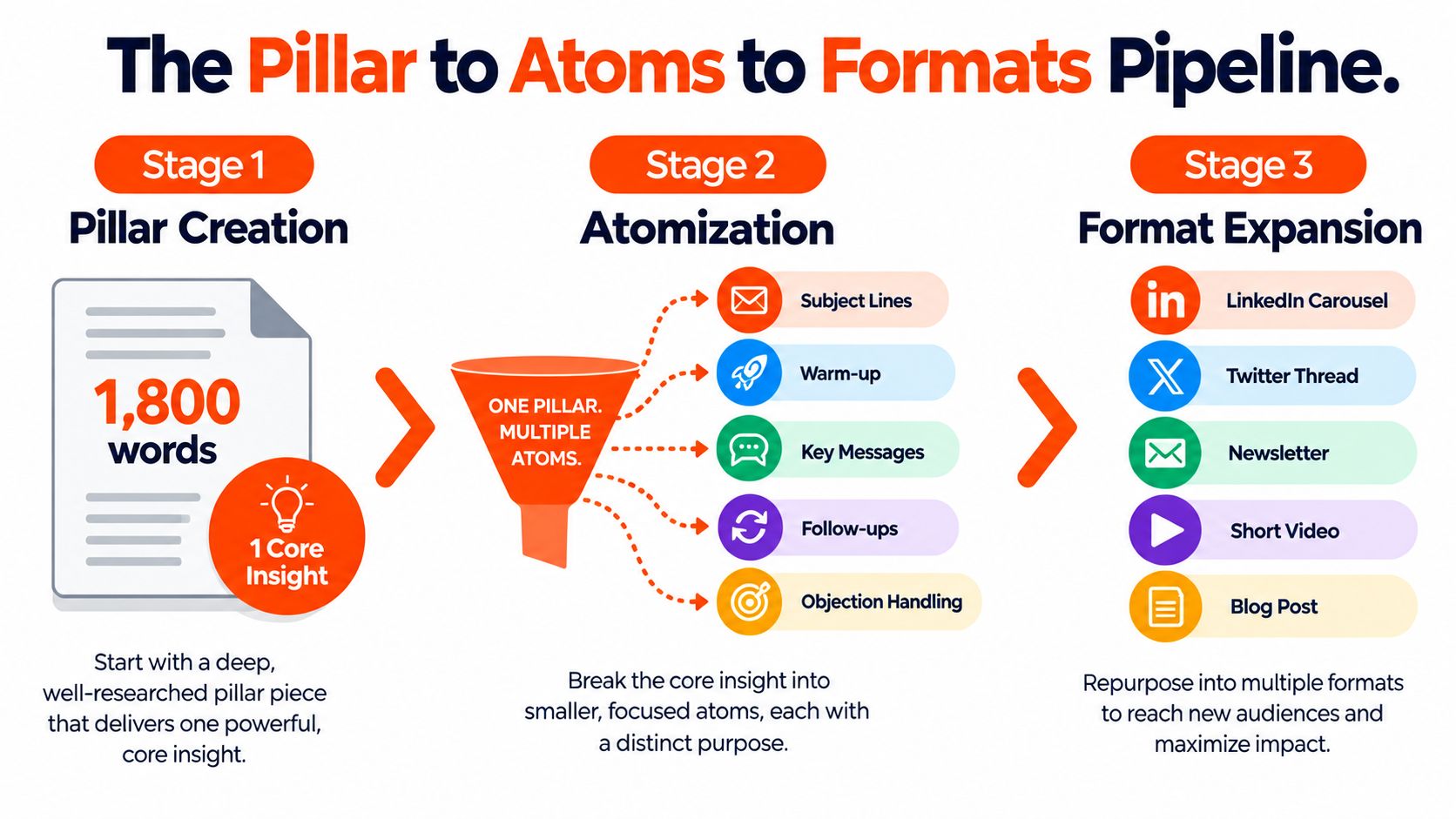
The pipeline starts with one source asset and ends with several distinct pieces that carry the same underlying argument without repeating the same presentation.
Take a long-form Substack essay about cold email deliverability. The pillar might explain inbox placement, sender reputation, warm-up practices, subject lines, and follow-ups. The next step isn't to paste its paragraphs into social channels. Extract 5 to 15 modular atoms, following the operational pattern described in Cognism's content repurposing workflow. Each atom should contain a complete idea, its own hook, supporting evidence or reasoning, and a clear takeaway.
Treat the atom as the unit of value
One atom could explain why a technically valid email still lands in spam. Another could show how a sender should sequence follow-ups. A third could challenge the assumption that a clever subject line fixes a weak sending reputation.
Then assign each atom to one or two platform-native formats:
- LinkedIn carousel: Turn the inbox-placement argument into a visual progression with one decision per slide.
- Medium article: Expand the technical setup and make the explanation searchable and self-contained.
- X thread: Lead with the most impactful fix, then build a sequence of concise supporting points.
- Substack Note: Share a sharp observation or question that points interested readers toward the pillar.
The format is packaging. The atom is the value. Confusing those two produces the familiar weak result, a long article chopped into smaller paragraphs with no adaptation.
Content pillars also benefit from a broader editorial structure. Big Moves Marketing's examples of content pillars are useful when you need to connect individual ideas to durable audience themes rather than treating every article as an isolated campaign.
Each atom needs a source-of-truth record containing the approved claim, supporting source, visual direction, intended audience, and call to action. Without that record, downstream drafts drift. One platform gets a qualification that another omits, a statistic changes shape, or an opinion becomes more absolute than the original argument allowed.
For teams building a broader content hub strategy, this pipeline creates a clean handoff. The pillar remains the canonical source. Atoms become the editorial inventory. Formats become channel executions.
The most useful test is simple: if the reader sees only the derivative piece, do they still receive a complete insight? If not, you haven't extracted an atom yet. You've copied a fragment.
Scheduling Distribution Waves Across Platforms
A repurposing system needs time between releases. Without that delay, every platform receives the same argument before the first version has produced useful feedback. A wave-based schedule turns each atom into a distribution test, then uses the result to shape the next format.
Use a 1 to 4 week distribution window. Publish the first version where feedback arrives fastest, then adapt the argument, framing, or format before releasing it elsewhere. The delay also gives the pillar a longer life without making your audience encounter identical packaging everywhere at once.
A practical 28-day calendar looks like this:
| Timing | Channel | Asset | Decision |
|---|---|---|---|
| Day 1 | Native text post or carousel | Test the core hook | |
| Day 3 | X | Thread built from the strongest atom | Test compression and quotability |
| Week 2 | Medium | Expanded article | Test search-oriented depth |
| Week 3 or 4 | Substack | Note or cross-promotion | Send qualified readers to the pillar |
The sequence is a starting point, not a rule. Start on X if that audience responds there first. Let Medium lead if it has historically produced stronger discovery. The operating principle stays the same: use early signals to improve later packaging.
A weak post does not automatically invalidate the idea. Check the platform fit, the reading effort, and the call to action. A LinkedIn text post may fail because the idea needs visual structure. A weak thread may show that the atom lacks a clear argument, rather than proving the pillar has no value.
Measure every asset at 7 and 30 days, then compare its performance with the platform average from the previous 3 to 6 months, following the measurement guidance in Neil Patel's repurposing analysis. Use impressions or shares to assess reach, comments and engagement rate to assess community-building, and assisted pipeline or influenced opportunities when the objective is commercial impact. Compare each format with its channel baseline, not with the source article's raw total.
A scheduler handles timing, not editorial judgment. Put every asset on a calendar with its source link and approval status. Pause later waves if the first test exposes a factual error, a positioning problem, or an argument that needs more work. The post scheduling workflow becomes useful after those decisions are settled.
Substack supports native Notes scheduling on web, iOS, and Android. Scheduled Notes remain editable in Drafts until publication, and Substack says creators can schedule them in their local time zone up to about 3 months ahead, according to Substack's Notes scheduling announcement. That makes delayed distribution practical without requiring real-time posting.
Templates and Voice Rules for Each Platform
Templates keep a good system alive during a bad week. They reduce blank-page friction, but they shouldn't flatten every platform into the same voice.
Substack
Use a short cross-promotion Note built around tension:
Most writers treat [topic] as a publishing problem. It's really a [different problem]. I broke down the practical system in the latest piece, including [specific takeaway]. Read it if you're trying to [reader outcome].
Substack should remain personal and reflective. The Note can be brief, but it should sound like a thought from the newsletter's author, not an advertisement for an article.
Use a carousel structure that moves from recognition to action:
- Hook
- Problem
- Framework
- Evidence or example
- Practical steps
- Takeaway
- Call to action
The first slide earns the swipe. The middle slides teach one idea at a time. The final slide gives the reader a next step, not a vague request to engage. LinkedIn rewards skimmability, so remove context that the slide doesn't need.
Medium
Don't republish an article without changing its entry point. Write a short preamble that explains why this version exists for the Medium reader, then use descriptive subheads and a canonical reference back to the original pillar. The body should prioritize clarity and search intent rather than preserving the source's personal chronology.
X
Build a thread from 6 to 8 standalone insights only when each point can survive outside the original article. Lead with the most quotable line, not the background. Every post should either advance the argument, clarify a distinction, or give the reader a useful action.
The same idea can appear on all four platforms, but the voice shouldn't become identical. Current repurposing data says 48% of social media marketers publish similar or repurposed content with minor changes, while 34% create unique content from scratch for each platform, according to Shno's content repurposing statistics. That makes adaptation quality the important question. You don't need four unrelated ideas. You do need four credible reader experiences.
Keep a voice sheet beside the source record. Include preferred sentence length, words you avoid, how directly you state opinions, and the kinds of examples you use. A practical brand voice consistency guide can help formalize that sheet without turning every draft into a compliance exercise.
What 90 Days of Following This Framework Actually Looked Like
A 90-day distribution test needs more than a post count at the end. Before publishing the first atom, set a baseline, define the measurement window, and record what will be stopped. Otherwise, a pillar-to-atoms-to-waves system produces an attractive activity report without showing whether delayed distribution created useful results.
The calendar followed a simple sequence. The pillar went live first, its strongest claims became atoms, and each atom entered platform-native formats in later distribution waves. The source record and handoffs followed the fields in this content creation workflow, so every release could be traced back to the original idea.
I would not claim a subscriber lift, search-visit total, or impression multiplier without a documented dataset. The result table therefore captures the fields required before the experiment begins:
| Platform | Posts Published | Avg. Impressions | Click-Through to Pillar | New Email Subs |
|---|---|---|---|---|
| Substack | Record by wave | Compare with baseline | Record by Note | Attribute with tagged links |
| Record by format | Compare with platform average | Record by asset | Attribute assisted subscriptions | |
| Medium | Record by article | Compare with recent average | Record by canonical or CTA link | Attribute where observable |
| X | Record by thread and post | Compare with recent average | Record by thread | Attribute with tagged links |
That record is less dramatic than a polished case study, but it exposes the trade-offs. An internal benchmark analyzing 258 brands with 50,000 to 100,000 followers found that multi-format reuse increased views across brands over a 6-month period. The practical lesson is to compare every atom and format with its channel baseline, rather than comparing a repurposed post with the pillar article's raw total.
What usually flops
Copying a personal essay word for word often fails on Medium. The original may rely on intimacy, chronology, or an existing subscriber relationship. A Medium version usually needs a clearer promise, stronger subheads, and a direct explanation of the reader's practical gain.
A LinkedIn text post can stall even when its underlying framework is sound. Change the packaging before abandoning the idea. Turn the sequence into a visual explanation, lead with the decision the reader must make, or isolate one disagreement instead of compressing the whole pillar into a summary.
The calendar also needs a pruning rule. If the pillar stays quiet after proper testing, stop producing new atoms from it. Keep the useful insight in the editorial archive, mark the failed format or angle, and choose a stronger source for the next wave.
The framework cannot make every atom work. It gives the team a consistent way to separate a weak idea from a weak format, review performance at 7 and 30 days, and stop spending effort where the evidence does not support another release.
Turning This Framework Into a Repeatable System
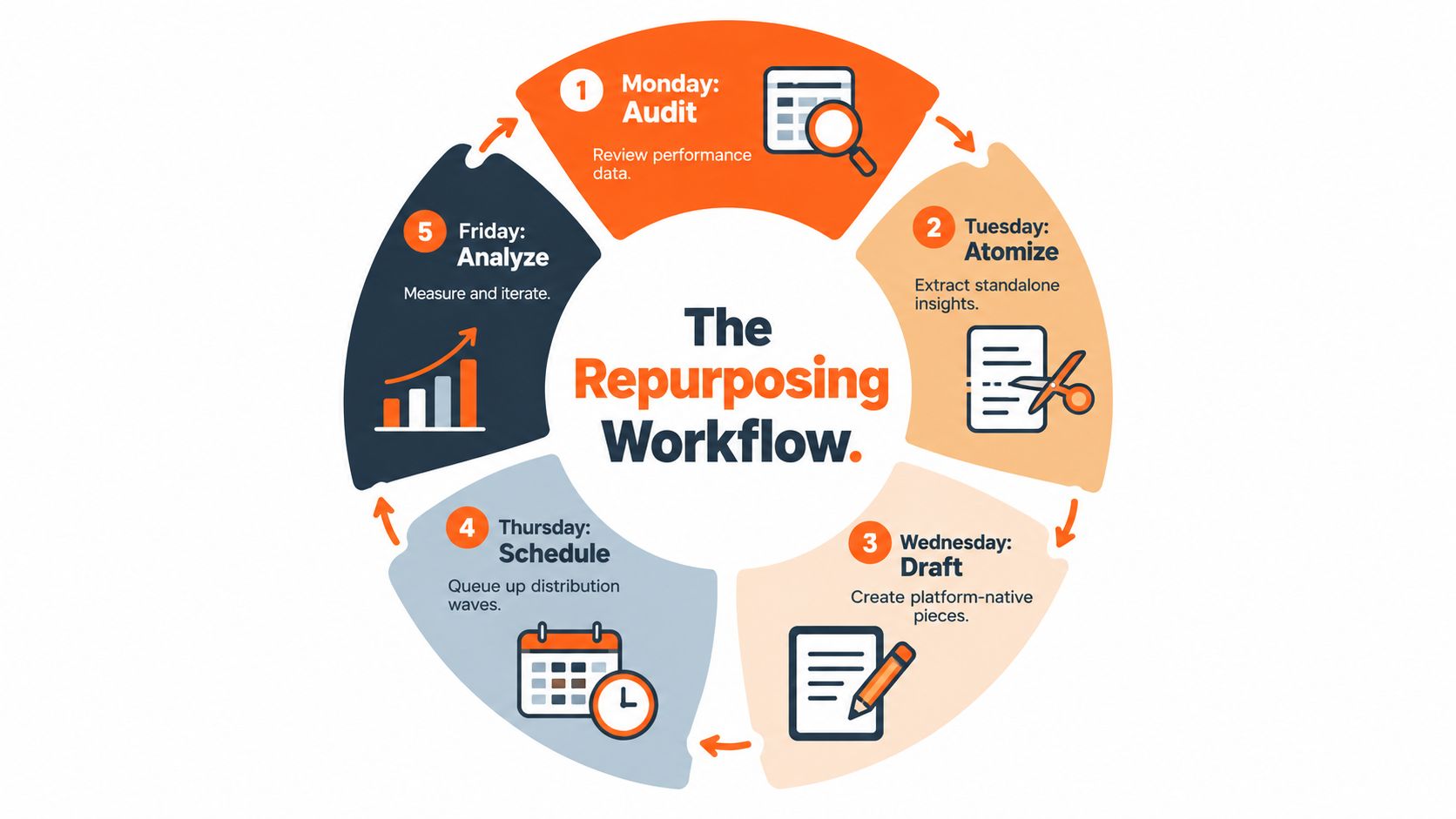
The system becomes manageable when every day produces a defined handoff.
Monday is audit day. Review the latest platform data, compare assets with recent baselines, and select the source pieces worth developing. The output is a shortlist, not a giant backlog.
Tuesday is atomization day. Extract the claims, examples, objections, and practical steps that can stand independently. Attach approved sources and voice notes to each atom so the next writer or tool doesn't have to reconstruct the original argument.
Wednesday is drafting day. Create the platform-native versions. Write the LinkedIn hook separately from the X opening. Expand the Medium version for its reader intent. Keep the Substack Note conversational and selective.
Thursday is scheduling day. Place the assets into distribution waves, assign publication windows, and check that every CTA leads to the correct destination. Substack's scheduler supports Notes across web and mobile, and scheduled Notes can remain editable before publication, which helps when the editorial sequence changes.
Friday is analysis day. Review early signals, mark the strongest atoms, and record what you'll change before the next wave. Don't optimize for views alone. Track the action that matters for the channel, whether that's qualified discussion, pillar clicks, subscribers, or assisted opportunities.
The source of truth should remain your editorial archive, not the scheduler. Store the original claim, approved wording, citations, visual instructions, and status there. A distribution tool can handle queueing, formatting, and reporting, but it shouldn't replace the decisions about which idea deserves another wave.
Adobe's survey found that the average delay between original publication and repurposing was seven and a half months, which supports treating reuse as a delayed distribution layer rather than a same-day remix. The strongest system is patient enough to let a useful idea return when the audience, platform context, or format gives it a better chance.
Start manually this week with one pillar, a shortlist of atoms, and a simple calendar. If you want to reduce the copy-paste work, Narrareach can turn existing articles and newsletters into reviewable drafts, schedule posts and Substack Notes across supported channels, and help you track which ideas drive subscribers. Build the editorial judgment yourself, then use the distribution layer to make the waves easier to execute consistently.