
Content Distribution Manager Guide for Writers in 2026
You finish a strong Substack article and immediately face a second job. The piece needs a LinkedIn version, an X thread, a Medium adaptation, and several...
By Ian Kiprono
You finish a strong Substack article and immediately face a second job. The piece needs a LinkedIn version, an X thread, a Medium adaptation, and several Substack Notes, but each destination expects a different format. You copy the draft into new tabs, shorten paragraphs, repair links, rewrite the opening, schedule a post, then lose track of which version went live where.
By the time you finish the manual loop, the idea has consumed the time you meant to spend writing the next one. Worse, one good argument may disappear inside a single feed while your audience growth stays flat. You're publishing consistently, yet distribution still feels improvised. The problem isn't that you lack ideas. You lack a repeatable way to decide where each idea should go, how it should change, and whether it brought the right readers back.
The Distribution Trap That Keeps Writers Stuck
The trap starts with a reasonable assumption: write something valuable, publish it, and share the link. That works until your audience stops gathering in one place. A Substack post can be excellent and still reach only the readers who happen to open the email or visit the publication that day.
Then the guilt begins. You know the article could become a useful LinkedIn post, a concise X thread, a Medium article, and a sequence of Notes. You also know that copying the same paragraph everywhere feels lazy, while rewriting everything from scratch turns distribution into a second editorial project.
I've seen this loop consume the best part of a publishing day. The writer opens the original article, creates a new document for each channel, adjusts the hook repeatedly, checks whether links survived, and tries to remember which post was scheduled. The work looks productive because there are many open tabs. It produces little clarity about which version drove a subscriber.
The practical diagnosis: a finished article isn't a finished campaign. It's the source asset.
The audience problem is structural, not personal. Content distribution requires more than placing an article on one website, because readers discover ideas through different feeds, recommendation systems, social posts, and newsletter surfaces. A writer who treats every channel as a separate writing assignment eventually publishes less, not more.
The waste usually appears in three places:
- Reformatting: You spend energy making the same argument fit new interfaces.
- Repetition: You manually rebuild posts that could have been planned as connected derivatives.
- Blind measurement: You see likes or views, but not whether a specific version led to a subscriber.
The result is a frustrating contradiction. Your archive grows, but the audience doesn't compound at the same pace. Strong ideas die early because nobody has assigned them a second angle, a later publishing window, or a clear route back to the source.
The answer isn't to post everywhere without judgment. It's to treat distribution as an operating responsibility with its own decisions, assets, and evidence. That responsibility is what a content distribution manager owns.
What a Content Distribution Manager Actually Does
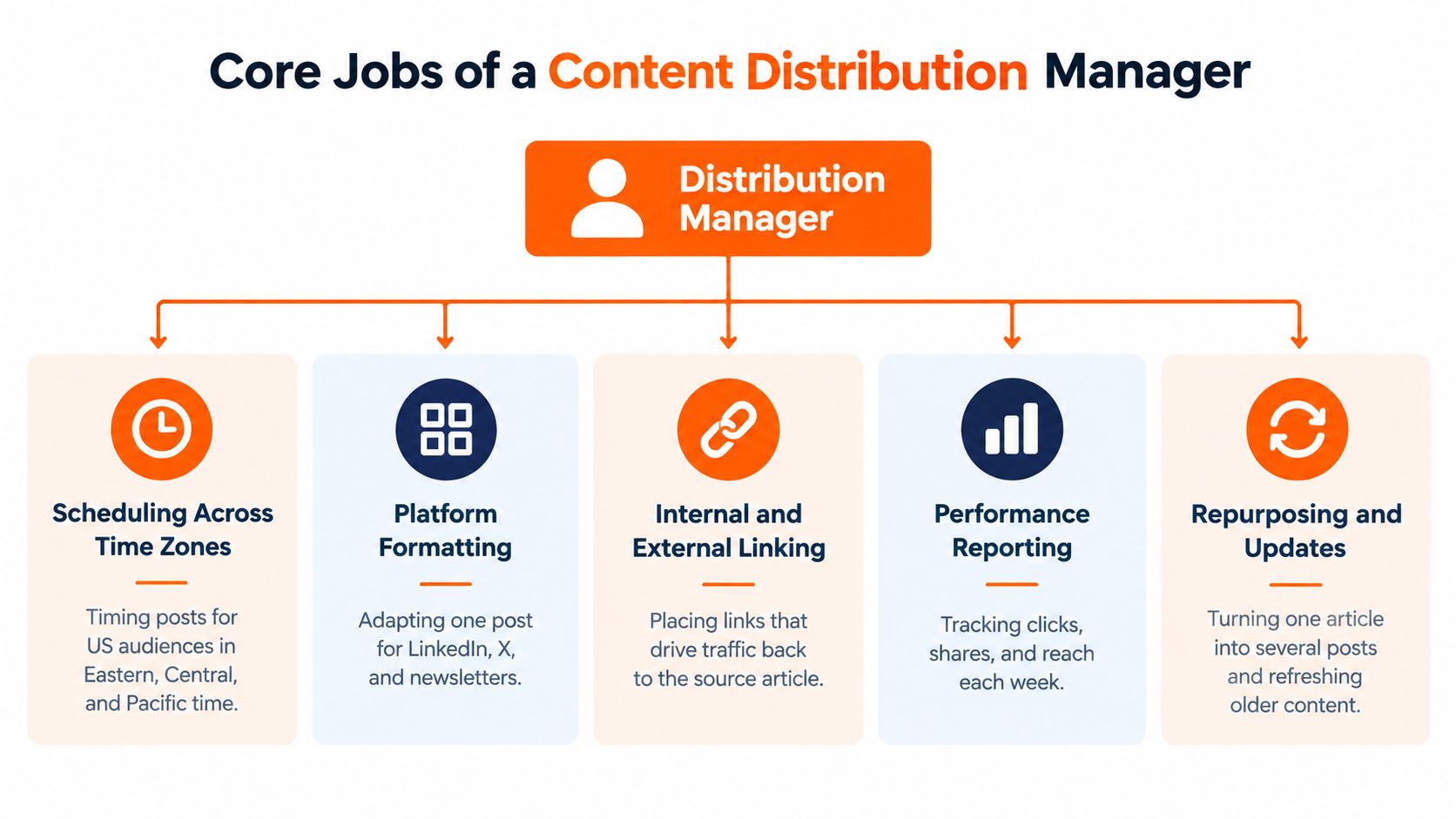
A content distribution manager is the person, process, or software layer that moves an editorial idea from creation to measurable reach. At the simplest level, that means scheduling and publishing content across multiple platforms. In practice, it also means deciding which channels deserve attention, adapting the source without damaging its meaning, and connecting activity to outcomes.
The role has expanded because audiences no longer stay on a single publisher homepage. DataReportal recorded 5.24 billion active social-media user identities worldwide in January 2025, with social platforms reaching 94.2% of internet users. The typical social-media user actively uses or visits 6.5 platforms each month and spends an average of 18 hours and 36 minutes per week on social media, including video platforms such as YouTube, TikTok, Instagram, and Facebook. For a writer, that means one article may need several carefully chosen entry points.
The role is broader than scheduling
A scheduler answers, “When should this post go live?” A content distribution manager also answers:
- Where should the idea appear?
- What should change for that audience?
- Which link or action should the reader take?
- How long should the idea remain in circulation?
- Did the derivative create useful attention or only activity?
That distinction matters for independent writers. You might perform the role yourself, delegate parts of it to an editor, or use software to manage the repetitive work. The job remains the same even when the operator changes.
Third-party discovery now shapes publishing decisions. The Reuters Institute's 2025 Digital News Report analyzed more than 97,000 online news consumers across 48 markets. It found weekly social-video consumption rose from 52% in 2020 to 65% in 2025, while consumption of any online video rose from 67% to 75%. The shift doesn't mean every writer needs a video strategy. It does mean discovery increasingly happens away from the original publication.
A decision layer between writing and publishing
A strong distribution manager keeps a canonical version of the argument, then creates channel-specific variants. LinkedIn may receive the thesis and supporting evidence. X may receive concise conversational units. Substack Notes may receive several focused observations that stand alone while pointing toward the full article.
The role also protects consistency. Every derivative should retain the source's central claim, caveats, and audience promise. The manager coordinates the system so the writer can spend less time rebuilding the same content and more time developing ideas worth distributing.
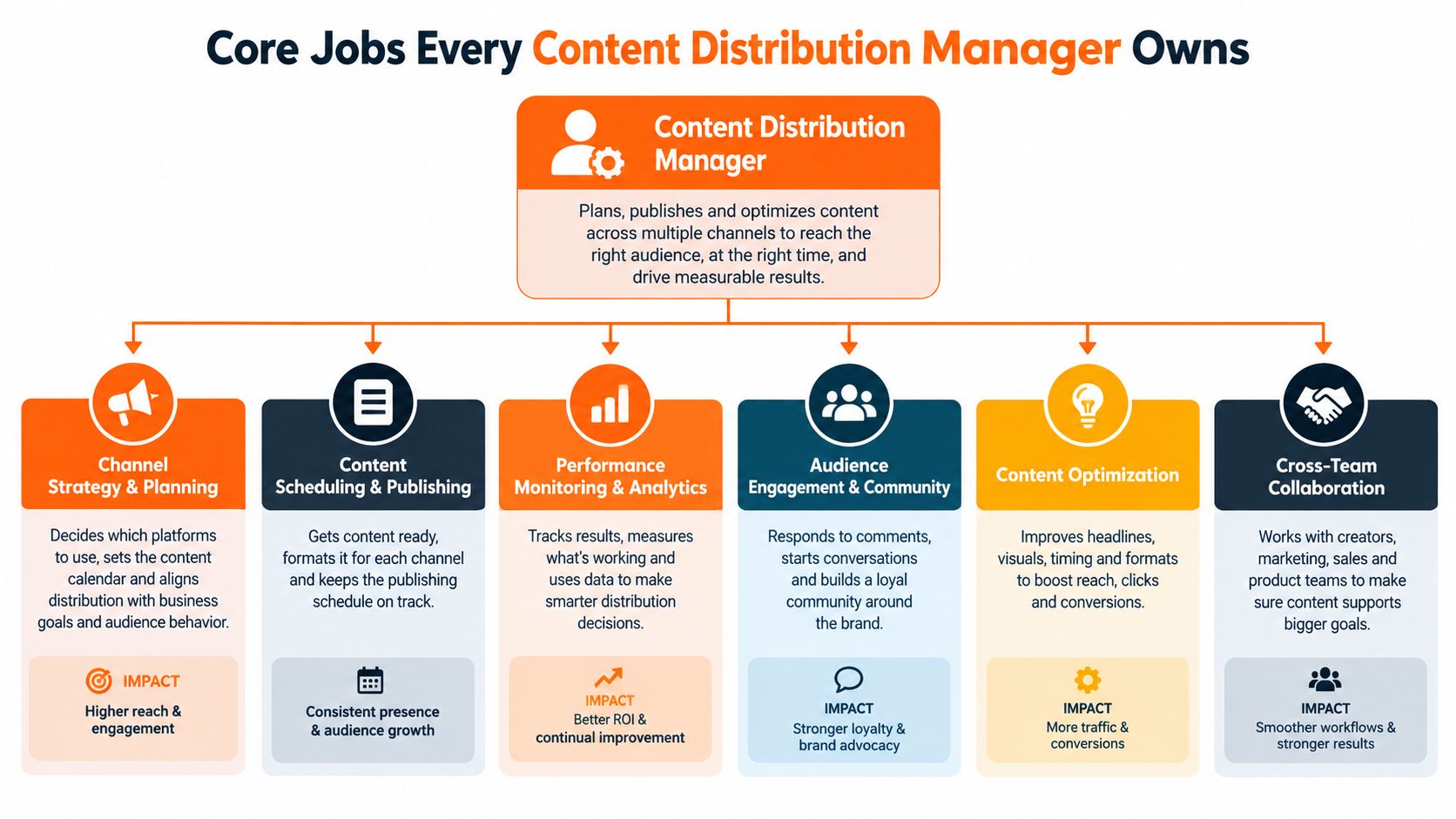
Core Jobs Every Content Distribution Manager Owns
The role becomes easier to understand when you separate the jobs. Scheduling is only the visible layer. The deeper work connects editorial judgment with platform adaptation and subscriber outcomes.
Scheduling creates a distribution sequence
A manager builds a sequence around the source asset rather than publishing every derivative at once. The main article goes live first, followed by related posts that introduce different angles, excerpts, or questions. Later versions can reach people who missed the initial release without repeating the same creative.
Research on online dissemination trajectories found that many articles receive most mentions soon after publication, while another group spreads more slowly, with a meaningful share of mentions arriving five or six days later. Articles distributed across multiple platform types also tend to receive more citations, according to the research on dissemination trajectories. That supports a simple operating model: publish the source, then schedule sequenced derivatives during the early attention window and again several days later.
Repurposing changes the shape, not just the length
A long-form article contains multiple usable units: a thesis, a counterargument, a practical example, and a conclusion. A manager identifies those units and assigns each to a format that can carry it.
Comparative platform research found that engagement drivers differ by channel, with visual content improving interaction overall while platform-specific factors matter more than publishing time, frequency, or content length alone. The study of social-platform engagement drivers supports adaptation over copy-and-paste publishing.
Analytics must connect attention to action
Raw interaction totals don't tell you whether distribution worked. Track engagement rate, click-through rate, subscriber conversion, and downstream retention in a way that lets you compare platforms fairly.
A useful content-variant record includes:
- Source ID: The original article or newsletter.
- Platform and format: LinkedIn post, X thread, Note, or article.
- Hook and call to action: The reason someone should continue.
- Publication timestamp: When the version appeared.
- Conversion outcome: Click, subscriber action, or later retention signal.
The content approval workflow should include this provenance before publication. Without it, you'll know that a subscriber arrived during a busy week, but not which derivative helped them decide.
A content distribution manager also handles cross-posting, link hygiene, approvals, and refreshes. The common thread is accountability. Each version should have a purpose, an owner, and a way to determine whether it earned another iteration.
How a Distribution Manager Fits Into a Writer's Weekly Workflow
A workable system starts with one source asset and a small set of deliberate derivatives. You don't need to create new material for every platform every day. You need to decide what the source already contains, then schedule its strongest ideas in forms readers can consume.
Monday starts with the source
Publish the long-form Substack article first. Mark its central thesis, strongest supporting passage, useful example, and most natural call to action. Those elements become the raw material for the week.
On the same day, create a LinkedIn version built around the argument and a short X sequence built around the tension or practical lesson. Keep the destination clear. A reader should understand why the post exists before seeing the link.
A content creation workflow becomes more reliable when creation and distribution share the same source record. That prevents the common failure where a derivative uses an old headline, an outdated link, or a claim that was removed during final editing.
Tuesday through Friday use Notes deliberately
Substack Notes can be scheduled natively on the web, iOS, and Android. A writer creates the Note, selects a time in the local time zone, and continues editing it from the Notes Drafts tab until publication, as described in Substack's Notes scheduling update.
The format has practical limits. A Note can contain up to 10,000 characters, and links count fully toward that limit, according to Buffer's Substack documentation. It requires text, an attachment, or both. Supported attachments include an image or GIF, a link, or a video, but those attachment types can't be combined in one Note.
Use those constraints when batching:
- Draft a text-first Note: Pull one clear observation from the article.
- Create an image-led version: Use a visual when the idea benefits from a quick scan.
- Prepare a video variation: Keep the video within the documented limit of 5 minutes.
- Check the final link count: Shorten the copy if the URL pushes the Note beyond the character limit.
Substack Notes are public and can be discovered by people who don't already follow you. The Notes FAQ states that a Note may contain plain text, up to 6 images or GIFs, or a video of up to 5 minutes. That makes several focused Notes more useful than one overloaded summary.
Friday closes the loop
Review delivery, clicks, subscriber actions, and the quality of replies. Don't just ask which post received the most attention. Ask which idea attracted readers who continued engaging with your work.
A weekly distribution session should leave you with a source article, scheduled Notes, platform-native social versions, and a short record of what happened. That's enough structure to reduce daily context switching without turning your publishing practice into a rigid content factory.
Choosing Platforms With Intention Instead of Posting Everywhere
Monday starts with good intentions. You publish one strong article, open five tabs, and tell yourself you'll turn it into posts for every channel by lunch. By the end of the day, you have fragments everywhere, little sense of what deserved the effort, and no clear view of which platform brought the right readers back.
That is the trap. Posting everywhere looks disciplined, but it usually spreads attention across channels with very different payoffs. A content distribution manager earns their keep by making decisions, not by filling a queue. The hard part is choosing where a piece has the best chance to create subscriber growth, qualified replies, or repeat readership, then leaving the rest alone.
The useful split is raw reach versus useful reach. Raw reach gives you visibility. Useful reach gives you qualified engagement, referral traffic, subscriber acquisition, and signs that readers stay with the work after the first click. Those signals matter more than broad exposure because platform activity only counts if it compounds into audience relationship.
That decision has become harder. Analysts cited in the Reuters executive summary found that six networks reached at least 10% of people weekly, compared with only two a decade earlier. The same summary describes a fragmented media environment where attention is split across social, streaming, gaming, music, and podcasts. You do not solve that by publishing everywhere. You solve it by assigning each platform a job and judging it by that job.
| Platform | Best For | Watch For |
|---|---|---|
| Substack Notes | Discovery among newsletter readers and short observations | Surface engagement that doesn't become a subscriber |
| Professional arguments, lessons, and evidence | Polished reactions that produce discussion without clicks | |
| X | Fast testing of hooks, tension, and concise ideas | Threads that spread without a clear route to the source |
| Medium | Searchable long-form adaptations and new reading contexts | Rebuilding the entire article without a distinct reason to read |
| Direct access to known subscribers | Assuming delivery equals continued attention |
A simple test helps. Give every platform one clear responsibility before you draft anything. If LinkedIn is for attracting professional readers who may subscribe, measure relevant clicks and the quality of those subscribers. If Notes is your discovery layer, watch which ideas pull people toward the publication. If X is where you test framing, compare hooks against downstream actions, not reposts on their own.
Track four signals by platform:
- Time to first engagement: How quickly the version receives a meaningful response.
- Engagement half-life: How long the post continues to attract attention.
- Referral traffic: Whether readers move from the platform to the source.
- Conversion lag: Whether subscriptions happen immediately or after repeated exposure.
Narrareach can help here as an attribution layer. It links derivative posts to a source idea, schedules Notes and social versions, and shows delivery, traffic, and subscriber performance across destinations. The software does not make the choice for you. It gives you a repeatable way to judge whether a platform deserves another week of effort.
If you want a wider channel reference, see our guide to platforms for content marketing, then compare it with BarkerBooks' authors social media playbook. Both are most useful when you use them to narrow the list, not expand it. The goal is a small set of platforms with a clear purpose, a measurable path back to the source, and a reason to keep showing up there.
Keeping Your Voice When AI Handles the Repurposing
You publish a strong article, run it through AI for LinkedIn, X, and Notes, and get back clean copy that no longer sounds like you. The wording is sharper than the source, the caveat is gone, and the takeaway has drifted. That is the genuine risk with repurposing. The problem is not speed. It is losing the judgment behind the original piece.
A content distribution manager should treat AI as a drafting layer, then make an editorial decision about what survives. Every derivative needs a visible line back to the source passage that supports it, not just a loose connection to the article title. If you cannot point to the paragraph behind a claim, that line is not ready to publish under your name.
I use a simple review before touching style:
- Claim: Does the short version keep the original assertion intact?
- Caveat: Did compression remove a qualification that kept the claim honest?
- Voice: Does the certainty level still sound like the writer?
- Action: Does the CTA fit what the source offers?
That check matters because once a bad adaptation is posted, it spreads faster than the article it came from. The manager's job here is not scheduling. It is deciding whether the version still deserves distribution.
For a practical workflow, see this guide to AI content repurposing. The useful part is the review discipline: attach source passages, flag uncertain claims, and hold publication until a human signs off.
Analysts at HubSpot found in their HubSpot newsletter survey that writers are distributing well beyond email, while many still track too little to judge whether those adaptations are preserving strategic value. More channels create more chances for a fluent draft to outrun the original argument.
Format choice matters too. LearnStream's guide to micro content formats that work is helpful for choosing shapes for short-form distribution. A good format still fails if it strips out the idea that made the long version worth reading.
A reliable AI workflow drafts variants, keeps source and derivative connected, surfaces uncertainty, and waits for editorial approval. It should save copy-paste time while keeping your argument, your restraint, and your voice intact.
Your Next Step and How to Stay Connected
A content distribution manager is ultimately a decision-making role. The work begins with an editorial asset, but it doesn't end when the article goes live. You decide which audience deserves the next version, how the message should change, when the follow-up should appear, and whether the resulting attention moved people toward a relationship you own.
You can start manually next week. Choose one Substack article, extract its thesis and strongest evidence, create a LinkedIn adaptation, draft an X thread, and schedule focused Notes across the week. Record the source link, platform, format, hook, publication time, clicks, subscriber actions, and any later retention signal. That small record will teach you more than a general posting calendar.
You can also use a distribution manager when the repeated work starts taking attention away from writing. The useful features are specific:
- A source library that keeps articles and derivatives connected.
- Platform-aware drafting that changes structure rather than copying text.
- Scheduling for Substack Notes, articles, and social posts.
- Approval and provenance checks before AI-assisted content goes live.
- Cross-platform reporting that emphasizes subscribers and qualified actions.
Choose the path that fits your current workload. If you're still testing channels, the manual workflow is enough to establish a baseline. If you're already publishing regularly and losing hours to formatting, queues, and attribution, centralizing the work can help you grow faster without asking you to write more from scratch.
Subscribe to the Narrareach newsletter if you want ongoing experiments, distribution playbooks, and practical Substack Notes strategies. You'll keep learning without committing to a new workflow before you're ready.
Narrareach gives writers one place to schedule Substack Notes, Medium articles, LinkedIn posts, and X content, repurpose long-form work into platform-specific drafts, and review which distribution activity drives subscribers. If you're ready to replace copy-paste burnout with a clearer publishing system, visit Narrareach and start free without a credit card.