
LinkedIn Post Creator: How I Grew My Audience by 5,000%
You open LinkedIn, post something thoughtful, and wait. A day later, it has a handful of likes, most from people who already know you, and barely any real...
By Ian Kiprono
You open LinkedIn, post something thoughtful, and wait. A day later, it has a handful of likes, most from people who already know you, and barely any real conversation. Then the second problem hits. You know that same idea could become a Substack Note, a longer article, maybe even a carousel, but turning one idea into five assets feels like a second job. So the draft sits there, your best thinking gets one chance, and your audience growth stalls even though you're still doing the work.
The Frustration of Shouting Into the Void
For a long time, that was my normal. I'd write what felt like a strong LinkedIn post, polish the opening lines, add line breaks, hit publish, and then watch it land softly and disappear. Not because the idea was weak, but because I was treating distribution like an afterthought.
The worst part wasn't low engagement. It was the amount of effort behind low engagement. Writing took time. Editing took time. Publishing took time. Then I'd realize the post could have become a Substack Note, a longer newsletter section, maybe a follow-up angle for X, and I still wouldn't repurpose it because I was already tired.
What the hamster wheel actually looked like
My workflow was messy:
- I wrote from scratch too often. Every LinkedIn post felt like a new assignment.
- I guessed at format. Some posts were short. Some were long. Some had a story. Some were just observations.
- I rarely reused winners. If a newsletter idea worked, I still didn't automatically turn it into LinkedIn-native assets.
- I confused publishing with distribution. Posting once felt productive, even when it wasn't enough.
That last point mattered most. Once I started reading more about audience building and live traction community strategies, I realized I'd been acting like good content should naturally travel on its own. It doesn't. Creators have to give it multiple chances in multiple formats.
Practical rule: If one good idea only appears once, you're under-distributing, not under-creating.
There was also a mindset problem. I kept judging posts emotionally. If a post felt smart, I assumed it should do well. If it didn't, I'd change topic instead of changing process. That's a fast way to burn through ideas without learning anything.
A better frame came from understanding what reach on social media actually means. Reach isn't a reward for effort. It's distribution plus packaging plus consistency. Once I accepted that, I stopped asking, “Why didn't this post work?” and started asking, “What variable did I leave untested?”
That shift is what led to the experiment.
I treated my LinkedIn presence like a small lab for 30 days. Same body of ideas. Different lengths, hooks, formats, and publishing workflows. The big breakthrough wasn't some magical sentence template. It was finally seeing that my long-form Substack writing already contained almost everything I needed. I just wasn't turning it into enough LinkedIn-ready assets.
What My 30-Day Experiment Actually Tested
I didn't need more inspiration. I needed fewer guesses.
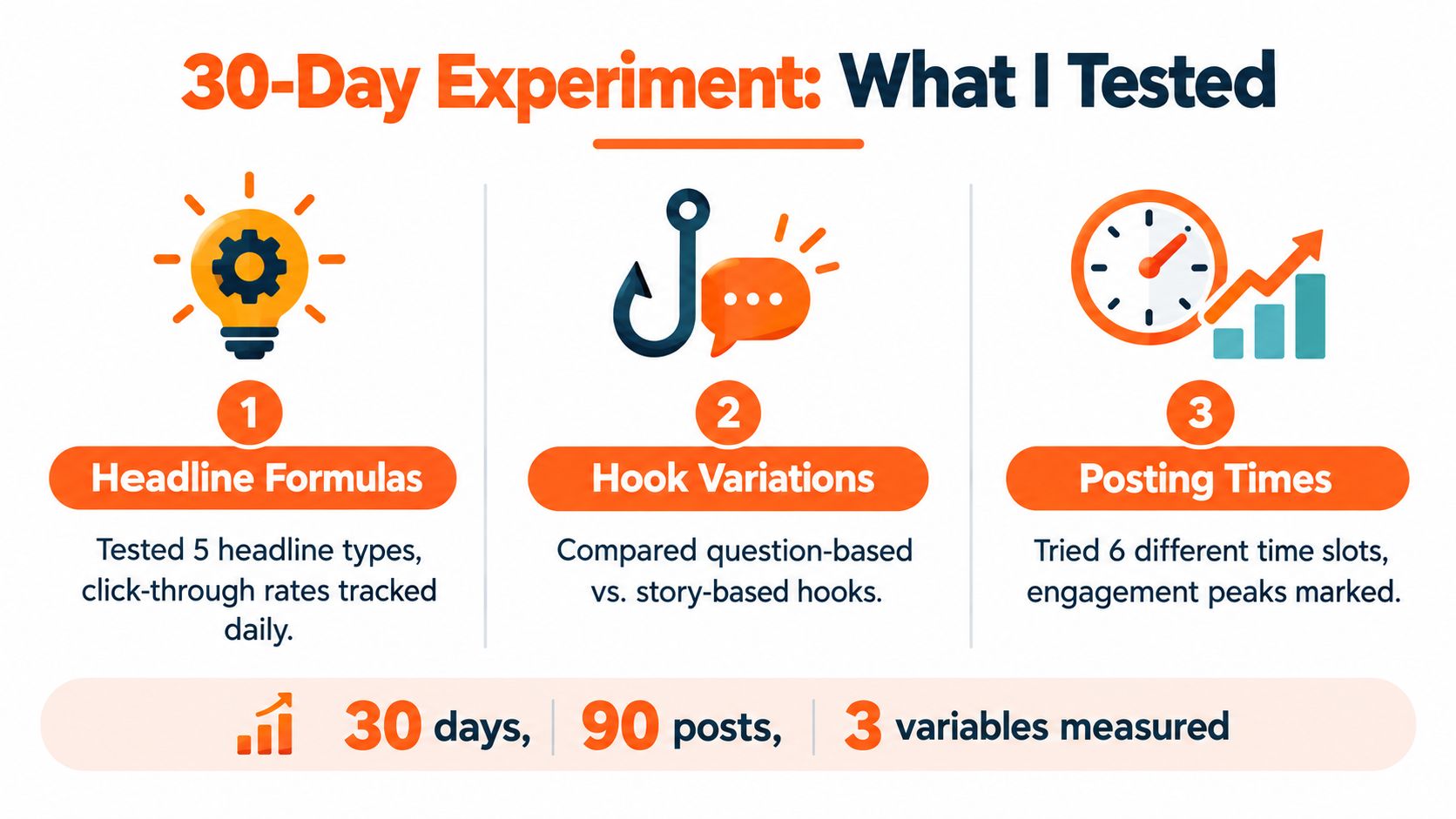
For 30 days, I tested three things hard: headline formulas, opening hooks, and format choice. I also tracked post length and publishing times, but the biggest lesson came from how those variables worked together rather than in isolation.
The backdrop for this test mattered. LinkedIn isn't a sleepy networking site anymore. Independent benchmark reporting in 2026 put the platform-wide average engagement rate at about 5.20%, with an 8% year-over-year increase, and found that document-style posts reached roughly 7.00% engagement, the top-performing format according to Socialinsider's LinkedIn benchmark coverage. That immediately changed how I thought about a LinkedIn post creator. It can't just spit out text. It has to support documents, text, image variants, and short-form repackaging.
The variables that actually mattered
Here's what I tracked most closely:
- Hook style: Question-led openings versus story-led openings
- Post length: Short observations versus developed arguments
- Format: Plain text versus document-style post
- Source material: Fresh idea versus repurposed newsletter insight
- Timing: Different slots, but only after the post itself was worth distributing
One reason I became more disciplined is that median performance on LinkedIn is humbling. A 2026 dataset described the typical LinkedIn post as about 1,011 characters long, with a median of 28 likes, 788 impressions, and a 0.39% median engagement rate against followers, according to Voxbooster's 2026 LinkedIn statistics roundup. That's the reality. Most posts don't magically break through. They need repeatable structure.
What I stopped doing
I cut three habits fast:
| Habit | Why I dropped it | What replaced it |
|---|---|---|
| Writing one-off posts | No compounding value | Repurposing from long-form drafts |
| Judging success by likes alone | Too noisy | Looking at format-level patterns |
| Defaulting to text | Left reach on the table | Matching format to idea depth |
I also stopped comparing my profile to everything I saw in the feed. Audience size changes the benchmark. One 2026 dataset reported median engagement rates of 2.56% for profiles with 0 to 1,000 followers, 2.68% for 1,001 to 5,000, 2.53% for 5,001 to 20,000, 2.38% for 20,001 to 50,000, 1.78% for 50,001 to 100,000, and 1.53% for 100,001+, with 2.50% across all profiles, as summarized by AuthoredUp's guide to LinkedIn metrics. That saved me from overreacting to individual posts.
Most creators don't need more ideas. They need cleaner benchmarks and a workflow that lets one idea appear in more than one native format.
That's where a content system started to matter more than a writing habit. I used a content distribution platform mindset instead of a posting mindset. Once I did that, LinkedIn stopped feeling like a place where I had to constantly invent. It became a place where I could package and distribute ideas more intelligently.
Repurposing Long-Form Content for Maximum Reach
The biggest jump in quality came when I stopped asking LinkedIn to carry the whole burden of originality.
My best raw material was already sitting in long-form drafts, especially Substack posts. Those pieces had stronger arguments, better examples, and sharper opinions than anything I could force out in twenty rushed minutes for a social post. The problem was translation, not idea quality.
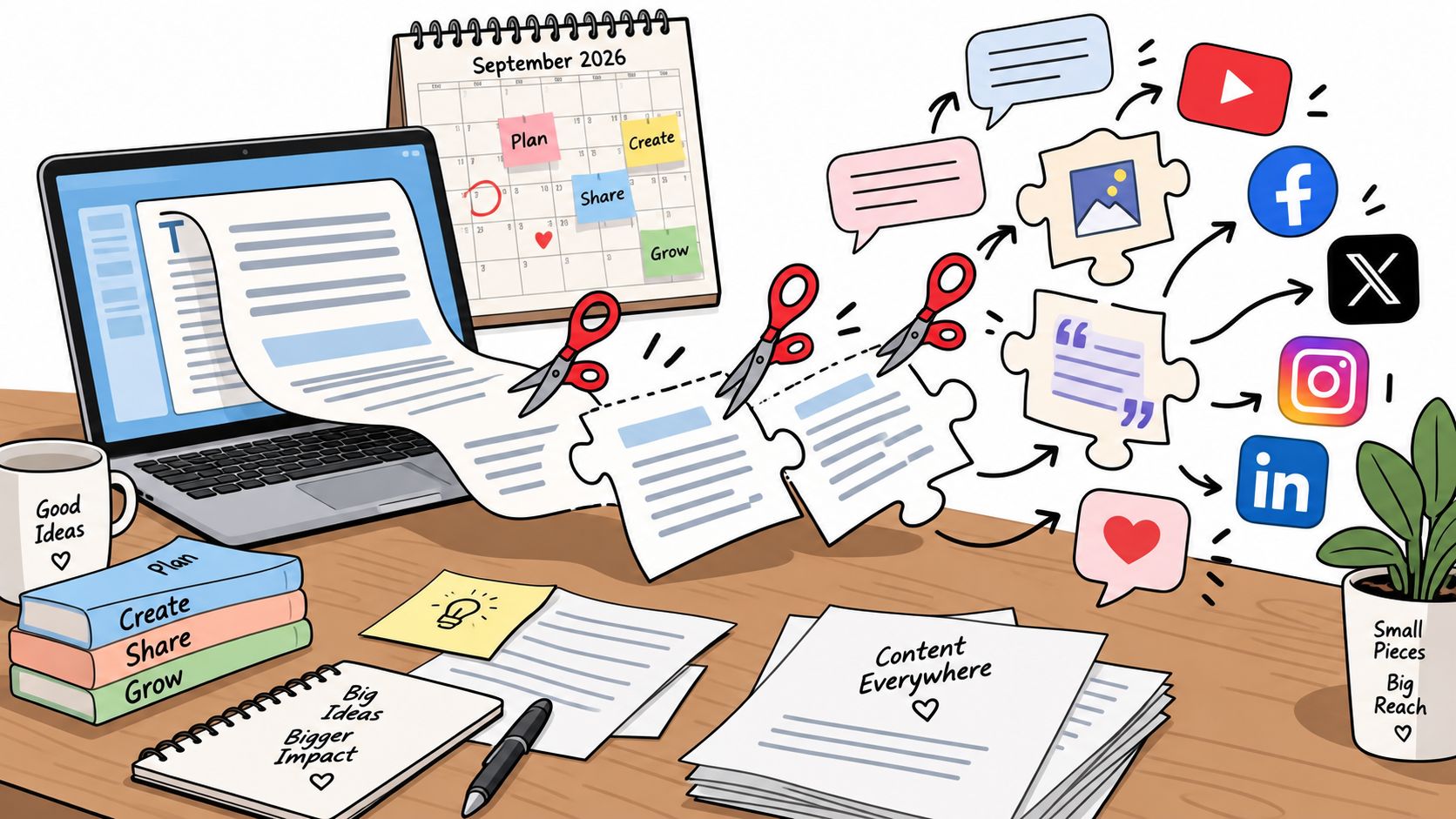
The repurposing workflow that finally stuck
I started with one published or nearly finished Substack piece and pulled out three layers:
The core claim
What's the single point worth debating, teaching, or saving?The supporting proof
Which story, detail, or result makes the claim believable?The platform-specific expression
Should this be a longer LinkedIn text post, a document carousel, or a quick Note?
That changed everything because I wasn't trying to summarize an article. I was extracting usable assets from it.
For creators who are still doing this manually, I like practical guides on how to repurpose your LinkedIn content because they reinforce the same principle. Don't copy-paste. Adapt the same idea to the native behavior of each platform.
A simple conversion map
This became my default map for every strong long-form draft:
- Substack article to LinkedIn post for the strongest single argument
- Substack article to LinkedIn carousel for frameworks, steps, or layered ideas
- Substack article to Substack Note for one sharp takeaway
- Substack article to X thread for fast distribution and reply-driven conversation
The key was voice preservation. A lot of repurposing workflows flatten the original writing. That's why I started leaning on systems built around adaptation rather than generic generation, including content repurposing workflows for writers that focus on turning one idea into several outputs without losing tone.
A short walkthrough helps here:
Why Substack matters more than most LinkedIn creators admit
Substack became the anchor because it gave me somewhere to think in full sentences first. Then LinkedIn became the distribution layer for those thoughts.
That workflow got even more practical once scheduling became easier. Guidance published in 2026 says creators can schedule both Substack posts and Notes directly in the composer, and that the scheduled item is saved as a draft that can still be edited before publishing, according to this Substack scheduling walkthrough. That matters because it means your long-form and short-form outputs don't need separate manual publishing routines.
Field note: Long-form writing creates depth. Repurposing creates surface area. You need both if you want your ideas to keep working after publication.
Once I accepted that, I stopped treating LinkedIn like a blank page. I treated it like a distribution endpoint for ideas I'd already earned.
Mastering Structure and Formatting for Engagement
Repurposing helped me produce more assets. Formatting determined whether people read them.
The first uncomfortable lesson was that my short posts weren't “punchy.” They were underdeveloped. LinkedIn posts can be up to 3,000 characters, and several 2026 benchmark analyses found engagement is highest in roughly the 1,300 to 2,500 character range, while posts under 400 characters consistently underperform, according to ConnectSafely's LinkedIn length benchmark summary.
That lined up with a larger post analysis. A 2026 review of 372,126 LinkedIn posts found median engagement rates of 2.10% for posts under 400 characters versus 2.61% to 2.67% for posts in the 1,301 to 2,500 character range, or about 27% higher engagement for the mid-length band, according to Neal Schaffer's LinkedIn post analysis.
What worked better than “be concise”
“Be concise” is vague. This was more useful:
- Open with tension. Lead with a mistake, a mismatch, or a surprising observation.
- Use whitespace on purpose. Dense blocks lost me readers before they lost the algorithm.
- Develop the point. Mid-length posts gave enough room for context, proof, and a clean ending.
- Cut filler, not substance. Trimming examples to sound efficient usually made the post weaker.
Format choice beat clever wording
I also had to stop treating text as the default. Independent benchmarks have shown that document and carousel posts consistently outperform text-only posts, with carousels reaching roughly 2.5 to 4 times the reach of text posts and documents hitting about 7.0% engagement in 2025, according to Carouselli's LinkedIn content strategy benchmark.
That changed how I matched content to format:
| Idea type | Best format | Why |
|---|---|---|
| Strong opinion | Text post | Better for direct response and comments |
| Framework or process | Document carousel | Better for saves and clearer sequencing |
| Visual proof or demo | Native video or image | Better when the proof is visual |
| Expanded lesson from newsletter | Mid-length text post | Better when nuance matters |
A lot of this overlaps with strong thought leadership practice. I found the framing in this thought leadership strategy by AI Optimization Services useful because it pushes beyond “post more” and toward “make your expertise legible.”
Good formatting doesn't rescue a weak idea. It stops a strong idea from getting buried.
There was also a practical writing threshold I couldn't ignore. Independent 2026 benchmark coverage found that 400-plus-word posts earned 47 median likes, compared with 19 for posts under 25 words, a 147% difference, according to MagicPost's LinkedIn algorithm roundup. I didn't read that as “make everything long.” I read it as proof that substance usually beats drive-by posting.
If you're struggling with readability, a good checklist for how to format a LinkedIn post helps because formatting on this platform is part writing, part packaging. The same idea can look either skippable or compelling depending on line breaks, sequencing, and whether the first two lines earn the click.
Scheduling and Cross-Platform Workflows
My experiment would have fallen apart if I had to manually publish every version of every idea.
The hidden cost in content isn't always writing. It's context switching. Open LinkedIn. Reformat. Publish. Open Substack. Rewrite into a Note. Save. Come back later. Forget what you meant to post next. That's how consistency dies, even when the ideas are good.
The workflow that reduced friction
What I needed was one pipeline:
- Draft long-form once
- Extract 2 to 4 social angles
- Assign each angle a native format
- Schedule each asset without leaving the workflow
- Review performance, then reuse what earned attention
That's where a unified scheduler started doing real work for me. Tools differ in depth, but the important capability is having one place to schedule LinkedIn posts, Substack Notes, and other distribution assets so you're not rebuilding the same publishing motion every day.
What an efficient weekly system looks like
I found the weekly rhythm mattered more than the daily one.
Monday: Draft or finish the long-form piece.
Tuesday: Pull out the main claim and one supporting angle for LinkedIn.
Wednesday: Turn the process/framework section into a document post.
Thursday: Schedule a Substack Note tied to the same theme.
Friday: Review which asset sparked comments, saves, or subscriber movement.
That cadence made my content feel connected instead of random. It also created a better feedback loop. If a LinkedIn post got traction, I knew which angle to expand in the next Note. If a Note got replies, I knew which argument deserved a fuller LinkedIn post later.
Where a LinkedIn post creator should fit
A useful LinkedIn post creator isn't just a drafting box. It should help with:
- Adaptation: Taking a long-form idea and reshaping it for LinkedIn's feed
- Scheduling: Letting you queue the LinkedIn version and the Substack version efficiently
- Distribution: Making sure the same idea gets more than one shot
- Review: Showing what format and packaging worked
In my workflow, Narrareach fit here as one option because it handles scheduling, repurposing, and cross-platform distribution for writers who want to publish across LinkedIn, Substack, Medium, and X from one system. That matters less as a “tool recommendation” and more as an operating model. Keep the content close to the writing process, not scattered across five tabs.
Working rule: If publishing your content requires too many separate decisions, you'll post less often and learn less from every idea.
The payoff wasn't just speed. It was consistency without draining the part of me that likes writing.
Turning Data Into a Growth Engine with Narrareach
The final change was trusting evidence more than instinct.
Once I could see which repurposed posts pulled people back to my longer writing, my content decisions got simpler. I wasn't asking what to write from scratch. I was asking which idea had already shown signs of life, and which format gave it the best chance on the next platform. That's the whole promise behind what Narrareach is built to do. Spot what's working, then turn it into distribution.
That's also where audience growth gets easier. Not automatic, but easier. You stop burning energy on isolated posts and start building a repeatable system for turning one strong idea into LinkedIn posts, Substack Notes, and other platform-native assets. You grow faster when each piece of writing gets multiple chances to earn attention.
If you're using Substack, this matters even more. Scheduling posts and Notes efficiently is useful on its own. Pair that with a workflow that also publishes your LinkedIn version, and your writing stops living on one platform at a time. It starts traveling.
The creators who break out of the content hamster wheel usually aren't the ones writing the most. They're the ones distributing their strongest ideas with the least friction.
If you want a simpler way to turn long-form writing into LinkedIn posts, Substack Notes, and scheduled cross-platform distribution, Narrareach gives you that workflow in one place. If you're ready to test a more systematic content engine, try it; if not, stay close to the process and start by repurposing one strong article into three native assets this week.