
Smart Scheduling System: What It Is and Why Writers Need One
You've finished the newsletter, but you haven't finished the work. Substack is open beside LinkedIn, X, and Medium, each waiting for a different version of...
By Ian Kiprono
You've finished the newsletter, but you haven't finished the work. Substack is open beside LinkedIn, X, and Medium, each waiting for a different version of the same idea. You're tired, so you publish when the draft is ready rather than when readers are likely to notice it. Tomorrow, you'll check the reactions, wonder why a casual Note attracted more attention than the essay, and start the whole process again. The frustrating part isn't just the extra clicking. It's not knowing whether weak distribution means weak writing, poor timing, or an audience that never saw your work.
The 2 A.M. Publishing Trap Most Writers Fall Into
It's Sunday night. You've tightened the opening, checked the links, and rewritten the ending until it finally sounds like you. Publishing feels like the finish line, so you hit the button.
Then distribution becomes whatever you can manage before bed. You paste an excerpt into LinkedIn, leave an X draft unfinished, and promise yourself you'll write a Substack Note tomorrow.
The next time you check analytics, the essay looks quiet. A quickly written Note gets more visible reactions, and you're tempted to conclude that readers don't want your longer work. But you've changed the format, the subject framing, the publication time, and the audience context simultaneously.
The problem is an uncontrolled workflow
That comparison doesn't tell you which variable mattered. It tells you that you need a cleaner way to separate content performance from distribution performance.
Creator burnout makes this more than an organizational annoyance. Reporting on Adobe's 2023 creator study puts burnout at 48% and identifies multi-platform production, overlapping editing and production duties, and inconsistent scheduling as operational pressures associated with creators pausing or leaving.
You don't need a marketing department to address those pressures. You need to stop treating every publication as a fresh administrative emergency.
- Separate finishing from publishing. A completed draft should enter a queue, not automatically go live.
- Prepare distribution while the idea is fresh. Extract the claim, example, and reader question before moving to another subject.
- Keep unfinished work out of the calendar. A scheduled item should already have its destination, formatting, and final copy.
Content batching gives you the preparation layer. A smart scheduling system adds the decision layer: when to release that prepared content, where to send it, and what to learn afterward.
Practical rule: Don't use your writing completion time as a substitute for your audience's reading time.
The useful change isn't publishing more aggressively. It's making publication deliberate enough that you can learn from the result, rather than interpreting another late-night guess.
What a Smart Scheduling System Actually Is
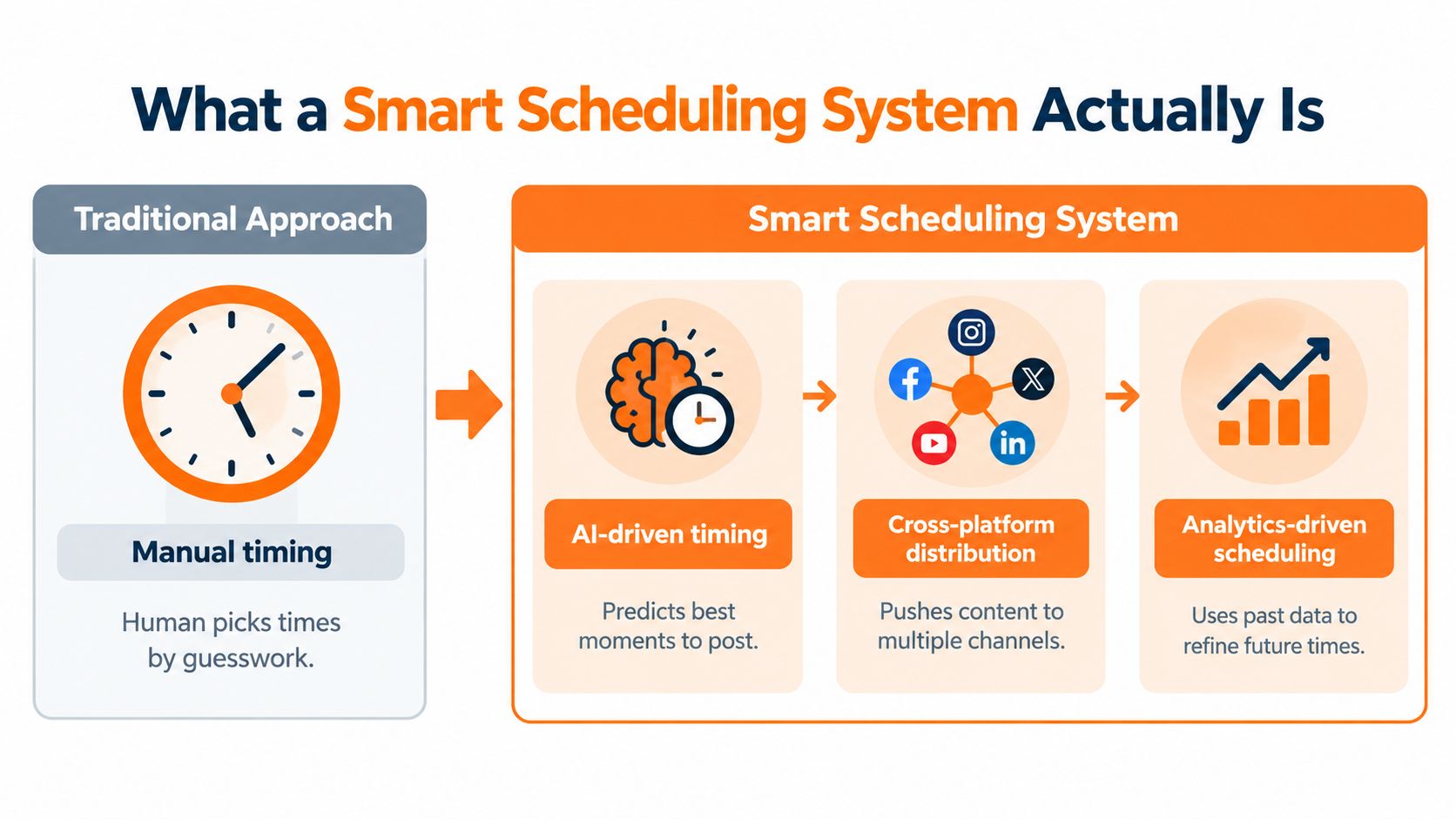
A smart scheduling system coordinates publication decisions using audience signals, destination requirements, and past results. A standard scheduler executes a timestamp. A smart system helps you decide whether that timestamp is appropriate, then uses the outcome to improve future recommendations.
The distinction is easier to see as a connected workflow rather than a feature list.
Timing, distribution, and feedback
AI-driven timing estimates suitable publication windows from relevant history. For a Substack writer, that might mean comparing when similar Notes received meaningful responses, while acknowledging uncertainty when there isn't much data.
Cross-platform distribution coordinates destination-specific versions. An essay's central argument might become a concise Note, a professional application for LinkedIn, and an X thread. The point isn't to paste identical text everywhere, but to preserve the idea while adapting its presentation.
Analytics-driven scheduling connects the outcome to the next decision. If a window attracts reactions but few subscriber actions, the system shouldn't automatically rank it above a quieter window that attracts interested readers.
Standard Scheduler vs Smart Scheduling System
| Capability | Standard Scheduler | Smart Scheduling System |
|---|---|---|
| Publication timing | Executes a selected time | Recommends and revises times using evidence |
| Content preparation | Stores prepared posts | Coordinates destination-specific variations |
| Performance review | Presents results separately | Feeds results into future decisions |
| User control | Lets users edit calendar entries | Should also explain and permit overrides |
These are functional distinctions, not guarantees attached to product labels. Some conventional schedulers include analytics, and an AI label alone doesn't establish meaningful learning.
Scheduling has always been an optimization problem
Simio's scheduling history traces the progression from early twentieth-century visual planning through DuPont's 1956 UNIVAC-generated project schedule, the development of CPM and PERT in the 1960s, and broader constraint-aware planning by the late 1980s.
For writers, the relevant inheritance is dependency management: content must be approved before publication, formatted for its destination, and released within a useful window. Adding a calendar doesn't resolve those dependencies by itself.
When evaluating products, resources such as StreamGen's AI posting tool provide a concrete starting point for comparison. Check whether any candidate merely generates and queues copy or also connects timing decisions to outcomes you can inspect.
Automation executes a plan. Intelligence helps revise it. A useful system needs both, without pretending that prediction removes the need for editorial judgment.
The Core Components That Make a Scheduling System Smart
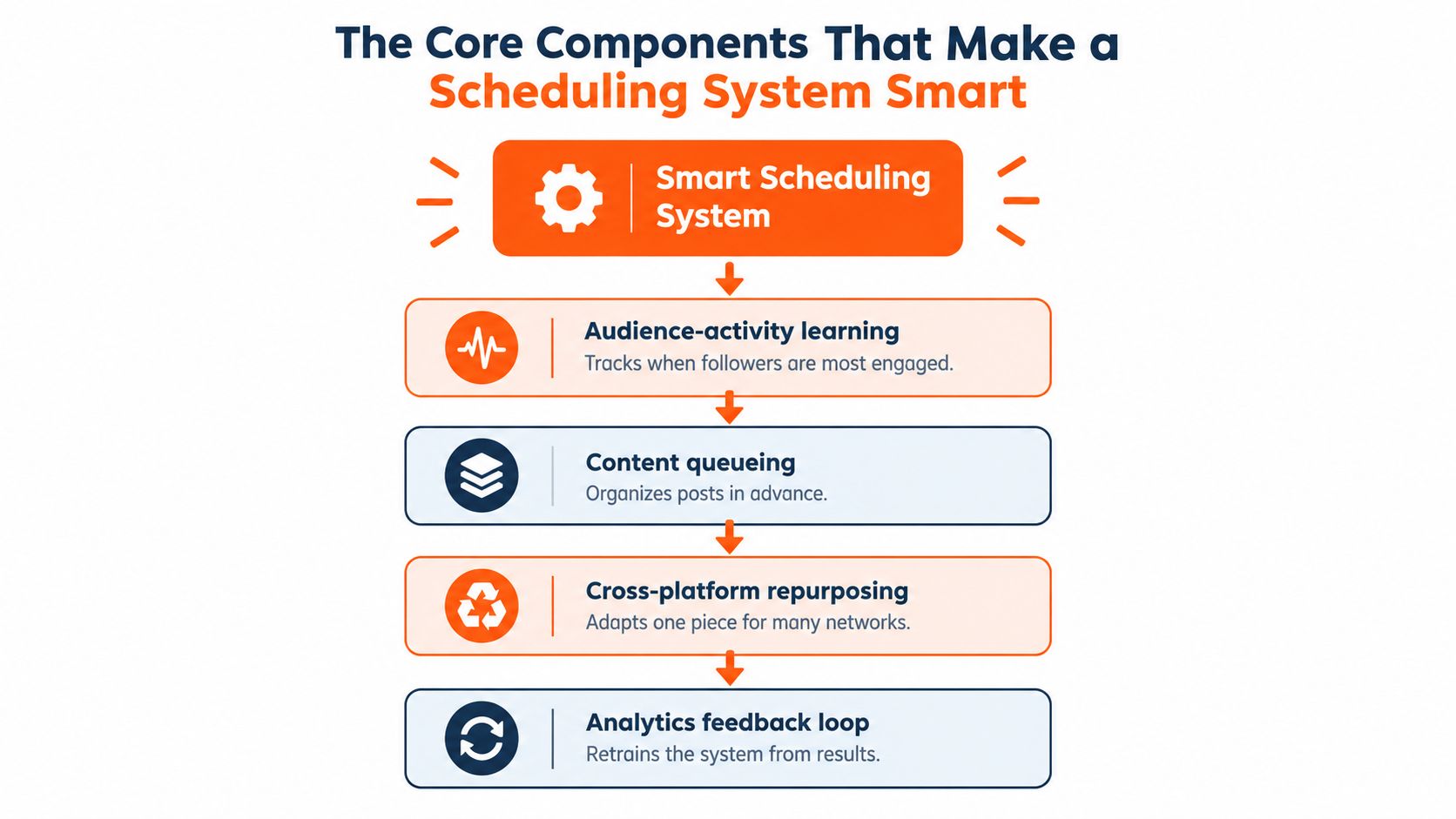
The engine needs distinct responsibilities. Mixing audience prediction, draft preparation, publication execution, and reporting into an opaque recommendation makes failures difficult to diagnose.
This workflow separates the moving parts you should inspect.
Learning and preparing the queue
Audience-activity learning should maintain separate histories for Substack, LinkedIn, X, and Medium. Store the original timestamp and an audience-local interpretation so a time-zone conversion doesn't alter the experiment.
A 2024 study of university Facebook pages found stronger engagement during midweek and weekend periods and identified 12:00 p.m. to 5:59 p.m. as a useful afternoon window, while acknowledging contradictory findings across datasets and platforms. That's evidence for local testing, not a universal timetable for newsletter writers.
A contextual bandit or Bayesian model can implement that principle by exploring nearby slots while favoring the strongest current candidate. With limited history, the recommendation should remain provisional.
The preparation layer needs equally explicit inputs:
- Content queueing. Record approval status, destination, publication window, and dependencies. Don't let an unfinished derivative block an already approved essay unnecessarily.
- Cross-platform repurposing. Preserve the original claim and its qualifications. A shorter version mustn't turn a cautious argument into an unsupported promise.
- Analytics feedback. Associate results with the actual published version, not merely the source draft. A content analytics dashboard should make those relationships inspectable.
Capacity is part of intelligence
A good recommendation is useless if the publishing worker can't execute it. Uploads, authentication, retries, and analytics collection all compete for processing capacity.
The rate-monotonic scheduling analysis describes a sufficient utilization bound approaching 69.3% as task counts grow. For a publishing engine, reserving roughly 30% of worker capacity is a conservative engineering adaptation, not a guarantee that real-time theory precisely models every API workload.
Prioritize approaching publication deadlines over nonurgent reporting. Use durable queues, idempotency keys, exponential backoff, and deadline alerts so a failed request doesn't become a duplicate post or a missed publication.
For a visual companion to these mechanics, use the following video alongside the workflow.
Audience optimization and execution reliability are separate tests. Evaluate both before trusting a calendar that looks beautifully organized.
How Smart Scheduling Improves Content ROI
For a writer, content ROI means more than reactions per post. It means whether the research, drafting, editing, and distribution effort attracts readers who want more of your work.
Timing matters because an otherwise useful piece can enter a weak publication window. Repurposing matters because the original research can support additional reader entry points without requiring an entirely new argument each time.
The Substack evidence supports testing, not promises
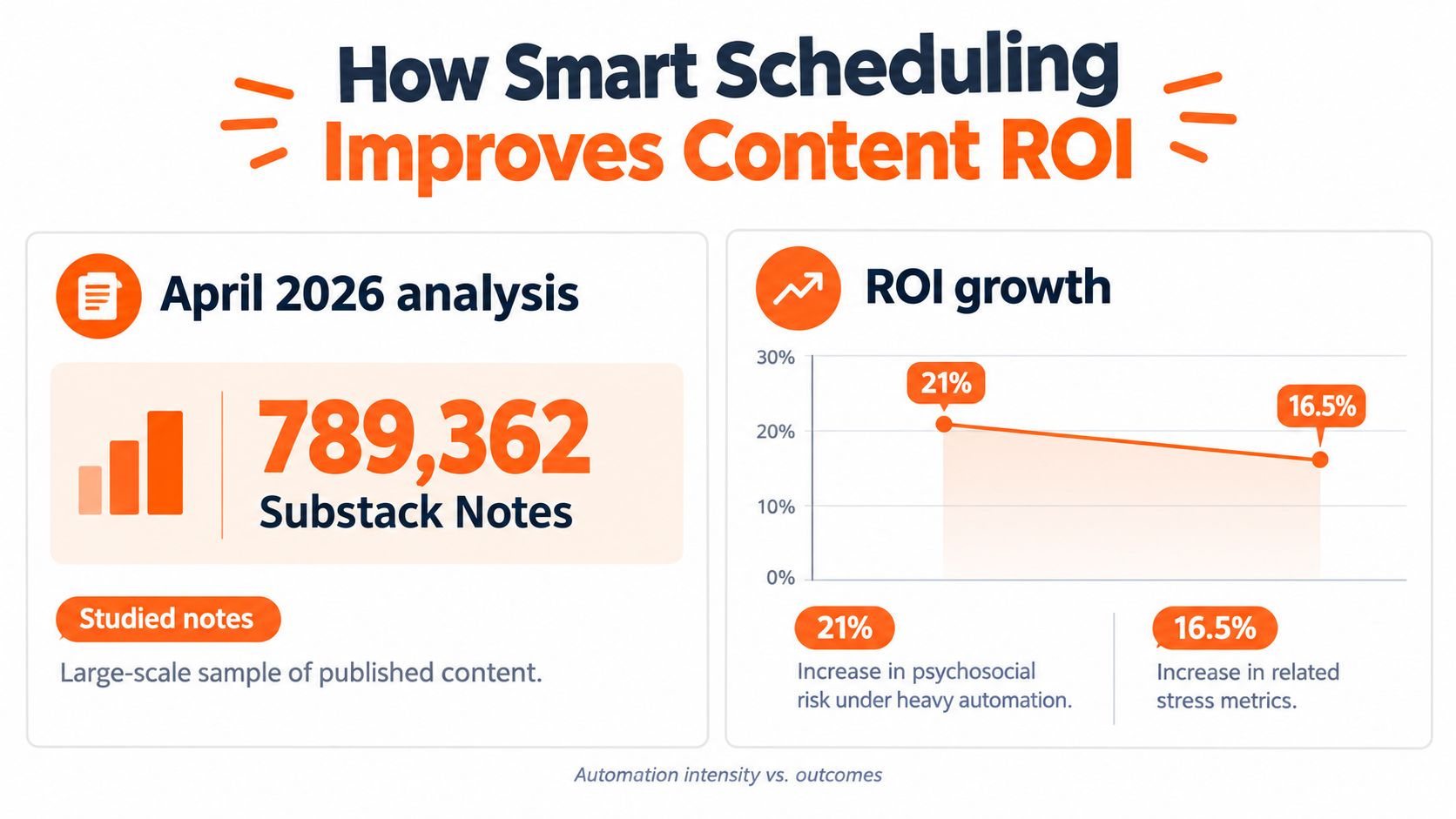
An analysis of 789,362 original Substack Notes published in April 2026 reported that the best-performing hour exceeded the worst by 82%, while the 19:00 to 23:00 UTC window averaged 23.2 reactions per Note, 16% above the platform average.
That spread makes timing worth investigating. It doesn't establish that moving your own Notes into that window will produce the same improvement, or that reactions translate directly into subscriptions.
A newsletter report on Substack Notes activity found that newsletters above 10,000 paid subscribers averaged 52 Notes per month in October 2024, compared with 12–18 for smaller tiers; it also described diminishing returns beyond roughly 60 and an apparent sustained-growth range of 30–50 Notes monthly.
Treat those figures as observational benchmarks. Established newsletters may have more resources and stronger existing distribution, so copying their frequency doesn't establish causation.
The visual below brings distribution data and automation risks together. Its health-related figures are not content ROI gains; they concern algorithmic-management risks discussed later, and its stress wording shouldn't replace the distinction between psychosocial risks and health issues.
Measure the reader journey
A practical social media ROI framework should connect exposure to actions rather than ranking posts by applause alone.
| Signal | What it helps you assess |
|---|---|
| Reactions and replies | Whether the idea prompted a response |
| Restacks and shares | Whether readers distributed it further |
| Profile visits and clicks | Whether readers investigated the writer |
| Subscriber conversions | Whether distribution attracted ongoing interest |
A quieter post that attracts relevant subscribers can be more valuable than a popular post that attracts nobody interested in your publication.
Extract an argument, a useful example, and a genuine question from existing long-form work. Then evaluate which derivative creates useful reader movement. That yields a better return on editorial effort than filling the queue with paraphrases just because the scheduler has empty slots.
Running Your Own 30-Day Timing Experiment
You don't need to claim a successful personal experiment before you have the records to support it. For a 60-day evaluation, I'd use the opening 30 days to identify candidate windows and the remaining period to check whether the apparent winner holds up. That's a proposed protocol, not a reported performance result.
Start with Substack Notes rather than changing your newsletter cadence, LinkedIn format, and X frequency together. A narrower test makes the result easier to interpret.
Keep the comparison fair
- Choose a primary outcome. Use subscriber conversions when attributable data is available. Otherwise, select a clearly defined intermediate action and acknowledge the limitation.
- Rotate comparable windows. Test several three- to four-hour windows across a four-week period. Use your audience's local time rather than assuming a global recommendation fits.
- Hold the material reasonably steady. Keep topic families, format, and calls to action comparable. Don't put all your strongest arguments in the slot you already favor.
- Record exceptions. Mark unusually timely subjects, external mentions, or publication failures instead of treating them as ordinary observations.
Use a simple log that connects the post to its result:
| Field | What to record |
|---|---|
| Content | Topic family, format, and opening |
| Timing | Publication window and audience time zone |
| Response | Reactions, restacks, replies, and profile visits |
| Outcome | Clicks and attributable subscriber actions |
| Context | Unusual promotion, failures, or topical events |
Select a candidate, not a permanent winner
Compare repeated performance rather than choosing the slot containing your biggest outlier. If the sample is small or results are inconsistent, continue testing instead of announcing a definitive best time.
For LinkedIn, the Linkboost LinkedIn timing tool can help you explore a starting point for a separate test. Keep that exercise separate from Substack so you don't confuse platform differences with timing effects.
Use best-time scheduling guidance to generate hypotheses, then let your own records determine what you keep. The useful result is a defensible next decision, not a dramatic growth claim.
The Trade-Offs Nobody Talks About
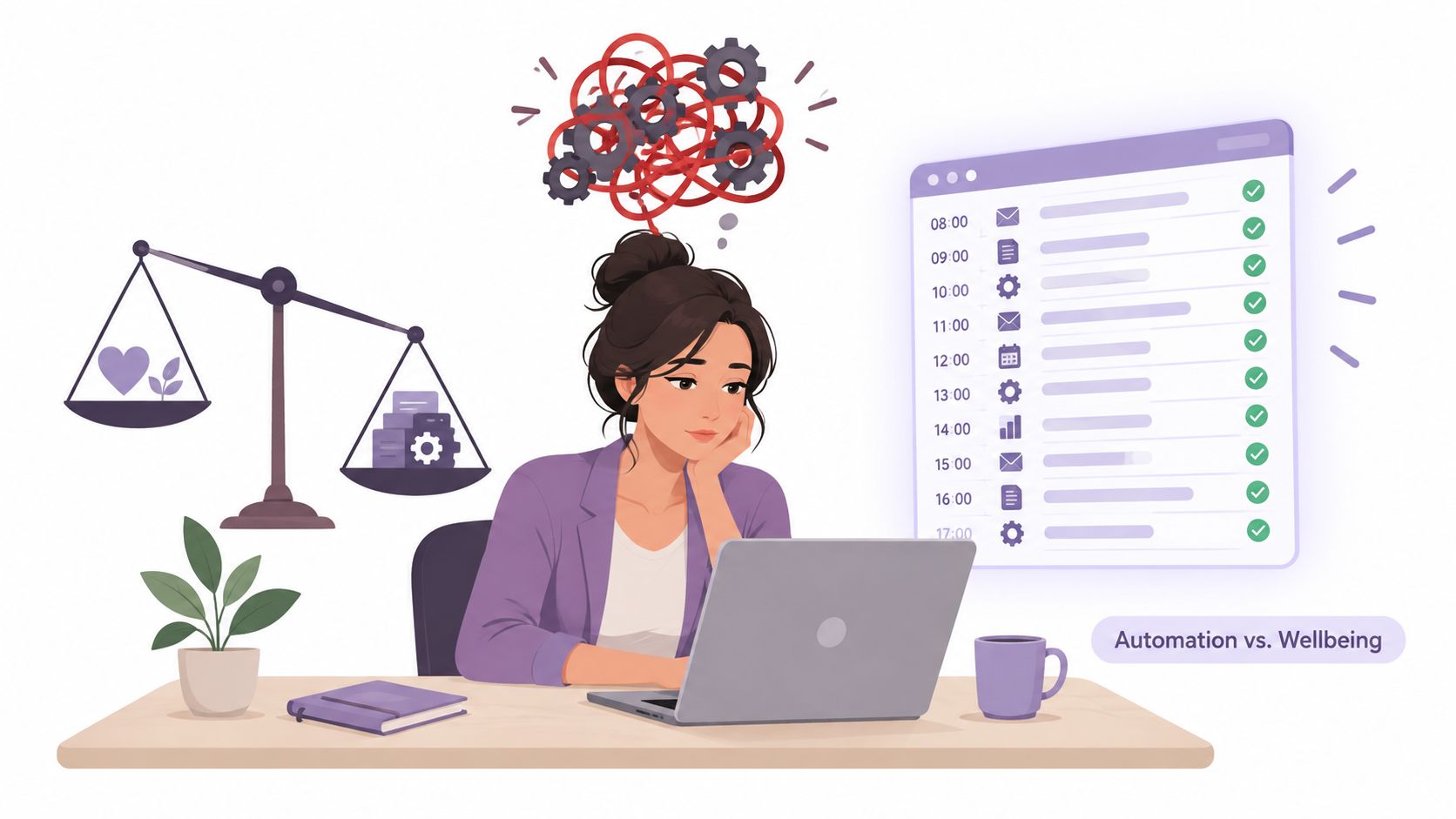
The dangerous assumption is that every available audience window should become a publishing obligation. A writer can have an optimized calendar and still have an unsustainable working life.
Automating distribution should let you leave the laptop, not give you another reason to monitor it constantly.
Efficiency isn't the same as wellbeing
European evidence on algorithmic management estimates exposure at 42.3% of EU workers and stress prevalence among exposed workers at 6.2 percentage points above a 23.9% general-population baseline, alongside weaker work-life balance and reduced rest.
OECD research on workplace algorithmic management identifies unclear accountability for wrong decisions as the most commonly reported issue and discusses research associating greater management intensity with a 21% increase in psychosocial risks and a 16.5% increase in health issues.
These findings concern workplace management, not a controlled test of newsletter scheduling software. They nevertheless raise a practical design question: who sets the limits when an optimizer recommends more activity?
Set boundaries before optimization
- Cap the cadence. Set a maximum publishing frequency you can support without sacrificing research and editing.
- Protect recovery. Leave cooldown periods after intensive production and keep uninterrupted writing blocks off-limits.
- Require explanations. A recommendation should identify its evidence, uncertainty, and relevant audience assumptions.
- Preserve human control. You should be able to override, pause, or reschedule without fighting the system.
Boundary test: If accepting the recommended schedule makes your writing week less predictable, the optimization objective needs changing.
Track workload alongside distribution outcomes. Note whether you're publishing without last-minute intervention, whether writing time stays protected, and whether the queue creates relief or pressure.
The capacity reserve discussed earlier protects infrastructure. Your personal reserve needs its own rule: don't commit every available working block to production. The scheduler should support an editorial practice you can sustain, including periods when publishing less is the correct decision.
Your Distribution Engine for Faster Audience Growth
Faster audience growth starts with giving useful work a better chance to reach interested readers. It doesn't require treating every platform as a separate writing job or interpreting every disappointing post as a failure of the underlying idea.
The operating model is straightforward: prepare strong source material, create appropriate derivatives, choose publication windows with evidence, and inspect which reader actions follow. Keep editorial approval and workload boundaries under human control.
Choose tools for the workflow you actually need
A spreadsheet and native scheduling controls can support the timing experiment. They're a reasonable starting point when you want to understand the process before adding automation.
Narrareach is an option for consolidating that workflow: it schedules Substack Notes, Medium articles, LinkedIn posts, and X content, supports voice-aware repurposing, and provides cross-platform analytics to track content that drives subscribers. For Substack writers, preparing Notes in batches and placing them in a visible publishing queue makes distribution less dependent on remembering to post between writing sessions.
- Publish consistently. Prepare and approve material before its publication window.
- Reuse selectively. Expand ideas readers already respond to, rather than generating filler.
- Evaluate subscriber interest. Look beyond surface engagement when deciding what to distribute again.
Keep discovery and distribution distinct
Search discovery is a complementary workflow. Resources such as The SEO Agent's AI SEO offer a separate category to evaluate, but search optimization shouldn't be confused with audience-time learning.
Your content distribution strategy should assign each channel a purpose and each metric a decision. That prevents the calendar from becoming a collection of activity with no clear reader outcome.
The meaningful finish line isn't a full queue. It's a repeatable publishing practice that helps interested readers find your work while leaving you enough attention to write the next piece well.
Start free, with no credit card required, at Narrareach to batch Substack Notes, schedule cross-platform posts, and track which content attracts subscribers. If you're not ready to automate distribution, follow this publication for ongoing timing experiments and practical publishing templates, then run the timing test with your existing tools.