
What Is an AI Scheduling Tool and How Writers Use It
Your Substack article is ready, but publishing it hasn't finished the job. You still have to pull out an idea for Notes, rewrite the opening for LinkedIn...
By Ian Kiprono
Your Substack article is ready, but publishing it hasn't finished the job. You still have to pull out an idea for Notes, rewrite the opening for LinkedIn, shorten another passage for X, and decide whether the article belongs on Medium. The tabs are open. The drafts don't match. You can't remember which version you scheduled.
Meanwhile, the next article is waiting. You're spending your writing energy moving finished work between platforms, and you still don't know whether that effort brings readers back to your newsletter.
The Problem Every Writer Knows Too Well
The frustrating part isn't copying text. It's making the same editorial decisions repeatedly, usually when you're already tired from writing.
A Substack introduction needs context. A LinkedIn post needs an opening that works without the article attached. An X thread needs a sequence, not paragraphs chopped at arbitrary points. By the time you've adapted everything, scheduling can feel like another assignment.
The administrative burden is real, even though meeting research isn't a direct measure of publishing work. In a 2023 survey of 1,200 professionals, 89% spent up to four hours per week scheduling meetings, according to Calendly's State of Scheduling report. For writers, the comparable question is how much coordination surrounds each finished piece.
Separate writing friction from distribution friction
Before changing tools, run a publishing-cycle experiment: record every action between approving an article and confirming its related posts are scheduled. Don't claim time savings yet. Establish what you do.
- Record repeated work. Note every copy-paste, formatting correction, and return visit to a platform.
- Record unfinished work. Include the LinkedIn adaptation you intended to publish but abandoned.
- Record uncertainty. Flag moments when you can't tell whether something is drafted, queued, or live.
Practical rule: Automate the repeatable action, not the editorial decision you haven't resolved.
If you're avoiding the next draft, distinguish that problem from distribution fatigue. These approaches to overcoming writer's block address a different bottleneck than a publishing queue does.
For an X-specific workflow, SuperX's guide to schedule tweets with these tools offers a focused place to explore automation.
An AI scheduling tool should address the wider problem: adapting approved work, coordinating release times, and making publication status visible without requiring you to supervise every tab.
What an AI Scheduling Tool Actually Does
A traditional calendar is like a paper planner: you decide what happens and enter the time. An AI scheduler adds a recommendation layer, using available context to suggest when work should happen.
For writers, that context might include audience time zones, previous engagement, content format, and the spacing between related posts. The important distinction is prediction versus execution. A tool can publish automatically without making an intelligent timing recommendation, and it can recommend a time without supporting publication.
The workflow has several connected parts.
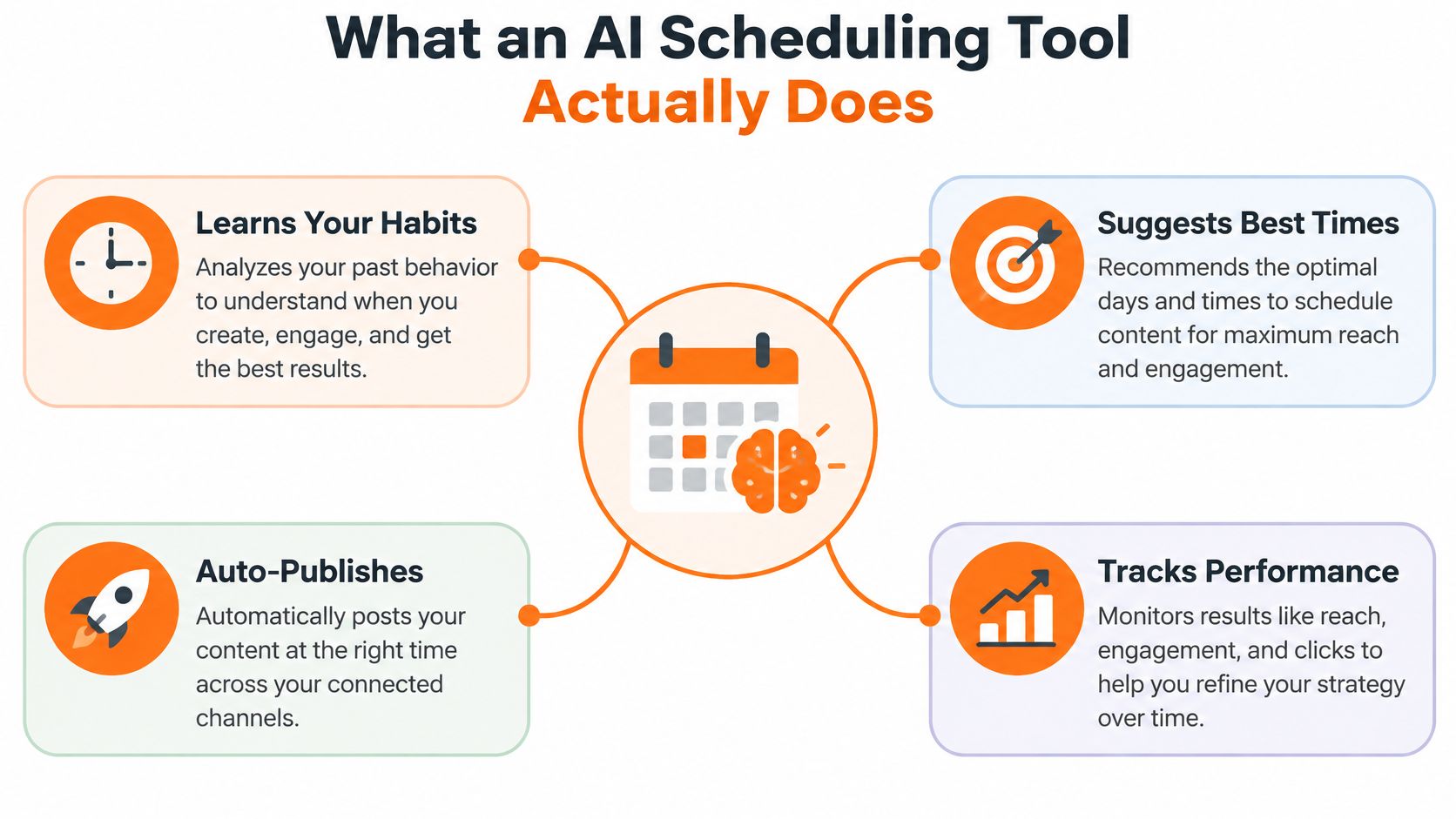
A recommendation isn't a universal best time
Rule-based scheduling repeats your instruction. Predictive scheduling estimates which available slot might suit a particular piece of content. Neither approach removes the need for editorial judgment.
The evidence argues against applying the same timing rule everywhere. An analysis of 5,706 Facebook posts from a top-50 U.S. newspaper found that non-boosted morning posts generated 8.8% more link clicks, while boosted posts performed 21% better in the afternoon than in the morning, as described in Baylor's account of the publication-timing research.
That doesn't establish a Substack send time. It demonstrates why promotion status and content characteristics belong in the decision.
- Inputs describe the audience, content, platform, and available publishing windows.
- Recommendations rank possible times within your constraints.
- Execution sends approved content to supported destinations.
- Feedback compares the recommendation with what happened.
A useful assistant should also respect fixed commitments. A launch announcement might need to follow an article's publication regardless of a predicted engagement peak.
For a small newsletter with limited history, a straightforward schedule can be more defensible than a precise-looking prediction. The tool should acknowledge weak evidence rather than turn it into certainty.
Core Features That Save Writers Real Time
Buy against tasks, not feature labels. A dashboard isn't useful if you still have to open every destination to repair formatting or confirm publication.
Start with an approved article and ask a prospective tool to carry it through your actual workflow. Keep the original available so you can inspect every adaptation.
What to test in a working queue
Cross-platform scheduling should show destination, publication time, approval status, and the latest version. Test what happens when you change the source article after preparing its related posts. You need to know which drafts require review.
AI repurposing should extract a complete idea, not just shorten paragraphs. For example, a practical newsletter passage might become a self-contained Note, while its supporting argument becomes a longer LinkedIn post. Reject drafts that remove qualifications or manufacture certainty.
Timing recommendations should help you test audience behavior. CleanMyList's guide to find your ideal send window is a useful planning resource, but your own results should determine whether a proposed window stays.
Analytics should connect activity to the outcome you care about. Ask whether subscriber attribution is available, how it works, and where the reporting has gaps.
Manual vs AI-Assisted Scheduling
| Task | Manual Effort | AI-Assisted Effort |
|---|---|---|
| Prepare adaptations | Rewrite separately for each destination | Review generated drafts for accuracy and voice |
| Set publication times | Enter and track times across platforms | Approve suggested slots in a shared queue |
| Maintain consistency | Remember each publishing commitment | Review upcoming work and resolve gaps |
| Extend reach | Prepare additional versions yourself | Approve platform-specific versions, without guaranteed reach |
| Evaluate results | Reconcile separate reports | Inspect consolidated reporting and attribution limits |
The comparison is qualitative deliberately. There's no defensible universal time-saving estimate for your publishing routine.
Pair the software with content batching: prepare related adaptations together, then review scheduling separately. Otherwise, you may use a faster tool while preserving the same fragmented working habits.
How Writers and Newsletter Creators Use AI Scheduling
A useful trial starts with ordinary editorial work, not a polished product demonstration. Use a real draft, an existing publishing commitment, and the destinations you already maintain.
The aim is a calmer publishing routine, not a busier calendar.

A Substack writer preparing ahead
Draft the article, approve its argument, and extract distinct ideas for Notes. Give each Note enough context to stand alone, then place related content around the article's release.
Substack already supports scheduled Notes on web, iOS, and Android. On the web, use the calendar icon; on mobile, choose Schedule from the three-dot menu. Scheduled Notes remain editable in Drafts and use your local time zone, according to Substack's scheduling announcement.
Its native workflow also supports scheduling and revising long-form posts before publication. An external assistant therefore needs to earn its place through coordination beyond native scheduling, not merely duplicate it.
A Medium writer extending an argument
Take an existing Medium article and identify a claim that prompted useful discussion. Prepare a LinkedIn interpretation and an X thread that develops that claim rather than repeating the article's opening.
Use AI content repurposing to prepare candidates, then check the source, examples, and conclusion before approving them.
Keep the publishing sequence visible while reviewing the workflow demonstration.
For an editorial team, add ownership and approval status to the same exercise. A queued post shouldn't go live because nobody noticed it was awaiting a client's decision.
- Before scheduling confirm the account, final text, destination, and responsible editor.
- After scheduling inspect the queue and verify that dependent posts follow the source publication.
- After release check the live result rather than treating a queued status as proof of publication.
How to Choose the Right AI Scheduling Tool
Choose the category before comparing products. A meeting assistant, task planner, and publishing scheduler solve different problems, even when they all use the same AI terminology.
Fluidwave's guide to compare AI calendar apps can help with calendar-oriented options. For distribution, evaluate the publishing workflow separately.
Match the tool to your actual constraints
| Criterion | Solo writer priority | Editorial team priority | Evidence to request |
|---|---|---|---|
| Platform coverage | Your active destinations | Required accounts and brands | A successful supported publishing workflow |
| Voice preservation | Recognizable phrasing and nuance | Appropriate voice for each author | Adaptations compared with original drafts |
| Analytics | Useful subscriber signals | Clear reporting by account | Attribution definitions and limitations |
| Control | Easy editing and cancellation | Permissions and approval gates | A demonstrated correction workflow |
| Portability | Recoverable drafts and records | Exportable operational history | Available export and disconnection options |
Trust deserves its own evaluation. Among infrequent AI users, 70% in the United States cited trust issues, according to Edelman's research on why AI isn't routine at work.
The practical response is to ask for explanations rather than accept an opaque score.
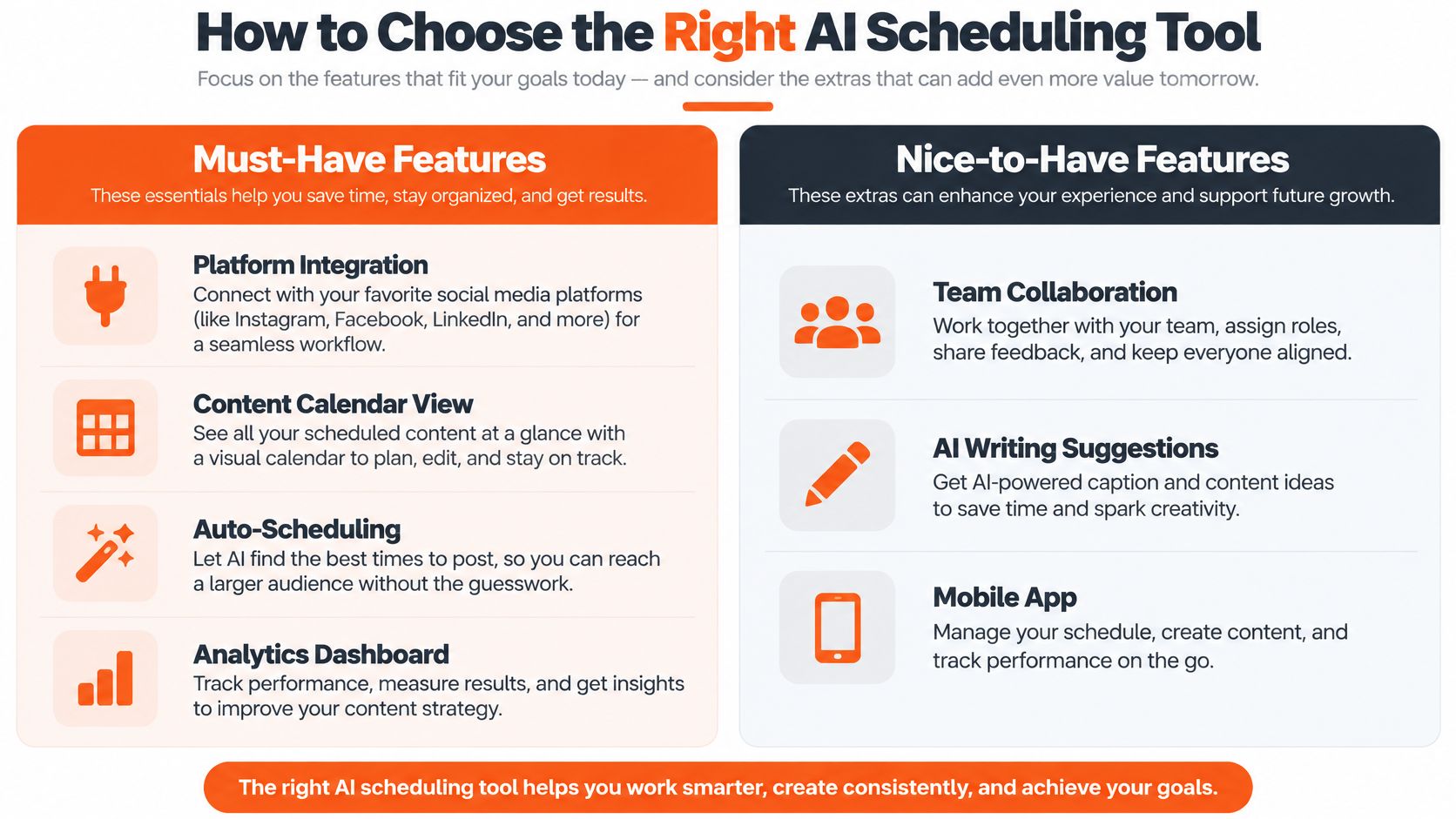
Ask what would change the recommendation
When evaluating best-time-to-post recommendations for Substack, ask what history supports the suggestion and how the tool handles insufficient data. Can you override it? Will recommendations adjust when audience geography or platform behavior changes?
A trustworthy recommendation includes a reason to doubt it, not just a reason to accept it.
Finally, test recovery. Edit a scheduled draft, cancel another, and disconnect an account after confirming the consequences. A tool that makes scheduling easy but cancellation confusing creates operational risk precisely when you need control.
Why Writer-Focused Tools Beat Generic Schedulers
A writer-focused tool earns its advantage when it preserves the relationship between an argument and its adaptations. The label alone doesn't prove anything.
A generic scheduler may be entirely sufficient if you already prepare platform-ready drafts and only need reliable publication. Don't replace a working queue just to acquire an AI writing button.
The difference matters when the administrative problem includes editorial work. A personal essay, a practical tutorial, and a client announcement shouldn't receive interchangeable treatments.
Evaluate the editorial handoff
Consider a hypothetical essay about leaving a difficult job. A careless adaptation might turn a qualified personal observation into sweeping career advice. The wording could sound polished while misrepresenting the author.
A writer-oriented workflow should make that change visible before publication.
- Preserve context. Keep the conditions that make advice valid.
- Preserve authorship. Don't invent experiences, quotations, or stronger conclusions.
- Preserve boundaries. Exclude private subscriber material and client information unless you're authorized to process it.
Governance isn't a peripheral concern. 81% of surveyed digital-trust professionals said employees in their organizations use AI, whether permitted or not, according to ISACA's research on AI use and training. That workplace finding doesn't measure creators, but it reinforces the need to establish rules before automation becomes routine.
Make privacy part of the publishing decision
Ask what text leaves your workspace, how long drafts remain stored, whether they're used for training, and how access can be revoked. Require clear answers rather than treating a privacy badge as a complete explanation.
Editorial boundary: Automating distribution doesn't transfer responsibility for what appears under your name.
Writer-focused tools are preferable when they reduce this review burden without weakening it. A generic scheduler with better controls can still be the right choice.
Growing Your Audience With a Content Distribution Engine
Audience growth requires more than an occupied calendar. You need a useful idea, a reason for readers to continue, and a way to learn which distribution choices contribute to subscriptions.
A content distribution engine connects those decisions. Treat the following as a workflow to test, not a promised growth result.
Follow the path from article to subscriber
Publish an approved Substack article and prepare related Notes, a LinkedIn post, and an X thread. Give each adaptation a distinct purpose: introduce the problem, explain a technique, or develop a counterargument.
Use destination-specific tracking where available, and make the invitation relevant. Someone reading a practical excerpt should know what additional value the full publication offers.
The intended relationship between publishing and growth is straightforward.
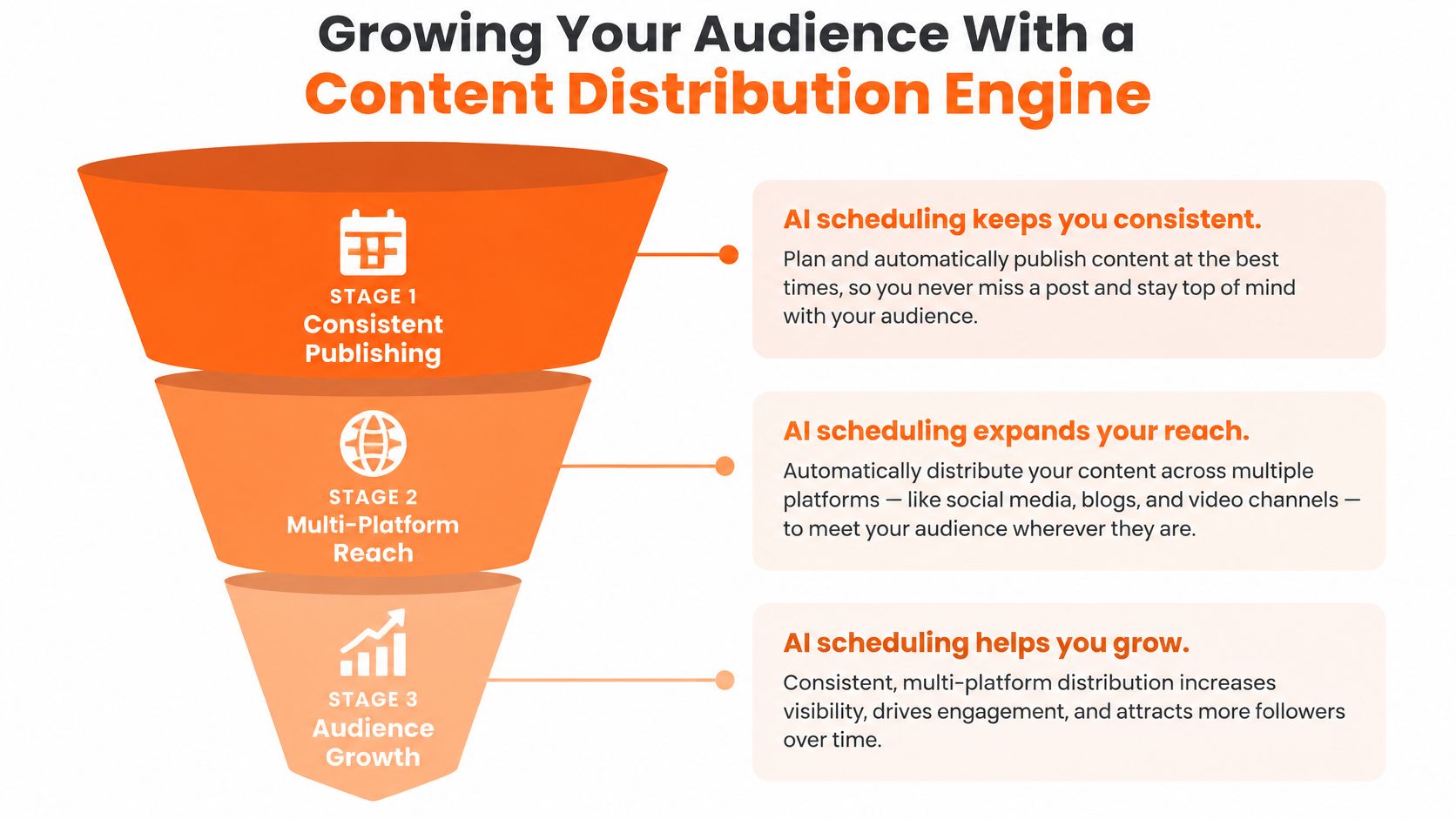
Review results by the job each adaptation was meant to perform.
- Discovery posts should attract relevant readers, not merely broad reactions.
- Article referrals should bring people to the promised material.
- Subscription invitations should explain what readers will receive next.
Don't confuse a good result with a proven cause
If a post performs well, the topic, opening, format, and timing may all have contributed. Changing everything together makes the outcome difficult to interpret.
A limited study involving 53 Gen Z respondents across TikTok, Instagram, and YouTube reported a relationship between posting time and engagement, but its narrow sample warrants caution about broader applications, as documented in the published timing-and-personalization study.
Use comparable content and a clear hypothesis when testing timing. Record what changed and what remained uncertain.
A sustainable content distribution strategy should also include stopping rules. If a destination requires substantial editing but contributes little relevant readership, reduce the effort before expanding the schedule.
Final Thoughts and Your Next Step
The right AI scheduling tool should make your publishing process easier to inspect, not harder to understand. You should know what will publish, why it's scheduled there, and how to stop it.
Start with your current bottleneck. If native Substack scheduling already meets your needs, keep it. If adaptations and disconnected queues consume your attention, test a cross-platform workflow using an article you'd publish anyway.
Run a bounded publishing experiment
Keep the comparison honest. Record the manual workflow before changing it, then include setup, review, corrections, and publication checks when evaluating assistance.
- Define success in advance. Choose less administrative work, fewer missed posts, clearer attribution, or another outcome you can observe.
- Keep an approval gate. Review generated text before granting permission to publish.
- Inspect the result. Check live formatting, destination links, and the relationship between the adaptation and its source.
- Decide what to retain. Keep useful automation and remove steps that add supervision without reducing work.
The most convincing proof isn't a full queue. It's a publishing cycle you can complete without losing track of your work or compromising your standards.
Choose a next step that matches your readiness
If you're ready to try software, bring a finished article and a small set of intended destinations. Test the awkward parts, including revisions, failed handoffs, and cancellation, rather than judging only the happy path.
If you're not ready, improve the workflow you already have. Batch adaptations, use native scheduling, and keep a clear record of approved drafts and published versions.
You don't need to automate every platform. You need enough operational support to distribute worthwhile work while protecting the time and attention required to write the next piece.
For a writer-focused option, visit Narrareach to try scheduling Substack Notes, Medium articles, LinkedIn posts, and X content, with AI repurposing and cross-platform analytics; you can start free without a credit card. Bring an approved article and test whether it helps you distribute efficiently and identify what drives subscribers. If you're not ready to try a tool, follow the blog for practical writing and audience-growth advice, and begin with the publishing-cycle audit above.