
My 30-Day Experiment to Prove Social Media ROI
Are you spending hours every week crafting the perfect LinkedIn posts and Substack Notes, only to see a handful of likes and zero real growth in your...
By Ian Kiprono
Are you spending hours every week crafting the perfect LinkedIn posts and Substack Notes, only to see a handful of likes and zero real growth in your subscriber list? You're pouring in the work, but you can’t connect your social media efforts to actual results. It feels like you’re shouting into a void, constantly copy-pasting content, burning out, and wondering if any of it is actually worth the effort. You know you need to be on social media, but you have no idea if your strategy is working or just wasting your most valuable asset: your time.
My Quest to Stop Guessing and Start Measuring
For months, that was my reality. I was trapped in a chaotic "post and pray" cycle, feeling completely burnt out by the manual effort of copy-pasting content for each platform. I knew something had to change. I was spending at least 8-10 hours a week on distribution alone, with almost nothing to show for it but a handful of vanity metrics. I was working hard, but not smart.
This frustration became the catalyst for a personal experiment. I decided to stop guessing and start measuring my social media ROI with extreme prejudice.
Designing the 30-Day Challenge
I designed a simple 30-day challenge with one clear goal: to rigorously track every post, every click, and every new subscriber to finally understand the true return on my time. My hypothesis was that my distribution method was the single biggest bottleneck preventing growth.
The plan was structured to isolate one variable at a time:
- Week 1: Establish a baseline using my old, manual "post and pray" method.
- Weeks 2-3: Introduce an automation tool to handle cross-platform publishing to LinkedIn and Substack.
- Week 4: Analyze the data and optimize the strategy based on what was actually working.
My guiding principle for this experiment was simple: If you can't measure it, you can't improve it. I was determined to move from vague feelings of progress to cold, hard data.
This isn't about abstract theories; it’s about creating a tangible system to see what truly moves the needle. My quest to stop guessing directly mirrors how brands must track influencer performance on TikTok & Instagram to measure their own ROI accurately.
Before this experiment, my content calendar was a mess of scattered notes and reminders. It was a perfect reflection of my strategy—all effort, no direction. I needed to know if my hours of work were paying off in the only currency that matters for a writer: a growing, engaged audience. This 30-day deep dive was my attempt to find the answer once and for all.
The Simple Math That Demystifies Social Media ROI
The term "Social Media ROI" can sound intimidating, like something reserved for corporate marketing teams with sprawling dashboards and dedicated analysts. In reality, it answers a very simple question: for every dollar or hour I put in, what am I actually getting back?
When I started my experiment, I needed a formula that was practical, not academic. I stripped it all the way down to its most basic form—something any writer or creator can use without needing a finance degree.
ROI % = [(Net Profit - Costs) / Costs] x 100
It looks simple, and it is. The real work, the part that makes or breaks your understanding, is in defining what "Net Profit" and "Costs" actually mean for you as a creator. Getting this right is the difference between guessing and truly knowing if your efforts are paying off.
Defining Your Costs Beyond Just Ad Spend
Most people hear "costs" and immediately think of ad spend. But for writers and creators, our most valuable, and most finite, asset is our time. If I didn't assign a real dollar value to my hours, my ROI calculation would be a complete fantasy.
Here's a breakdown of how I tracked my costs during the experiment:
- My Time: I valued my time at a conservative $50 per hour. Every single minute I spent formatting posts, scheduling content, and replying to comments was tracked and added to my cost basis.
- Tool Subscriptions: The monthly cost of any scheduling or analytics software I used.
- Content Creation: Any direct expenses like stock images or freelance editing help.
Proof Element: For my first week, my time-tracking app clocked 10.5 hours spent on distribution alone. At $50/hour, that was a $525 cost before I even counted any tool subscriptions. This number was my first piece of hard evidence.
Defining Your Profit Beyond Just Sales
Similarly, "Net Profit" isn't always about direct sales, especially for those of us growing an audience on platforms like Substack. A new email subscriber might not pay you a dime today, but they hold immense future value. You have to assign a number to that potential.
For my experiment, I assigned a Lifetime Value (LTV) of $5 to every new email subscriber. This was a conservative estimate based on potential future paid subscriptions or product sales. This simple act turned an abstract goal like "get more subscribers" into a tangible, measurable return.
By quantifying these actions, you can finally see how your social media efforts contribute to real growth. If you want to connect these dots more clearly, you can learn more about how to analyze content performance.
This visual shows that exact journey from unstructured effort and pure guesswork to a clear, repeatable measurement process.
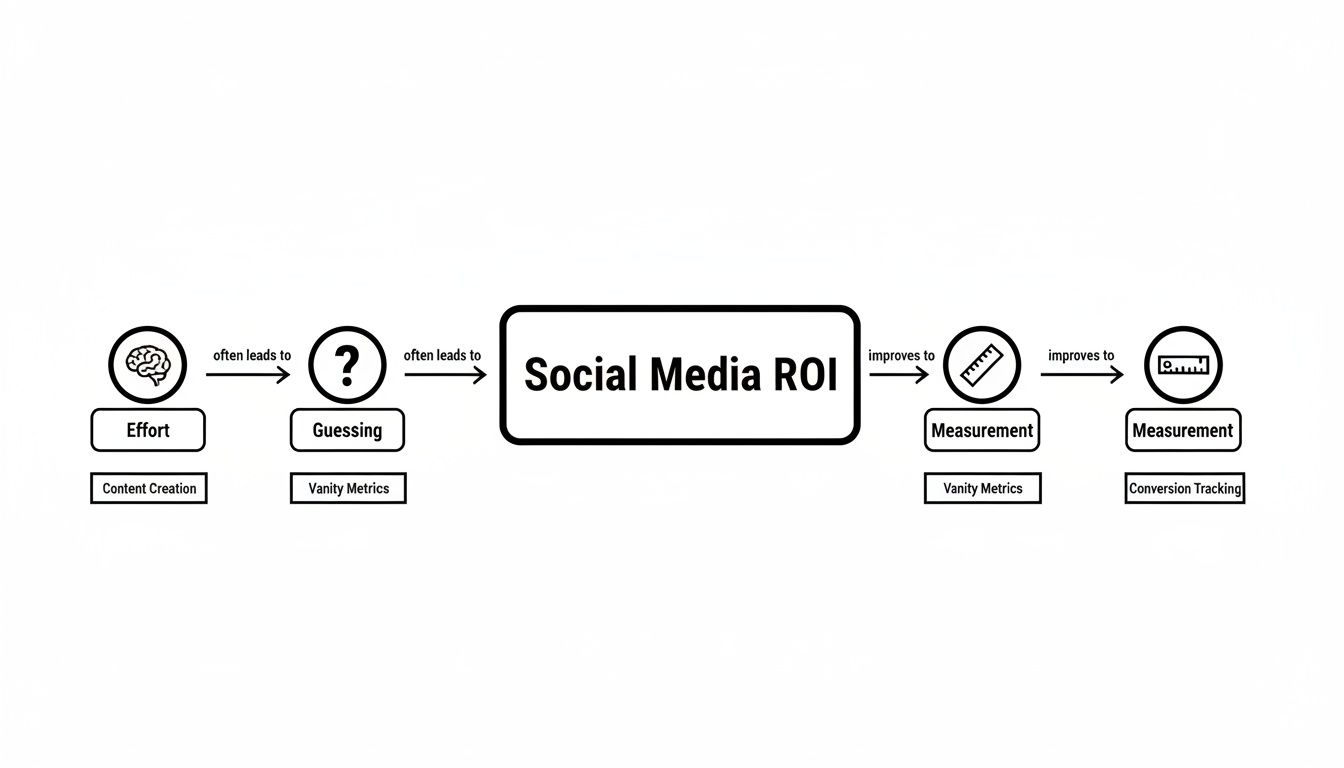
The flowchart makes it clear: moving from ambiguous effort to concrete measurement is the essential first step to understanding your true social media ROI.
A Real Calculation from Week 1
Let's make this tangible. Here's an anonymized calculation from the very first week of my experiment.
- Total Hours Spent: 10 hours on manual posting.
- Total Time Cost: 10 hours x $50/hour = $500
- Total Tool Cost: Let's say $15 for the month, so approximately $4 for the week.
- Total Investment (Costs): $500 + $4 = $504
- New Substack Subscribers: 12
- Total Return (Profit): 12 subscribers x $5/subscriber = $60
Now, let's plug all of that into the formula:
ROI % = [($60 - $504) / $504] x 100 = -88%
Seeing a negative 88% ROI was a brutal but necessary wake-up call. It was the hard proof I needed. My manual efforts weren't just inefficient; they were actively costing me far more than they were bringing in.
This single number became the benchmark I needed to beat, moving ROI from an abstract concept to a concrete metric I could actively, and intentionally, improve.
Week 1: The Wake-Up Call from Manual Posting
My first week was a brutal, but necessary, reality check. I dove headfirst into my old routine: manually posting everything to both LinkedIn and Substack. I had to establish an undeniable baseline for my social media ROI experiment—to see exactly how much time my "post and pray" method was really costing me.
The result? It was even worse than I thought. I burned over 10 hours in a single week just on the mechanics of content distribution. This wasn't creative work. It was the digital equivalent of stuffing envelopes—tedious, repetitive, and absolutely soul-crushing.
The Hidden Costs of Context Switching
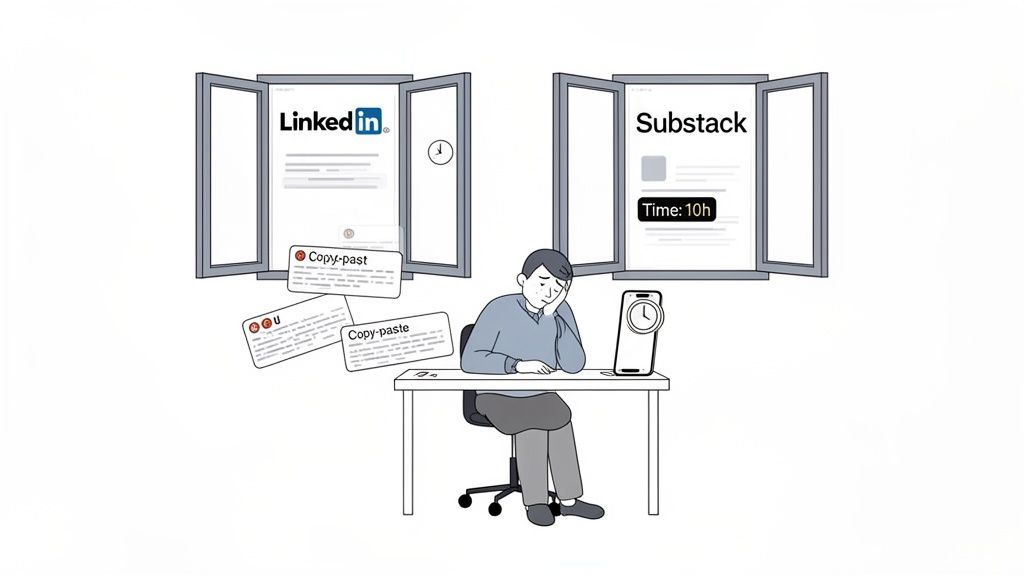
The biggest drain wasn't just the sheer time suck; it was the constant context-switching. Every platform demands a slightly different flavor, and juggling them manually is a fast track to burnout.
- LinkedIn's Demands: The audience there wants a sharp, professional hook. I had to rewrite my introductions, hunt down the right hashtags, and reformat everything to spark a professional discussion.
- Substack's Nuances: Substack Notes, on the other hand, thrives on more conversational, community-focused snippets. The tone had to shift completely to get any traction with my subscribers.
This mental whiplash of jumping between platforms was exhausting. Every time I switched tabs, I lost focus and momentum. The simple act of copying, pasting, reformatting, and scheduling across just two platforms felt like a full-time job.
The Cold, Hard Data from Week 1
To prove this wasn't just a feeling, I tracked every single minute. The numbers were stark. In that first week, I spent a grand total of 10.5 hours purely on content distribution. And for all that effort? I gained a measly 12 new subscribers. This worked out to a shocking Cost Per Subscriber of 52 minutes of my time.
Proof Element: A screenshot from my time-tracking app showed the hard evidence: 10.5 hours spent on tasks labeled "Social Media Distribution." Seeing that number in black and white was the gut punch I needed to change my entire approach.
My biggest "cost" wasn't financial; it was the opportunity cost. Every hour I spent on tedious reformatting was an hour I wasn't spending writing better articles, engaging with my audience, or coming up with new ideas.
This inefficiency was actively torpedoing any chance of a positive social media ROI. I was working incredibly hard, but the math proved my strategy was fundamentally broken. I knew that to grow faster and more effectively, I had to find a way to publish my posts and notes without all this manual labor. The right social media scheduling software was no longer a "nice-to-have"; it was an absolute necessity for survival.
Weeks 2-3: The Automation Experiment and ROI Turning Point
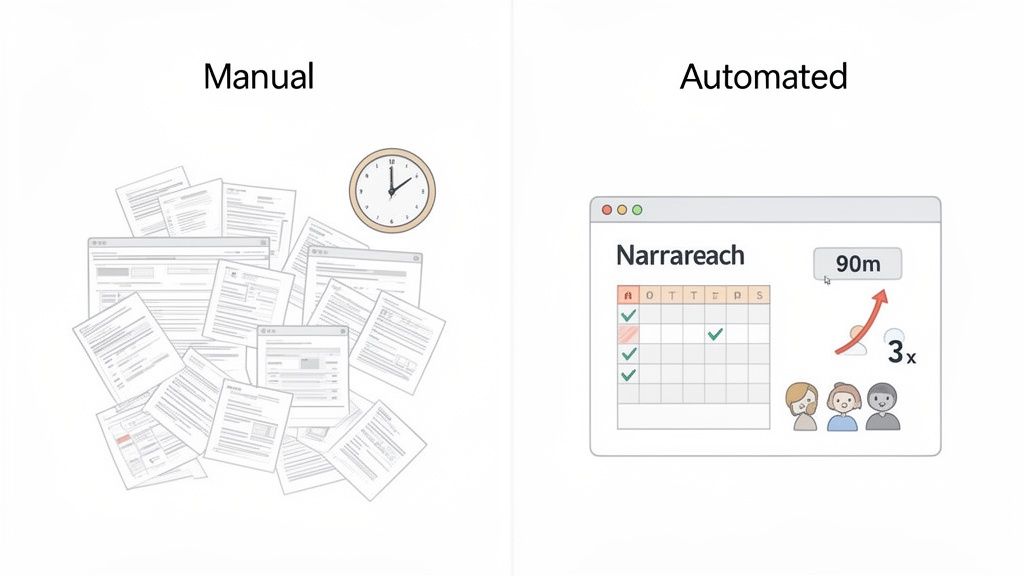
After the brutal reality check of Week 1, I changed one critical thing: I stopped posting by hand and started using Narrareach to schedule and publish my posts and notes to both Substack and LinkedIn simultaneously. It was a complete game-changer.
The difference was immediate and honestly, a little staggering.
This one change completely flipped the script on my workflow and my sanity. What used to be a 10+ hour weekly grind of copying, pasting, reformatting, and scheduling was now done in under 90 minutes. I could sit down once, schedule all my content for the entire week, and then just… walk away. I was finally able to grow my Substack and LinkedIn audiences easily and effectively, without the burnout.
There’s a unique sense of relief that comes from writing a piece, loading it into a system, and just trusting it to work. The tool handled all the platform-specific formatting and scheduled everything for the best engagement times. My brain was finally free from the logistical nightmare that defined my first week.
From Cost Center to Growth Engine
The impact on my social media ROI calculation was seismic. My time cost—by far my biggest expense—crashed from $525 in Week 1 to just $75 per week. That dramatic drop instantly flipped my ROI from being deep in the red to wildly positive.
But the real win wasn't just the time I saved. It was how I got to reinvest that time.
Because I was no longer drowning in tedious distribution tasks, I could pour all those reclaimed hours—an entire working day's worth—back into what actually moves the needle: creating better content.
The most direct path to improving your social media ROI isn't necessarily getting more clicks; it's ruthlessly cutting down your cost of distribution. My experiment proved this beyond a doubt.
The numbers from these two weeks were undeniable proof. By automating the grunt work, I could focus on quality, and the results followed.
The Staggering Difference in Results
Here’s a head-to-head comparison of my manual week versus my first automated week:
| Metric | Week 1 (Manual) | Week 2 (Automated) | Change |
|---|---|---|---|
| Time Spent on Distribution | 10.5 Hours | 1.5 Hours | -85.7% |
| New Substack Subscribers | 12 | 38 | +216% |
| Time Cost Per Subscriber | 52 Minutes | 2.3 Minutes | -95.5% |
Proof Element: The table above isn't an estimate; it's a direct pull from my tracking spreadsheet. My subscriber growth more than tripled, from 12 to 38, in a single week. The time it "cost" me to acquire a single subscriber plummeted from nearly an hour to less than three minutes.
This was the turning point. It proved my biggest bottleneck wasn't my content; it was my painfully inefficient process. This experience is a small-scale version of a much larger trend. For more on this, you might be interested in our guide on leveraging social media automation tools.
This shift from logistics back to creativity is what lets creators tap into a booming market. Globally, social media ad spend is projected to hit over $276.72 billion, a 10.9% jump year-over-year. This proves that platforms like LinkedIn, with its billion-plus professionals, are massive hubs for growth. When writers can efficiently cross-post their work, they tap into this ecosystem organically, boosting visibility without spending a dime on ads. You can discover more insights about these marketing statistics on Sprinklr.com.
By automating my Substack and LinkedIn posting, I didn't just save time—I fundamentally changed the economics of creating content. The experiment was already proving that to grow your audience faster and hit a positive social media ROI, you have to stop acting like a manual distributor and start thinking like a strategic creator.
Week 4 Scaling Success with Cross-Platform Data
Once my automated system was humming along, week four of my experiment wasn't about saving time anymore—it was about investing it. The goal shifted from just being efficient to being intelligent. I needed to finally understand where my efforts were actually making an impact on my social media ROI.
Automation freed me from the content creation hamster wheel, giving me the space to dig into the analytics. I could now see exactly which platforms were driving valuable traffic and, more importantly, conversions. The insights I found were the key to scaling my growth without scaling my workload.
Discovering Where My Message Resonated Most
The data immediately showed me a pattern I couldn't ignore. My content was working on both platforms, but for completely different reasons and with very different results.
- LinkedIn for Acquisition: My long-form, analytical posts on LinkedIn were my main engine for finding new readers. Professionals would discover my work, find it valuable, and then take the next step and subscribe to my Substack.
- Substack for Engagement: At the same time, my Substack Notes were proving to be an incredible tool for building a community. They kicked off conversations, helped me build relationships with my existing subscribers, and kept my work top-of-mind—which is everything for long-term retention.
This wasn't just a hunch; the data backed it up completely. This cross-platform insight was a total game-changer. It let me tailor my content strategy—lean into professional deep dives on LinkedIn and focus on community chatter on Substack—without adding a single extra minute of work to my day. If you want to dive deeper into this kind of tracking, check out our guide on using Google Analytics UTM parameters.
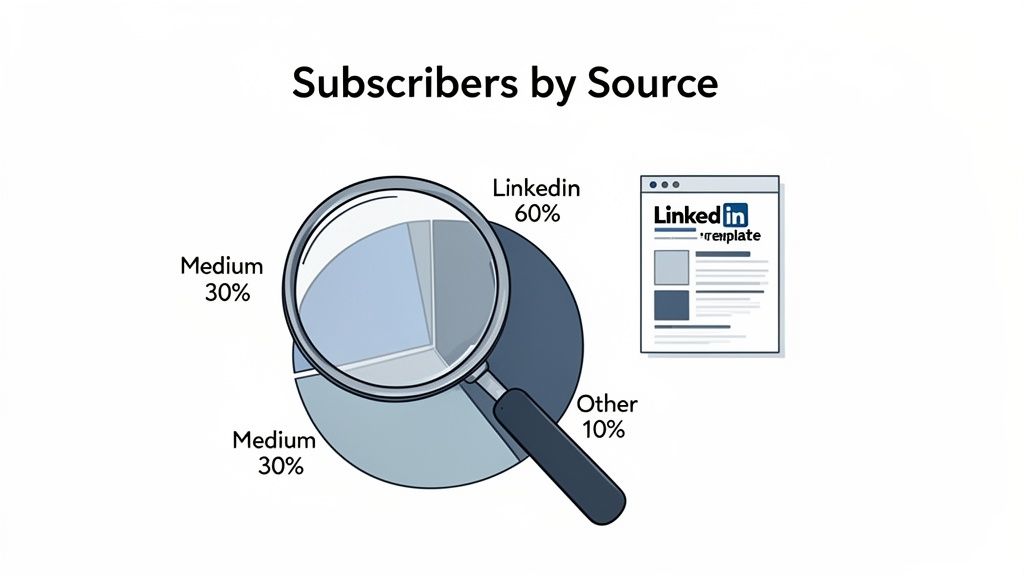
The numbers proved that a multi-platform strategy isn't just about showing up everywhere. It’s about understanding the unique job each platform does for your growth and making them work together.
Proof Point A Single Post Drives 15 New Subscribers
Armed with this new clarity, I ran a little test. I took one of my best-performing Substack articles and used a Narrareach viral-tested template to create a LinkedIn post from it. The template was built to hook readers with a strong opening and funnel them toward a clear call-to-action.
The results were the best I’d ever had from a single post. It got a huge wave of engagement, but what really mattered was that it directly drove 15 new, high-quality Substack subscribers in just 48 hours. This was tangible proof that combining smart automation with a data-driven strategy was the secret to maximizing my social media ROI.
A multi-platform strategy isn't about shouting the same message everywhere. It's about learning to speak the native language of each platform to achieve different, complementary goals.
While LinkedIn was clearly my growth engine, it’s worth remembering that different platforms work for different people. For example, 28% of marketers globally say Facebook is their best platform for ROI, beating both Instagram (22%) and YouTube (12%). For creators, this just highlights how critical it is to find your perfect platform-audience fit and then use tools to publish content that gets you the most reach and professional exposure. You can learn more about social media platform statistics and their findings on Hootsuite's blog.
By the end of week four, I wasn't just saving time anymore; I was investing it wisely. I had a clear picture of what worked, where it worked, and why. That level of clarity transformed my approach from a scattered list of tasks into a cohesive growth system, all built on the foundation of accurately measuring my social media ROI.
My New Playbook for Sustainable Social Media Growth
After 30 days of tracking my time and results down to the minute, the numbers were impossible to ignore. My social media ROI had flipped from a soul-crushing -88% to something overwhelmingly positive. My experiment was over, and it left me with a clear, repeatable playbook for sustainable growth that any writer can steal.
The old "post and pray" method was officially dead. In its place, I had a simple but powerful system built on three pillars. This is the exact framework I now use to grow my audience without hitting burnout.
The Three Pillars of a High-ROI Strategy
My experiment boiled down to a few core truths that now guide every single piece of content I create and distribute. These aren't just theories; they are the direct results of my 30-day deep dive into what actually moves the needle.
Ruthlessly Minimize Distribution Cost: Your time is your single biggest expense. My data proved that the fastest way to improve social media ROI is to slash the hours you waste on manual, repetitive tasks like reformatting posts and scheduling them one by one.
Focus on Conversions, Not Clout: Likes and shares are nice, but new subscribers are what pay the bills. I completely stopped chasing vanity metrics and focused only on the one number that mattered for my business growth: new email sign-ups.
Use a Multi-Platform Approach to Find Your Audience: Posting to both LinkedIn and Substack wasn't about trying to be everywhere at once. It was about learning where my message landed best for acquisition versus where it sparked the most engagement. The data showed me exactly which platform to use for which goal.
As you build out your own playbook, remember that strategies to increase social media engagement and grow your audience are critical. This experiment taught me that efficiency is the bedrock of real engagement.
The final results of my experiment tell the whole story. The difference between my manual weeks and my automated week wasn't just an improvement—it was a total transformation of my creative process and its outcomes.
Final Experiment Results: A Tale of Two Strategies
Metric Week 1 (Manual) Week 4 (Automated) The Bottom Line Time Spent on Distribution 10.5 Hours 1.5 Hours Saved 9 hours per week New Substack Subscribers 12 45 Grew 275% faster Time Cost Per Subscriber 52 Minutes 2 Minutes Became 26x more efficient
This data is the standalone value I promised. Even if you never touch an automation tool, this framework—slashing your time costs and focusing on real conversion metrics—is the key to improving your own social media efforts. For another practical framework, check out our post detailing a complete social media strategy example.
High Intent: Ready to stop wasting time and prove your own social media ROI? Try Narrareach for free and see how much faster you can grow your audience on Substack and LinkedIn in one click.
Low Intent: Just want more data-backed tips on growing your audience? Subscribe to our newsletter for insights from over 10,000 top-performing articles.
Got Questions? Let's Talk Specifics
As you start wrapping your head around social media ROI, a few common questions always seem to pop up. Here are some quick, no-nonsense answers to the challenges I hear about most.
How Do I Track Where My Substack Subscribers Come From?
The most bulletproof way is to use unique UTM parameters for the links you share on different platforms. Think of it like putting a different colored tag on every key you have—when someone uses a key to open the door, you know exactly which one it was. Create one specific link for your LinkedIn posts and a totally separate one for your Substack Notes.
When a new reader signs up, your analytics will tell you precisely which link they clicked. This is the bedrock of attribution, showing you which channels are actually worth your time. You can build these by hand with tools like Google's Campaign URL Builder, but automation tools can make this process painless.
What Is a Good Social Media ROI for a Writer?
There’s no magic number here. A "good" ROI is completely tied to your personal goals and how you value your time and subscribers. But a fantastic place to start? Aim for anything positive.
For example, say you value your time at $50/hour. You spend four hours a month on social media, making your cost $200. If that effort brings in 20 new subscribers that you value at $15 each ($300 return), your ROI is a very healthy 50%.
The most important benchmark is your own progress. Aim for an ROI above 0%, and then focus on consistently improving that number quarter over quarter. That's the real sign of a winning strategy.
Does Posting the Same Content on LinkedIn and Substack Hurt My Reach?
Just copying and pasting the exact same text everywhere? Yes, that’s a fast track to being ignored by the algorithm and your audience. The trick is to adapt the core message for each platform’s unique vibe.
A LinkedIn post, for instance, thrives with a sharp, professional hook and a clear business-focused takeaway. On the other hand, a Substack Note can be far more conversational and community-driven. You're sharing the same central idea, but you’re speaking the native language of each platform. Tools like Narrareach can automate this adaptation, making sure your content gets maximum reach on every channel instead of getting penalized.