
What Is Content Repurposing and How It Actually Works
You finish a polished Substack essay late at night, close the laptop, and promise yourself you'll distribute it tomorrow. Tomorrow arrives with coffee...
By Ian Kiprono
You finish a polished Substack essay late at night, close the laptop, and promise yourself you'll distribute it tomorrow. Tomorrow arrives with coffee, notifications, and a blank calendar. You paste the link into one social post, refresh the dashboard, and watch the article disappear beneath newer updates. The same five loyal readers share it, the open-rate curve flattens within a day, and you're left wondering why hours of careful writing produced only a brief flicker of attention.
I know that desk. I've spent too many mornings drafting from scratch because yesterday's work felt “used up,” even when the idea still had useful life. I decided to test a different approach for 60 days, publishing across Substack Notes, LinkedIn, Medium, and X. The experiment started with a simple question: was the problem distribution, or was each idea reaching readers in the wrong format?
The Lonely Newsletter That Disappears
The first essay in my experiment was about creative burnout. I remember the small details more clearly than the analytics. A mug had gone cold beside the keyboard. My notebook was open to a page of crossed-out headlines. I'd spent the afternoon trimming a paragraph that still felt too long, then pressed publish just before dinner.
For a few hours, the article felt alive. I answered replies, watched the first notifications arrive, and sent the link to a couple of friends. By the following morning, the dashboard had gone quiet. The essay hadn't failed because the argument was weak. It had stopped moving.
That pattern creates a peculiar kind of fatigue. You aren't only writing. You're also carrying the entire burden of distribution, one platform at a time. A new Substack post asks for a Note, a LinkedIn update, an X thread, perhaps a Medium adaptation, and each version seems to demand a fresh blank page.
The problem: A finished article can be valuable long after its first publication, but readers won't automatically encounter it again.
I began tracking which ideas deserved another form and which should remain where they were first published. The goal wasn't to fill every channel or post the same paragraph repeatedly. It was to find a way to let one strong idea travel without making every audience feel like it had received leftovers.
That distinction matters in any content syndication strategy for writers. Distribution isn't a matter of putting a link in more places. It depends on whether the idea makes sense in the room where you're placing it.
After 60 days, I had a clearer vocabulary for the process. The work wasn't “getting more posts out.” It was deciding what the original essay contained, which parts could stand alone, and how each platform expected those parts to arrive. That's where content repurposing begins.
What Content Repurposing Means
During my 60-day experiment, a Substack essay rarely failed because the idea was weak. It failed when I treated distribution as a copying exercise. Content repurposing is the deliberate transformation of one source asset into multiple formats for different audiences or platforms, while preserving its semantic core. The work is deciding which parts deserve another form and which should stay in the original.
Cross-posting shares content as-is. Reposting publishes it again on the same channel. Repurposing takes the central idea, separates it into usable pieces, and rebuilds each piece for a different reading situation. A long argument may become a question on Substack Notes, a practical lesson on LinkedIn, a sequence on X, or a revised explanation on Medium. The source remains connected, but the reader does not receive the same paragraph everywhere.
I found a useful comparison in cooking. One roasted chicken can become a dinner with herbs, a sandwich with sharp mustard, and broth made from the bones. The ingredient remains related across meals, while the seasoning, texture, and presentation change. Serving the same plate three nights in a row is repetition, not reuse.
A Substack essay can carry the complete argument. A Note can isolate the tension that opens it. LinkedIn can develop one practical lesson. An X thread can arrange the reasoning as a sequence. Medium can preserve the long-form explanation with a different introduction and structure.
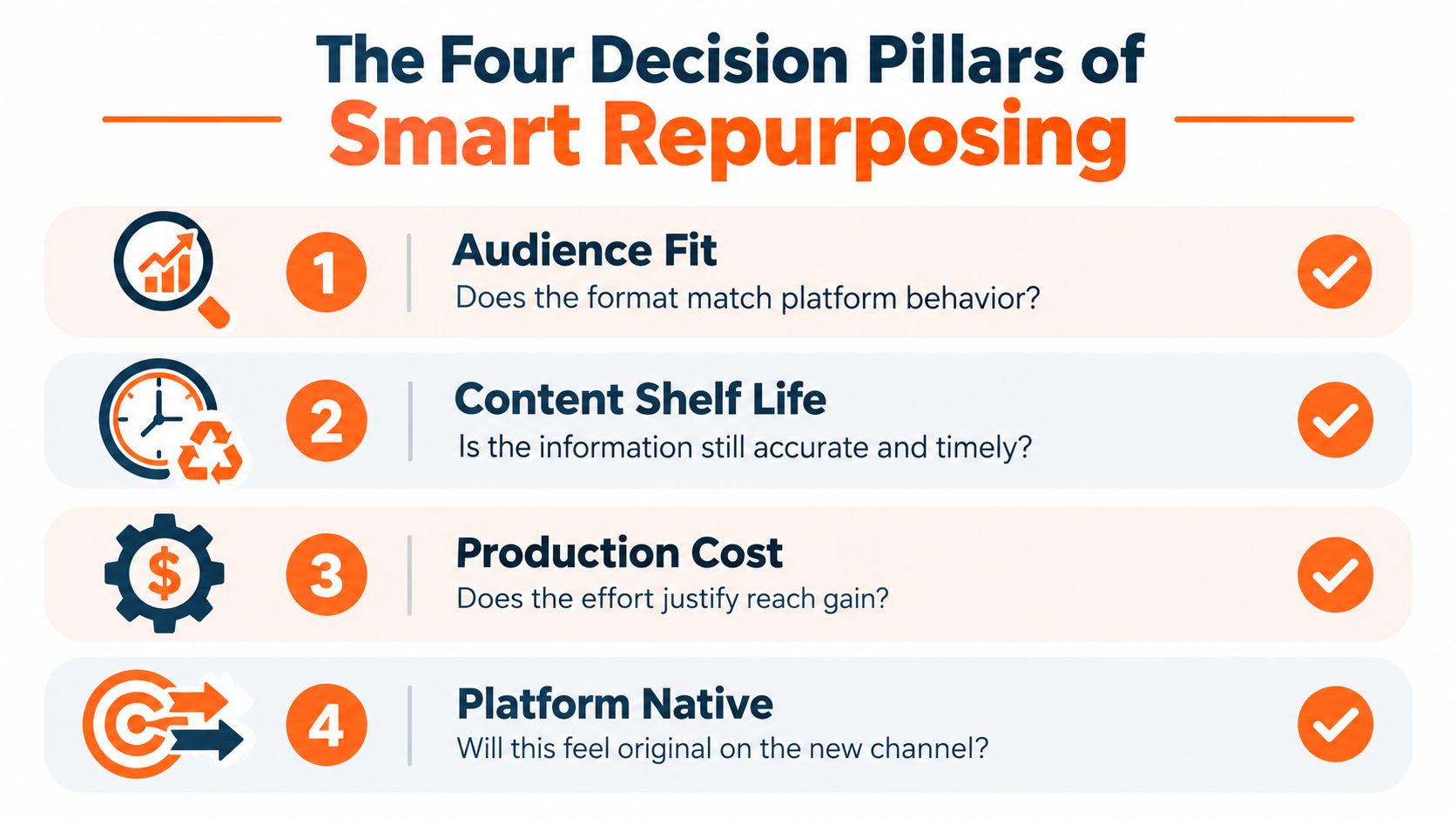
Industry reporting suggests that 94% of marketers repurpose content in some form, while 46% identify repurposing as the single best-performing content marketing strategy and 65% call it the most cost-effective approach (content repurposing statistics from TapVid). The same source says one blog post can become 8 to 12 pieces. In my experiment, that possibility worked only when each piece had a clear job.
The useful shift is from format-juggling to judgment. Before adapting an article, I check whether its ideas have enough life, clarity, and audience fit to earn another serving.
The Four Decision Pillars of Smart Repurposing
During the experiment, I stopped asking, “How many posts can this become?” I asked four narrower questions instead. They helped me separate an idea with genuine distribution potential from an article that was complete only in its original form.
Evergreen density
The first filter was how much of the piece would remain useful after its original publication moment. A creative-burnout essay passed easily. Its observations weren't tied to a launch date, a current event, or a temporary feature. A timely platform announcement was different. It could travel quickly, but only while the information remained accurate.
I marked evergreen passages in my drafts with a pencil. A paragraph earned a mark when it explained a durable problem, offered a repeatable method, or described a pattern readers could recognize later. Posts with a strong concentration of those passages became candidates for slower, staggered distribution.
Emotional hook strength
A useful idea still needs an entry point. The burnout essay opened with the feeling of staring at a finished draft that nobody sees. That tension could work as a Note, a LinkedIn opening, or the first line of an X thread because it gave each version a human reason to continue.
Not every personal essay had that flexibility. A grief piece mattered to me, but its power depended on the full context and careful pacing. Pulling out a single line would have made it smaller, not more accessible.
Quotable density
Some articles contain sentences that can stand independently. Others rely on the paragraphs around them. I looked for claims, contrasts, questions, and compact observations that retained their meaning outside the original sequence.
The burnout essay had several. The grief piece had very few. I left the latter alone, not because it was less valuable, but because its value would have been damaged by extraction.
Visual extractability
Finally, I checked whether the argument had a shape that could be seen. A sequence, checklist, contrast, or four-part model can become a carousel or a structured social post. A quiet narrative may need the full page.
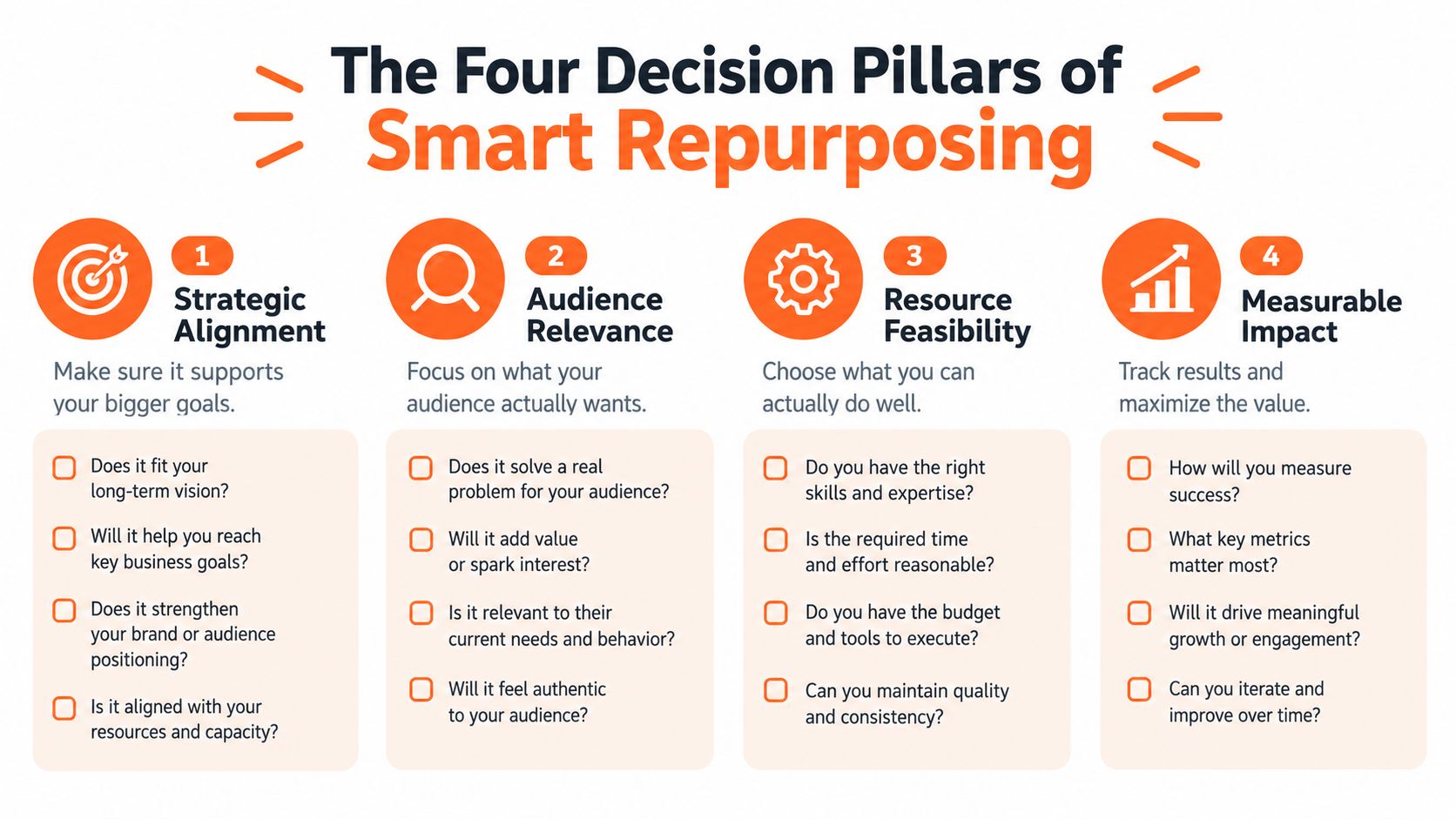
The burnout article passed all four filters. It became a Substack Notes thread, a LinkedIn carousel, and an X post, while the full essay remained the canonical version. I tracked the choices beside the other editorial signals in my content performance metrics workflow, but I didn't treat early engagement as permission to reuse everything.
My selection rule: Repurpose the strongest ideas that survive outside their original context. Leave alone the pieces whose meaning depends on the whole.
That returned me to the kitchen analogy. I wasn't trying to turn every ingredient into leftovers. I was choosing the meal that could be served again with a different preparation.
My 60-Day Substack to LinkedIn to X Workflow
I kept the first part manual because I wanted to understand the work before adding automation. After publishing a Substack article, I read it once without editing. On the second pass, I extracted the thesis and three supporting beats. Those four items became the source map for every derivative asset.
The first adaptation was a Substack Note. I wrote the hook as a compact observation rather than a miniature article, then used the supporting beats as a short sequence. The Note needed to feel complete on its own, while still making the longer essay worth opening.
LinkedIn received a different treatment. I expanded one supporting beat into a narrative with a specific situation, a clear lesson, and a soft invitation to read the original. I removed phrases that depended on the Substack layout and gave the post enough context to make sense in the feed.
X required compression and movement. I turned the thesis into the opening post, assigned one beat to each subsequent post, and cut explanations that belonged in the essay. Medium took the longest to trim because I wanted it to remain a coherent reading experience rather than a stretched social post.
| Platform | Format | Avg. Time | Output per Source Post |
|---|---|---|---|
| Substack Notes | Hook and short thread | 8 to 12 minutes | 1 Note |
| Narrative post or carousel outline | 20 to 25 minutes | 1 post | |
| X | Compressed thread | 15 minutes | 1 thread |
| Medium | Adapted long-form article | 20 minutes | 1 article |
The working range was 4 to 6 derivative assets from one source post, based on this experiment's workflow. That number is a planning benchmark, not a promise that every article deserves the same treatment.
I created each version manually first, then automated the repetitive parts. The manual pass exposed the decisions software couldn't make for me: which sentence sounded like my voice, which example needed more context, and where a platform-specific opening would feel forced.
A practical sequence: Read, extract, adapt, edit, schedule, then review the response before repeating the cycle.
The broader industry guidance points in the same direction. Start with high-performing evergreen assets, use analytics to identify engaged work, and adapt length, freshness, and format to each platform rather than duplicating the original (Optimizely's guide to content repurposing). I kept my own notes on the process in this content repurposing workflow, especially the edits that made each version feel native.
When Repurposing Hurts Your Reach
During my 60-day experiment, a LinkedIn post sent readers straight to Substack and earned less response than a post that delivered the lesson within LinkedIn. The link made the post feel like an exit. I had adapted the format, but left the platform with little reason to keep reading.
X exposed a different problem. Threads published within 24 hours of the newsletter sometimes competed with the original article. Readers could get the compressed argument and skip the longer version, especially when the thread added no new example or question.
Substack Notes punished repetition more visibly. After I reused the same hook three times in one week, engagement declined. The idea still had value, but the opening had become predictable. Readers recognized the shape before reaching the point.
A 2026 trend analysis draws a similar distinction between depth and volume, noting that five shallow repurposed pieces per week can perform worse than two substantial, well-adapted pieces (repurposing trends analysis from Repurpuzai). My strongest weeks followed that rule in practice: one substantial article, then adaptations with enough space and a clear purpose.
Release order changed the result. I kept the newsletter as the canonical home, published the most self-contained social version first, and waited before adapting the idea again. Each version had to earn its place by offering a different entry point, example, or conversation.
The practical lessons matched my notes on how algorithms work:
- Protect the original: Keep the complete argument and deepest context in the newsletter.
- Space the releases: Avoid publishing every derivative version in one burst.
- Change the entry point: A new format needs a new hook, not a shortened paragraph.
- Stop when the idea is spent: Filling every available slot is not a distribution strategy.
Repurpose strong work, then leave some material alone. A useful adaptation gives readers a reason to stay on its platform while preserving the newsletter's role as the complete version.
How Smart Tools Make Repurposing Feel Native
During my 60-day experiment, the first draft from an automation tool often looked efficient and felt wrong. A Substack argument copied into LinkedIn sounded clipped, while an X thread pasted into Notes had too much scaffolding. The workflow improved only after I separated scheduling, formatting, and drafting.
Scheduling solved a timing problem. I held Notes, LinkedIn posts, Medium articles, and X threads for deliberate release windows instead of publishing every version together. Staggering gave each adaptation room to develop its own context and made it easier to see which angle readers used.
Formatting solved a platform problem. A cross-poster can move text between services, but native versions need different structures, line breaks, links, and lengths. LinkedIn benefits from a complete thought with room for discussion. An X thread needs progression. A Substack Note should stand on its own rather than resemble a copied introduction.
Drafting remained the writer's job. Voice-matched AI gave me useful starting points from finished articles, especially when I used a clear workflow for AI content repurposing. I still checked every opening for honesty, every claim for support, and every platform version for a reason to exist independently.
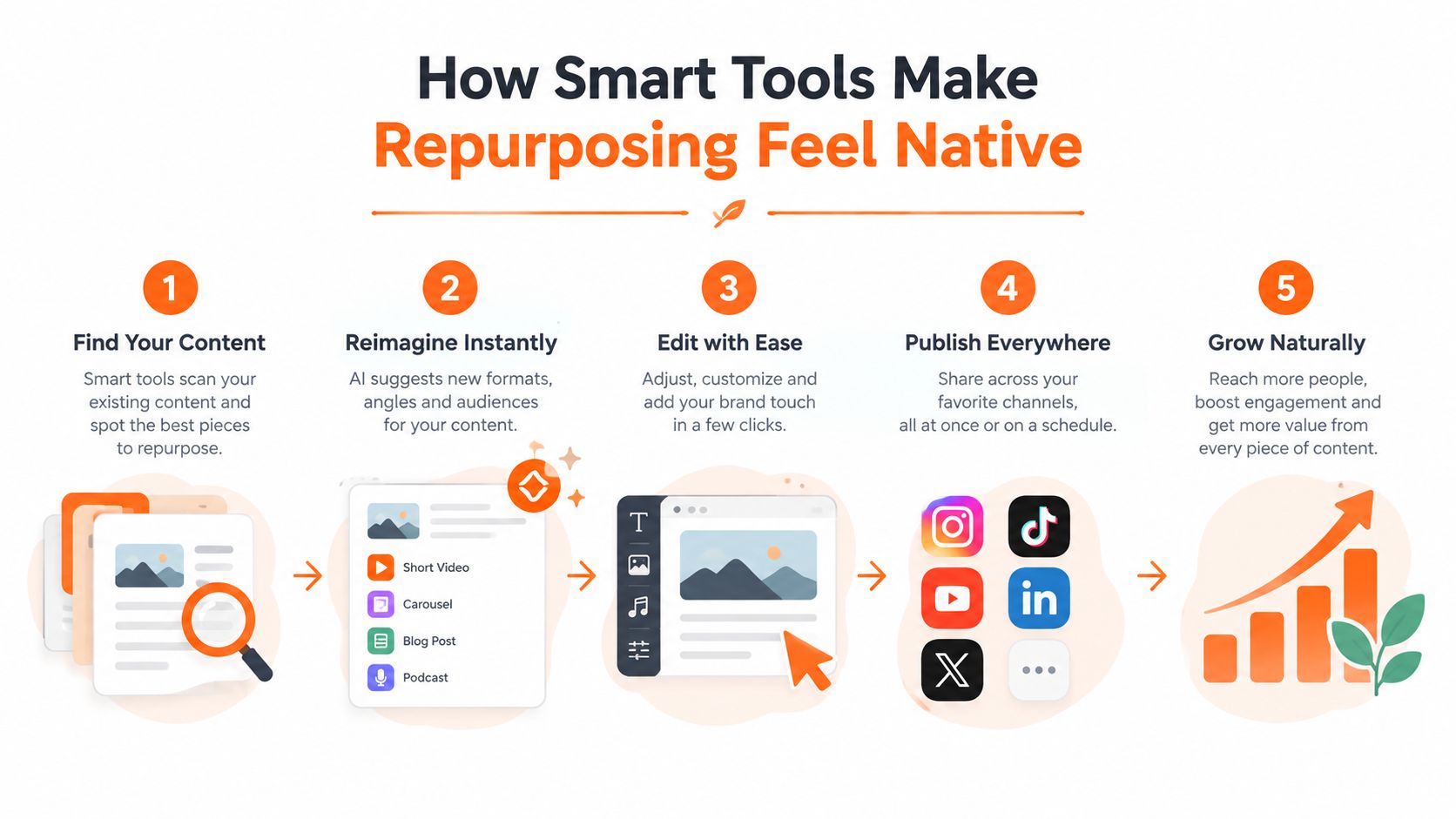
Substack's product direction supported that approach. In March 2026, Substack introduced Notes scheduling on web, iOS, and Android, letting writers draft ahead, choose a local publish time, and edit scheduled Notes from Drafts before publication (Substack's Notes scheduling announcement).
I also tested visual adaptations. A focused tool helped me create UGC videos with AI, but the editorial decision stayed with me. A private story may not belong in a public clip, and a visual can flatten a careful argument into a slogan.
I used Narrareach as the distribution layer. It turned a finished Substack draft into reviewable Notes, LinkedIn posts, and X threads, scheduled them across platforms, and provided cross-platform analytics. I treated each output as material for review, never as final copy.
The division of labor became clear:
- The writer chooses the idea and angle.
- The tool creates structured drafts and holds them for release.
- The writer edits for truth, voice, and platform fit.
- Analytics guide the next selection, not automatic duplication.
That arrangement reduced distribution fatigue because the system handled repetition while I kept the decisions about what deserved another life.
Your 30-Day Repurposing Starter Plan
On day one, open your last 10 posts. One may be a durable how-to, another tied to a passing event, and a third too personal to publish again. Tag each as evergreen, timely, personal, or visual-led. Then test the idea itself: is it still accurate, does it contain a clear tension, are there quotable lines, and can a visual carry part of it without flattening the argument?
During the second week, select one source article. Keep the newsletter as the complete version, then draft one Substack Notes thread, one LinkedIn post, and one X thread. Give each adaptation a different job. Notes can open a question, LinkedIn can clarify the lesson, and X can build a sequence. You are learning which form helps readers, rather than forcing equal output everywhere.
Week three exposed my distribution fatigue. I stopped trying to draft and publish everything in one sitting. I used one short block to extract ideas, another to shape platform drafts, and a final block to schedule them. Stagger the releases so each version has room to earn attention.
Week four is for decisions. Track saves, reposts, clicks to the original newsletter, and new subscribers by source platform. Treat those signals as evidence, not fixed rules. A format that receives no meaningful response after several careful attempts may need a new hook or may not deserve another version. Saves without clicks usually call for a clearer invitation to the full essay, not an immediate rewrite of the topic.
| Week | Focus | Time Commitment | Key Metric to Track |
|---|---|---|---|
| Week 1 | Audit the last 10 posts and tag them | One review session | Number of viable source posts |
| Week 2 | Convert one article into three platform formats | One weekly conversion slot | Saves and reposts |
| Week 3 | Batch drafts and schedule releases | Three short work blocks | Engagement by release timing |
| Week 4 | Review results and adjust | One measurement session | Click-throughs and new subscribers |
Starting with proven material keeps the experiment manageable. As noted earlier, repurposing is already common among marketers. Your first month does not need to match anyone else's publishing volume. It needs to produce enough evidence to decide which ideas deserve a second life, which format fits each platform, and which pieces should remain untouched.
Final Thoughts and Where to Go Next
After 60 days across Substack Notes, LinkedIn, Medium, and X, I stopped chasing a higher post count. A creative-burnout essay found new readers in shorter forms. A grief piece stayed as a newsletter because trimming it for distribution weakened the writing.
That choice came down to four filters: evergreen density, emotional hook strength, quotable density, and visual extractability. They made repurposing a decision-making discipline. Each draft needed a clear reason to exist on its platform, while some work earned protection through staying untouched.
Content repurposing works when the source keeps its meaning and each adaptation serves a different reader or task, as noted earlier in research on reuse and remix. I now ask three questions before creating another version: What is the strongest idea? Which platform can carry it naturally? What would be lost by cutting or reshaping it?
Narrareach can organize a Substack-to-Notes-to-LinkedIn-to-X workflow, keep drafts reviewable, schedule releases, and track which adaptations bring readers back to the newsletter. I would still review every draft. For a lower-intent start, choose one strong article and manually make one Note, one LinkedIn post, and one X thread before adding automation.
The experiment left me with a practical rule: choose fewer ideas, then give each worthwhile idea more than one honest path to discovery.
Narrareach helps writers turn finished articles into reviewable Notes, LinkedIn posts, X threads, and Medium content while managing scheduling and cross-platform distribution from one place. Visit Narrareach to build a workflow that keeps your voice and editorial judgment visible.