Content Distribution Matrix: Formats, Platforms and Goals
You finish a newsletter issue, publish it on Substack, and check the results the next morning. A few readers respond, but subscriber growth barely moves. You...
By Ian Kiprono
You finish a newsletter issue, publish it on Substack, and check the results the next morning. A few readers respond, but subscriber growth barely moves. You know the argument could work on LinkedIn, Medium, and X, yet adapting it feels like starting another writing assignment.
Meanwhile, your next issue needs attention. You copy an excerpt into a social post, forget the follow-up, and leave the rest untouched. Your archive grows, your publishing workload stays high, and you still can't tell whether the problem is the idea, the channel, or the way you're distributing it. Your strongest work deserves another chance, but you're already busy writing.
Why One Post on One Platform Stalls Growth
That publish-and-move-on loop leaves discovery largely to chance. Existing subscribers can read your issue, but someone who doesn't know you needs another route into the argument. Publishing more newsletters doesn't necessarily create that route.
The potential audience isn't small. In April 2024, 5.07 billion active social-media user identities represented 62.6% of the world's population, according to the We Are Social global statshot report. Those are user identities, not distinct people, but the scale makes the practical point: your potential readers aren't gathered around your publication.
Test distribution without rewriting your whole operation
I would start with a bounded experiment: choose an existing issue, adapt it for a few relevant channels, and record which derivatives bring readers toward a subscription. Keep the subscription offer consistent so you're testing distribution rather than changing everything simultaneously.
Say your issue explains how freelancers should raise prices. A LinkedIn reader might respond to a client-negotiation lesson; a Substack reader might prefer a candid question about undercharging. Both can lead to the same article without opening with the same paragraph.
Practical rule: Test whether an idea travels before committing yourself to maintaining another channel.
The trade-off is editorial time. Every derivative needs a reason to exist, not just an empty slot in a calendar. A channel that requires substantial rewriting but produces no useful audience movement shouldn't receive equal attention indefinitely.
A useful working system needs more than scheduled posts. It needs a matrix template, a way to select promising pieces, platform-specific derivatives, subscriber measurement, and a repeatable scheduling routine. Together, those let you test distribution without turning every issue into an open-ended promotional project.
The Content Distribution Matrix at a Glance
A content distribution matrix is a grid where each row represents an asset or derivative and each column records its platform, format, audience, goal, and cadence.
Think of a train timetable. Each asset needs a route and a destination, rather than departures everywhere. The full piece lives on its primary channel; secondary channels receive adaptations suited to their readers.
Starting matrix: formats, platforms, goals and cadence
These are proposed operating cadences, not performance benchmarks. Treat them as starting points to tune after a 12-week trial, reducing the workload if editorial quality slips.
| Asset format | Primary platform | Secondary platforms | Main goal | Starting cadence |
|---|---|---|---|---|
| Long-form newsletter issue | Substack | Medium, LinkedIn Article | Subscriber growth | Weekly |
| Evergreen Medium article | Medium | Substack, LinkedIn | Discovery | 1–2 per month |
| Substack Note | Substack | X, Threads | Retention and replies | Daily |
| LinkedIn post | X, Bluesky | Professional reach | 3 per week | |
| X post or thread | X | Threads, Bluesky | Clicks to the owned article | 3 per week |
Give each channel a primary job
Use discovery, trust, conversion, or retention as the underlying goal categories. Professional reach belongs under discovery; replies from existing readers may indicate retention. Subscriber growth is the outcome, but the channel's immediate job might be earning enough trust for someone to visit your subscription page.
That distinction prevents unrealistic comparisons. A discovery post shouldn't need to close the whole subscription journey, and a retention Note shouldn't be judged solely by how many strangers it reaches.
Consistency deserves more attention than minute-by-minute timing. In Write Build Scale's analysis of Substack Notes, the steadiest quarter of posters added a median of 1.33 subscribers per week, compared with roughly 0.53–0.55 for the burstiest groups, while the best and worst posting hours differed by only about 5%. That's an association, not proof that posting steadily causes the difference.
For additional ways to match adaptations to their destinations, Contesimal's guide to repurpose content for wider reach provides useful context.
Before queuing anything, check the destination's current composer requirements. A matrix is an editorial routing system, not permission to ignore formatting, paid-content boundaries, or the reader's expectations.
Measuring Which Channel Actually Drives Subscribers
The channel with the highest engagement isn't automatically your best growth channel. A reader can encounter your argument on LinkedIn, X, and Medium before subscribing. Each platform records its own interactions, but those totals don't establish how many new people you reached.
Say a hypothetical Medium article receives 300 reads and 15 subscriptions, while a LinkedIn post receives 20,000 impressions and 2 subscriptions. Medium produces more subscriptions in that scenario, but reads and impressions aren't comparable denominators, and you still need to examine effort and assisted conversions.
Separate attribution from incrementality
Attribution records a trackable route to subscription. Incrementality asks whether the subscription would have happened without that distribution. Tagged links help with the former; a holdout test helps investigate the latter.
The Narrareach newsletter content marketing guide discusses newsletter measurement in a broader distribution context. For implementation, use this walkthrough to track Substack subscriber conversions rather than treating every outbound click as a new subscriber.
Build your measurement around these fields:
- Post identity: Give every derivative an asset ID and distinct tagged link.
- Audience movement: Record unique reach, repeat exposure, clicks, and subscriptions where available.
- Conversion quality: Track subscriber conversion rate, time-to-conversion, and subsequent engagement.
- Measurement gaps: Mark audience overlap and any unreported metric as unknown, not zero.
Review each post's cohort after allowing time for delayed subscriptions. For a holdout, temporarily withhold a derivative from a selected channel while keeping the core issue and subscription offer comparable. Small samples and changing topics make this directional evidence, not a clean causal result.
Judge additional distribution by additional subscribers, not by the sum of platform counters.
For monthly allocation, use estimated incremental subscribers ÷ distribution hours. If you only have attributed subscribers, label the score accordingly. Continue investing while conversion remains healthy relative to your own baseline; when exposure rises but subscriptions stay flat, test a different audience, framing, or format before increasing frequency.
How to Build Your Matrix in Five Steps
Start in Google Sheets or Airtable. You need a shared record you can update reliably, not a complicated reporting system that takes longer to maintain than the posts themselves.
The workflow below keeps asset selection, channel priority, and review connected.
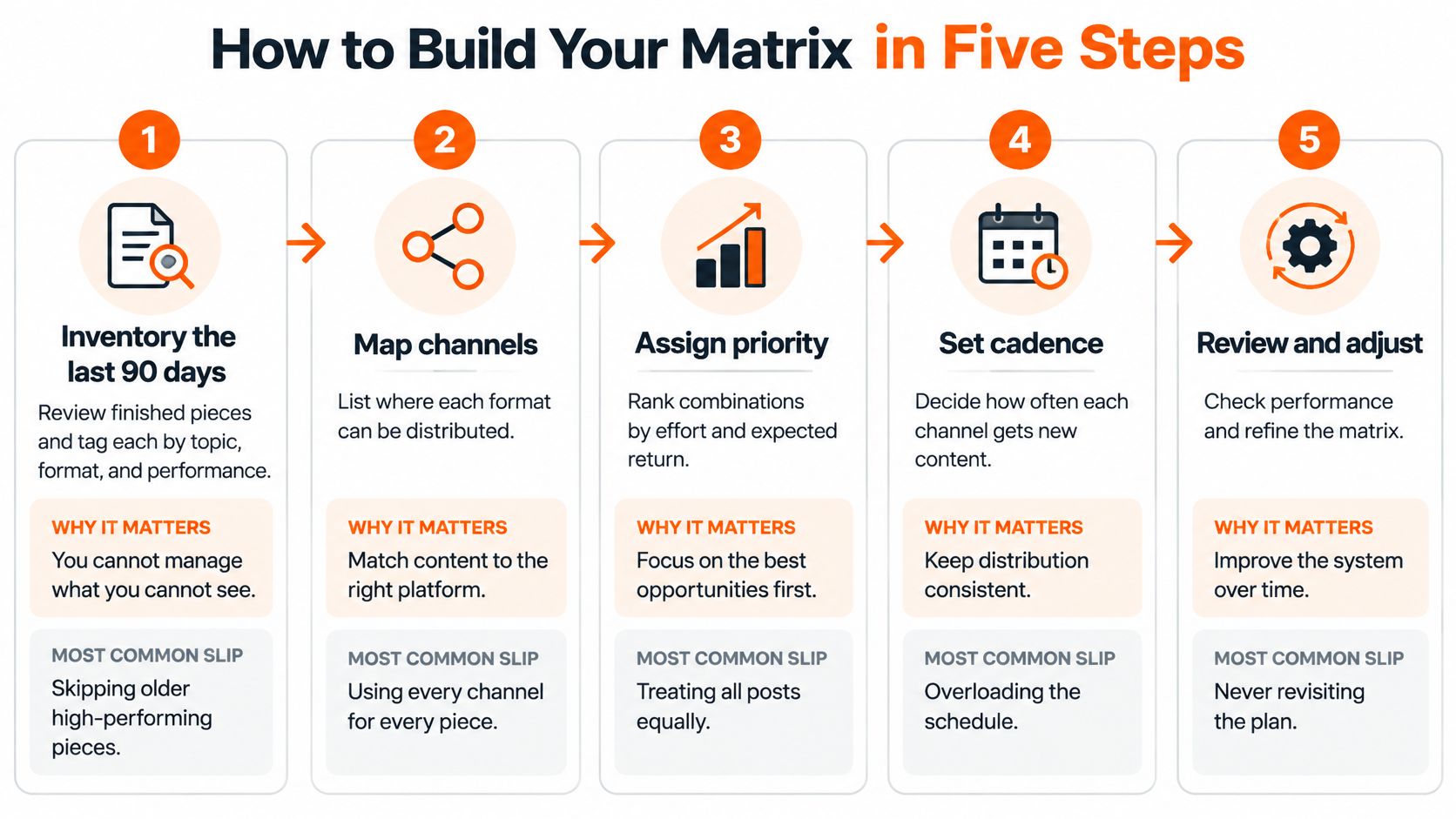
Inventory finished work. Review the last 90 days as a practical audit window, tagging each piece by topic, format, and performance. Topic-only tagging is the common slip: it tells you what you covered, not which treatment readers valued.
Choose a primary home. Assign each asset the destination where its complete version belongs, then list eligible secondary channels. Giving every destination equal priority creates competing versions and makes updates harder.
Assign the channel's job. Record discovery, trust-building, conversion, or retention beside each destination. Don't require a LinkedIn discovery post to do the work of both an explanatory article and a subscription page.
Set a sustainable cadence. Choose a schedule you could maintain for a 12-week trial, with a daily Substack Note as an optional starting target rather than an obligation. Plan for a typical working week, not the unusually quiet week when you built the sheet.
Review every Friday. Keep rows for individual derivatives and columns for platform, format, publication time, exposure, click-through rate, distribution effort, and new subscribers. Waiting for a monthly review can leave broken links or a poor-fit hook running unnoticed.
Make the first row usable
Use the social media marketing planning guide to connect those publishing decisions to an actual calendar. Keep the master asset and its derivatives linked by an ID, so you can distinguish an article's total contribution from a particular post's contribution.
Sample tracking row, illustrative values
| Asset | Primary platform | Format | Secondary platforms | CTR | New subscribers |
|---|---|---|---|---|---|
| Pricing essay issue 14 | Substack | Long-form issue | Medium, LinkedIn, X | 4% | 9 |
These are hypothetical entries, not recorded results. Add the publication time and exposure count from your own reports, and define the CTR denominator beside the sheet. A click rate calculated from delivered email isn't directly comparable with a social click rate calculated from impressions.
Finding High-Leverage Content Worth Repurposing
Start with material that has already earned a meaningful response. The Write Build Scale guide to Substack Notes recommends reviewing the last 10–20 Notes for strong performers and describes a workflow for producing 15–20 Notes in a weekly session.
A crowded like count can hide a weak asset. Judge candidates by replies that name a specific problem, restacks that carry the idea to new readers, and subscriptions tied to the post. That is the matrix test: a channel can create discovery, but the source piece earns repurposing only when it moves readers toward subscribing.
Filter for durable demand
For long-form articles, examine where readers came from and whether interest continues after the initial send. As working filters, check for search or referral visits after 30 days and compare conversion against your own 90-day median. These are proposed review windows, not universal thresholds.
Ask:
- Did it convert above baseline? Compare like-for-like destinations and subscription offers.
- Did new readers return? Look for repeat engagement rather than relying on a launch-day spike.
- Is the question still active? Check recent replies, reader emails, and relevant discussions before updating the piece.
A hypothetical article with 40 clicks and 6 subscriptions deserves attention before a post with 500 impressions and 1 subscription. It produced more subscribers in that example, but the denominators differ, so investigate traffic quality and effort before declaring a winner.
Selection test: Repurpose the reader problem that produced useful action, not merely the sentence that attracted applause.
Use a structured content analysis for social media to separate topic strength from format strength. If an evergreen article could also help another publisher's audience, prioritize editorial fit before outreach. Keep SEO link prospecting separate from that reader-fit decision; Keyword Kick's guide to backlink building sites belongs to the other workflow.
Build the weekly batch from the selected themes: a misconception, a checklist, an objection, a worked example, and a question. Don't force every idea into the same number of derivatives. Stop when you're repeating the wording rather than adding another useful entry point.
Turning One Article into Platform-Native Posts
Derivative rules by platform
| Target | Format rule | Hook style | Keep from source | Change per platform |
|---|---|---|---|---|
| Substack Note | Short, conversational, focused on one idea | Extract the sharpest line | Core claim | Opening, length, and link |
| LinkedIn post | Scannable text within the current composer limit | Lesson with a sourced number | Key data point and takeaway | Hook and call to action |
| X post or thread | Fit the account's current post allowance; split developed arguments into a thread | Contrarian or numbered claim | One takeaway | Length, format, and link placement |
| Medium article | Full-length argument with relevant tags | Reader problem | Full argument and examples | Title, subtitle, and tags |
Keep the claim; change the entry point. Your argument shouldn't contradict itself across platforms, but readers don't need identical openings. Check live format limits before scheduling, particularly when account types or publishing interfaces differ.
Adapt the pricing essay
For a Substack Note, extract the distinction between raising prices for new work and renegotiating an existing agreement. End with a question readers can answer from experience, rather than attaching a generic request to subscribe.
For LinkedIn, open with the business consequence: a higher rate won't improve your income if the scope expands unchecked. Include a supported calculation or clearly hypothetical example, explain the lesson, and offer the full essay to readers who need the negotiation framework.
The guide to repurposing content on LinkedIn helps turn that distinction into a professional post rather than a newsletter excerpt.
On X, use the counterargument: the problem may be undefined scope rather than the quoted rate. If the explanation needs a thread, structure it around diagnose, define, propose, with the article link where readers can continue. Don't stretch a simple point into a thread just to occupy more space.
On Medium, preserve the complete reasoning and examples while rewriting the title and opening for someone who has never read your newsletter. Explain the context instead of assuming an ongoing relationship.
Check for editorial duplication
Before approving the batch, compare the opening and promised benefit of each derivative. If every post says the same thing, you're repeating exposure rather than testing distinct reasons to read.
- Keep evidence intact: Preserve qualifications and source context.
- Match the invitation: Ask for a reply, a read, or a subscription according to the post's job.
- Protect the source: Use previews for paid material rather than publishing the complete argument elsewhere.
Create only as many derivatives as your schedule can carry without crowding out the next worthwhile idea.
Automating the Matrix Across Substack, Medium, LinkedIn and X
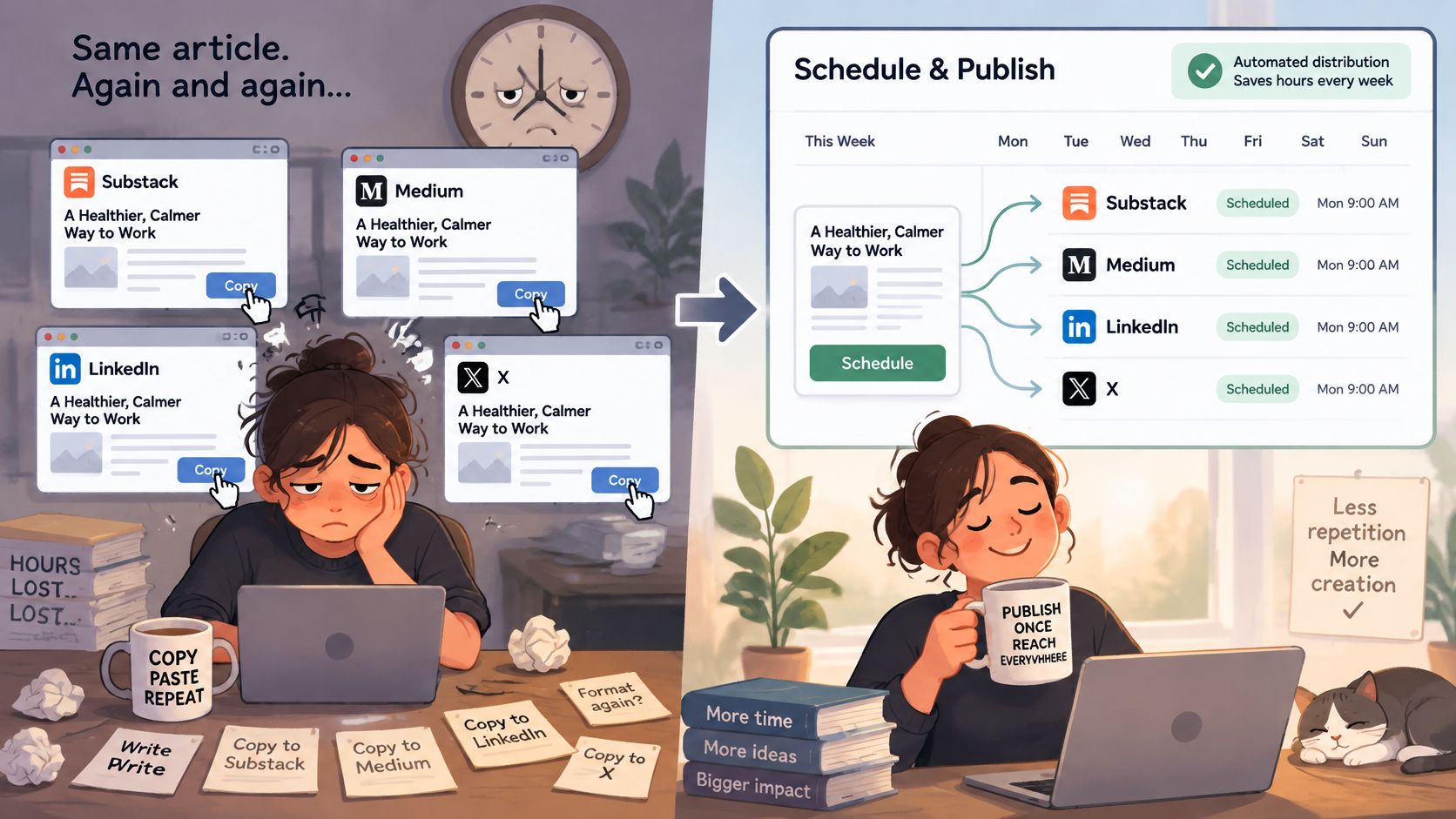
Manual distribution becomes expensive when you're repeatedly opening composers, checking links, and recreating formatting. The useful automation removes those repeated operations while leaving argument, evidence, and tone under editorial control.
The difference is between recreating a publishing task and approving a prepared batch.
Start with native scheduling
According to Substack's Notes scheduling announcement, web users select the calendar icon in the Notes composer; on mobile, they open the three-dot menu and choose Schedule. Scheduling follows the writer's local time zone, and queued Notes remain editable in Drafts until publication.
That gives a solo operator a workable baseline. Draft away from the composer, review the complete batch, then schedule publication. Leave room to revise queued material when a claim changes or a discussion makes a planned post inappropriate.
For cross-channel work, Narrareach extends that workflow into a dashboard for scheduling Substack Notes, Medium articles, LinkedIn posts, and X content. It turns long-form ideas into platform-specific drafts that match your voice, while subscriber attribution helps identify which posts bring subscribers. You approve the drafts, so distribution gets faster without handing over editorial judgement.
The practical automatic Substack distribution workflow helps connect the source article with its supporting posts.
Use this walkthrough alongside your publishing queue.
Run an editorial routine
- Prepare: Finish the source article and identify the audience problem each derivative addresses.
- Approve: Verify sources, voice, destination, tagged link, and the subscription invitation.
- Schedule: Spread the batch across the working week, checking time zones and avoiding overlapping arguments.
- Review: On Friday, inspect subscriber outcomes and record what to change before preparing the next batch.
Faster Substack growth isn't a guaranteed consequence of filling the queue. The useful outcome is reliable distribution of proven themes, with enough measurement to stop repeating weak ones. A scheduled Note should give readers something worthwhile on its own and a clear reason to explore the article.
Your First Two Weeks and Next Steps
Week one: Fill the starting matrix for the channels you use. Choose five assets from the last 90 days as a manageable audit exercise, apply the checklist, and draft a platform-specific derivative for each relevant destination of the strongest piece.
Don't expand the channel list yet. Resolve missing source links, unclear subscription offers, and tracking gaps before adding more publishing work.
Week two: Prepare the first batch of 15–20 Notes if your selected themes support that much distinct material. Schedule only the drafts that pass editorial review, then run your Friday check and record which channel brought attributable subscribers.
Finish the test with a smaller, clearer system rather than a larger queue you can't maintain.
This workflow suits writers who already publish consistently and need scheduled distribution, not another obligation to create from scratch. You can complete it with native scheduling and a spreadsheet.
Choose either a tool-assisted start or the lower-commitment mailing-list route below. Your first action today is the same: open the shared sheet and add the first five assets from your archive.
Ready to put your matrix into operation? Visit Narrareach to turn an article into platform-specific drafts, schedule distribution across Substack, Medium, LinkedIn, and X, and see which posts bring subscribers. If you're not ready for a tool, join the mailing list to stay connected with practical distribution guidance while you build your matrix and channel scoring sheet yourself.