How to Promote Medium Articles Across Platforms in 2026
You hit publish on a piece you were proud of. The formatting was clean, the argument held together, and you gave it three evenings. Four days later the stats...
By Ian Kiprono
You hit publish on a piece you were proud of. The formatting was clean, the argument held together, and you gave it three evenings. Four days later the stats page shows 38 reads, a couple of claps from people who already follow you, and nothing from anyone new. The obvious conclusion is that the topic was wrong or the writing wasn't good enough, so you open a fresh draft and lower your expectations.
It's almost never the writing. A published article with one link dropped into one feed is competing against everything else in that feed, and the feed doesn't owe you a second look. What separates the writers who build an audience from the ones who keep restarting is rarely talent. It's a distribution routine they run every time, whether or not the first post lands.
Why Your Medium Article Stalls Without Promotion
The pattern repeats. Drafting gets the calendar block, the research, the third revision. Distribution gets whatever's left, which is one post on one network and a link in a group chat. Then you refresh the stats page for three days and start the next draft slightly less sure of what works.
The platform isn't the bottleneck. Medium's published statistics, compiled by McKlinky, record that readers reached Medium more than 100 million times through Daily and Weekly Digest recommendations in 2024, the same year Medium said it surpassed 1 million members and became profitable for the first time in its 12-year history. The same source notes Medium passed 1 million published posts by 2015, with posts and readership each growing approximately 300% year over year in 2016.
Scale cuts both ways. A recommendation engine generating 100 million digest visits has plenty of room for your article and no obligation to include it. Discovery is a bet Medium's system makes about whether a given reader will click, and that bet gets settled without you in the room.
Working rule: if an article only exists in one place, it only has one chance to be found.
The fix is structural, not motivational. Treat each article as a source asset that needs four or five entry points: Medium's own topics and recommendations, a newsletter send, a LinkedIn post, an X hook, a Substack Note. One link drop reaches one audience once.
What follows is the operating version. A channel map for a single article, a five-step campaign you can run in an afternoon, a weekly batch routine, and the numbers that tell you whether any of it produced readers rather than traffic.
Where to Post One Article and What Each Channel Does
One article, five destinations, five different jobs. Posting identical text everywhere wastes the format each channel is built for.
| Channel | Role for the article | Format to post |
|---|---|---|
| Medium full article | Discovery through tags and recommendations | Full text, clear subtitle, five tags |
| LinkedIn post | Professional reach | Practical takeaway with tagged link |
| X post or thread | Sharp problem or insight hook | Counterintuitive claim plus one-line takeaway |
| Substack Notes | Reach readers already in the Substack network | Short Note with quote or link |
| Owned newsletter | Direct audience | 500 to 1,000-word excerpt plus link |
The row writers skip most often is the newsletter, and it's the one with the clearest evidence behind it. HubSpot's guide to integrating social media and email marketing, citing MarketingSherpa and Silverpop research, reports that adding social-sharing options to email increased the average reach of an email by 24.3%. The same research tracked SmartBrief, a B2B newsletter publisher, after it added sharing buttons to articles featured in its emails: visits from LinkedIn rose 2,070%, from Twitter 1,680%, and from Facebook 1,351%.
Those SmartBrief figures describe one B2B publisher in a historical case, so read them as proof that the mechanism works, not as a forecast for your list. The mechanism is simple. A subscriber who forwards your article is both a reader and a distributor, and a share button is the cheapest way to convert one into the other.
If LinkedIn is where your professional audience sits, Linkboost's engagement platform guide covers how early comments and reshapes push a post into other people's feeds, which matters far more than the like count on your own.
Deciding which rows an article deserves gets easier with a content distribution matrix that maps formats to intent. Then apply the rule that keeps promotion from becoming noise: send each article only to the channels where its angle genuinely fits. A technical teardown earns an X thread and a publication submission. A personal essay earns the newsletter and a Note. Sending everything everywhere burns your audience's patience for the pieces that deserve the push.
How to Run a Five-Step Promotion Campaign
The campaign below turns one finished article into a week of coordinated posts, and it runs in a single sitting.
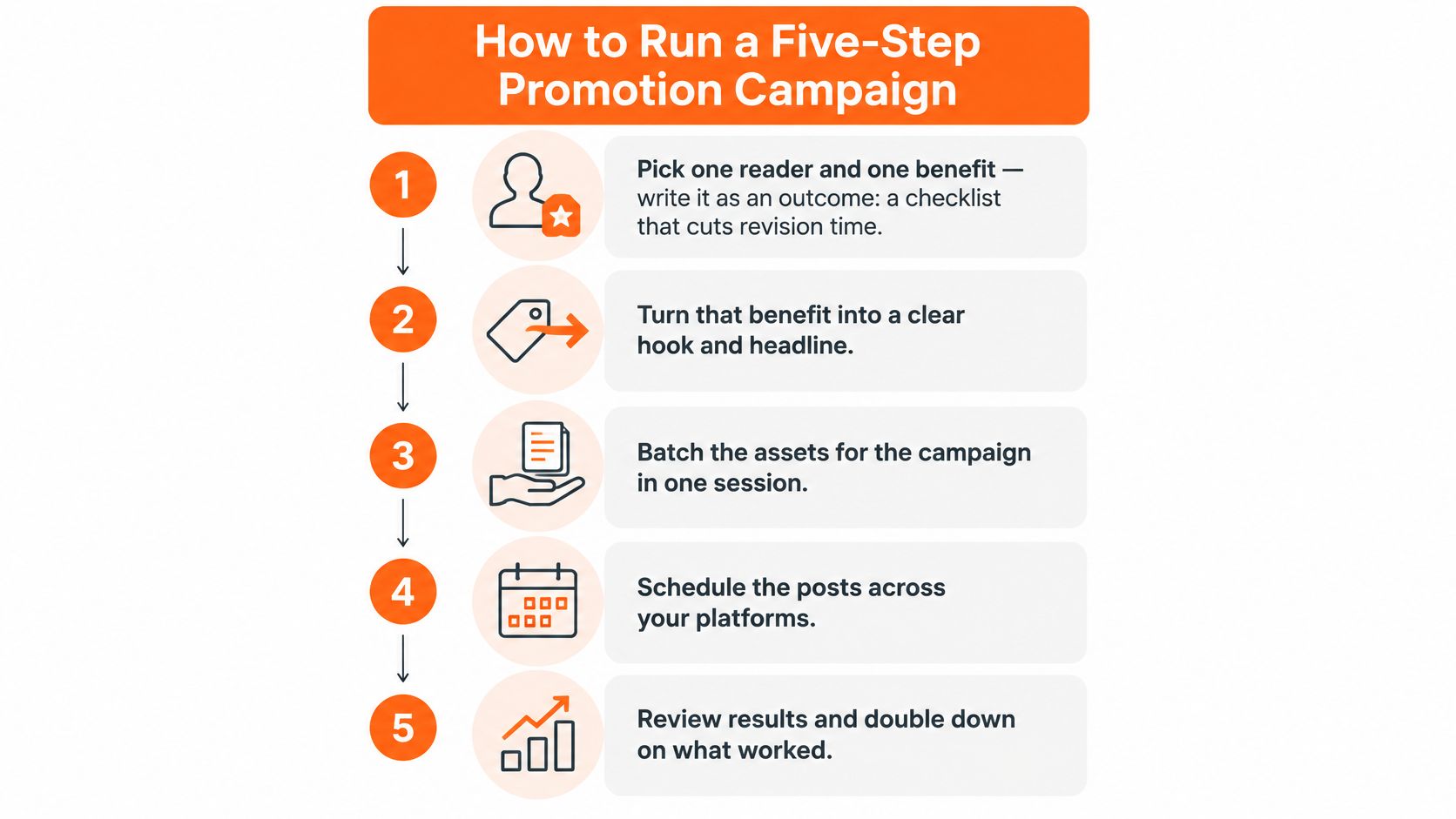
Before the steps, one caution about how you'll judge them. A peer-reviewed study of 324 scholarly-article posts, published in the Journal of Information Science, found that Facebook generated 2.5 to 4 times the engagement of Twitter and roughly twice as many article visitors, but that platform advantage largely disappeared once follower-base size was controlled. The same study found clicks were a more direct promotion measure than likes or shares. So compare channels by clicks per follower, not by raw engagement.
- Pick one reader and one benefit. Write it as an outcome a specific person gets, such as "a checklist that cuts revision time in half," not "new article." A benefit you can name in one line becomes a hook you can reuse on every channel.
- Turn that benefit into platform-specific hooks. A concise problem or insight for X, a practical takeaway for LinkedIn, a visual summary or discussion question for broader social. Rewriting is the work. Pasting the same paragraph into four boxes is the shortcut that wastes the effort.
- Publish the full article on Medium with a clear subtitle and all five tags. Then give each channel its own tagged destination URL. Without tags on the links, you can't tell which post sent the readers who stayed.
- Post when your followers are active, and test at least two hooks per article. Two variants of the same article tell you whether the idea or the phrasing did the work. One version tells you nothing.
- Reply to early comments within the first day, then retest the strongest angle a few days later. The follow-up reaches the people who missed the first pass, and it costs one post.
Two steps Medium handles differently
Before publishing, check whether a relevant Medium publication accepts submissions, because a publication puts your story in front of followers who never heard of you. Write the subtitle around the phrase a reader would type into search, since subtitle and tags shape both recommendations and search discovery. After publishing, answer every comment on day one. Early replies keep the article in conversation and signal to later arrivals that someone is there.
You draft inside Narrareach and schedule the Substack post, then publish the article to Medium, LinkedIn, X Articles, WordPress, and Ghost at the same time, which removes most of the manual copying in steps three to five. A content repurposing workflow covers how to cut one article into the shorter pieces each channel needs.
If you'd rather watch the walkthrough than read the checklist, this covers the same sequence end to end.
A finished campaign contains: one article with five accurate tags and a search-shaped subtitle, one newsletter send with a share button, one LinkedIn post, two to three X posts, one Substack Note, and a tagged link for every channel.
Batch and Schedule Posts Across Platforms
Batching beats daily improvisation because the expensive part is context switching, not writing. One session per week produces one article and three to four Notes, and the rest of the week is replies and measurement.
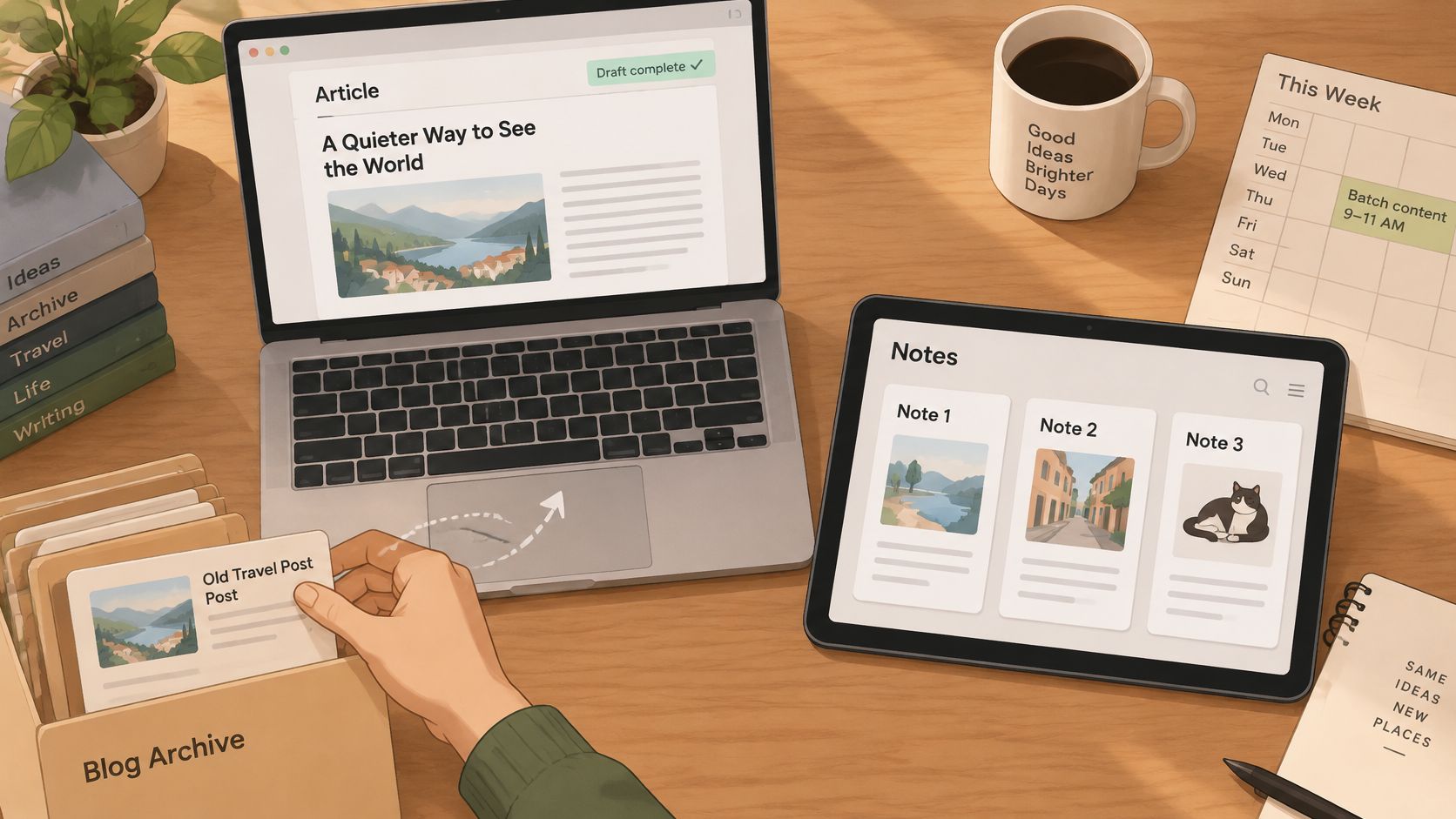
Start from a blank page or import existing work from a Substack or Medium archive, a blog, or Google Docs, then bring in an editor to review the draft before it goes anywhere. In Narrareach, a writer can start an article, Note, or social post from a blank page or import existing work, invite a team into the editor, then schedule and publish across supported destinations and compare performance.
Substack's own tooling supports the routine. Substack's features page lists drafts with autosave, version history, post templates, SEO metadata controls, and a date-and-time picker for scheduling posts. On the web you schedule a Note from the calendar icon. In the mobile app you open the composer's three-dot menu and choose Schedule, and scheduled Notes are saved in Drafts, so check that folder before the week starts. Once a Note is live, its statistics become available within 24 hours and usually refresh hourly, with metrics covering revenue, new free and paid subscribers, new followers, total clicks, and total shares.
The weekly plan that holds up
- One long article: drafted Monday, published Tuesday on Medium with tags and subtitle set.
- Three to four Notes: written in the same session, spread across the week, each from a different angle on the article.
- One LinkedIn post: the practical takeaway, tied to the same article with a tagged link.
- A fixed review window: wait until each Note has had a day to collect numbers before you judge it.
Scheduling without review leaves stale hooks in the queue. Re-read each scheduled post the day before it goes out, and cut anything that no longer matches the article. If you want the deeper mechanics of when posts should land, block scheduling covers why protecting a repeating window beats finding time each day.
One practical detail for teams: a Manager teammate can schedule articles to the owner's Medium or LinkedIn, and those articles go out through the owner's own connections rather than a brand account.
Measure Qualified Readers Instead of Raw Views
A view is a visit. A qualified reader reads the piece, follows you, or subscribes. Those are different events, and most promotion advice collapses them.
Medium's discovery model recommends articles by reader interest and subject, while its direct channels include follower feeds and email notifications, so what happens after the click matters more than how the click arrived. That distinction is laid out in a walkthrough of Medium's 2025 discovery and distribution model.
| Metric | Where to find it | What it tells you |
|---|---|---|
| Tagged-link clicks | Analytics for each channel's link | Which channel sends visits |
| Medium read ratio | Medium article stats | Share of viewers who actually read the piece |
| New followers after publishing | Medium stats | Whether readers want more from the writer |
| New subscribers per Note | Substack Notes statistics | Which Notes lead to subscriptions |
| Notes clicks and shares | Substack Notes statistics within 24 hours | Reach and interest in the idea |
| Newsletter sign-ups from a send | Email platform report | Growth of the owned audience |
Read the table in that order. Tagged clicks tell you which channel sent traffic. Read ratio then filters it, because a high-view article with a low read ratio attracted the wrong readers. Record new followers per article and new subscribers per Note, and retest your strongest hook after two weeks rather than rewriting everything at once. Medium analytics explained covers where each number lives in the dashboard.
The earnings question you can't skip
Third-party coverage reports that the Medium Partner Program formula has changed repeatedly since October 2025 and may count external traffic, search discovery, email sharing, and new-member conversions. One analysis of the Medium Partner Program's payout changes describes a 5% bonus for member reads arriving from general external sources plus additional incentives for search and email traffic, and notes that the older recurring referral model was replaced. None of that is official Medium documentation. Check the current payout terms before you make income decisions on it.
The mistake to avoid: judging a campaign by likes. Likes are cheap, and they make a weak channel look strong while a channel sending five subscribers gets ignored.
Run a 30-Day Substack Notes Experiment
Notes work because the reader never leaves the network. Substack's guidance on growing an audience explains that Notes was designed to help writers' work travel through the Substack network so new readers discover it, and that someone encountering a shared post is already inside the ecosystem, one click from subscribing.
Run the test as a fixed experiment, not a vibe. One topic, 30 days, three Notes per day, and a 10-5-1 interaction rule applied to each Note: like 10 Notes from other creators, leave five meaningful comments, send one direct message. A documented 30-day Substack growth plan uses exactly that target, which compounds to 90 Notes, 300 likes, 150 comments, and 30 direct messages across the month. Report your actual totals instead of an impression.
Split the month into two hooks
Days one to fifteen use one hook for the article's excerpt with a link. Days sixteen to thirty use a different hook while the daily activity stays identical. That way the hook is the only variable that changed.
Worked example. Say hook A produces 12 new subscribers from 6 Notes and hook B produces 2 from 6. Hook A earns the next article and hook B gets rewritten rather than abandoned. If both produce nothing, the problem is the audience match, not the phrasing, and you change the topic or the community you're participating in.
Log clicks, new followers, and new free or paid subscribers for each Note, sort by subscribers gained, and turn the top two ideas into full Medium articles. A Substack Notes performance tracker keeps those totals in one place so the comparison stays honest.
Close the month with three lines: the totals you hit, the hook that won, and the one change you're making next month. Anything longer won't get re-read.
Choose Your Next Promotion Step
Run one finished article through the five-step campaign this week, and judge it after 14 days on read ratio, tagged clicks, and new subscribers.
If you publish on more than one channel, start free with no credit card, connect Medium and Substack, and schedule the same article across the channels in the map above. Narrareach publishes to 15 channels, including Substack, Medium, LinkedIn, X, Threads, Bluesky, Instagram, Facebook, TikTok, Pinterest, WordPress and Ghost, and most writers publishing on more than one channel clear the cost within the first month.
If you'd rather watch one experiment before committing to a tool, subscribe to receive the results of the 30-day Notes experiment and the weekly batch template. No pitch attached, just the numbers and the schedule.
Record three figures for your first article, each with the date you pulled it:
- Tagged clicks: the total per channel, recorded 7 and 14 days after publishing.
- Read ratio: the Medium stat, recorded on the same two dates.
- New subscribers: counted from the newsletter and Substack dashboards at the 14-day mark.
Narrareach is built for the part after the writing: drafting once, scheduling Substack Notes and the article itself, then publishing to Medium, LinkedIn, X, WordPress, and Ghost from one place, with cross-platform analytics that show which channel produced subscribers. You can start free without a credit card and run the next article through the channel map above instead of dropping one link and hoping. Visit Narrareach to connect Medium and Substack and put the first campaign on the calendar this week.