
What Is Block Scheduling for Newsletter Writers
Your writing day is scattered across drafts, email, and platform tabs; block scheduling replaces those scraps with fewer, longer work periods, about 70–90...
By Ian Kiprono
Your writing day is scattered across drafts, email, and platform tabs; block scheduling replaces those scraps with fewer, longer work periods, about 70–90 minutes in the school model, used here as protected creative blocks. The immediate problem is that you keep reopening the same unfinished issue while its Notes, LinkedIn post, and X thread remain unwritten.
You've done the thinking, but you haven't reached the readers. By the time you return to Substack, you're trying to remember what you meant to say instead of finishing it.
When Your Writing Week Falls Apart
Monday's draft has a strong opening. You've found the story, connected it to a reader's problem, and written enough to know the issue could work.
Then a client message arrives. You answer it, check email, and open LinkedIn because you meant to share something there. When you return to the draft, you reread the opening rather than write the ending.
By Thursday, the article is still unpublished on Substack. The idea hasn't become a Note, and adapting it for another platform feels like accepting another assignment.
The unfinished work around the work
The frustration isn't only a late newsletter. It's watching subscriber growth stay flat while useful ideas remain inside documents your readers can't see.
- The article exists, but its conclusion still needs attention.
- The distribution plan exists, but only as a reminder to post something.
- The calendar looks occupied, yet there's no protected appointment for finishing either job.
That distinction matters. If you know what you want to say but keep losing the conditions needed to say it, you may have a scheduling problem alongside a creative one. A guide to overcoming writer's block can help you examine the creative side without assuming every stalled draft needs another productivity tool.
For a business newsletter, distribution also needs a purpose beyond being present everywhere. SemDash's a playbook for reaching buying committees is a useful companion when you're deciding which prospective buyers an article should help.
An experiment without an invented success story
I'd test a different weekly shape: protect drafting, return later for revision, and give distribution its own appointment. The worked week below is an illustrative experiment, not a claim that I ran a measured trial or achieved a subscriber lift.
The test isn't whether I can stay busy inside a longer appointment. It's whether I leave with something a reader can receive.
That's a useful standard even if you never change tools. A calendar, a draft, and a clear exit artifact are enough to begin.
What Block Scheduling Means for Writers
A school timetable makes the idea easier to understand. Instead of moving students through many short periods, a block schedule gives them fewer classes with more uninterrupted time in each.
In secondary education, a typical design includes four or five classes daily, with periods of approximately 70–90 minutes. Common formats include 4×4, where students take four subjects daily for one term, and A/B, where different classes meet on alternating days; the EPPI Centre's systematic review of block scheduling also found higher average cross-subject achievement under 4×4 schedules, while warning that averages could conceal gains in some subjects and declines in others.
Translate the timetable, not the achievement claim
At a newsletter desk, the useful borrowing is the arrangement of time. School achievement findings don't establish that writers will publish better articles or attract more subscribers.
A 4×4-style concentration might mean staying with research and drafting through a concentrated production stretch. You're not asking yourself to alternate between developing an argument and adjusting social-post formatting throughout the same sitting.
An A/B-style rhythm might alternate composition with distribution and review. You return to the same idea in different modes instead of abandoning it after drafting.
| School design | Writer's adaptation | Practical question |
|---|---|---|
| Concentrated subjects | Concentrated production work | What substantial task needs continuity? |
| Alternating classes | Alternating writing and review | When will I return with fresh attention? |
| Extended instructional period | Protected creative session | What must exist when I stop? |
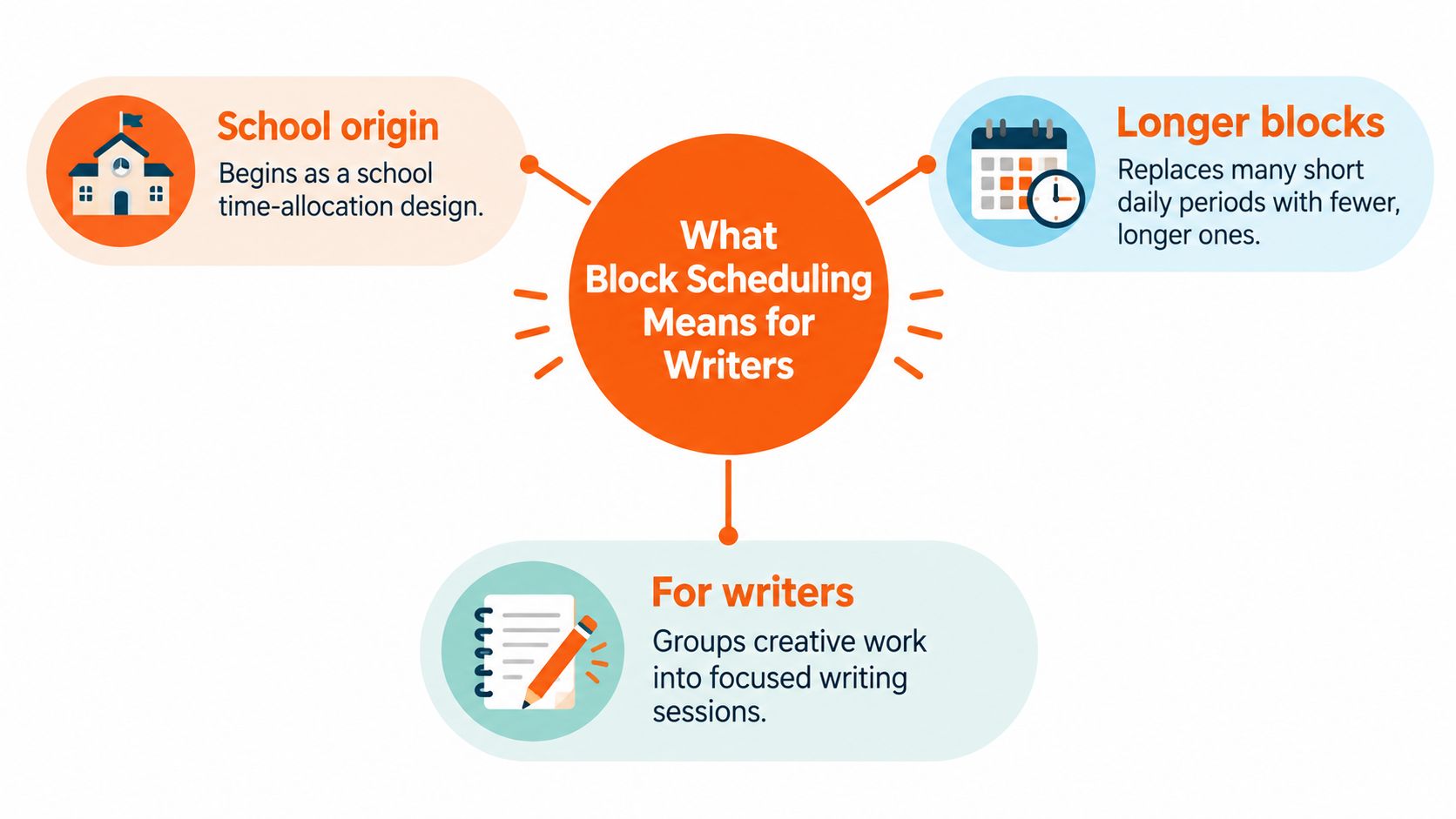
The concept map shows the relationship between the school model and its writing adaptation.
Capacity isn't quality
A classroom can use contiguous time for laboratory work, projects, guided practice, and assessment rather than repeatedly stopping for transitions. A writer can use the same principle to keep research, reasoning, and revision close enough that the argument remains visible.
But a longer appointment can also hold an unfocused draft or an extended browse through other people's posts. Block scheduling supplies room for a sequence of activities. It doesn't choose those activities for you.
When someone asks what is block scheduling for writers, that's the distinction I'd emphasize: protect a category of meaningful work, then decide how you'll move through it.
Why Longer Blocks Help and When They Fail
Open a research document, locate the supporting passage, reread your outline, and you've already performed the setup for writing. If you stop immediately afterward, the next session may begin with the same preparations.
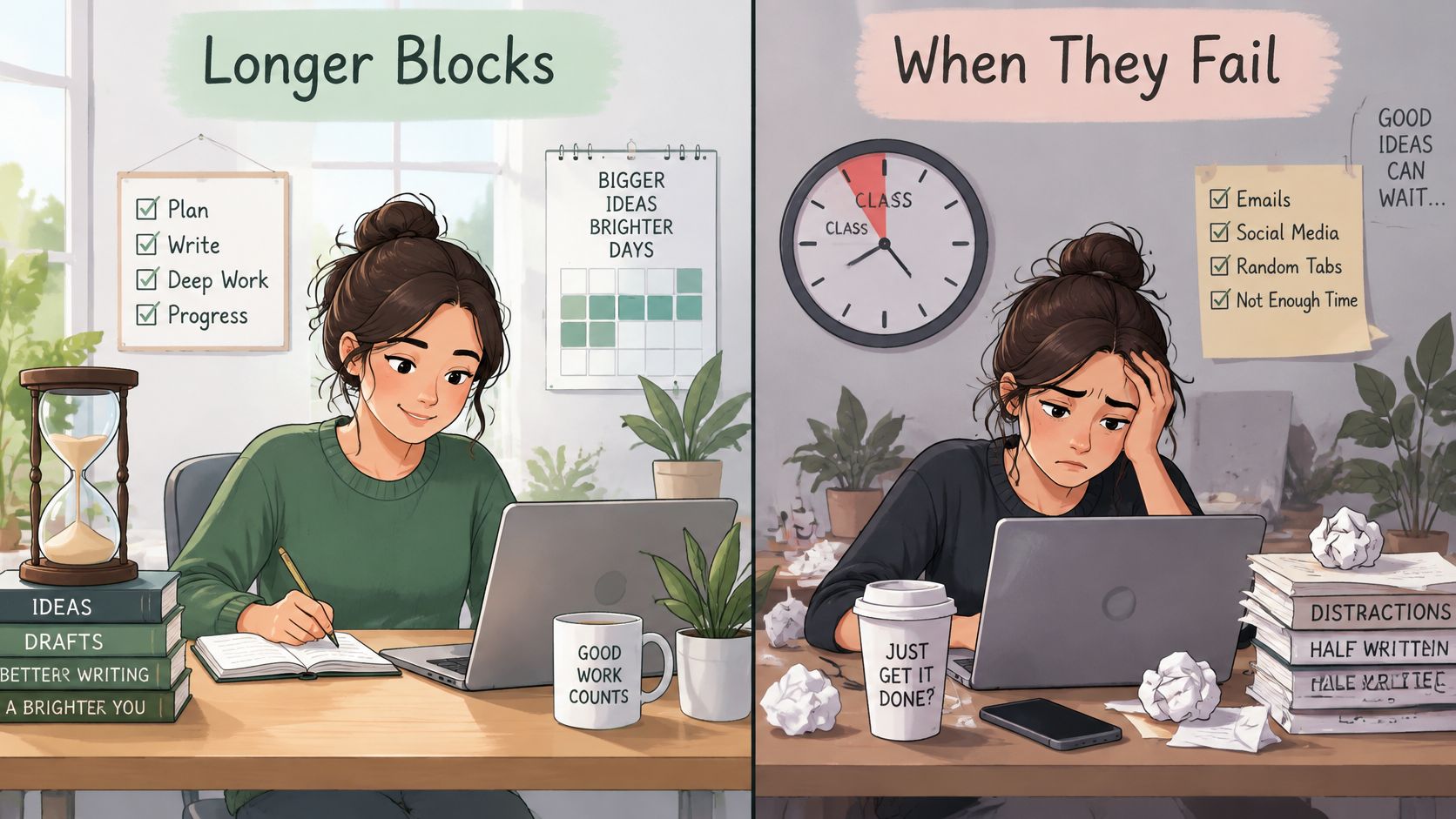
The comparison below captures the practical difference between staying with an argument and repeatedly restarting it.
Depth has a counterweight
Research summaries describe conventional classes of approximately 50 minutes and block periods commonly around 75–95 minutes; the American Library Association's review of block-scheduling research notes mixed learning outcomes and that spaced learning can outperform concentrated learning in some subject areas.
The writer's parallel is a planning judgment, not a proven transfer of classroom results. Staying with a difficult section may help you finish its reasoning, but avoiding that argument until publication day gives you no opportunity to reconsider it.
Practical rule: Protect enough time to develop the idea, then arrange another encounter with it.
A fresh review can ask a different question from the drafting session. Does the opening match the conclusion? Have you explained the offer clearly? Could a new subscriber understand the example without reading your previous issues?
This video provides another way to consider the scheduling model.
A missed block needs a response
Long appointments also concentrate risk. If an urgent client request consumes the drafting window, you've lost the main opportunity you assigned to that task.
The equity question matters in schools: longer periods can allow individualized support, but missed instruction and unreliable catch-up arrangements can make them harder to manage. A University of Connecticut policy brief found no strong evidence of improved standardized-test performance and reported that 80–90-minute A/B and 45–60-minute traditional schedules outperformed other modified formats after controlling for poverty.
For a solo creator, the practical response is a recovery appointment. Don't build a system that works only when nobody gets sick, no deadline moves, and every morning is available.
How to Split a Creative Block into Phases
A long block needs internal movement. Otherwise, you've replaced scattered work with a longer opportunity to get stuck.
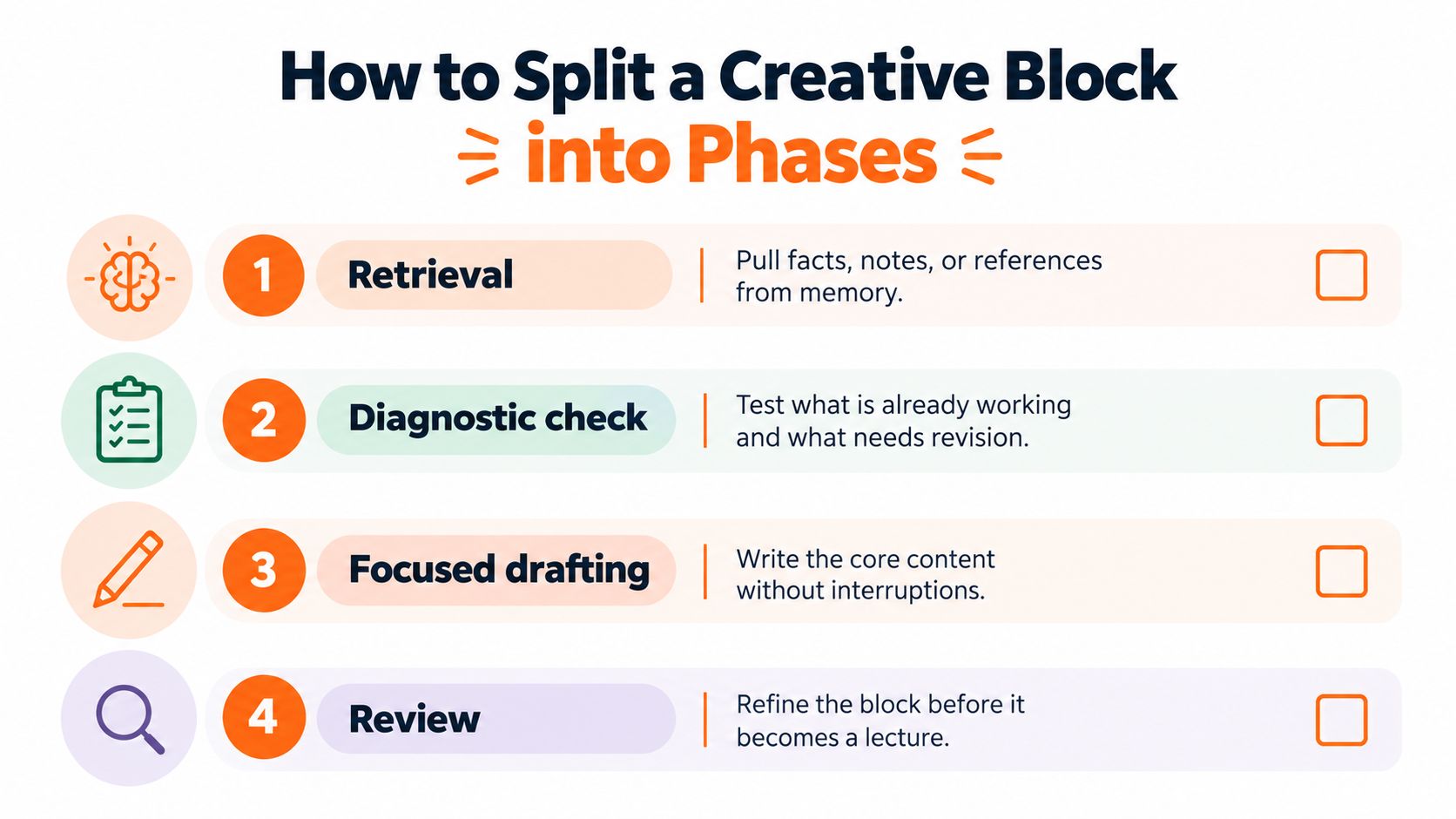
I'd give a creative sitting a sequence that moves from remembering to deciding, then producing and checking. This is an adaptation of the varied instructional phases described in the research, not a claim that a particular writing routine has been experimentally validated.
Begin with retrieval and a diagnosis
Before opening a blank document, retrieve the idea you're continuing. Read the previous issue's hook, revisit a reader's question, or summarize the argument from memory.
Then identify the actual obstacle. Missing evidence calls for research; an unclear promise calls for outlining; a complete argument with awkward sentences calls for revision.
- Retrieve the thread. Write what the reader needs to understand before consulting the entire research folder.
- Diagnose the gap. Name the unfinished job rather than labeling the whole issue bad.
- Set the brief. State the point, the supporting example, and the action you want the reader to consider.
The visual below offers a compact checklist for keeping the session varied.
Use the middle for production
Once the brief is clear, draft or revise without switching into publication administration. Leave a visible marker where a link needs checking instead of opening every platform while the argument is unfinished.
If you're preparing related pieces, batching similar content tasks gives that work a boundary. Drafting newsletter sections together is a different activity from preparing platform-specific introductions.
Finish with an exit assessment. Write the reader's next action in a sentence, then record what's missing for Substack Notes, LinkedIn, and X.
Build safeguards into the appointment
Keep returning to cumulative skills such as headlines, offer language, and the argument running through a series. Don't assume an intensive drafting session replaces later practice.
The implementation concerns in the policy research also deserve practical respect. Schools must consider disability accommodations, English learners, transportation, meals, and advanced-course access; a creator's adaptation should likewise fit real access and energy constraints rather than an imaginary ideal morning.
If you miss a session, begin the next appointment with a catch-up decision. Judge the schedule by the work attempted, the opportunities to return, the switching required, and the artifact completed, not by how impressive the calendar looks.
A Sample Week for Newsletter Creators
For this illustrative week, I'm preparing a long newsletter issue and adapting its central idea for other platforms. The calendar is a proposed workflow, not a record of measured results.
Monday begins with research and an outline. Before stopping, I leave an exit note describing the issue's promise and the evidence still needed, so Tuesday doesn't start with another search for direction.
Tuesday is for drafting. Near the end, I mark passages that could stand alone as a Note or support a social post, without interrupting composition to format them.
Sample Block Week for a Newsletter Creator
The deep-work appointments below use the school-model durations already discussed; the shorter appointments are proposed review windows, not evidence of an optimal writing dose.
| Day | Block length | Primary job | Exit artifact |
|---|---|---|---|
| Monday | 90 minutes | Research and outline | Argument map, supporting links, exit note |
| Tuesday | 90 minutes | Draft the issue | Complete rough draft with reusable passages marked |
| Wednesday | 45–60 minutes | Review headlines, links, and reader action | Edited issue and publication checklist |
| Thursday | 90 minutes | Prepare distribution | Platform-native Notes, LinkedIn post, and X thread |
| Friday | 45–60 minutes | Retrieve lessons from responses | Review note and next issue's opening prompt |
Wednesday's review changes the kind of attention I bring to the article. Rather than asking what else I can add, I check whether the opening promises what the finished piece delivers.
Thursday is deliberately separate. I adapt the idea for each platform rather than paste the newsletter introduction everywhere and hope it fits.
Leave room for an interrupted Tuesday
I'd keep a recovery pocket available beside the review appointment. If the draft isn't ready, that pocket becomes completion time, and I reduce the distribution scope rather than pretend the missing work disappeared.
- If drafting slips, finish the central argument before polishing derivatives.
- If review finds a weak claim, revise it before scheduling.
- If the issue ships as planned, preserve the recovery space instead of filling it automatically.
An editorial calendar example can help you record those dependencies alongside publication dates. The important addition is an artifact column: every appointment should leave something usable behind.
Friday's review then has a concrete job. Check available subscriber attribution and replies, distinguish observed responses from guesses, and leave a prompt that makes the next Monday easier to begin.
Batching Blocks with a Distribution Dashboard
Thursday arrives with an edited issue and marked passages. The remaining choice is operational: how will those passages become scheduled publications without reopening the entire writing process?
Manual publishing can be the right choice when you want direct control and the workload is manageable. A dashboard becomes worth considering when formatting, scheduling, and checking multiple platforms consume the appointment you meant to spend adapting ideas.
Compare the handoff
| Approach | What you do | What remains |
|---|---|---|
| Manual copy-paste | Open each platform and adapt the material directly | Repeated formatting, scheduling, and checking |
| Batching alone | Prepare the article's derivatives together | Move the finished pieces into separate queues |
| Distribution dashboard | Adapt and schedule through a shared workspace | Review voice, formatting, destinations, and timing |
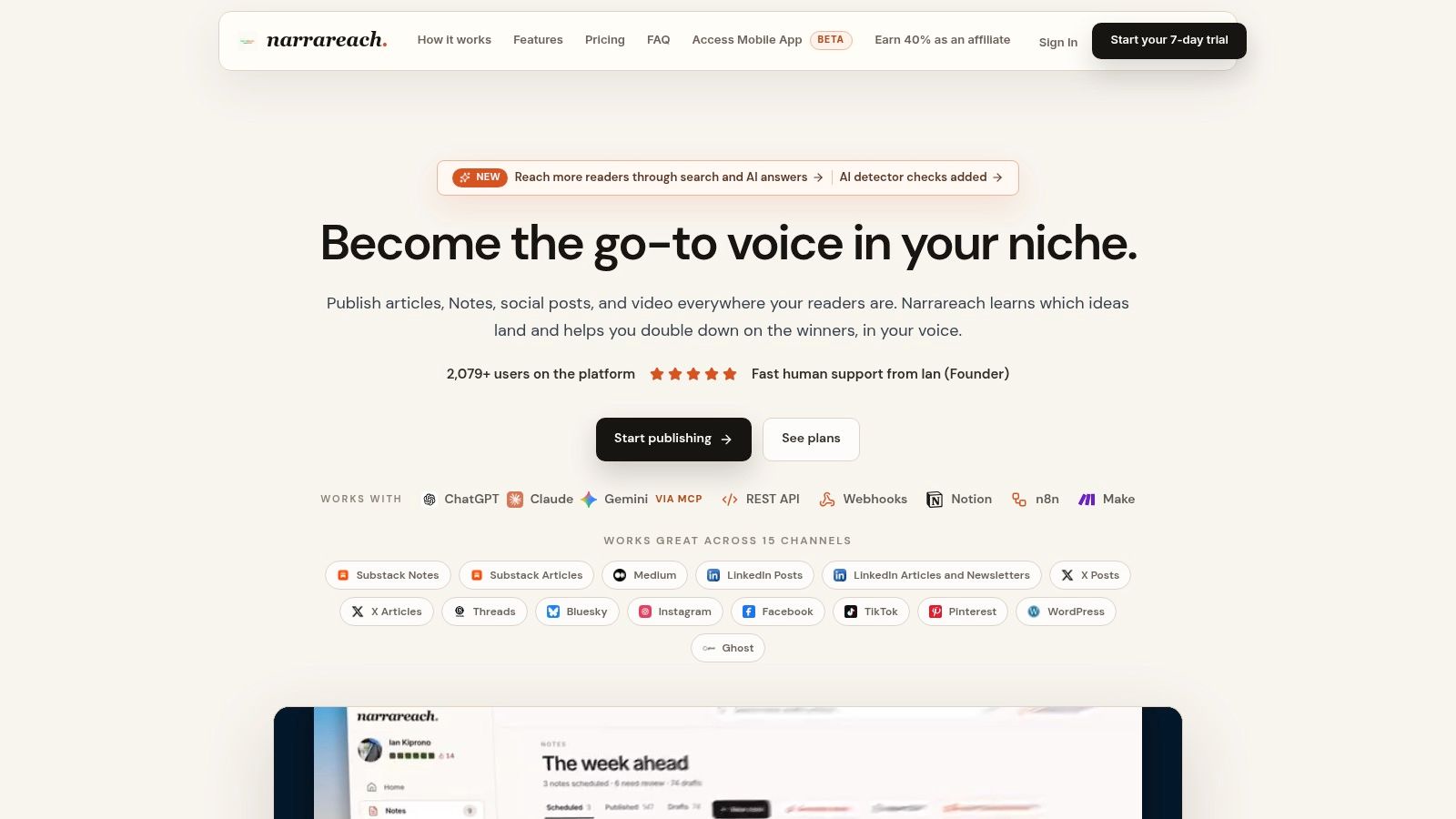
Narrareach is an option in that last category: it schedules Substack Notes, Medium articles, LinkedIn posts, and X content; supports cross-posting to LinkedIn and X without copy-paste; and repurposes long-form material into short posts intended to retain the writer's voice. Its stated capabilities include cross-platform analytics for subscriber-driving content and smart scheduling based on audience activity, with access through supported assistant integrations or its own dashboard.
The platform screenshot provides a concrete view of the tool.
Schedule distribution without surrendering judgment
In the worked experiment, Thursday ends with scheduled Notes and social posts rather than a document labeled “publish later.” Friday can then focus on response instead of unfinished paste work.
That's an operational outcome, not a promised growth rate. A scheduler can help you publish consistently and test ideas across platforms, but the reader still decides whether to follow, reply, or subscribe.
- Check the adaptation. A Note should make sense without the full article beside it.
- Check the destination. Make the next action appropriate to the platform.
- Check the response. Use a content analytics dashboard to examine available evidence rather than equate every impression with a subscriber.
Publishing and email delivery also require different checks. If your concern is whether newsletter messages reach the inbox, MailGenius offers an email inbox placement test; don't treat a social scheduling queue as a diagnosis of email delivery.
If the sample calendar solves your immediate problem, keep it and publish manually. Add a dashboard when you can name the handoff it will remove.
Grow the Audience from the Next Block
The useful outcome of this experiment isn't a fuller calendar. It's a finished issue, deliberate adaptations, and a review appointment that asks what readers did.
In the illustrative week, I've assigned drafting and distribution separate homes. I can see whether I completed each handoff instead of relying on the feeling that I worked hard.
Judge the trial by observable work
Run the schedule for your next issue and keep the exit artifacts. Don't claim an audience-growth improvement because the workflow felt calmer.
- Did the issue ship? Record what was published, not just what was drafted.
- Did the rhythm survive disruption? Check whether a missed appointment led to recovery or abandonment.
- Did another platform carry the idea? Save the published adaptation and examine its available responses.
- Did readers take the next step? Look for attributable subscriptions, meaningful replies, or other actions connected to your purpose.
For a broader acquisition plan, use these practical approaches to growing newsletter subscribers. Let the review appointment help you choose what to test next rather than require you to invent a new topic whenever a post disappoints.
Choose a commitment you can keep
If you're ready to automate distribution, start with the next Thursday appointment. Prepare the article's derivatives, review them, and place them in a publishing queue.
If you're not ready for another tool, copy the sample week into your existing calendar and keep it beside the draft. Stay connected to readers through replies, and carry their questions into the next retrieval prompt.
When email delivery needs separate investigation, mailX deliverability diagnostics offers a relevant place to look. Keep that investigation distinct from deciding whether your content and scheduling choices worked.
Block scheduling isn't a universal upgrade. It's protected time plus an intentional sequence, with room to return and recover. The practical stake is simple: your next strong idea should reach readers, not remain an unfinished publishing task.
Visit Narrareach to start free, with no credit card required, and use your next distribution block to schedule Substack Notes, Medium articles, and social posts from a shared dashboard. If you'd rather keep your current tools, copy the sample week into your calendar, run it for your next issue, and save reader replies as prompts for the next block.