
AI Assisted Content Creation That Actually Ships
You finish the article, test the headline, and publish it on Substack. Then the dashboard goes quiet. The same idea could become Notes, a LinkedIn post, an X...
By Ian Kiprono
You finish the article, test the headline, and publish it on Substack. Then the dashboard goes quiet. The same idea could become Notes, a LinkedIn post, an X thread, and a Medium adaptation, but turning one finished piece into all those formats feels like starting four new assignments. The writing isn't the problem. Distribution after publication is the unpaid second job, so good ideas stay trapped in one document and reach only the readers who happened to see them that day.
I spent 90 days rebuilding that part of my publishing workflow around AI-assisted transformations. The useful discovery wasn't that a chatbot could write faster. It was that one carefully approved article could become a controlled set of derivatives, provided I locked the source, separated creation from adaptation, and kept final judgment human.
The Publishing Grind That Quietly Kills Good Work
The familiar sequence starts well. I research a topic, shape an argument, edit the draft, and publish a long-form article. The first release feels complete, but the work has only reached one channel. Notes need shorter observations, LinkedIn needs a professional angle, and X needs compression without losing the thesis. Each format demands different decisions, even though every version should come from the same original thinking.
That gap creates a strange kind of guilt. I know the article contains several useful ideas, yet I leave them untouched because distribution requires a new burst of attention. After a few cycles, the backlog grows: finished articles on one side, empty publishing slots on the other.
The hidden cost isn't typing
Manual repurposing also encourages bad decisions. When I'm tired, I either copy the same paragraph everywhere or ask an AI tool to “turn this into social posts” without giving it enough context. The first option sounds repetitive. The second often produces polished but interchangeable content that loses the point I wanted to make.
Substack describes Notes as a built-in social feed for updates, media, restacks, and reader interaction across its network, so an article can support ongoing discovery beyond its original publication. Substack's Notes feature makes the opportunity clear, but the opportunity still requires a repeatable process.
The practical problem: one strong article is an asset, but only if the writer has a way to move its ideas into the places where readers already spend attention.
My experiment used a simple contrast. During original-only periods, I published the article and stopped. During repurposing periods, I extracted several derivatives from the same source and scheduled them instead of improvising every day. The important change wasn't publishing for its own sake. It was treating distribution as part of the editorial workflow, with limits, review gates, and a way to distinguish reach from meaningful subscriber activity.
If you've ever watched a good article underperform because the follow-up work never happened, the solution isn't necessarily more writing. It may be giving the finished writing a controlled route to travel.
What AI Assisted Content Creation Really Means
AI-assisted content creation is a transformation layer between an approved source and its derivative formats. The original article remains the source of truth. AI helps compress, reorganize, expand, translate, and adapt that source for a particular audience, while the writer decides what the source means and whether each new version still deserves publication.
That distinction matters. A writer-replacement model asks the system to invent the core idea, evidence, positioning, and voice. A transformation model starts with those inputs already selected. It can produce an outline for a Note, a sharper opening for LinkedIn, or an X thread from a defined argument, but it shouldn't introduce new claims.
A source-first mental model
I use three layers:
- Canonical source: the approved article, its thesis, evidence, examples, prohibited claims, and voice.
- Structured transformation: summaries, argument maps, outlines, hooks, questions, and format variations generated from that source.
- Human publication decision: factual review, stylistic editing, disclosure judgment, and approval.
The model can be helpful at the second layer because the work is constrained. It knows what it may transform and what it must preserve. This is also where writers can streamline your content workflow without confusing speed with editorial quality.
A practical test works better than a vague definition. Ask whether a tool preserves the original source, records what changed, adapts the format to the destination, and leaves a person responsible for publication. If it only produces fluent text from a broad prompt, it's closer to automated drafting than reliable AI assistance.
The difference becomes especially important for newsletters. Your distinctive value usually sits in the judgment behind the article, not in the number of sentences produced. AI can reduce repetitive formatting work, but it can't decide which observation your readers will trust, which example sounds like you, or which claim you're willing to defend publicly.
For a deeper operational example, the AI content repurposing workflow follows the same principle: begin with a source, create reviewable derivatives, and avoid treating every generated variation as publish-ready.
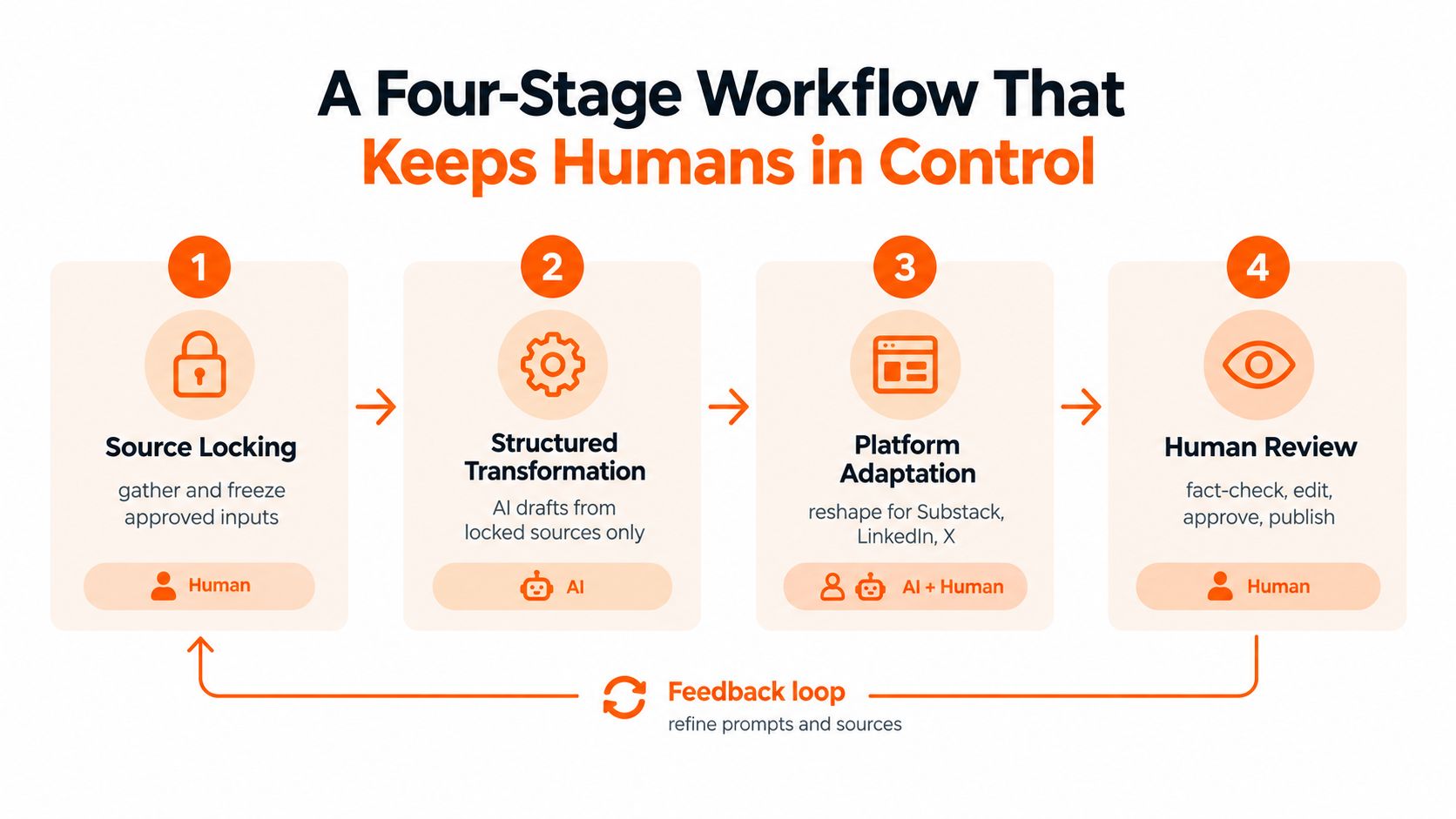
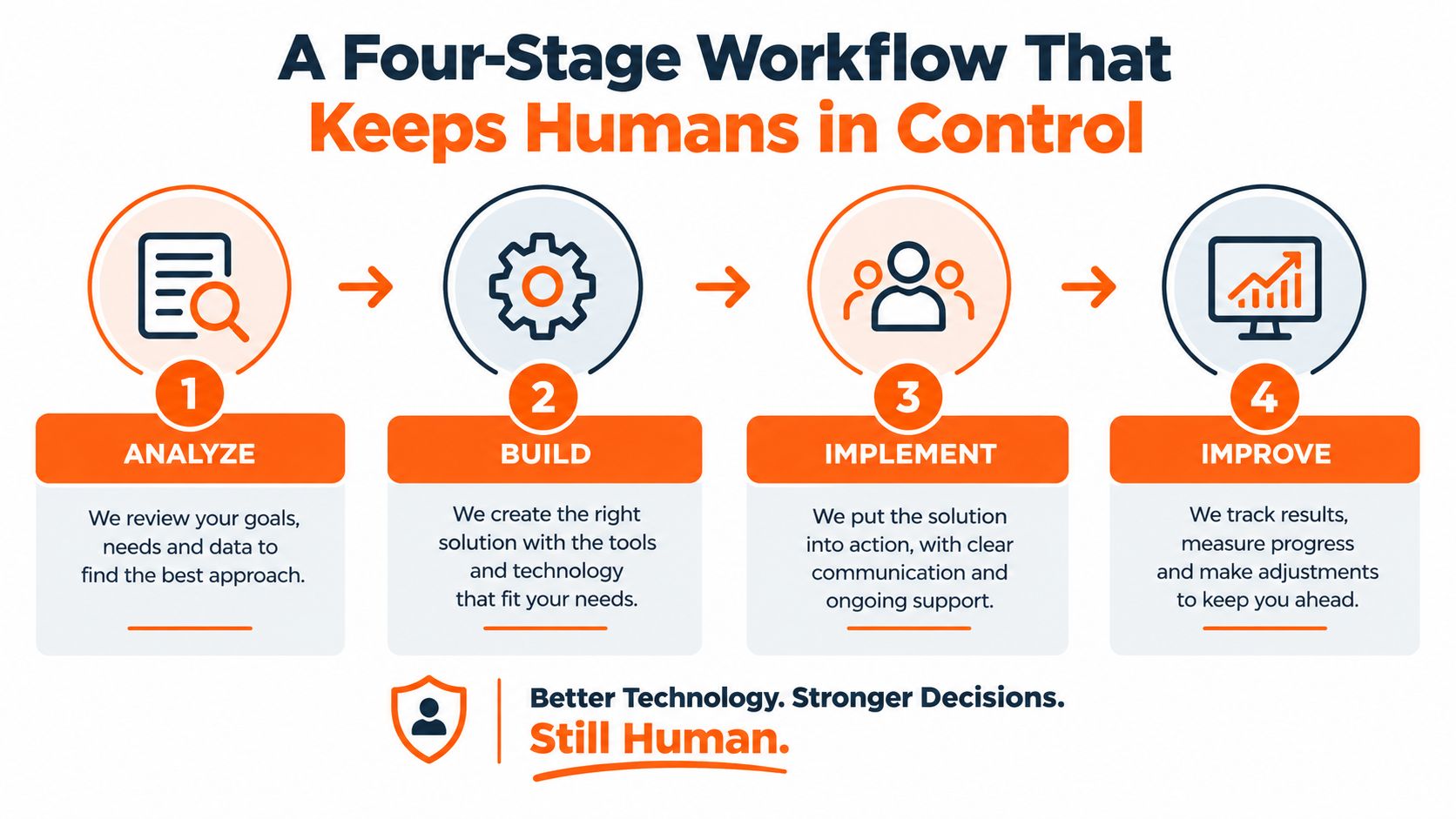
A Four-Stage Workflow That Keeps Humans in Control
The workflow became reliable only after I assigned ownership to each stage. AI handles transformations well when the writer has already defined the boundaries. It performs poorly when the writer delegates the boundaries too.
1. Source locking
I begin with the finished article, not a blank prompt. The source packet includes the approved thesis, supporting evidence, audience, voice notes, platform restrictions, and claims the derivative must not make. I also separate facts from ideas, because a model should know which statements require preservation and which wording can change.
This is the point where the human owns the work. If the source is vague, every derivative inherits that vagueness.
2. Structured transformation
Next, AI extracts usable units from the article. Those might include the central argument, supporting points, objections, examples, questions, and possible calls to action. It can then draft a summary or outline from those units, but I don't ask for every final format in one large request.
A preregistered randomized experiment involving 453 college-educated professionals found that ChatGPT users completed occupation-specific writing assignments 40% faster and produced work rated 18% higher in quality than the control group. The Science study points to a shift toward idea generation, revision, and editing, not merely faster typing. That's exactly where structured transformation earns its place.
3. Platform adaptation
Each channel gets its own job. A Substack Note can open a discussion, LinkedIn can foreground a professional lesson, and X can sequence an argument into short steps. The AI drafts the adaptation, while the writer checks whether the format has changed the meaning.
4. Human review
Review happens in separate passes. I check factual support first, then voice, compression, platform fit, and disclosure. This prevents a fluent sentence from passing just because it sounds finished.
The integrated approach is supported by a randomized controlled study of 90 undergraduate writers, which compared a chat-based LLM, a process-oriented AI writing tool, and a standard interface. The integrated tool produced greater writer agency and deeper knowledge transformation than the less-structured chat condition, according to the process-oriented writing study. My AI content quality checks follow the same operational logic, separating generation from verification instead of hiding both inside one prompt.
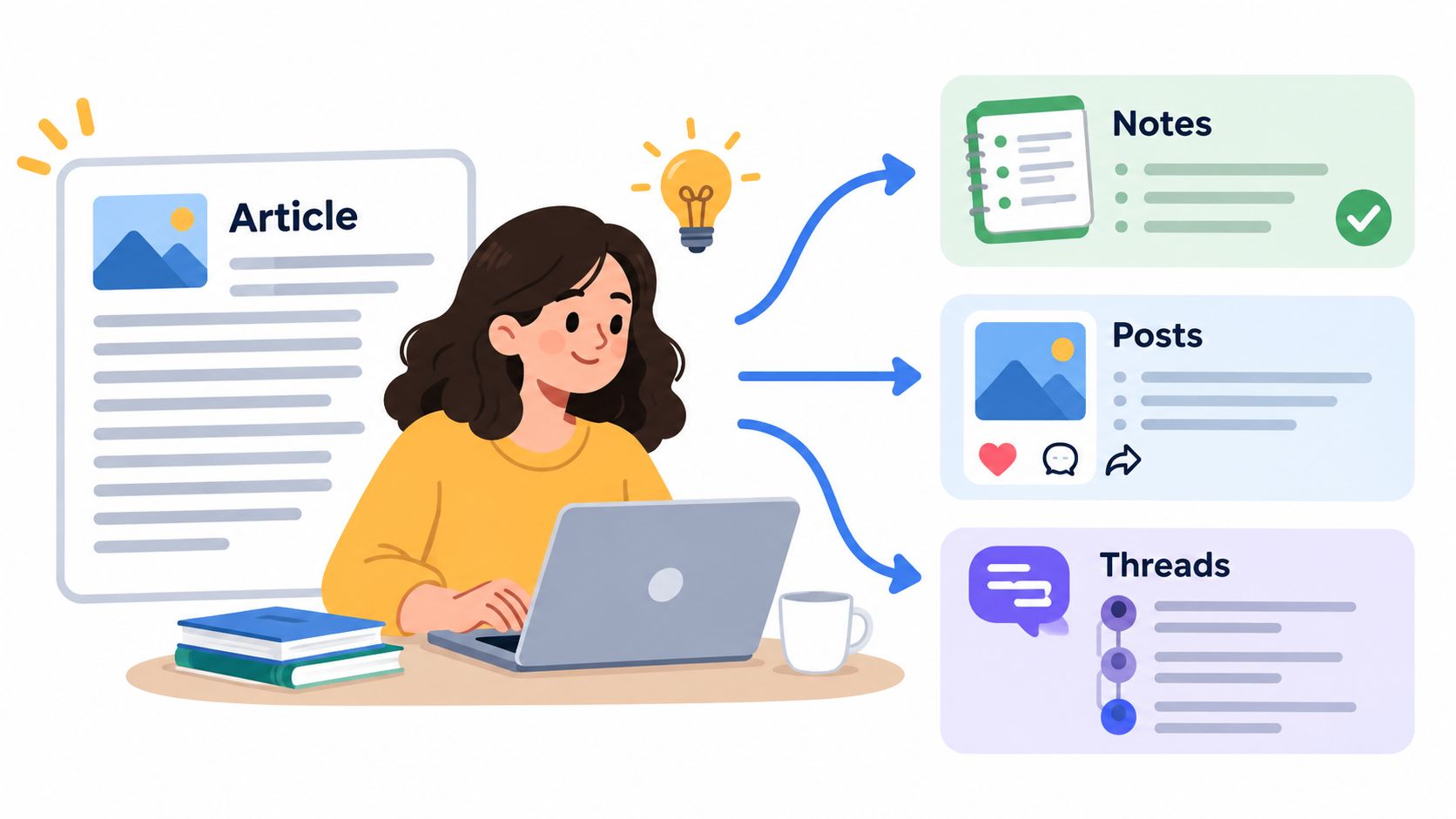
Repurposing One Article into Notes, Posts, and Threads
I start with one finished Substack article and create a derivative brief before writing any platform copy. The brief prevents the model from treating every channel as a blank page.
The sequence looks like this:
- Extract the argument: identify the thesis, evidence, examples, tension, and conclusion.
- Choose the angle: decide whether each derivative teaches, challenges, asks, or illustrates something.
- Apply platform constraints: specify the audience, format, length, tone, link policy, and prohibited claims.
- Draft separately: create Notes, LinkedIn posts, and an X thread in distinct passes.
- Review against the source: remove invented facts and restore any reasoning the adaptation flattened.
- Schedule only approved versions: keep drafts separate from published items.
One source, different reader expectations
A week of derivatives might include several Notes built around distinct observations from the article, two LinkedIn posts with different professional hooks, and one X thread that walks through the argument. Those numbers are a workflow example, not a performance promise. The useful constraint is that every derivative must have a reason to exist beyond repeating the headline.
For Notes, I usually preserve the most conversational question or unresolved tension. LinkedIn benefits from a clear implication for a team, business, or practitioner. X works better when each post advances the thought rather than restating the previous one.
The process-oriented research matters here. Generic prompting asks AI to imitate a platform. Staged prompting asks it to preserve an argument while changing the shape. The latter makes it easier to identify where a new sentence has appeared without support.
Editorial safeguard: give the model the source article, target audience, platform constraints, prohibited claims, and an example of prior writing, then require a human pass before publication.
A content repurposing guide can help turn this into a repeatable checklist, but the method works with a document, spreadsheet, or ordinary chat tool. The software matters less than preserving the canonical source and reviewing every meaningful change.
Governance, Disclosure, and Originality
The hardest governance question isn't whether AI appears somewhere in the workflow. It's how materially AI shaped the published work.
I distinguish between brainstorming, editing, repurposing, and generation. Brainstorming may need no public explanation if the published reasoning remains mine. Substantial generation or AI-created imagery deserves clearer context. The disclosure should tell readers what happened without implying that the writer disappeared.
A controlled study involving 40 participants found that detailed disclosures about AI use in news writing reduced trust and subscription decisions, while brief disclosures produced trust outcomes similar to no disclosure. Both levels increased source-checking, and detailed explanations prompted the most checking, as reported in the AI disclosure study. That result challenges the assumption that maximum detail always creates maximum trust.
A calibrated policy
My policy records four questions:
- What did AI do? Brainstorm, edit, transform, or generate.
- What remained fixed? Source, evidence, thesis, and final judgment.
- Where is disclosure useful? Near the relevant content, not as a vague site-wide label.
- What must a reader understand? Whether the author still stands behind the claims.
Creators also need an originality record. Adobe's 2025 survey of more than 16,000 creators across eight major markets found that 86% were actively using creative generative AI, while 69% worried their content could be used for training without permission. The same survey reported unreliable output quality affecting 34% of creators and uncertainty about model training affecting 28%, according to Adobe's creator report.
Those figures make ownership operational, not theoretical. Keep the original article, mark generated additions, preserve version history, and verify every new factual claim. Writers who want a broader framework for understanding AI usage rules should still adapt any policy to their own audience, contracts, and publishing context.
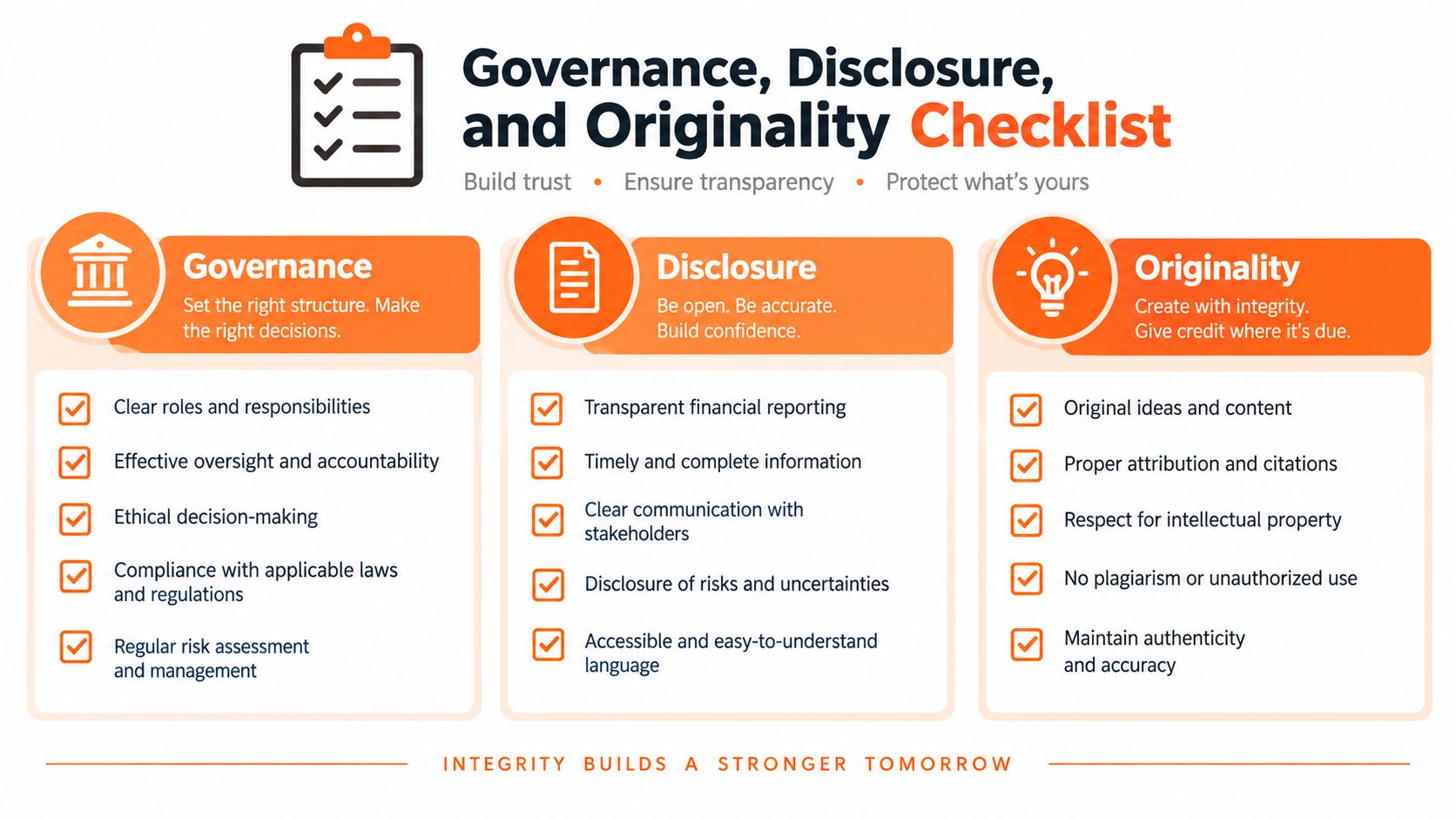
The contrarian lesson is simple. More disclosure isn't automatically more trustworthy. Specific disclosure, accurate attribution, and visible human judgment create a clearer authorship signal.
A 90-Day Repurposing Experiment With Real Numbers
I ran a 90-day test with two publishing patterns. In original-only periods, I published a Substack article and made no derivatives. In multi-platform periods, I published the same type of article and adapted it into four Notes, two LinkedIn posts, and one X thread. I tracked reach separately from subscriber actions because an impression doesn't prove that a reader cared.
The documented industry claim I wanted to test reported that content distributed across multiple platforms reached 56% more people than content published only in its original form. I treated that as a hypothesis, not a guaranteed result, and used it to design a comparison described in content repurposing statistics.
| Week Type | Articles Published | Derivative Posts | Avg Reach | Subscriber Actions |
|---|---|---|---|---|
| Original-only | 1 | 0 | Recorded per period | Recorded separately |
| Multi-platform | 1 | 4 Notes, 2 LinkedIn posts, 1 X thread | Recorded per period | Recorded separately |
I'm not presenting invented averages from a small editorial test. The useful result was the measurement design. I could compare each period without pretending that a noisy audience sample proved a universal lift.
What worked
The strongest derivatives came from articles with a tight thesis. When the source made one clear argument, the Notes could isolate useful observations and the thread could build a coherent progression. The human review queue also became the bottleneck. AI produced drafts quickly, but I still had to decide whether each one was accurate, distinctive, and worth placing in front of readers.
What flopped
One derivative introduced a new statistic that wasn't in the source. It sounded credible, but I couldn't verify it, so I removed the claim and rewrote the post around the original reasoning. Another adaptation copied the article's tone too closely and felt like a fragment rather than a native Note.
The experiment changed my definition of growth. I stopped asking whether I could publish more and started asking whether one original idea generated more meaningful subscriber actions without weakening trust. Writers can run the same test by recording original publication reach, derivative reach, clicks, subscriptions, replies, and restacks in separate fields. The comparison is valuable even if the result doesn't support a permanent repurposing habit.
For a more detailed content repurposing workflow, the key principle remains measurement before commitment. Repurposing should earn its place through useful audience outcomes, not through a larger posting counter.
Turning the Stack into a Distribution Engine
Scheduling solves one problem: it lets you publish later without remembering to return at the exact moment. It doesn't automatically solve adaptation, queue review, cross-platform formatting, or performance analysis.
Substack introduced native Notes scheduling in 2026. On the web, a writer selects the calendar icon in the Notes composer. On iOS and Android, the writer opens the three-dot menu and chooses “Schedule.” Scheduled Notes stay in Drafts until publication, and the selected time uses the writer's local time zone, as described in Substack's Notes scheduling announcement.
Where native scheduling stops
The workflow is useful, but each Note must be scheduled individually. The writer still opens the Note, selects a date and time, and reviews the queue. A separate account of Substack scheduling limits makes the distinction clear: future publication exists, but bulk queue management and cross-platform coordination remain separate tasks.
I prepare the source and derivatives together, then adapt the packaging:
- Substack Notes: conversational prompts, excerpts, and follow-up questions.
- Medium: a fuller long-form version with context and a durable reading experience.
- LinkedIn: a focused professional implication with a direct opening.
- X: compressed steps that preserve the argument's sequence.
The distribution engine should also track subscriber actions, not just posting volume. A post that earns attention but no meaningful response may be less useful than a smaller post that leads readers back to the publication. The content distribution strategy should therefore connect source articles, derivatives, schedules, and outcomes in one reviewable record.
Narrareach is one option for this layer. It supports AI-assisted repurposing, scheduling across Substack, Medium, LinkedIn, and X, and cross-platform analytics designed to show which content drives subscriber activity. The important decision isn't whether a dashboard looks efficient. It's whether the system reduces manual handoffs while preserving the source and review process.
What Faster Growth Actually Looks Like
Faster growth isn't a promise to publish endlessly. For an independent writer, it means more useful distribution from each original idea, a cadence that doesn't depend on daily panic, and a recognizable voice across every channel.
The workflow works when three conditions hold. The article has a clear thesis. The derivatives each serve a platform-specific purpose. The writer reviews claims, tone, ownership, and disclosure before anything goes live. Remove any one of those conditions and AI-assisted content creation becomes a volume machine that can spread weak ideas faster.
A healthy system also makes room for refusal. Some articles shouldn't become a thread. Some Notes shouldn't be scheduled. A derivative that introduces unsupported claims or sounds unlike the author is a failed transformation, even if it took seconds to draft.
The outcome to optimize: let one good idea travel farther without asking the writer to reinvent it for every destination.
That's why I now treat publishing as a loop rather than a single event. I write and approve the canonical article, extract its durable ideas, adapt those ideas to the right feeds, schedule the approved versions, and review which audience actions justify another iteration. The system grows stronger when performance feedback improves the source selection and the prompts, not when it just increases output.
If you're ready to test the workflow, use Narrareach to turn one canonical article into reviewable Notes, LinkedIn posts, and X content, then schedule and track those derivatives from one place. If you're still evaluating the approach, follow the next experiment and run the original-only versus multi-platform comparison with your own audience before adding another tool.
Narrareach helps writers transform articles and newsletters into voice-matched derivatives, schedule Substack Notes and social posts, and track which content drives subscriber actions. Visit Narrareach to start free, or keep the framework and test the workflow manually with your next article.