
8 Content Repurposing Examples That Grow Audiences
Your strongest idea can disappear within hours of publication. You spend an afternoon researching and writing a thoughtful article, send it to your...
By Ian Kiprono
Your strongest idea can disappear within hours of publication. You spend an afternoon researching and writing a thoughtful article, send it to your newsletter, and then watch the feed move on. LinkedIn wants a sharp opening, X rewards a thread, Medium needs a different reading experience, and Substack Notes work best as focused standalone thoughts. By the time you adapt the piece manually, the next article is already waiting.
The practical answer isn't creating more from scratch. It's finding the claims, stories, and questions that already deserve attention, then rebuilding them for the way people read on each platform. That approach matters because content repurposing is already mainstream: 94% of 48 surveyed marketers reused content across media or distribution channels, while the remaining 6% planned to start, according to the Referral Rock survey summary.
The eight content repurposing examples below cover articles, newsletters, podcasts, posts, email sequences, Notes, video, and reader feedback. Each one includes a before-and-after workflow, a reusable template, a scheduling or measurement decision, and a warning about what tends not to work. You can run the process manually, or use Narrareach to extract ideas, format drafts, schedule Substack Notes and social posts, and track which derivatives drive subscribers.
Platform-native repurposing: Keep the core idea, but change the hook, length, structure, evidence, and next action to fit the destination.
1. Long-Form Article to X Thread Series
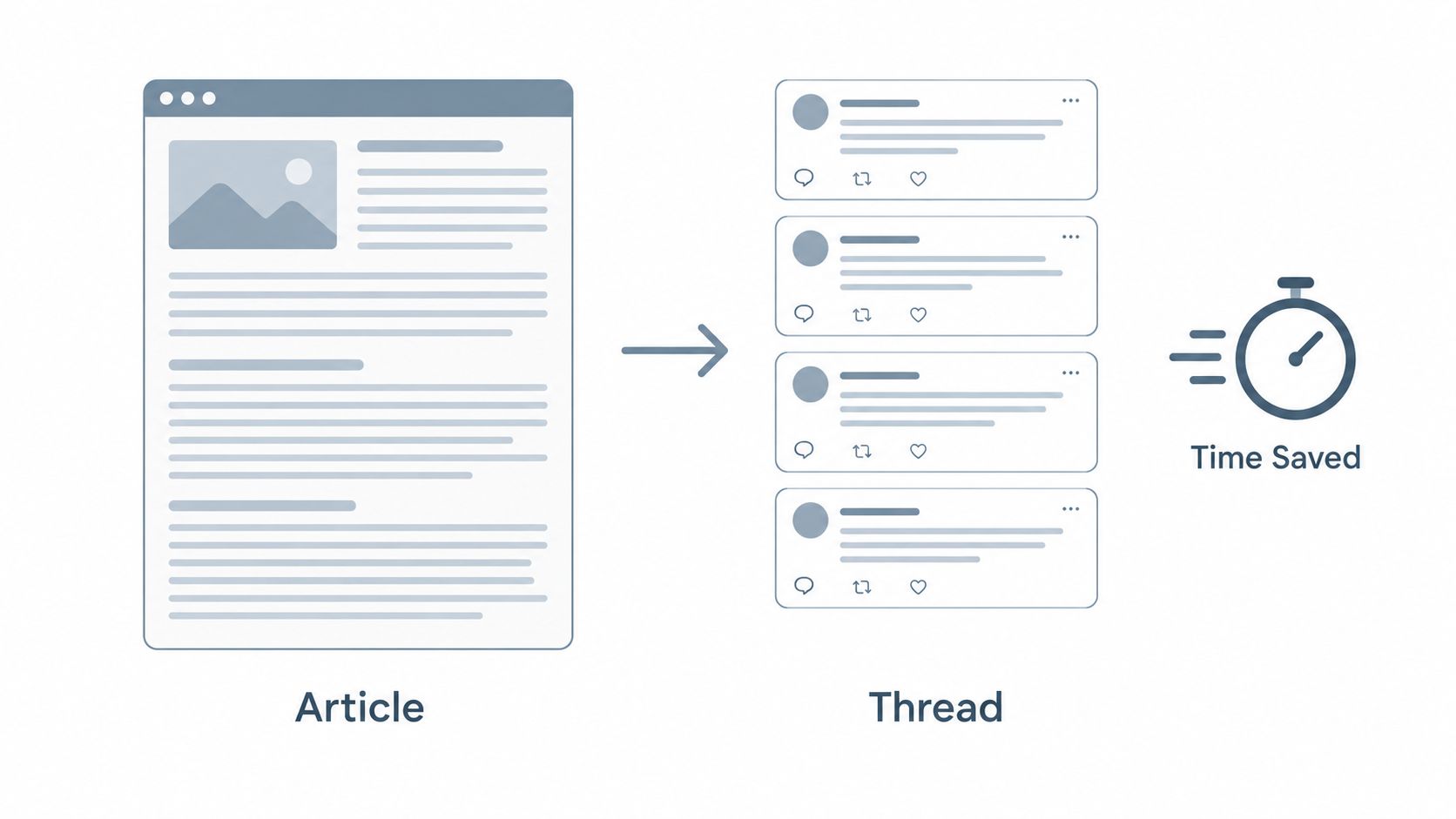
A long-form article can support several X threads, but only if each thread gets rebuilt around one reader problem. Treat the article as a source file, not a finished social post.
Select the three to five strongest claims, then choose one for the first thread. Remove observations that depend on the article's full context. On X, the argument needs a clear hook, a logical progression, and a reason to keep reading. The result should read like a guided explanation, not a paragraph split into short lines.
The before-and-after workflow:
- Before: A detailed Substack essay with context, transitions, and supporting examples.
- After: An X thread led by the most surprising or contrarian claim, followed by one point per post and a specific invitation to read the full essay.
- Time decision: Automate claim extraction and initial formatting. Use the saved drafting time to verify accuracy, preserve the author's voice, and fix weak transitions.
- Outcome check: Add tagged links and compare thread-driven profile visits, clicks, and subscriptions with other X formats.
- Scheduling decision: Publish the first version when analytics show that your audience is active, then reuse only the strongest structure after reviewing its results.
Use this thread template:
- Contrarian or unexpected opening.
- The common assumption.
- Why that assumption fails.
- Claim one with a concrete example.
- Claim two with a consequence.
- The practical adjustment.
- A concise summary.
- A platform-specific call to action.
The main trade-off is compression. Including every qualification makes a thread difficult to follow, while removing all qualification can make an accurate article misleading. Keep detailed nuance in the source, but retain enough context for each post to stand on its own.
An observational analysis of brands with 50,000 to 100,000 followers reported higher monthly social-media views for brands that repurposed content than for those that did not. It also reported a 152% visibility lift, but the analysis was not randomized. Use that finding as a distribution benchmark, not proof that repurposing caused the result.
Narrareach can turn a finished article into reviewable X drafts while retaining source context. For a practical thread structure, use this sample Twitter post workflow. Review the draft before publishing, then schedule follow-up versions only when your analytics support the format.
2. Substack Newsletter to LinkedIn Article and Short Posts
A newsletter and a LinkedIn post can share an argument without sharing the same shape. The newsletter reader has opted into depth. The LinkedIn reader is deciding whether to pause while scanning a professional feed.
Use one Substack issue as a small LinkedIn campaign:
- One LinkedIn article: Rebuild the complete argument with a direct title, short sections, and a clear conclusion.
- Three carousel concepts: Give each carousel one claim, one example, and one practical implication.
- Two short posts: Pull out an opinion, tension, or useful question that can stand alone.
- One conversion path: Send interested readers to the Substack issue, a relevant signup page, or a specific resource.
Don't paste the newsletter into LinkedIn and call it repurposing. Remove the email greeting, tighten the introduction, replace subscriber-only context, and make the first screen useful even if nobody clicks away. LinkedIn content should earn attention before it asks for a subscription.
Newsletter distribution is already spread across several channels. A 2025 survey of more than 400 newsletter professionals found that 52% used LinkedIn, 50% used Facebook, and 42% used traditional email distribution; 42% also identified recommendations or word of mouth as the most effective subscriber-growth tactic, according to HubSpot's newsletter research. The practical lesson is to treat LinkedIn as a discovery and referral layer, not as a duplicate inbox.
Use this template for a LinkedIn article:
Problem: Name the reader's current friction.
Point of view: State the argument in one paragraph.
Evidence: Add the strongest example from the newsletter.
Application: Explain what the reader should change.
CTA: Offer the full issue or a related signup destination.
For scheduling, queue the article and short posts separately. A single publication day can make the campaign look like a broadcast. A spaced sequence gives each angle room to collect feedback. Narrareach can keep the derivatives in one review queue, cross-post approved drafts to LinkedIn and X, and connect the posts to subscriber outcomes. Its Substack and LinkedIn cross-posting workflow is useful when the source issue needs several platform-specific versions.
3. Podcast Transcript to Substack Essay and Medium Article
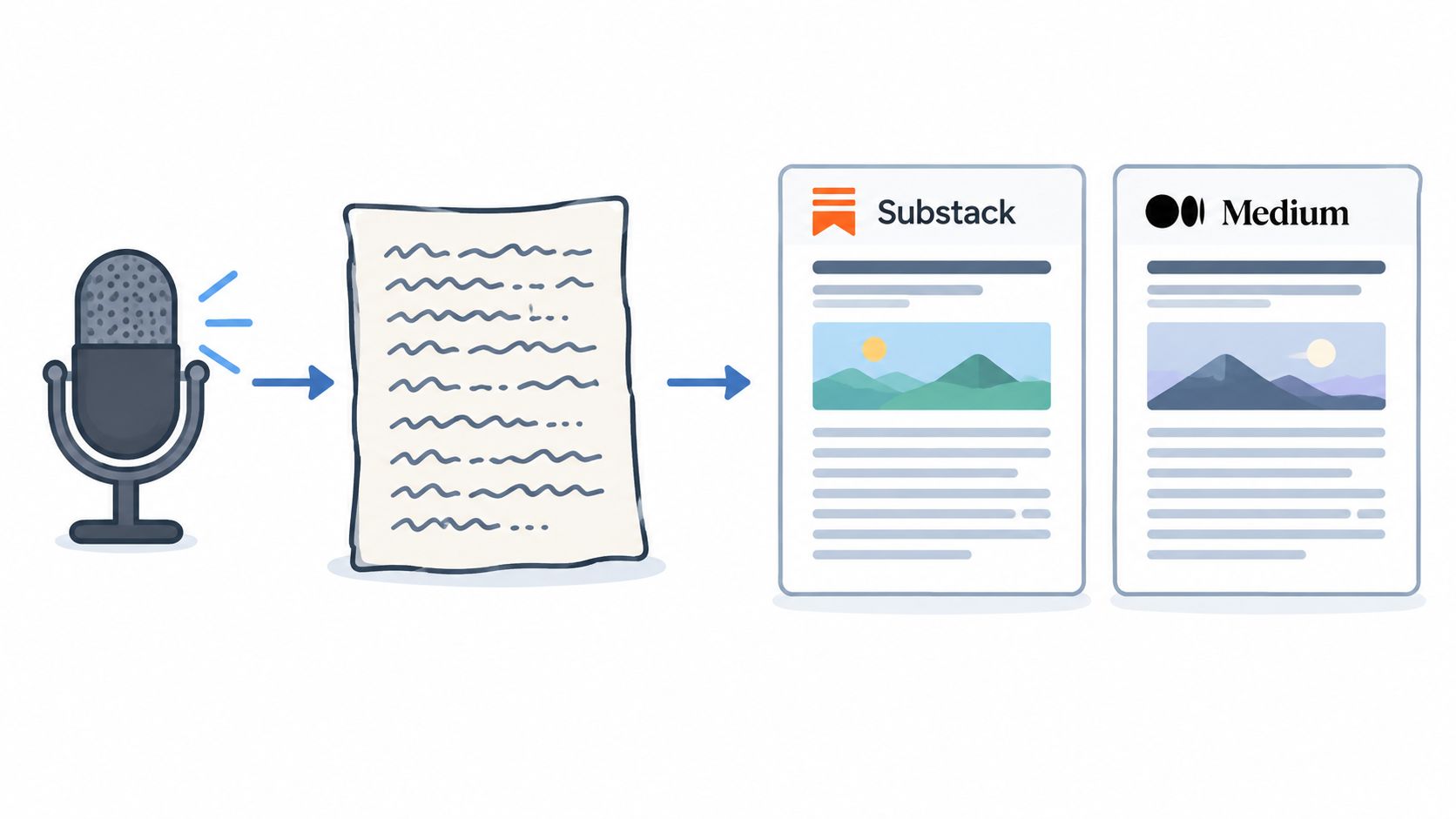
A podcast episode can generate strong written content, but a transcript is not a finished article. Spoken language contains repetition, incomplete sentences, tone-dependent references, and conversational detours that can slow readers down.
Start with one episode and identify its three or four core ideas. Then adapt the source for each platform:
- Substack essay: Open with the human tension, central lesson, or guest story. Add framing and explain why the idea matters to subscribers.
- Medium article: Use a more analytical angle, define terminology, and organize the material around a reader problem or search question.
- Substack Notes: Extract short, self-contained observations that do not pretend to summarize the entire episode.
- Audio link: Give readers a clear route back to the original conversation.
The transformation has a practical trade-off. Editing takes time, but it creates platform-specific assets instead of publishing the same transcript twice. A useful workflow is to clean the transcript, select evidence for each core idea, draft the Substack version first, and then reshape its structure for Medium.
Use this cleanup checklist:
- Remove filler, not personality: Keep distinctive phrasing when it carries meaning.
- Verify references: Rewrite pronouns and vague time references that depend on the audio.
- Separate speakers: Identify whether each idea belongs to the host or guest.
- Add missing context: Written readers cannot rely on vocal emphasis or an earlier exchange.
- Review every claim: Do not let an automated draft turn an impression into a factual assertion.
The Adobe Express survey cited in the content repurposing statistics overview found that 70% of 517 surveyed small-business owners had repurposed content, while 54% identified time savings as its main benefit. The figures support automation for transcript extraction and first drafts. They do not replace editorial review, fact-checking, or platform-specific rewriting.
Repurpose the argument, not the transcript.
A reusable episode template:
Episode tension: What problem did the conversation expose?
Core argument: What should the reader believe or do differently?
Three sections: Turn each major idea into context, evidence, and application.
Reader action: Invite a reply, subscription, or listen-through.
Note sequence: Convert each section into a separate short observation.
Schedule the essay after the audio has circulated, then publish Notes later to return to individual ideas. Measure article reads, Note engagement, subscriptions, and clicks back to the episode rather than treating every format as equal. Narrareach can turn source material into reviewable drafts and scheduled Notes. Its content repurposing guide offers a starting point for deciding which parts should become essays and which should remain short posts.
4. LinkedIn Post to Substack Essay and Medium Article
A strong LinkedIn post is a signal, not necessarily a complete article. Comments reveal which parts created recognition, disagreement, or a follow-up question. That response can tell you whether the idea deserves a longer treatment.
When a post performs well, preserve the original momentum but don't expand it mechanically. Capture the post, its comments, and the questions people asked. Then build the essay around the unresolved problem.
The workflow is straightforward:
- Save the original post: Keep the exact wording, date, and context.
- Group the responses: Separate agreement, objections, examples, and requests for clarification.
- Choose one editorial angle: Don't turn every comment into a section.
- Add evidence and counterarguments: A longer essay needs more than repetition.
- Create a distinct Medium version: Change the introduction and structure so it serves a different reading intent.
- Link the versions carefully: Give readers a reason to continue without making every page a promotional bridge.
A reusable expansion template starts with the original claim, then adds the hidden assumption behind it, a real scenario, a counterexample, a practical framework, and a final decision. The LinkedIn post should remain valuable as a short argument. The Substack essay should answer the next question a thoughtful reader would ask.
A documented real-estate data and analytics case reported a 148% year-over-year increase in referral traffic after the company repurposed existing content across social media and YouTube. Its organic traffic rose from 16,700 to 36,500 monthly sessions, an increase of approximately 118%, according to the repurposing case study. The case also illustrates why referral and organic traffic should be measured separately. A social post may assist discovery even when search receives the final visit.
Set a rule for your own workflow based on signal, not a copied impression threshold. For example, repurpose posts that generate unusually strong comments, saves, profile visits, or qualified replies compared with your normal content. Narrareach can help collect the source, produce an essay draft, schedule it for Substack, and track whether the longer version drives subscriptions. The LinkedIn repurposing workflow gives the process a repeatable shape.
5. Substack Article to Carousel Graphics and Social Posts
A long article often reaches only the people who open the issue or happen to find the page. Social derivatives give the same idea new entry points, but only if each one has a clear job.
Start with the article's strongest claims, not its headings. A heading may organize the source, but a carousel needs a sequence that makes sense to someone who has never seen the original.
A practical asset chain looks like this:
- Carousel one: The main problem and the cost of ignoring it.
- Carousel two: A framework or process from the article.
- Quote graphics: Distinctive opinions that can stand alone.
- Short captions: One takeaway adapted for the tone of Instagram, TikTok, LinkedIn, or X.
- Source CTA: A specific invitation to read the full article, reply, or subscribe.
For a five-slide carousel, use this structure:
Slide one: The strongest claim.
Slide two: Why the common approach fails.
Slide three: The first useful adjustment.
Slide four: A concrete example or caveat.
Slide five: The next action and source link.
Don't publish every derivative on the same day. A spaced campaign allows you to compare which framing drives readers back to the article. Change the caption and opening for each platform. A conversational Instagram caption, a practical LinkedIn post, and a direct X post shouldn't sound like one paragraph copied three times.
A SaaS-oriented case converted one webinar into five blog posts, three short videos, and ten social snippets. The reported results included impressions rising from 50,000 to 150,000, CTR increasing from 0.5% to 1.2%, trials moving from 27 to 65, cost per lead falling from $185.19 to $76.92, and ROAS increasing from 1.5x to 3.2x. The same case reported that platform-specific insights and visuals performed 15% better than simple reposts. See the SaaS content repurposing case study for the full context.
Use Narrareach to generate reviewable captions and distribute approved assets, but keep a human in the visual and editorial review. Its social media repurposing workflow can support batch scheduling, while your analytics should decide which formats deserve another campaign.
6. Email Sequence to Blog Posts and Substack Notes
An email sequence can become an owned-content workflow instead of remaining buried in an automation tool. It already answers objections, teaches a process, or guides a decision. The before-and-after change is simple: expand the sequence into search-focused blog posts, then extract one useful idea from each post for Substack Notes.
Start with the sequence showing reader interest through replies, forwards, clicks, or sustained engagement. Map each email to a distinct destination and record the original subject, reader question, and intended action. This map saves review time and makes the source-to-derivative relationship clear.
Email one: define the problem in a blog post.
Email two: explain the first mistake or misconception.
Email three: document the method.
Email four: answer a specific objection.
Email five: show a case-based application or conclusion.
A reusable blog template is: problem, context, mistake, method, example, objection, next step. Add definitions, examples, relevant internal links, and a clear search intent. Combine emails that answer the same question, or assign each page a distinct angle. That reduces fragmented reading and the risk of competing pages repeating the same advice.
For Notes, use a narrower template: observation, implication, practical step. One Note can state the sequence's central observation, ask the question it resolves, or share one action. Keep the Note self-contained rather than pasting a shortened newsletter. This format reduces editing time because each draft has one job.
Adobe reported in 2025 that 62% of more than 1,600 marketers said content demand had increased at least fivefold over the previous two years, as summarized in the content repurposing data. Existing sequences can meet that demand, provided every derivative has a clear reader purpose and receives editorial review.
Publish the blog posts gradually, placing Notes between releases. Use UTM parameters on links from each Note and post, then compare subscriber conversions by source. Schedule another cycle only for themes that generate meaningful clicks or subscriptions. Narrareach can turn the sequence into drafts, create standalone Notes, schedule approved assets, and keep each derivative connected to its source.
7. Substack Notes to Video Scripts and Short-Form Video
A good Note has already passed a small editorial test. It contains a focused thought, a clear opinion, or a practical observation that can be understood quickly. That makes it a useful starting point for short-form video.
Don't turn every Note into a video. Select the ones with the strongest combination of replies, reactions, saves, profile visits, or subscriber activity. The written response tells you which ideas deserve the production effort, while video gives the idea a different route to discovery.
Convert the Note into a four-part script:
- Hook: State the tension or surprising claim immediately.
- Substance: Explain the idea in plain language.
- Example: Show where it appears in real life.
- CTA: Ask the viewer to follow, visit the profile, or read the source.
Write several hook variations, but don't alter the central claim just to create artificial novelty. Film in batches, use on-screen captions, and keep the spoken version natural. A script that sounds polished on the page can sound stiff aloud, so read it out loud before recording.
An analysis of 473,405 Substack Notes reported that Notes shorter than 100 characters had a 24.2% probability of achieving at least twice the author's median likes, compared with 14.1% for Notes between 600 and 1,200 characters. It also reported roughly 20% breakout odds per Note for creators posting at least three Notes weekly, compared with about 18% for creators posting less than weekly. The Substack growth analysis supports a useful test: publish focused Notes consistently, then use the strongest ones as video candidates.
For scheduling, batch scripts and film several at once, but publish the videos according to platform behavior and your own audience data. Narrareach can help organize Notes, identify source ideas, draft scripts, and schedule the written derivatives. The ClipCreator.ai video playbook offers additional context for building a video repurposing workflow.
8. Blog Comments and Reader Feedback to Substack Essays
Your comments section can be a better editorial calendar than a brainstorming document. Readers reveal where an explanation stops, which objection remains unresolved, and what language they use to describe the problem.
Review feedback in batches rather than reacting to every comment individually. Group repeated questions, disagreements, requests for examples, and personal situations. Then choose one pattern that deserves a full response. The resulting essay should answer the reader's question directly, while making clear that it came from a real point of friction.
A simple feedback-to-essay template is:
Reader question: Preserve the wording that exposes the problem.
Short answer: Give the conclusion early.
Why people get stuck: Explain the mistaken assumption.
Detailed response: Add steps, examples, and boundaries.
Application: Show how the reader can use the advice.
Invitation: Ask for the next question or link to the related piece.
This approach also improves your Notes workflow. Extract one question as a Note, publish the essay as the complete answer, and later share a concise takeaway that points back to the article. The sequence gives the same idea several useful forms without pretending they are identical.
A sample of roughly 50,000 active Substack publications found that publications posting at least twice weekly averaged 28% more reactions per post than those posting less than once weekly, with 24.8 average reactions compared with 19.4. The sample included publications with at least 10 posts and one month of activity, according to the Substack publishing benchmark. The finding doesn't prove that cadence alone causes growth, but it gives writers a measurable consistency test.
Another analysis of approximately 17,000 Substack Notes found a median of 2 reactions, with 23% receiving none. Among approximately 11,700 publications, 71% posted only once during the five-day sample, while 4.5% published at least five times, as reported in the Substack Notes benchmark. That makes a feedback library useful: it gives you material for a consistent schedule without forcing a new essay every day.
Narrareach can help organize feedback-derived ideas into drafts, Notes, and scheduled posts. Keep the final editorial decision human. The tool can identify repeated questions, but you decide whether the pattern represents a broad reader need or one unusually vocal commenter.
8-Way Content Repurposing Comparison
| Approach | 🔄 Implementation Complexity | ⚡ Resource Requirements | 📊 Expected Outcomes | 💡 Ideal Use Cases | ⭐ Key Advantages |
|---|---|---|---|---|---|
| Long-Form Article → Twitter/X Thread Series | 🔄 Medium, extract+restructure long arguments for thread format | ⚡ Manual 2–3 hrs/article → Narrareach ~15 min; needs clear arguments & platform scheduling | 📊 Reach ↑ (example: 87K impressions); drives 25–40% more traffic back; X audience growth 30–50%/yr | 💡 Opinion/analysis pieces that map to bite-sized claims for X threads | ⭐ Preserves voice; auto-threading, scheduling, cross-platform analytics |
| Substack Newsletter → LinkedIn Article + Short Posts | 🔄 Medium-High, convert long essays to Document + carousels + short posts | ⚡ Manual 3–4 hrs → Narrareach ~15 min; requires weekly consistency (3×/wk) | 📊 Follower growth (e.g., 8.2K→31K); Substack growth +45%; ~1,200+ monthly visits from LI | 💡 B2B / thought leadership seeking email subscribers via LinkedIn | ⭐ Multi-format outputs (articles, carousels, posts) and LI-formatted CTAs |
| Podcast Transcript → Substack Essay + Medium Article | 🔄 High, transcript cleaning, context insertion, multi-angle drafting | ⚡ Manual 4–5 hrs/episode → Narrareach much faster; needs clear audio and human review | 📊 Per-episode: ~340 new subscribers + ~450 Medium reads; longer SEO shelf-life | 💡 Podcasts with strong takeaways that should reach reading/email audiences | ⭐ Auto-clean transcripts, dual-format outputs, SEO-optimized articles |
| LinkedIn Post → Substack Essay + Medium Article (Viral) | 🔄 Low–Medium, expand short thread into substantiated essay quickly | ⚡ Manual ~3 hrs → Narrareach within 12 hrs; best for high-performing posts (50K+ impressions) | 📊 Capture momentum (e.g., 340K post → 1,850 subscribers + 2,100 Medium reads) | 💡 Viral LinkedIn posts that need to be converted into evergreen assets | ⭐ Converts ephemeral attention into owned audience quickly; preserves voice |
| Substack Article → Carousel Graphics + Social Posts | 🔄 Medium, extract points and design platform-specific assets | ⚡ Manual 2–3 hrs saved; Narrareach auto-generates carousels, quotes, captions, scheduling | 📊 Extends reach 60–80%; example added ~890 readers via social campaign | 💡 Visual promotion across Instagram/LinkedIn/TikTok to amplify an article | ⭐ Multi-platform assets, platform-specific captions, scheduled campaigns |
| Email Sequence → Blog Posts + Substack Notes | 🔄 Medium, restructure short emails into SEO-ready blog posts | ⚡ Manual ~8 hrs/sequence → Narrareach ~45 min; needs proven/high-open sequences | 📊 Drives 200–300 monthly blog visitors; creates months of Notes; SEO subscriber lift (300–600/mo potential) | 💡 Onboarding or high-performing email sequences to create evergreen content | ⭐ Turns proven copy into SEO assets + multiple Notes; internal linking & scheduling |
| Substack Notes → Video Scripts + Short-Form Video | 🔄 Low–Medium, expand 2–4 sentence notes into 15–30s scripts | ⚡ Manual 20–30 min/script → Narrareach ~2 min; requires filming/on-camera or VO skills | 📊 Videos avg 12K–15K views; example TikTok growth 2.1K→8.4K; ~18% new subs from video | 💡 Short-form platforms (TikTok/Shorts/Reels) using proven micro-ideas | ⭐ Multiple hook variations, platform-formatted scripts, visual suggestions |
| Blog Comments + Reader Feedback → Substack Essays & Pillar Content | 🔄 Medium, analyze comments, surface patterns, outline essays | ⚡ Manual 3–4 hrs/week → Narrareach automates extraction; needs active engagement data | 📊 Subscriber-request essays: +45% open rates, +60% comments; accelerates growth (~3×) | 💡 Audience-driven content, FAQ-to-pillar conversions, product/topic validation | ⭐ Ensures relevance, higher engagement, prioritized topic pipeline |
Build a Distribution Loop From What Already Works
The eight workflows follow one operating principle: start with evidence, then adapt the idea instead of multiplying content blindly. A strong Substack article can become an X thread, LinkedIn posts, Notes, a carousel, and a video script. A strong Note can become a video. A thoughtful comment can become the outline for the next essay.
The loop is simple:
- Choose one high-signal source: Start with a Substack article, LinkedIn post, podcast episode, email, Note, or discussion that already earned attention.
- Identify the strongest claim: Don't repurpose the entire asset by default. Find the argument, story, question, or objection that created the response.
- Choose one destination: Decide whether the next version belongs on X, LinkedIn, Medium, Substack Notes, a blog, or video.
- Rebuild the format: Change the opening, pacing, visual structure, level of context, and CTA for that platform.
- Schedule the sequence: Give the source and derivatives enough separation to learn from each other.
- Measure the downstream action: Track clicks, profile visits, replies, referrals, and subscriber conversions, not only reactions.
- Repeat the winning path: Expand the formats that produce useful audience movement, and stop recycling ideas that no longer earn attention.
Substack Notes deserve a deliberate place in that system. A separate analysis of 1.3 million Notes from 13,534 authors reported that newsletters with more than 10,000 paid subscribers posted at least 30 Notes per month, and that this level correlated with 10-fold engagement growth over 12 months. The same analysis reported an average of 52 Notes in one examined month for those newsletters, compared with 12 to 18 for smaller newsletters. The Substack Notes engagement analysis describes correlation, not proof that cadence alone caused growth, so use those figures as an operating range to test rather than a promise.
Your first test doesn't need to cover every platform. Pick one source, create a small batch of native derivatives, and schedule them across Substack Notes, LinkedIn, X, or Medium. Review which version generates the most meaningful next action, then use that result to choose the following source.
These methods work without Narrareach. You can extract claims in a document, write each draft manually, add tracking parameters, and manage a publishing calendar yourself. Narrareach's role is to reduce the copy-paste work by turning articles, newsletters, documents, and URLs into reviewable drafts, helping schedule Substack Notes, Medium articles, LinkedIn posts, and X content from one dashboard, and connecting cross-platform performance to subscriber growth. Its approach fits the broader principle behind these content repurposing strategies: publish fewer disconnected ideas and distribute more intelligently from the work that already proves its value.
Use this decision check before you publish:
- Signal: Did the source earn an unusually strong response for your audience?
- Distinct angle: Does the derivative serve a different reading situation?
- Accuracy: Did shortening or expanding change the original meaning?
- Voice: Does the draft still sound like the writer?
- CTA: Is the next action specific to the platform?
- Tracking: Can you tell whether the derivative drove a meaningful result?
- Stopping rule: Will you stop or revise the sequence if the audience doesn't respond?
The best content repurposing examples aren't impressive because they create the most assets. They're useful because they show how one good idea travels, changes shape, and keeps generating opportunities for discovery without asking the writer to start over every time.
Narrareach helps you turn proven articles, newsletters, and Notes into platform-specific drafts, schedule Substack, Medium, LinkedIn, and X content, and track which derivatives drive subscribers. Start a free workflow at Narrareach and use your next high-signal idea as the source for a measured distribution sequence.