Content Distribution Network I Ran for 30 Days
You hit publish on the Substack essay you spent the morning writing. An hour later there are a handful of likes from people who already know your name, and...
By Ian Kiprono
You hit publish on the Substack essay you spent the morning writing. An hour later there are a handful of likes from people who already know your name, and the Medium draft, the LinkedIn version, and the X thread are still sitting in a notes app because reformatting feels like a second job. Readers in 2026 live in separate apps. One home base no longer carries an audience by itself.
Why One Great Post Still Feels Invisible
Say it is Tuesday afternoon. The essay is live. The subject line went out. You refresh the dashboard, see the same names, and tell yourself you will "adapt it later." Later never comes, because cutting a 1,800-word piece into a Note, a Medium article, a LinkedIn post, and a short X thread means new openings, new lengths, and new links. The writing was the work you wanted. The pasting is the work that ate the rest of the afternoon.
That was my week 0. One platform. Manual paste between tabs. Subscriber growth that had stalled, not because the essays were empty, but because almost nobody outside the existing list ever met them. I stopped treating distribution as a mood and ran it as a 30-day experiment.
The rules were boring on purpose.
- One theme a week. A single long piece, not four unrelated ideas.
- Short posts pulled from that piece. Each one had to stand alone.
- A fixed clock. Slots chosen in advance, not "when I have energy."
- A score. Replies, restacks, profile visits, and new subscribers, written down.
I wanted two things out of the month, and neither was another pep talk. First, a plain definition of both kinds of network, the technical one that moves files and the writer one that moves an idea into rooms where people already read. Second, a scorecard I could copy on a Sunday and reuse. A fuller map of that split lives in this guide to what content distribution actually is.
The post was not the problem. The missing path from that post to the next three platforms was.
Before I changed any tool, I had to see which network I lacked. A fast page that nobody else ever sees is still a quiet page.
Two Kinds of Content Distribution Network
A content distribution network either moves files closer to readers, or it moves one idea onto the platforms where those readers already spend time. In 2026 most writers need the second, while the site under the essay depends on the first.
Think of the technical version as nearby warehouses holding the same package, so a reader in another city does not wait on one distant shelf. The writer version is the same story retold in four rooms, Substack, Medium, LinkedIn, and X, without another email blast.
Where the technical model came from
This is architecture, not a posting hack. After Tim Berners-Lee raised congestion worries in 1995, the idea took shape at MIT, and Tom Leighton and Danny Lewin incorporated Akamai on August 20, 1998, to replicate popular content across distributed servers and route each user toward a nearby location, as Akamai's account for Ofcom records. Akamai carried its first live traffic in February 1999, including ESPN's March Madness and a Star Wars trailer, opened commercial service in April 1999, and held about 227 customers on recurring contracts by the end of that year.
The gains are concrete. Distant readers wait less. The origin server takes less of the spike. A surge does not have to knock over one machine. The writer-side gains are different, and they were the ones I could feel in the experiment. One essay can meet people on four surfaces. Notes can reach a second-degree audience. Reformatting time falls once the cuts are planned instead of improvised.
| Question | Technical CDN | Writer network |
|---|---|---|
| What moves | HTML, images, video, and APIs | Articles, Notes, LinkedIn posts, and X posts |
| Where it lives | Edge servers near the reader | Substack, Medium, LinkedIn, and X |
| Speed problem | Latency and origin overload | Reformatting and missed publish windows |
| Proof it works | Cache-hit ratio and p95 latency | Replies, restacks, profile visits, subscribers |
| Main risk | Stale cache or a regional miss | Audience trapped on one platform |
Notes are feed discovery. They do not replace the email issue. A fast site still fails if the essay never leaves it. Feed ranking cares about what people do with a post, which is why it helps to know how those algorithms weigh engagement before you blame the writing.
If one of those Notes needs a simple visual for a family explainer, an AI kids video generator can turn a single sentence into a short clip. You still have to check that the picture matches the claim.
Mark which column is broken in your own stack before you change tools. I had a decent origin and almost no writer network. That was the column I fixed.
How Technical CDNs Decide What to Cache
A newsletter site does not send every request down one path. You choose among three patterns: origin-only logic, CDN caching, and edge-executed logic.
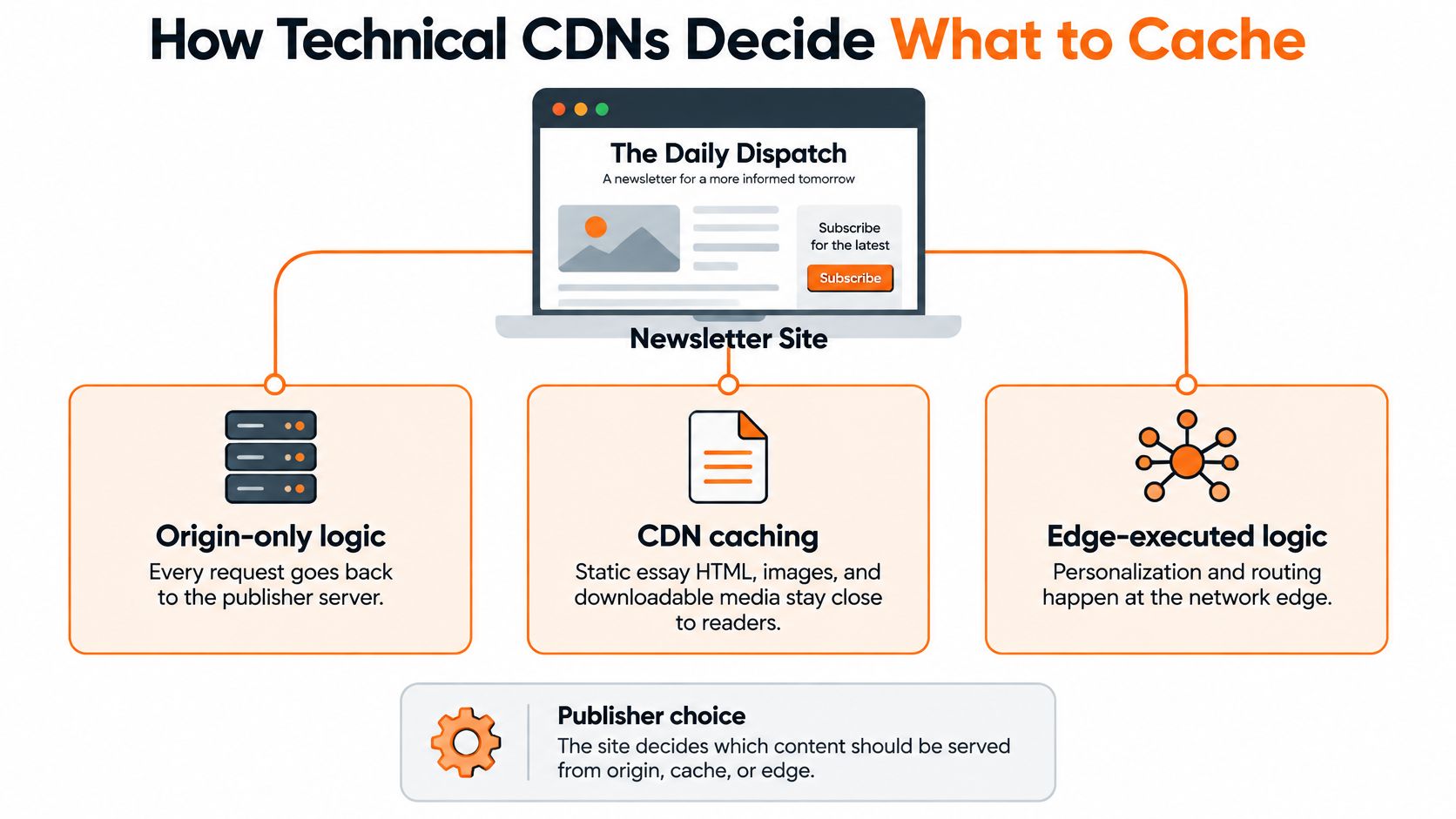
Three places a request can land
Origin-only means the publisher's server answers every time. Paywall checks, subscriber entitlements, and anything that must be correct for that one person often stay here, because a wrong answer is worse than a slower one.
Caching stores the finished box nearby. Static essay HTML, images, and downloadable media are the usual candidates. The next reader gets the box without a trip home.
Edge execution rebuilds the box at the branch. Geo-routing, bot filters, and some entitlement checks can run there. That helps only when the rebuild is faster than the trip back, and only when you can see a failure when it happens.
| Pattern | What runs there | Gain | Cost |
|---|---|---|---|
| Origin-only logic | Origin answers every request | Simplest to debug | Slow for distant readers and during spikes |
| CDN caching | Edge stores essays, images, and media | Lower origin load and tail latency | Stale pages if TTLs are aggressive |
| Edge-executed logic | Edge runs geo-routing, bot filters, and entitlement checks | Faster decisions near the reader | State, privacy, and invalidation cost; harder debugging |
IDC's forecast puts the managed edge-services market, covering CDN edge, provider edge, and on-premises edge, at $2.84 billion in 2024 and $7.82 billion in 2029, a 22.4% compound annual growth rate. That is a shift from cache toward programmable edge, and it is a projection, not a promise that every extra point of presence will feel faster to a reader.
When the branch rebuild is not worth it
I use four checks before I move logic off the origin.
- Request frequency. A page hit thousands of times a day earns a nearby copy. A rare admin screen does not.
- Data locality. If the answer needs the subscriber record, the origin still owns it.
- Consistency. A price, a paywall, or a correction cannot linger as yesterday's version.
- Observability. If you cannot tell a bad edge decision from a slow origin, leave the logic at home.
For images and scripts that do not change, versioned URLs beat constant purges. You publish essay-hero-v3.jpg and let the old file expire, instead of chasing every cache.
A short walk-through of that request path makes the warehouse picture less abstract.
A fast origin still needs a human distribution layer. The next sections are how I measured that layer, then ran it for the rest of the month.
Metrics That Separate Reach From Noise
I built the weekly log before I added tactics. On the technical side, a cache hit serves the asset at the edge and a miss fetches the origin, so hit ratio has to be counted apart from total requests. In production-trace experiments, the LA-Cache approach raised true cache-hit ratio by up to 7% and cut average latency by 10%, with P90 latency down 4% and P99 down 3% versus a conventional cache, according to the USENIX paper on LA-Cache.
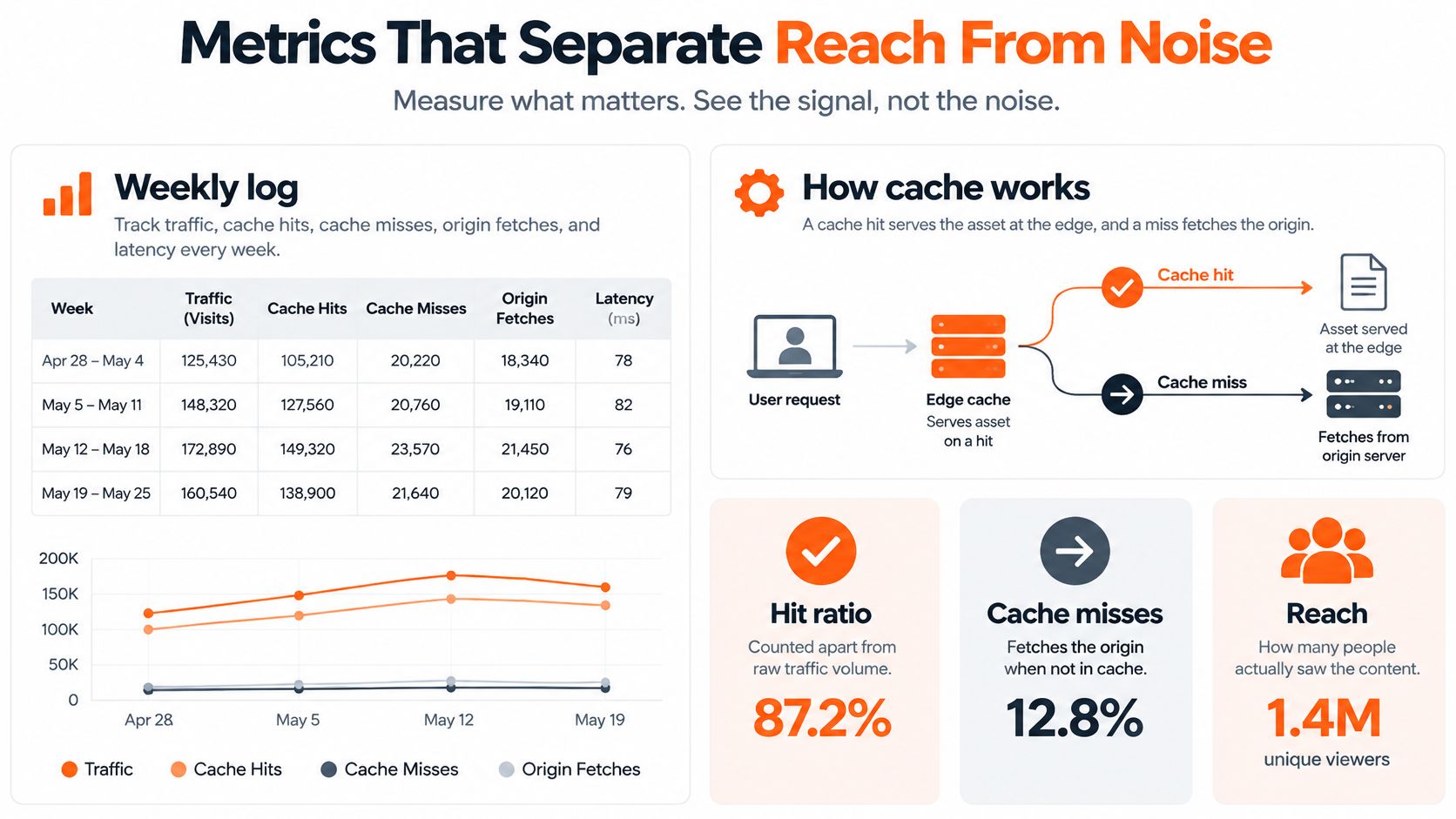
The same discipline, applied to publishing, ignored raw impressions. I counted Notes published, replies, restacks, profile visits, and subscriptions tied to Notes. A useful test is one long post and five to seven Notes a week, then a comparison of informational Notes against link-only promos. I kept that shape for the month and wrote the decision next to each row, the same way I would read a content performance metrics sheet instead of a vanity chart.
| Metric | What to record | Why it matters | Decision it triggers |
|---|---|---|---|
| Cache-hit ratio | Hits versus misses on images and page assets | A miss loads the origin and slows the tail | Version URLs instead of constant purges |
| Notes published | Count beside the weekly long post | Notes are feed discovery, not the email issue | Hold 5 to 7 or cut the batch |
| Replies | Replies per Note | Replies help the feed move past current subscribers | Rewrite hooks with none |
| Restacks | Restacks per Note | A restack reaches someone else's audience | Expand that idea into the next article |
| Profile visits | Visits after a Note | Interest that has not subscribed yet | Fix the profile and the link |
| Subscriptions | New subs tied to Notes | The outcome that pays for the cadence | Keep the format that converts |
What I changed when a row went quiet
A Note with zero replies got a new first line the next week, not a longer thread. A restack sent that idea into the following essay, because someone else's audience had already voted. Profile visits without subscriptions sent me back to the bio and the link, not to more posting.
Aggressive cache lifetimes create stale pages. Immutable assets should use versioned URLs, not a purge every time you twitch.
Fill one row from last week before you touch the schedule. I had been "posting more" while the only number moving was time spent in tabs. The log made the quiet rows obvious.
One Article Becomes Four Platform Versions
Each week I ran the same pass, in this order, so the long piece stayed canonical and the short pieces stayed native.
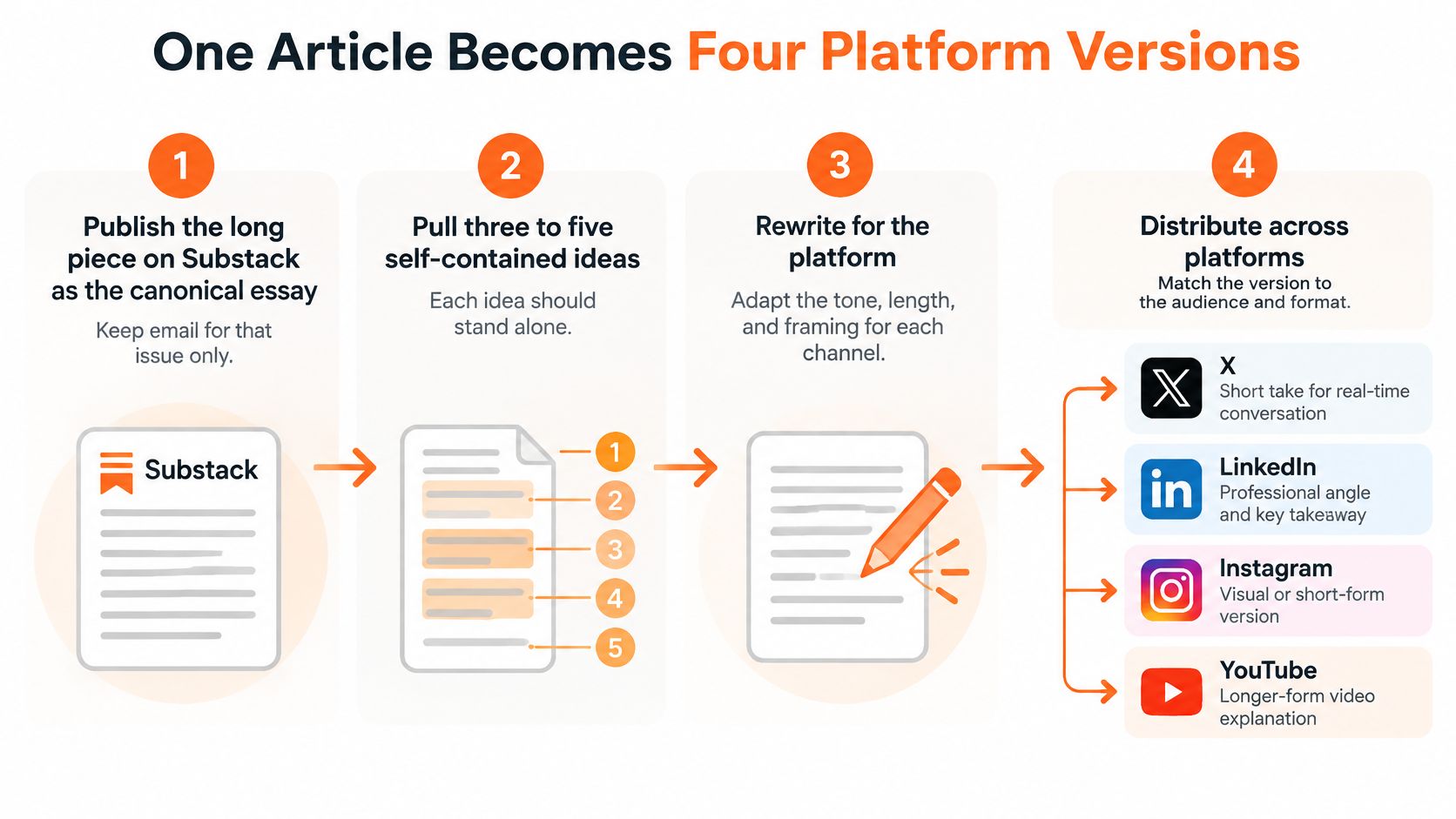
The six cuts
- Substack essay, email only for that issue. I published the long piece as the source of truth. The inbox carried the full argument once. I did not also email the scraps.
- Three to five ideas that can earn a reply alone. I pulled lines a stranger could answer without opening the essay. If the sentence needed the whole piece, it stayed in the piece.
- Notes, not a second newsletter. Substack's own description of Notes treats them as short posts with text, images, rich text, links, and @mentions, while the Home feed mixes people you follow with recommendations from their networks. Notes do not land in the inbox. I used one relevant @mention, one link back, and an image or a quote when the words needed a hook.
- One Medium cut aimed at search and Medium's reader graph. New title, a few honest tags, and a deeper slice of the essay. A pasted newsletter looked like a pasted newsletter, and it underperformed.
- One LinkedIn post that opens on a result or a tension. The first two lines had to work before the "see more" fold. I used the strongest claim from the week, not a summary of all of them.
- An X post or short thread that can be read without a click. Beats in order, one idea per post, the link last if it belonged there at all.
Promotional Notes that only said "new post" lost to Notes that contained the insight. Readers recommend, comment, and restack things their own subscribers might want, and a stranger can subscribe in one click from a reply, a restack, a mention, or a comment. More worked examples of that split are in these content repurposing examples.
One week, written down
In week three I shipped one essay, six Notes, one Medium cut, three LinkedIn posts, and four X posts, then scored them with the table above. The Note that led with the result picked up replies and a restack. The Note that led with the link did not. LinkedIn liked the tension opening. X liked the four-beat version more than a single paragraph with a URL.
Mark which of the six steps you still do by hand. For me, steps 3 through 6 were the ones that slipped whenever the afternoon ran out.
Schedule Notes and Posts Without the Copy Paste
Substack already lets you park a Note and have it publish itself. On the web, the composer has a calendar icon. On iOS and Android, the control sits in the three-dot menu. You pick a time in your local zone, and the Note goes out then, not when you remember. Substack's scheduling notes put those scheduled Notes in the Notes Drafts tab, where you can still edit them until the slot.
That is enough for a Sunday batch if Substack is your only room.
- Excerpts, questions, quotes, and links go into drafts in one sitting.
- Each item gets a slot before you close the laptop.
- Monday's replies tell you which draft to sharpen and which to leave.
In the second half of my 30 days, the same weekly set left in the windows I had chosen, instead of whenever formatting energy came back. Subscriber growth followed the formats that had already earned restacks, not the ones I felt like posting on a Wednesday night.
Native scheduling stops at one platform. The clerical gap, for me, was everything after the essay. Narrareach sits on top of that habit. I could schedule Substack Notes, Medium articles, LinkedIn posts, and X from one dashboard, cross-post without another paste, and turn a working Substack piece into Notes, posts, and threads that still sounded like me. The same queue is available in that dashboard or inside Claude or ChatGPT, with analytics aimed at which pieces drive subscribers. It does not replace the judgment in the metrics table. It removes the wait between a winning idea and the next slot, which is the boring half of how to schedule a post once the words are done.
The tool did not pick the hook. It kept the hook from dying in a draft.
The outcome I wanted, and got in those last two weeks, was more chances for the feed, Medium, LinkedIn, and X to work while writing time stayed on the essay.
Run the Next Cycle or Keep the Scorecard
The network that grew the audience was the repeated path from one essay to scheduled native posts, scored by replies, restacks, visits, and subscriptions. The technical content distribution network stayed in its lane, fast pages and fresh files, and did not substitute for that path.
Two ways to run the next cycle, at equal strength.
If you want the clerical gap gone now, start Narrareach free, with no credit card, and schedule the next week of Substack Notes plus the Medium, LinkedIn, and X cuts from one dashboard. A winning idea should not sit behind a single publish button.
If you are not ready for software, copy the six-row scorecard and run the next 14 days by hand. One long post. Five to seven Notes. Keep the format that earns subscribers. Save or share that scorecard and follow along for the next experiment instead of signing up.
Distribution compounds when the next post is scheduled before the writing energy runs out.
Narrareach schedules Substack Notes, Medium articles, LinkedIn posts, and X from one place, and it turns a piece that is already working into the next round of distribution without another afternoon of paste. If the scorecard showed you where reach was leaking, that is the gap it is built to close. Visit Narrareach and put next week's slots on the clock before the essay cools off.