
How to Schedule a Post Across Every Platform
You're probably trying to publish the same idea in four places while it's still fresh. At 7 a.m., that means finishing a Substack newsletter, copying it into...
By Ian Kiprono
You're probably trying to publish the same idea in four places while it's still fresh. At 7 a.m., that means finishing a Substack newsletter, copying it into Medium, trimming it for LinkedIn, cutting a line for X, and then discovering that one version is already stale because another went live an hour earlier. The writing may be good, but the distribution feels improvised, repetitive, and harder to measure than it should be.
I spent 60 days treating each post as one unit of work instead of four separate publishing jobs. I tracked reach, replies, and time spent per publish while moving one source idea through Substack, Medium, LinkedIn, and X. The useful change wasn't just pressing a scheduling button. It was separating the core argument from the timing, format, and audience behavior of each platform.
The Scheduling Grind Most Writers Live In
You start with a strong idea, then lose momentum to formatting. The Substack version needs a personal opening and a clear newsletter promise. Medium needs a title and structure that work for readers who don't already know you. LinkedIn needs shorter paragraphs and a hook that survives a busy feed. X needs compression, rhythm, and enough context to make a thread worth following.
Without a system, you make each version from scratch. The work feels productive because something is always being edited, but the same argument gets rewritten repeatedly and the publishing calendar remains fragile. Writers who are already trying to protect limited creative time can also benefit from practical tips for carving out writing time before they add more distribution channels.
My experiment began with a simple rule: one source idea, one source draft, several platform-shaped releases. I connected the publishing workflow to a single dashboard, recorded the time required for every publish, and compared reach and replies after each version appeared. The first uncomfortable finding was that posting everywhere at once felt efficient, but it diluted the attention available to each version. Staggering the releases gave each audience a separate reason to encounter the idea.
Practical rule: Treat the post as the asset. Treat each platform version as a distribution event.
The second trade-off was speed versus voice. Automation removed copying and pasting, but generic rewrites sounded flat. The third was volume versus attention. More scheduled slots didn't automatically create more useful conversations, especially when the same wording appeared across several feeds.
The alternative is a workflow built around one source idea, native variants, timed releases, and one view of performance. The mechanics are outlined in what content scheduling means, but you can apply the operating principle with a spreadsheet, a calendar, or a publishing tool. The point is to stop asking, “What should I write for each platform?” and start asking, “How should this idea travel?”
Connecting Your Accounts and Preparing Source Content
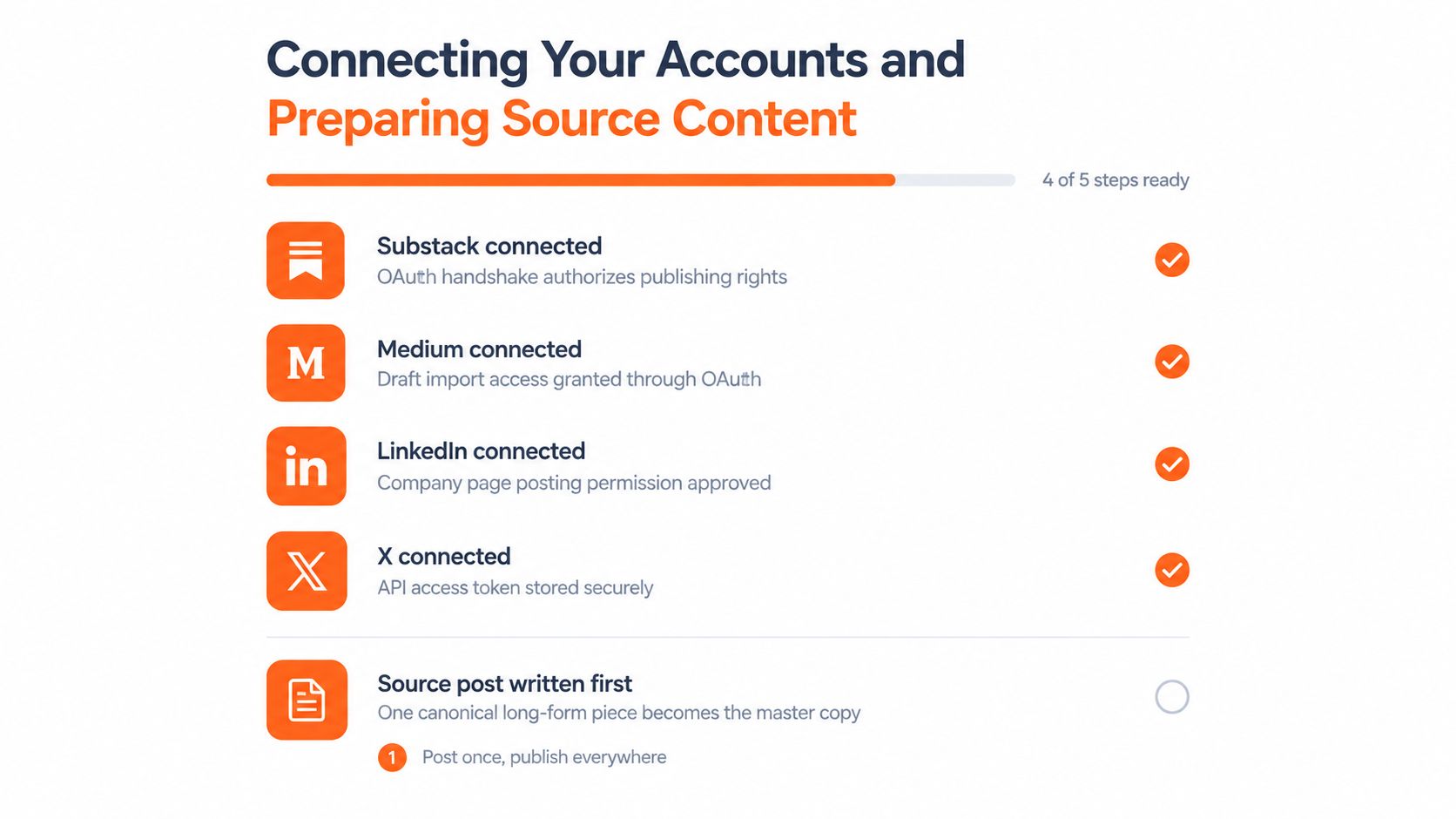
Before you schedule a post, make the account layer boring and predictable. Connect Substack, Medium, LinkedIn, and X in the Narrareach dashboard, using OAuth wherever the platform supports direct authorization. Substack requires an RSS-based bridge in this workflow, while Medium and LinkedIn use direct API authorizations.
After each connection, verify the handle, profile, page identity, and default audience. A connected account isn't necessarily the correct account. Check whether LinkedIn points to your personal profile or company page, confirm that the X handle is yours, and make sure the Substack publication matches the newsletter you intend to publish.
Write the source before the variants
Draft the argument in a clean source document before opening platform editors. Give the idea a working title and a one-sentence intent, such as, “Explain why newsletter growth depends on distribution timing, not only writing quality.” Keep the source draft free from platform-specific line breaks, hashtags, image crops, and calls to comment.
The source should contain:
- Core argument: The complete reasoning, evidence, examples, and conclusion.
- Working title: A label you can recognize in the content library.
- Audience promise: One sentence describing what the reader will understand or do.
- Reusable proof: Any cited observation, example, or supporting detail that must remain accurate.
Add these during repurposing:
- Platform hook: The first line changes according to the feed.
- Length and structure: A thread, article, note, or short post needs different pacing.
- CTA: The next action should fit the platform and the audience's intent.
- Media treatment: Image crop, preview text, and link placement belong to the destination version.
The Narrareach integrations page can help you review the available connection paths. Once the handles and permissions are correct, your dashboard should show four connected channels and a source library ready for repackaging. That preparation prevents the common mistake of writing four complete posts before scheduling even one.
Repurposing One Idea Into Platform-Ready Formats
Take one source idea about newsletter economics. The core claim might be that a newsletter grows more reliably when the writer distributes one useful argument across several audience contexts instead of waiting for a single inbox send to do all the work.
The Substack version can become a long-form essay. Open with a personal observation, develop the economics carefully, and finish with a soft invitation to subscribe or read the next issue. Medium can use the same argument but remove the insider context, add clarifying subheads, and explain terms for readers discovering the idea for the first time.
LinkedIn needs a different entry point. Start with one strong line, use short paragraphs, and finish with a direct question that invites professionals to compare their own experience. X can turn the idea into a three-post thread: a decisive first post, a second post that delivers the practical takeaway, and a final post linking to the full essay.
| Platform | Format | Hook Style | CTA |
|---|---|---|---|
| Substack | Long-form newsletter essay | Personal observation or tension | Read the full piece or subscribe |
| Medium | Adapted article | Clear problem statement | Continue reading or follow |
| Short text post | One-line professional insight | Answer a direct question | |
| X | Three-post thread | Strong claim in the opening post | Read the linked essay |
Narrareach's per-platform fields are useful here because the canonical argument stays in one source while each destination receives its own preview text, canonical link, image crop, and CTA. The tool can schedule Substack Notes, Medium articles, LinkedIn posts, and X content from one dashboard, but the editorial decision remains yours.
A repurposed post should feel native on arrival, not identical at every stop.
The source draft is the only place where the complete argument needs to live. Each variant should preserve the meaning while changing the entry point, pacing, and reader action. The practical distinction between adaptation and duplication is also covered in what content repurposing involves.
Smart Scheduling Windows for Each Platform
Publishing one idea everywhere at the same moment saves time, but it ignores how differently audiences check each platform. LinkedIn often performs later in the day, X tends to favor weekday mornings, and TikTok often sees stronger evening or weekend activity, as summarized in this 2026 best posting times guide. For platform-specific windows, see our guide to the best time to schedule social media posts.
The available timing evidence supports scheduling rather than rejecting it. One industry experiment reported 8.19% engagement for Instagram posts published through a scheduler versus 6.44% for native posting, with 10,122 total reach versus 7,189 and 713 likes versus 336 for scheduled and native posts respectively (Posterly's scheduling experiment). Separate research found that morning publishing produced 8.8% more link clicks than afternoon posting and 11.1% more than evening posting (Social Science Space's scheduling analysis).
Use those findings as starting hypotheses, not fixed rules. Test a cadence for 3–4 weeks before changing it, following Hootsuite's social media engagement guidance. Keep a 20–30 minute engagement block after each release so early replies receive attention while the post is still gathering activity.
| Platform | Best Days | Best Time Window | Weekly Frequency | Stagger Offset from Source |
|---|---|---|---|---|
| Substack | Tuesday or Thursday | Morning delivery | One anchor issue | Source release |
| Medium | Midweek | Afternoon reading window | One adapted article | About one day later |
| Tuesday through Thursday | Professional commute or between-meeting window | One breakdown | After the source has context | |
| X | Weekday mornings, with a second distinct window | Morning and later-day testing | One thread or selected posts | Later in the sequence |
The table gives you a workable first pass. Hootsuite cites an overall benchmark of 8 a.m. on Wednesdays, LinkedIn peaks of 4 a.m. to 6 a.m. on Tuesdays and Wednesdays, and X peaks of 9 a.m. to 11 a.m. from Wednesday through Friday in its referenced data. Track impressions, engagement rate, and click-through rate by platform, then adjust for your audience instead of copying a global schedule.
A 24-hour burst creates launch energy, but repeated exposure can arrive before readers have responded to the first version. A four-day stagger takes longer and gives the same post room to meet different platform rhythms. It also creates more opportunities to compare which framing earns attention.
Set each platform's active window, publish the adapted post, reserve the engagement block, review the metrics, and change one variable at a time. The post remains the unit of work, while timing and presentation change by destination.
Building the Weekly Publishing Routine
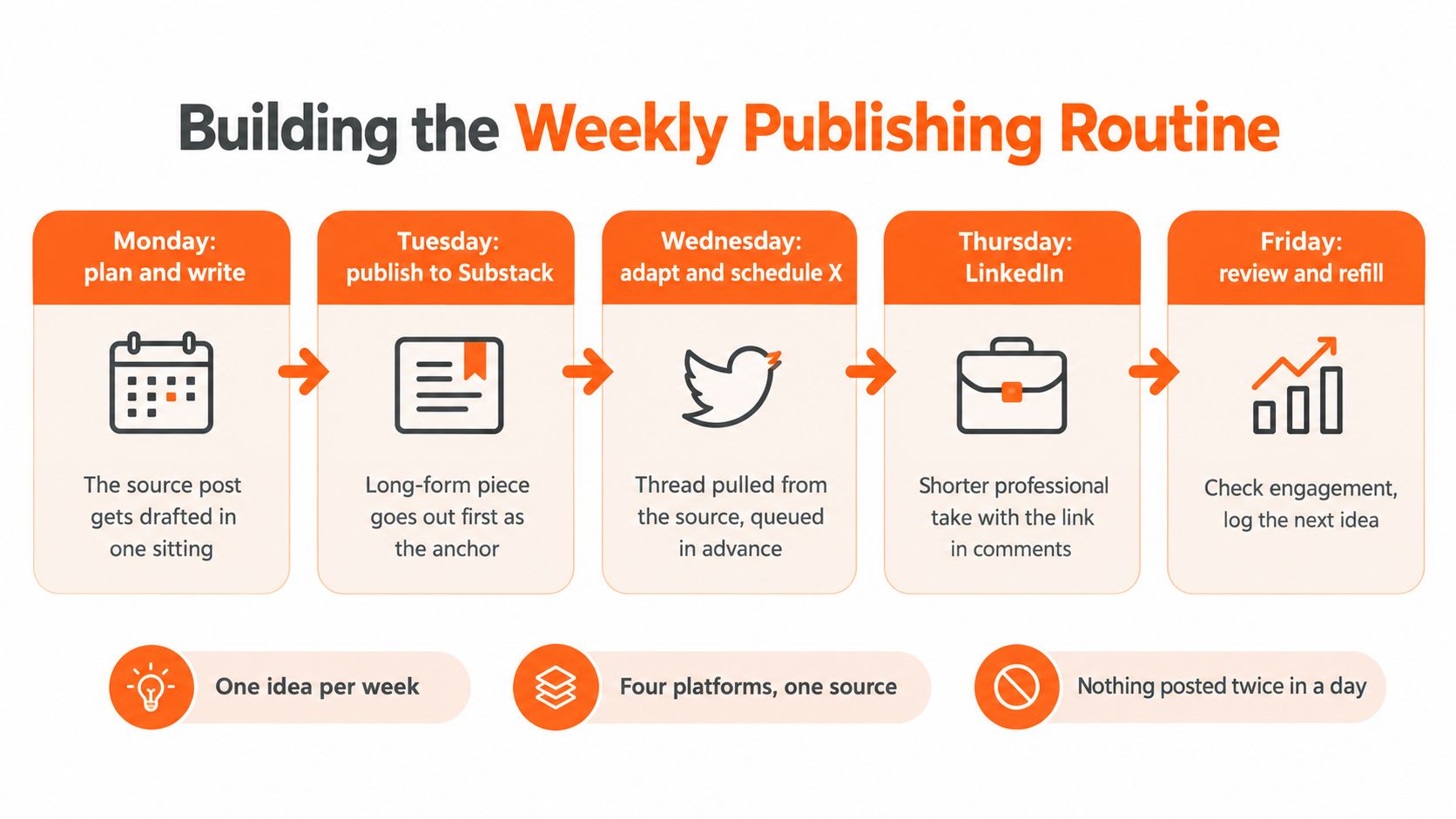
The routine below keeps the work visible without asking you to create four unrelated campaigns. Monday is the production day. Finalize the source post, draft the four variants, add links and media, and inspect every preview before anything enters the queue.
On Tuesday morning, publish the Substack source. Wednesday afternoon, release the Medium adaptation. Thursday morning, publish the LinkedIn breakdown. Friday afternoon, send the X thread. This sequence creates a deliberate distance between versions, so the same idea doesn't arrive everywhere as a copy-paste burst.
Put attention after publishing
Reserve a 30-minute engagement block immediately after every release. Use it to answer questions, acknowledge useful replies, and identify language your audience uses naturally. The block isn't a substitute for good writing, but it keeps scheduled publishing from becoming a one-way broadcast.
On Sunday, spend 15 minutes reviewing the week. Note which platform generated meaningful replies or clicks, which hook attracted no response, and whether a failed slot needs a different time. Don't rebuild the whole calendar from one quiet post.
A two-week buffer is a practical middle ground for most writers. It gives you room to batch production while preserving enough flexibility to replace a scheduled item when news, audience feedback, or a new insight changes its relevance. Industry data reports that 87% of users plan content at least one week ahead and 34% maintain a buffer of two weeks or longer, while scheduling tools save an average of 6.3 hours per week, or about 328 hours per year (ScheduleWave's scheduling statistics).
Don't fill every available slot. Leave space for timely Notes, replies, and ideas that deserve faster treatment than the routine allows.
Reading Cross-Platform Analytics That Matter
A dashboard can show dozens of metrics, but a weekly publishing routine needs a small decision set. Likes and views are easy to notice because they move quickly. They don't always tell you whether readers understood the idea, clicked through, replied with intent, or returned for the next piece.
During the 60-day test, I assigned one primary growth signal to each platform. The scorecard became easier to read because each number answered a different question: did the audience open, stay, discuss, or save the idea?
| Platform | Predictive Metric to Track | Vanity Metric to Ignore | Healthy Benchmark |
|---|---|---|---|
| Substack | Click-through from email to the full post | Open count alone | Compare against your own previous sends |
| Medium | Read ratio | View count alone | Look for sustained reading, not a universal threshold |
| Comment-to-impression ratio | Likes alone | Track the quality and consistency of replies | |
| X | Bookmarks and quote posts | Likes or reposts alone | Compare saves and quotes across similar threads |
For Substack, open rate can help you judge the subject line, but a click from the email to the full post shows stronger intent. On Medium, read ratio tells you more about attention than raw views. LinkedIn comment threads reveal conversation quality, while X bookmarks and quote posts can indicate that a reader found the idea useful enough to keep or reinterpret.
Diagnose the quiet failures
Scheduled publishing fails in operational ways that aren't visible in the final feed. A draft can remain stuck because a platform revoked an API permission. An X thread can publish while its LinkedIn counterpart fails without notice. Identical cross-posts can create duplication problems on Medium, and an outage can interrupt a slot even though the dashboard still shows it as scheduled.
Use a fixed diagnostic sequence:
- Check the dashboard error log: Confirm whether the item failed before dispatch, during authorization, or after the platform returned an error.
- Re-authenticate the account: Refresh the OAuth token when permissions have expired or changed.
- Compare timestamps: Match the failure time against the platform's status page to separate an account issue from a service outage.
- Inspect the destination: Confirm whether part of a thread or article published before retrying.
- Apply a prevention rule: Review pre-flight status before the publishing block ends and refresh tokens on a fixed weekly cadence.
The attribution problem is subtler. If the same link appears at different times, later clicks may reflect the combined effect of the source, the platform variant, and the delay between them. Use platform-specific tracking labels where available, keep the canonical destination consistent, and interpret the sequence rather than crediting every click to the last post.
A useful cross-platform analytics workflow should help you compare those events without pretending that every platform measures attention in the same way. If your team also needs broader channel reporting, an SEO reporting tool can sit alongside the publishing scorecard, but it shouldn't replace the platform-level diagnosis.
Your 30-Day Rollout and Two Ways to Keep Going
Don't connect every account and fill an entire calendar on the first day. A staged rollout gives you time to verify permissions, learn how each format behaves, and fix timing before a larger publishing system depends on it.
- Week 1: Connect the accounts, prepare one source idea, and publish one Substack post. Confirm delivery and record the click-through behavior.
- Week 2: Add X and run the Substack source plus one thread. Compare which part of the argument earns replies or saves.
- Week 3: Bring LinkedIn into rotation. Test the professional hook separately from the newsletter opening.
- Week 4: Activate Medium and tune the full four-platform cadence. Review the queue, links, previews, and error log before the next publishing block.
Use the rollout checkpoints stated for the workflow: aim for delivery confirmation rates above 98% and at least one engagement response per post within 24 hours. These are operating targets, not universal performance guarantees. If you miss them, inspect the account connection, timing, hook, and follow-up process before adding more volume.
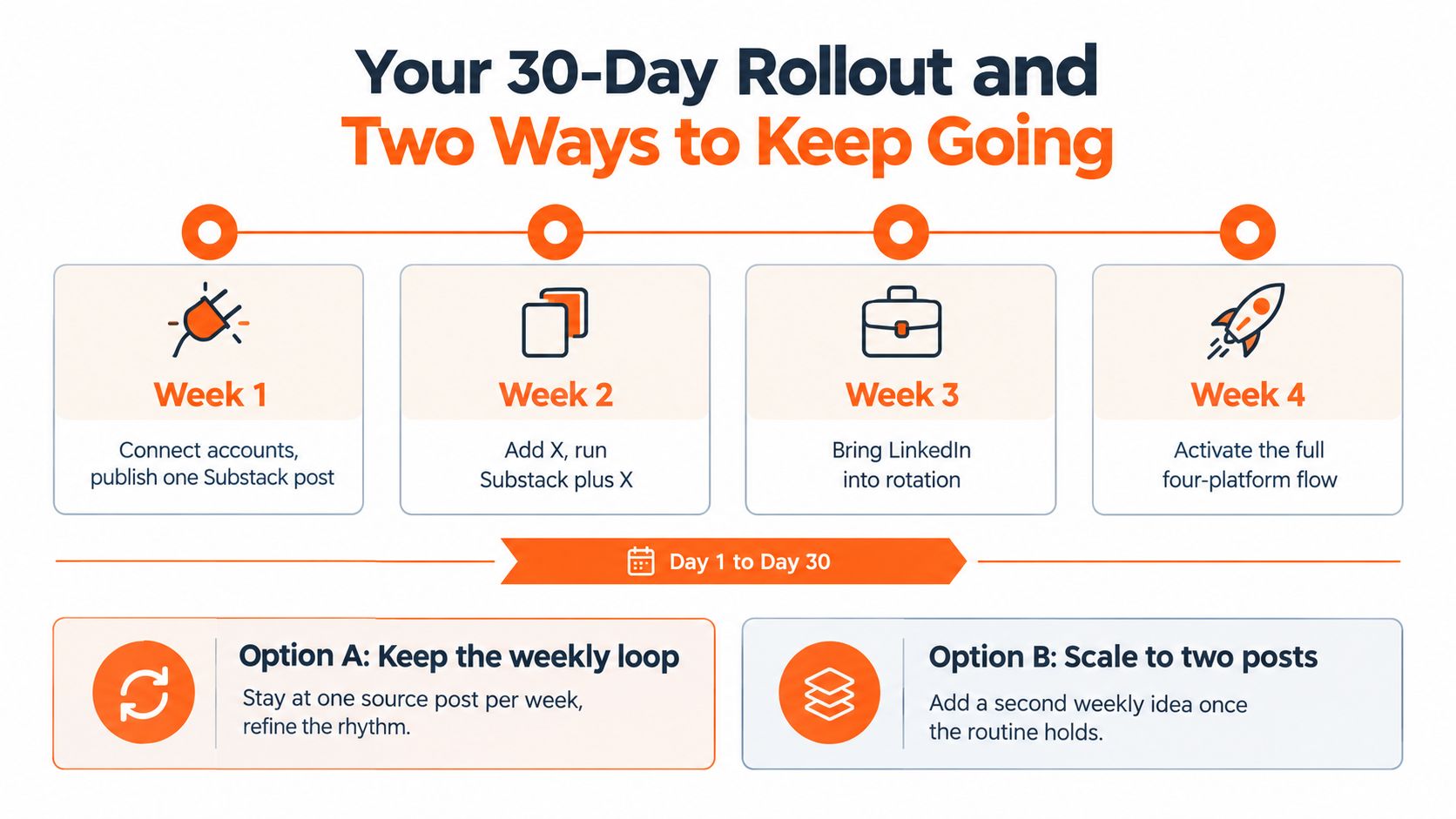
By the end of the month, choose one of two sustainable paths. Option A keeps one source post per week and improves the rhythm, hooks, and staggered timing. Option B adds a second weekly idea only after the first routine runs reliably, with enough review time to protect voice and relevance.
The broader scheduling environment reinforces this gradual approach. A 2025 scheduling guide warns against over-automation, ignoring analytics, and using one global posting time, while recommending a scheduling horizon of about 2–4 weeks (SocialRails' scheduling guidance). Automation should remove repetitive handling, not remove editorial judgment.
Narrareach brings Substack Notes, Medium articles, LinkedIn posts, and X content into one scheduling and analytics workflow, so you can turn one source idea into platform-ready releases without repeating the copy-paste grind. If you want to test that workflow, visit Narrareach, connect your accounts, and start with one weekly post before expanding the cadence.