Content Curation vs Content Creation: Which Wins in 2026
A long essay can consume a working day and still bring in only a few new subscribers. Then the practical problem starts: adapting that same argument for...
By Ian Kiprono
A long essay can consume a working day and still bring in only a few new subscribers. Then the practical problem starts: adapting that same argument for LinkedIn, X, and Substack Notes feels like another job, so your strongest ideas stay in one place. You're left asking whether original posts or curated material actually grow an audience.
The useful question isn't which approach wins in every situation. It's what to publish, how much editorial transformation to add, and which result you're trying to improve. A 2017 industry benchmark recommended a mix of created, curated, and syndicated content, treating curation as a complement to original publishing, not a replacement for it (Curata's content marketing benchmark roundup).
This article offers a side-by-side comparison, a planning estimate for time and output, a reader-performance framework, safeguards for repurposing, starting mixes for different publishing situations, and a practical two-week schedule. The time figures are estimates for planning, not measured results. For a separate perspective on adapting material across channels, Klap's guide to building a video distribution strategy can help you think through how one source asset can travel in different formats.
Content Curation and Content Creation Side by Side
| Dimension | Content Curation | Content Creation |
|---|---|---|
| Core output | Selected links with added context, roundups, and judgment-led Notes | Original essays, analysis, research, and original data |
| Main input | Other people's articles, posts, and datasets | Your experience, research, interviews, and observations |
| Typical time per asset | 10–20 minutes per annotated link, a planning estimate | Several hours or more, depending on research and length |
| Realistic frequency for a solo writer | Several short items per week | 1–2 long pieces per week, if capacity and quality allow |
| Main strength | Speed, breadth, and steady reader contact between releases | Distinctiveness, authority, and shareability |
| Main risk | Reads as aggregation when commentary is thin | Burnout and slow feedback on each piece |
| Trust risk | Low when sources are cited and your judgment is visible | Low when claims are sourced, high when content is generic |
| Best success metric | Source-click rate, replies, and saves | Dwell time, shares, and subscriber conversion |
Creation produces a primary asset: an essay, analysis, or original observation. Curation selects existing material and adds a decision layer around it. The difference isn't just who wrote the source material. It's what work you do for the reader: create something they couldn't find elsewhere, or help them identify and interpret something worth their attention.
The table's sharpest dividing lines are input, production time, and measurement. A curation workflow starts with an outside source, then needs verification, selection, context, and attribution. A creation workflow starts with your own experience or research and asks whether you've made a distinct contribution. Research on online curation found that selected material could surface items that weren't among the most popular search results, and that organized, consistent curation could help curators attract followers (the study of Pinterest and Last.fm curation).
Neither method automatically deserves more trust. A well-sourced Note with a clear judgment can be more useful than a generic original post. An essay that paraphrases other people's work without adding a point of view isn't distinctive just because you typed it yourself. Independent newsletter research also describes curation as filtering and contextualizing dispersed information, with the author-reader relationship making source quality and explanation important parts of the value (the study of independent newsletters).
Creation gains differentiation and the possibility of compounding search value, but costs hours and carries the risk that one piece will land unnoticed. Curation gains speed, breadth, and regular contact with readers, but it commoditizes quickly when commentary is thin. If you're choosing topics before you choose formats, this guide to finding trending topics can help you develop a source and idea pipeline.
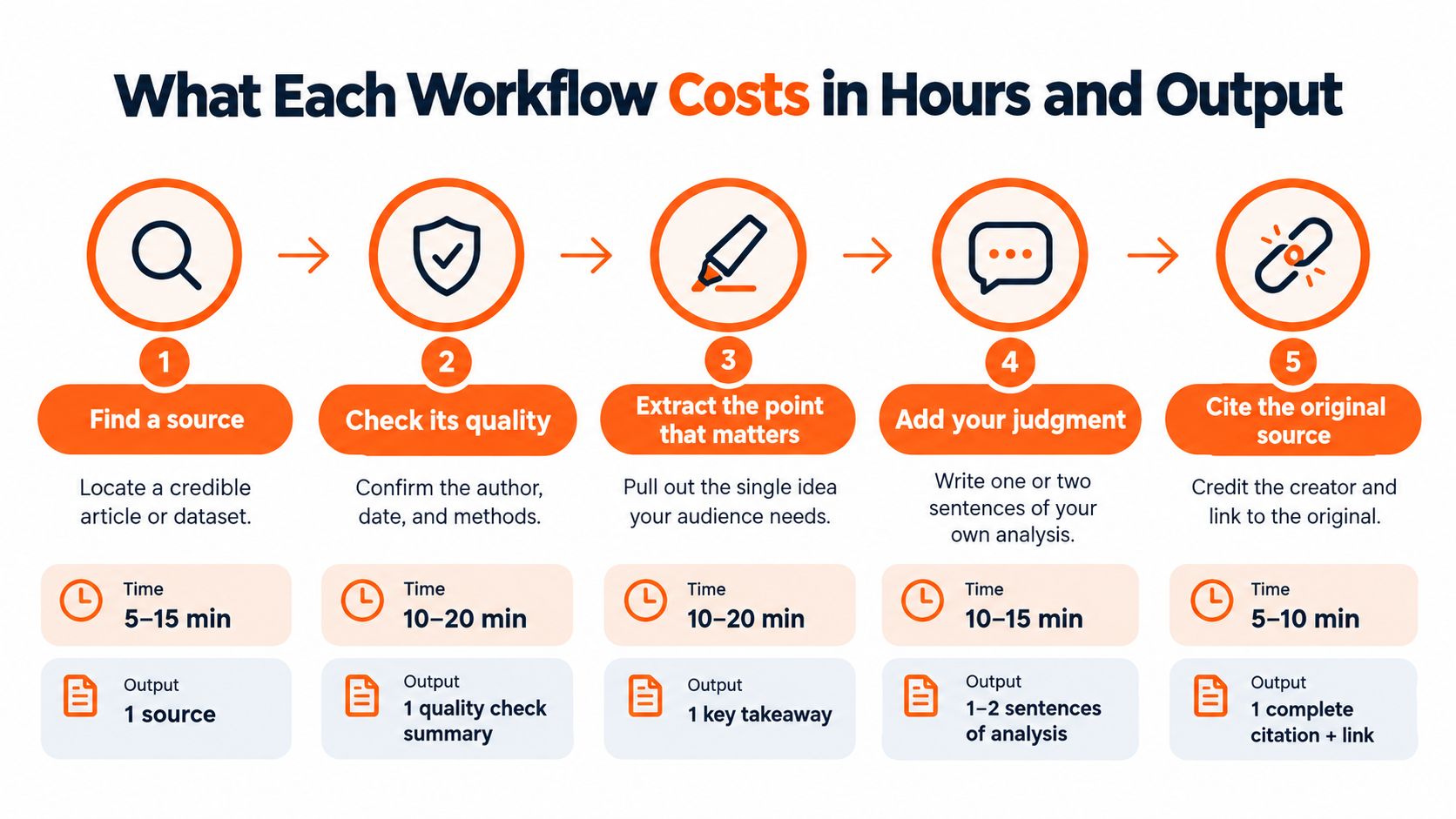
What Each Workflow Costs in Hours and Output
Curation works best as a deliberate sequence, not a link dump. Find a source, check its quality, identify the single point that matters, add your judgment in a sentence or two, cite the source, and schedule the Note. The reader should be able to tell both why you chose it and where it came from.
Creation follows a different path. Choose a theme because readers keep responding to it, research the question, draft and edit the argument, publish the essay, then extract short angles from the finished work. The essay is the original asset; its derivatives are ways to distribute its strongest ideas, not substitutes for the argument itself.
| Asset | Typical time | Output from 5 hours per week | Best use |
|---|---|---|---|
| Annotated link Note | 10–15 minutes | About 20–30 Notes | Keeping readers in contact between releases |
| Curated roundup of 5 links with commentary | About 75–90 minutes | 3–4 roundups | Showing judgment on one theme |
| Original 1,500-word essay | 6–10 hours including research | Under 1 essay | Building authority and subscribers |
| Repurposing cycle: one essay into 5 Notes and 2 LinkedIn posts | About 75–90 minutes | 3–4 cycles | Extending the reach of existing work |
These are planning estimates, not measured benchmarks. Your research depth, editing habits, and platform needs will change the time per asset. Log the start and finish time for each task over two weeks, including research, revisions, and scheduling, then replace these estimates with your own working averages.
The capacity implication is straightforward: creation is often the bottleneck. If you've already published a strong essay, the economical way to increase useful output is to adapt its tested arguments for other formats rather than draft another piece from scratch. That doesn't mean every sentence should be copied everywhere. Each platform needs a suitable angle and a judgment pass. For more ideas on managing production capacity, see how to scale content creation.
How Each Format Performs With Readers
A 3,100-campaign analysis reported that original pieces generated 1.9 times the interaction of curated pieces and 3.5 times the shares of aggregated content; engagement included average time on page, shares, and interaction rate (the analysis of content originality and engagement). That's industry research, not a peer-reviewed experiment, so it's a directional signal rather than a universal promise.
The practical distinction is that creation tends to be the stronger format for differentiation and shareability, while curation helps you maintain contact between larger original releases. Don't combine both into one engagement average. A share of a carefully framed outside source and a subscriber conversion from an original essay represent different kinds of value.
A curated Note that earns thoughtful replies may reveal a question readers want you to answer in your own words. Develop that recurring interest into original analysis. But a copied or lightly summarized post performing well doesn't prove that borrowed material can outperform your expertise. The useful signal is the audience's response to your framing, not permission to stop doing original work.
Measurement rule: Label each asset by source type before publishing. Compare original work with original work, and curated material with curated material.
Track impressions, engagement rate, dwell time, shares, source-click rate, subscriber conversion, and assisted conversions separately for each type. Preserve your point of view when repurposing, since more distribution can increase exposure without increasing distinctive value. For a deeper measurement framework, use content performance metrics to decide which outcomes matter for your publishing goals.

Repurposing Without Losing Your Point of View
When I adapt a newsletter essay into a Note, I keep its central claim and add a platform-specific angle. That is my editorial judgment about useful repurposing, not a conclusion established by research on trust. The cited report covers consumer attitudes toward generative-AI creator content, not repurposed writing or disclosure. Its findings, reported secondhand, therefore cannot show that adapting work without disclosure reduces trust.
The practical test is whether an adaptation preserves the original claim, its limits, and the writer's judgment. A change in format is usually lower risk; changing what a source says or obscuring where it came from calls for closer review.
Lower-risk transformations include:
- Reformatting: Adapt your essay for a Note, LinkedIn post, or X thread while keeping its claim intact.
- Summarizing your argument: Shorten your reasoning without dropping its limits or conclusion.
- Extracting an attributed quote: Name the speaker and link to the source.
- Adapting your own idea: Turn a point from an article into a Note with an angle suited to that platform.
Higher-risk transformations include adding unsupported claims, flattening your voice into generic phrasing, hiding a source, or publishing an AI draft based on a source list without editorial review. These choices can make a fast workflow feel careless instead of useful.
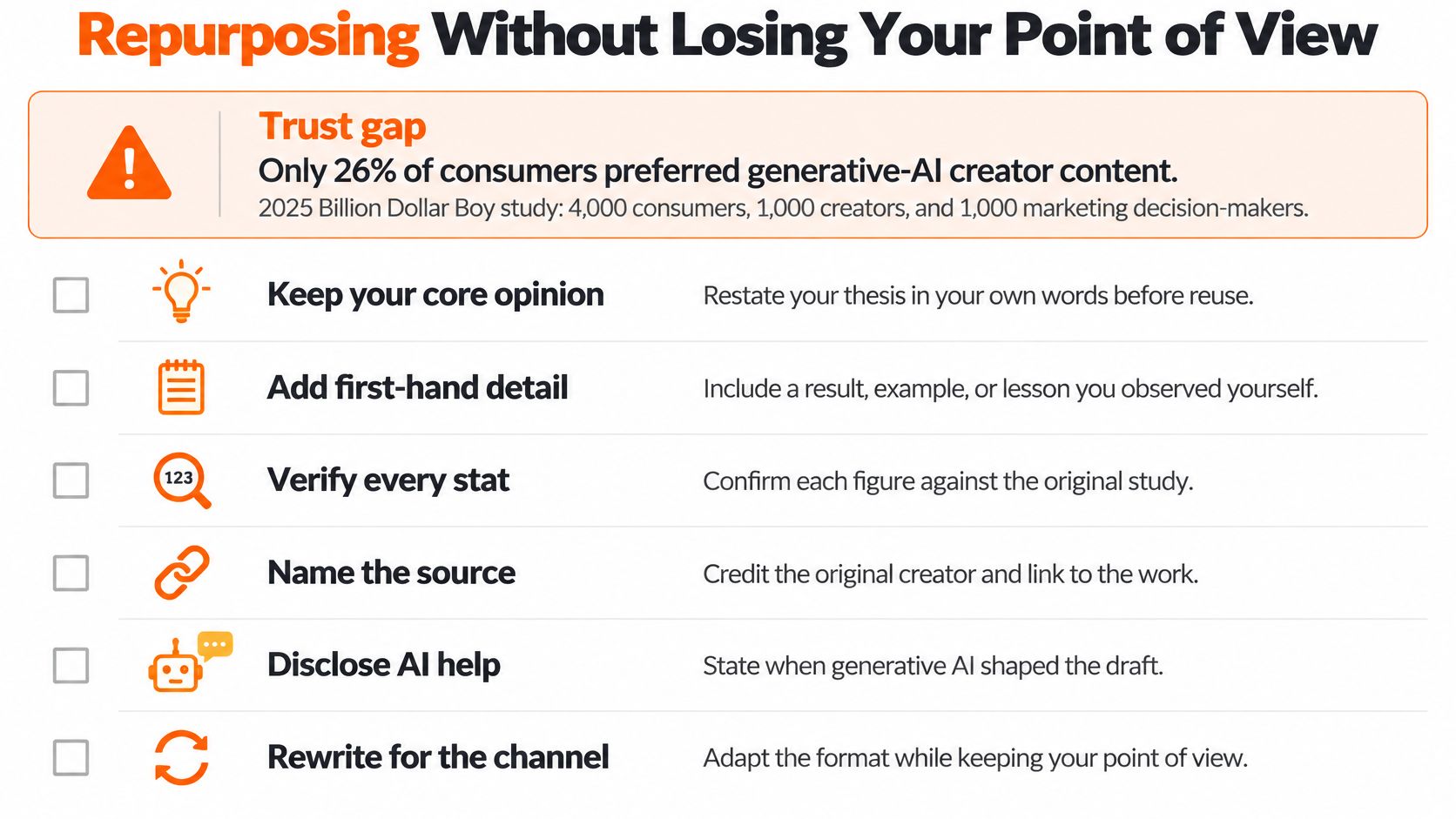
Use three editorial rules for adapted work:
- Keep provenance visible. Link to outside sources and identify material that isn't yours.
- Add original judgment. Explain why a point matters to your readers instead of repeating it.
- Check the voice. Read the finished piece aloud and remove language you would not use in conversation.
For a repurposing cycle, budget 75–90 minutes as a planning estimate, not an observed performance result. That is less time than drafting and researching an essay from scratch in the workflow estimates above, while still allowing for a human editorial review. A distribution tool can format and schedule adaptations, but it cannot assess whether a source's claim is sound or whether the final draft still expresses your view. Consistent wording across formats also helps readers recognize your publication's point of view. See this guide to brand voice consistency.
Which Approach Fits Your Situation and Mix
A peer-reviewed study of engagement on Instagram, Facebook, and Twitter found no statistically significant effect from posting frequency on those platforms. It also found no significant effect from publishing time or content length (the peer-reviewed social-media engagement study). Treat that finding as platform-specific evidence, not a rule that every channel should reuse the same idea. Your mix should reflect what you can produce well and what reader behavior you are tracking.
| Situation | Create | Curate | Repurpose |
|---|---|---|---|
| New newsletter under 500 subscribers | 70% | 10% | 20% |
| Established newsletter with 500–5,000 subscribers | 50% | 25% | 25% |
| News-heavy niche such as tech, policy, or finance | 35% | 45% | 20% |
| Agency or multi-brand editorial team | 40% | 15% | 45% |
| LinkedIn-first solo expert | 40% | 20% | 40% |
These ratios are starting shares, not research-backed performance guarantees. A new newsletter can weight creation more heavily to give subscribers a clear reason to return: your perspective. An established publication can reserve more room for useful outside material while keeping original analysis central.
In a news-heavy niche, curation helps you keep pace, while your selection and interpretation provide the value. Agencies and multi-brand teams can repurpose existing material across accounts and formats. A LinkedIn-first expert can also adapt original ideas, provided each post retains a distinct point of view.
The right balance depends on transformation risk and the metric you track. If a curated Note earns repeated replies, turn the question behind those responses into an original essay within two weeks. That's the point to move from sharing a source to developing your own analysis. Track outcomes by source type, such as replies to curated Notes or engagement with original essays, rather than relying on total post count alone.
Use day 14, the review point in the two-week schedule, to assess the starting mix and check whether the workflow is working. Keep that mix through day 30, then decide whether to change it using a full month of reader response. Day 14 is an early check, not a reason to reset the proportions; day 30 is the first planned adjustment.
Schedule Your Mix on Substack in Two Weeks
A two-week publishing cycle gives you enough time to test a mix, then review how readers respond. Substack's scheduling controls may change, so confirm the current steps in the app before relying on them. The Substack Notes scheduling details describe the web composer and mobile options; use the controls available in your version.
Choose a starting mix. Pick the row that best fits your publication and record the intended shares of creation, curation, and repurposing. Compare that baseline with what you actually publish at the end of the cycle.
Draft one original essay. Start with a question readers have already shown interest in. Mark the essay's central argument, then use it as the source for shorter adaptations.
Derive five Notes. Give each Note a distinct purpose, such as stating a key claim, drawing out a practical implication, or raising a question the essay explores. Repeating the same summary in different words adds little.
Schedule the Notes in Substack. As described in the scheduling guide, the web and mobile controls may differ. Check the current interface, set the publication time in your local time zone, and confirm the scheduled status before leaving the composer. Leave room to revise before a Note goes live.
Curate two annotated links per week. Add a sentence explaining why each source matters, and credit and link to its original publisher. The annotation is where curation becomes your judgment rather than a reading list.
Give reach time to develop. Avoid judging a Note after only 40 minutes. The available analysis of Substack Notes reach and timing does not provide a basis for treating its precise reach and posting-hour figures as settled benchmarks. Wait at least 24 hours before comparing performance, and assess posts over the same observation window.
Review on day 14. Sort results by source type, then decide whether the next cycle should include more creation, curation, or reuse. Keep that decision tied to your publishing schedule with a practical editorial calendar example.
Narrareach brings scheduling for Substack Notes, Medium articles, LinkedIn posts, and X content into one dashboard, with cross-platform analytics for tracking which content drives subscribers. Run a 14-day test with a clear mix, publish consistently, and compare posts across equivalent observation windows.
Try Narrareach to schedule your first week and track how original, curated, and repurposed posts perform across platforms, with a free start and no credit card required. If you prefer to keep your current workflow, record what you publish and how readers respond over the next two weeks.