Plan Social Media Marketing for Writers in 2026
You finished the essay at midnight, proofed it twice, and hit publish feeling like you'd finally said the thing properly. By morning it's got a handful of...
By Ian Kiprono
You finished the essay at midnight, proofed it twice, and hit publish feeling like you'd finally said the thing properly. By morning it's got a handful of likes, maybe one kind comment, and almost no new subscribers. Not because the writing was weak. Because nobody outside your existing list ever saw it, and you haven't got another evening free to rewrite the same argument four different ways for four different feeds.
The Newsletter That Nobody Else Saw
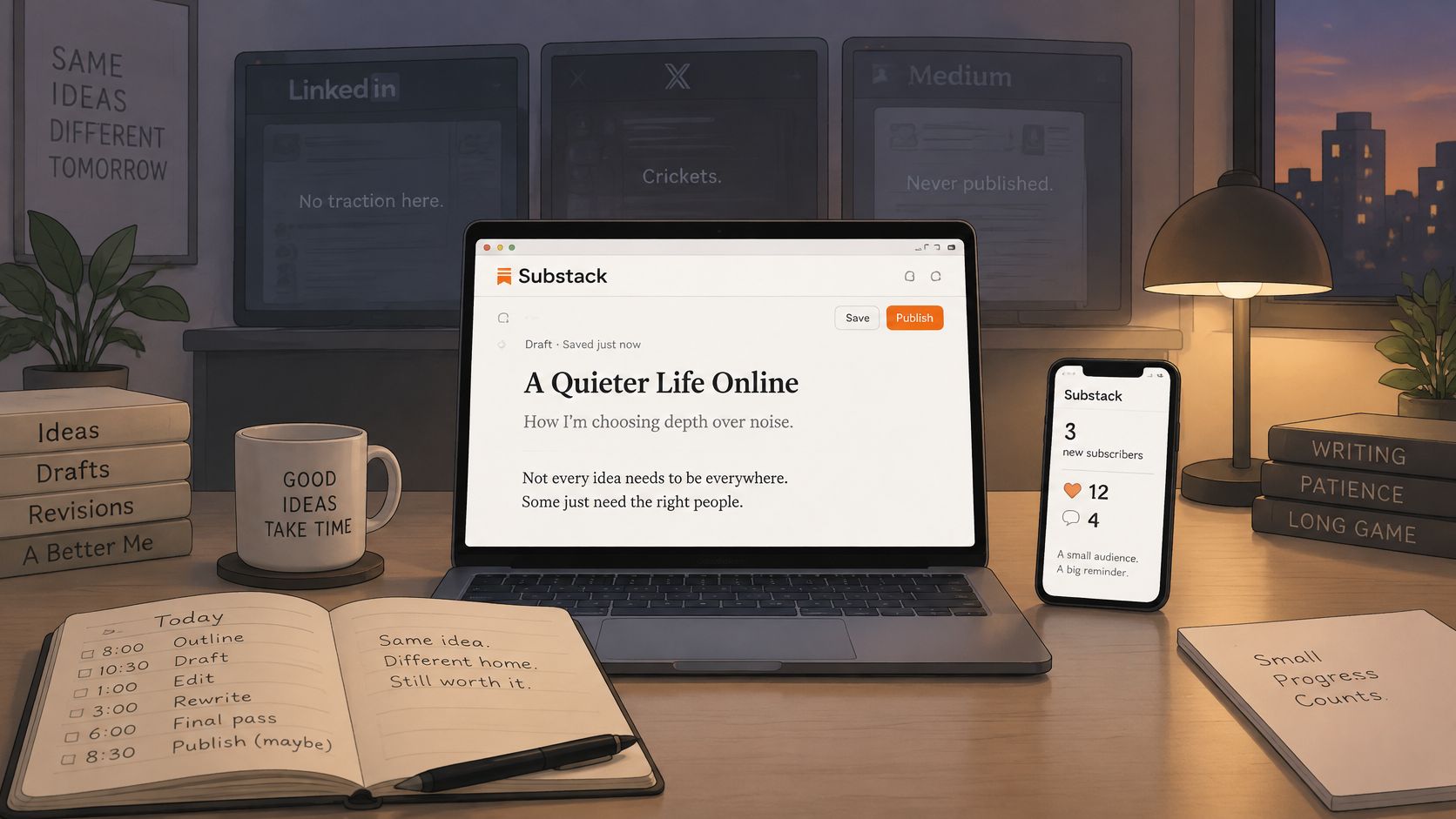
That was my stuck week before I ran this test. I'd spent about 10 hours on one Substack essay. It brought in 3 new subscribers. LinkedIn never carried it. X never tested its central claim. Medium never got the searchable version. Reformatting felt like a second job, so I skipped it and told myself I'd write a better essay next week.
The writing wasn't the bottleneck. Distribution was. Most of my workweek was going to drafting, then any energy left went to copying, resizing, and reposting. Thinking, the part readers subscribe for, kept getting squeezed out by logistics I hadn't planned for at all.
Why one platform cannot carry the whole plan
Readers don't sit in one place waiting for your issue. DataReportal's Digital 2026 Global Overview counts 5.66 billion social media user identities worldwide, equivalent to 68.7% of the global population, and found online adults spend more than one hour per day browsing social networks such as Facebook and X. Add video platforms including YouTube and TikTok and that rises above 2.5 hours a day, or 18 hours and 36 minutes per week.
That means your next subscriber probably meets your idea first as a short post, a note, or a thread, not as a full essay in their inbox. If the essay only exists in one format, you've built one door into a house people approach from six streets.
The test I set myself One flagship essay a week for 30 days, a short set of native derivatives from each, and a score based on subscriber actions rather than likes.
I didn't write more. I planned social media marketing around the essay I was already writing, so each strong idea got several native chances to find readers. The outcome I wanted was simple. A calendar a solo writer can keep, where distribution stops eating most of the week and starts compounding the writing you've already done. The cadence numbers come first, because they decide what's realistic. Then the seven-move build shows how to run it.
Weekly Cadence and Growth Benchmarks
Choose a weekly pace you can sustain before filling a calendar. A useful scorecard tracks one business outcome, one leading indicator for each platform, your posting cadence, and change against your own baseline. Broad averages describe other accounts. Your baseline shows whether your plan is working.
The bands worth testing
| Cadence band | Posts per week | Reach versus 1 to 2 posts | Planning note |
|---|---|---|---|
| Light | 1 to 2 | Baseline | For very limited capacity |
| Starter test | 3 to 5 | Directionally higher than baseline | A practical first test for a solo writer |
| Derivative week | 6 to 9 | Directionally higher than baseline | Use repurposed posts, not new essays |
| High volume | 10+ | Directionally higher than baseline | Requires capacity to publish consistently |
| Skipped week | 0 | Below the account baseline | An inactive week may underperform |
Treat these as observational patterns, not promised results. Buffer reports that accounts publishing at least 10 times weekly gained an average of 32 additional followers per week compared with silent weeks in Buffer's State of Social Media Engagement 2026. That comparison does not establish what any one account will gain. Accounts posting frequently may also have larger audiences, stronger ideas, or more people producing content. Volume alone cannot guarantee growth.
For a solo writer, 3 to 5 weekly posts is a workable starting band. The posts can come from one central idea rather than several new essays. Track whether those derivatives bring subscribers, not just reach or engagement. For consistent comparisons, use industry standard metrics to distinguish reach, engagement, and growth rate instead of treating them as interchangeable.
What a sample week can look like
- Monday: Publish the flagship essay and choose one outcome to track.
- Tuesday: Post a short, platform-native version of the essay's sharpest claim.
- Thursday: Share another derivative, such as a story or a number from the piece.
- Saturday: Publish a note built around a question raised by the essay.
- Sunday: Take a rest day. Leave the drafts folder alone.
This cadence gives one article several chances to reach readers without turning distribution into a daily writing assignment. Compare similar weeks, rather than drawing a conclusion from one unusually active day. Keep the same business outcome and platform indicators in your scorecard so you can tell whether a post brought subscribers, not only attention.
Choose a band you can maintain for 28 days without taking time away from the writing itself. Start with 3 to 5 if that fits your capacity, then consider a higher band only after you know which derivatives lead to subscribers. A schedule abandoned halfway through gives you little to learn from. A modest one you complete gives you a clear basis for the next decision.
Platform Jobs and Repurposing Rules for Writers
The fastest way to look duplicated everywhere is to paste the same block of text everywhere. I stopped cross-posting one format and gave each destination one job. The core argument stays. The opening, length, and ask change every time.
One visual kept me honest about which version belonged where.
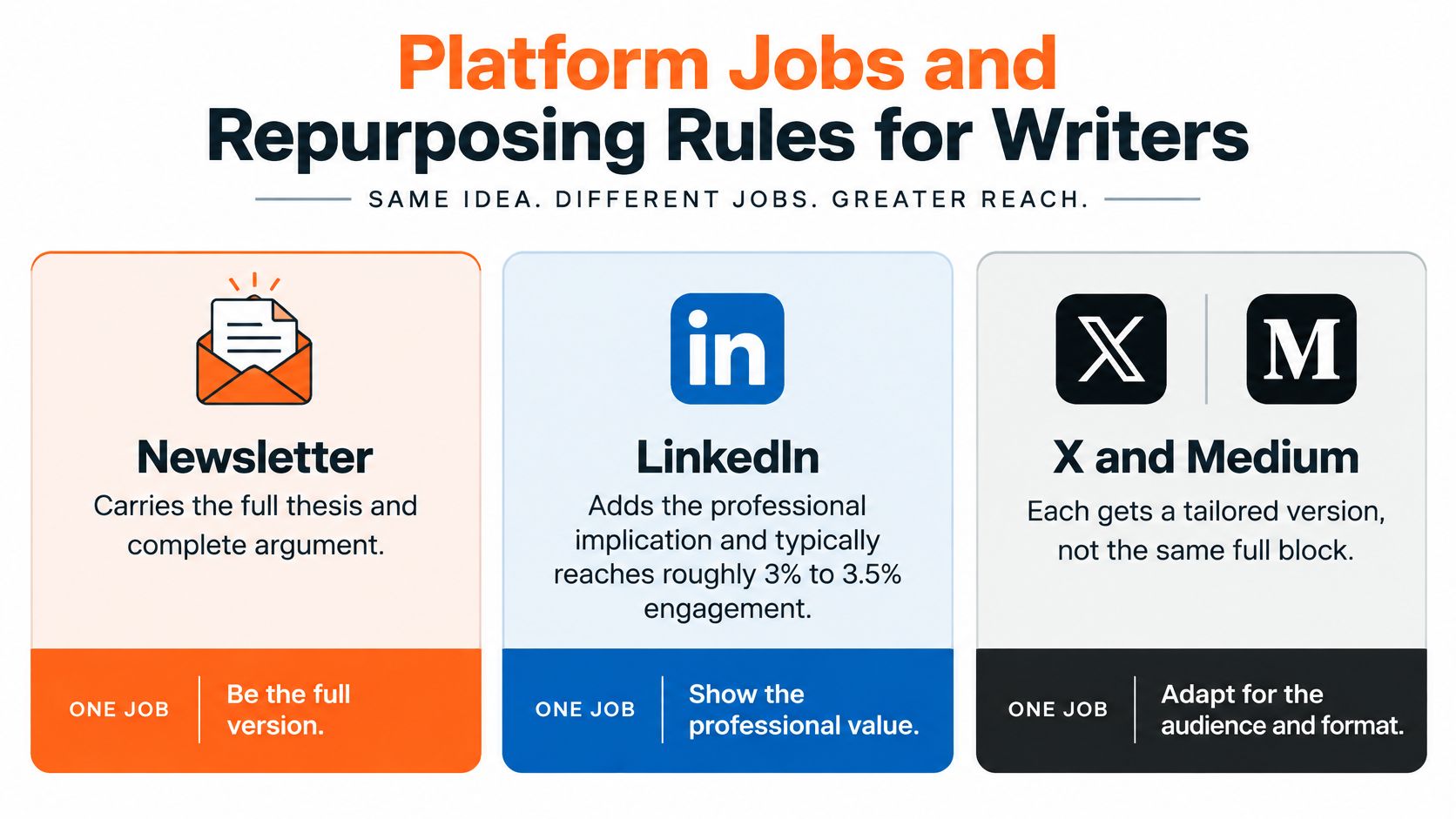
One job and one benchmark per platform
Benchmarks only help if you calculate them the same way each time. I used interactions divided by reach on every row, because follower-based and impression-based formulas produce materially different results. ZoomSphere's frequency and benchmark report places typical 2025 rates at roughly 3% to 3.5% for LinkedIn, 0.45% to 0.6% for Instagram, 0.04% to 0.15% for X, and 0.06% to 0.2% for Facebook.
| Platform | Typical engagement | Native job | What to change | Subscriber signal |
|---|---|---|---|---|
| 3% to 3.5% | Professional implication of the essay | Hook plus one story | Profile or newsletter clicks | |
| X | 0.04% to 0.15% | One claim or counterargument | Tight post or short thread | Profile visits |
| 0.45% to 0.6% | Optional visual excerpt | Carousel from the essay | Saves and profile taps | |
| 0.06% to 0.2% | Community discussion | Native post, not a link dump | Comments that lead to the issue | |
| Substack Notes | Compare with your own Notes median | Conversation around the issue | Short note with a scheduled time | Clicks into subscribe |
| Medium | Compare with your own article median | Searchable long-form context | Distinct opening, same thesis | Read-through and follows |
Read that table as permission, not pressure. A low-looking X rate isn't failure. X is a distribution and testing surface, so judge it on profile visits and whether a claim survives pushback. LinkedIn's higher typical rate makes it your authority channel, even with a smaller audience, because readers there click through to check who you are. The newsletter carries the full thesis. Medium holds searchable long-form context with its own opening. Substack Notes hold the live conversation around the issue, close to the subscribe button.
Four funnel layers and nothing more
I tracked exactly four layers for 30 days: content engagement, profile or article click, email sign-up, and retained subscriber. Every derivative got a source-content ID, a short code tying it back to the essay it came from. Without that tag, you're judging posts. With it, you're judging ideas, and you can see which essay produced subscribers across three platforms while a louder post produced none.
This short walkthrough shows how one piece of writing gets reshaped per destination without being rewritten from scratch.
Say your essay argues that most newsletters don't have a writing problem, they've got a distribution problem. On LinkedIn, that becomes the professional cost: hours spent copying instead of thinking. On X, it's one testable claim, that your best essay underperformed a weaker one that got distributed properly. On Notes, it's a question asking writers where their last ten subscribers came from. On Medium, it's the full argument with an opening written for search. Same spine, four different doors. A fuller breakdown of this split lives in this content repurposing framework if you want the worksheets.
Five checks before anything gets scheduled
- Different opening: Does the first line belong on this platform, or is it my essay's intro wearing a costume?
- Fits the length: Would a native reader finish this, or does it trail off like a cut-down article?
- One proof detail: Is there a number, an example, or a specific observation in here?
- Platform-matched call to action: One clear next step, not the same subscribe plea everywhere.
- Source ID attached: Can I trace any click or sign-up back to the original essay?
The trust risk is real, and it's worth naming. HubSpot's marketing statistics compilation reports 94% of marketers planned to use AI in content creation in 2026, while nearly one in three consumers reportedly starts product or information discovery on TikTok, Instagram, or YouTube rather than Google. Discovery is moving into feeds full of machine-written volume. Automation isn't the problem. Undifferentiated automation is.
So every derivative kept a human pass. I checked tone, swapped in a real example, kept one line of genuine disagreement where I had it, and fact-checked anything a tool had reworded. That pass took minutes per post, and it's the difference between repurposing and repeating yourself in a robotic voice across the internet.
Expand ideas that earn comments, saves, clicks, or subscriptions. Don't expand a post just because it collected the most impressions.
My promotion rule for the test was strict. A derivative earned more distribution only when it beat my account median on both response quality and subscriber conversion within a rolling 28-day window. Engagement alone never promoted anything. That one rule stopped me from spending week three amplifying a post everyone liked and nobody acted on.
How to Build the Plan in Seven Moves
You can build this in one sitting. I ran these seven moves before my 30 days started, and each one produces a concrete artifact, not an intention. By the end you've got a calendar, a tagging habit, and a review date.
The full sequence fits on one page, which is exactly where I kept it during the test.
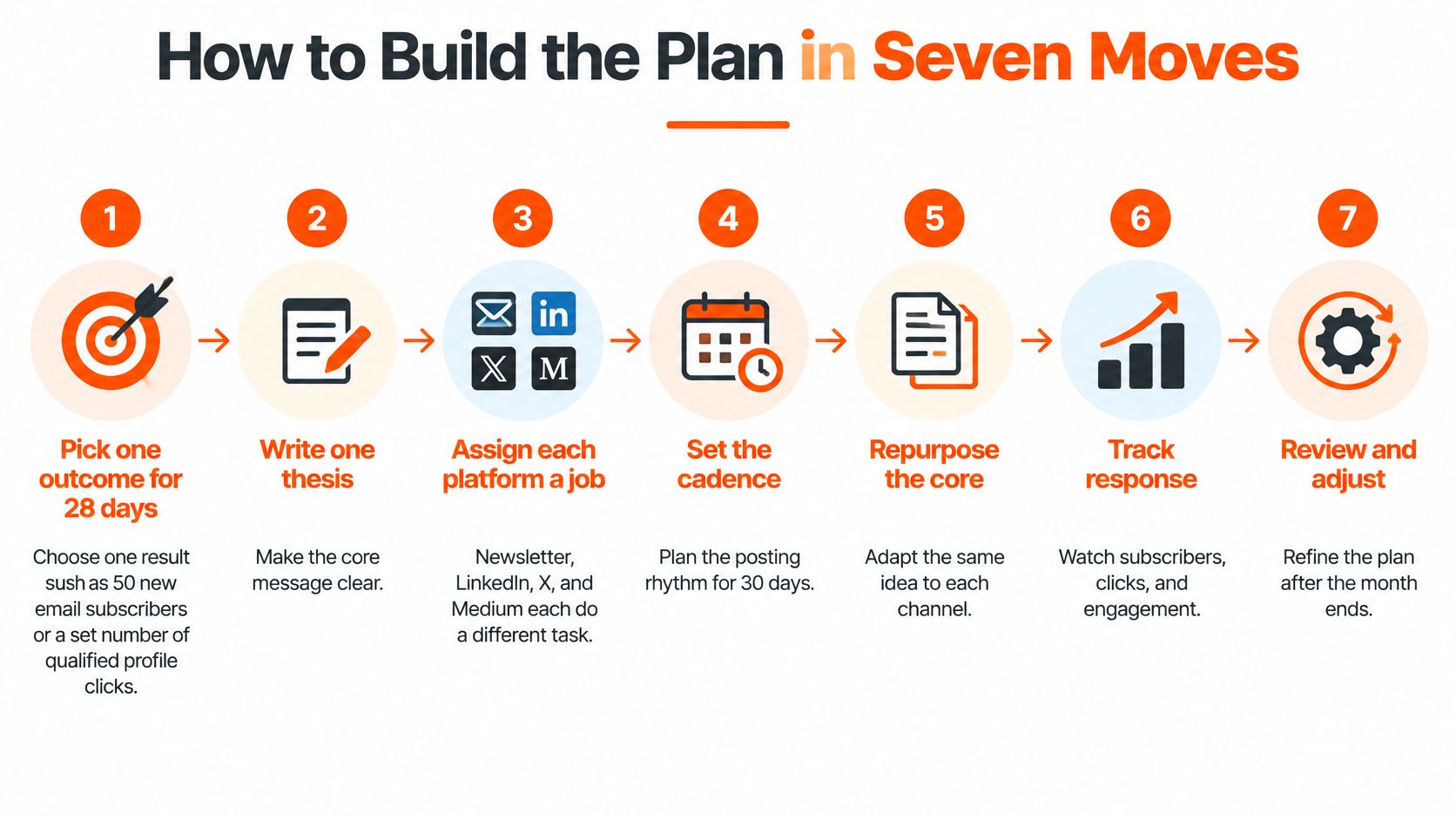
Moves one to three set the boundaries
- Pick one outcome for 28 days. Mine was new email subscribers. Yours might be 50 new subscribers or a set number of qualified profile clicks. One number. Vanity totals like total impressions don't count as the goal, because they can't tell you what to write next.
- Name the reader in one sentence. Who they are, what they already read, and the problem your newsletter solves for them. If you can't write that sentence, your hooks will wobble all month. Mine named independent writers who publish good work nobody sees.
- Lock three content pillars. I used a how-to, a field observation, and a contrarian take. Three is enough to rotate without repeating yourself. Any topic that doesn't serve the outcome or fit a pillar gets rejected, however interesting it is. That rejection is the system working.
Moves four and five turn essays into inventory
- Draft one flagship essay and mark four extractable pieces. The claim, the story, the number, and the question. I highlighted them while editing, which took ten minutes and saved me from rereading my own essay cold on Thursday trying to find a post in it.
- Assign each extract a platform job and a source-content ID. The claim goes to X. The story goes to LinkedIn. The question becomes a Note. The number anchors whichever derivative needs proof. Stable campaign parameters on every link mean analytics can trace a subscriber back to the exact extract that earned the click. If you're auditing what you've already published before starting, this social media audit template gives you the baseline to tag against.
Moves six and seven run and judge the month
- Batch the calendar. On Substack's web composer you select the calendar icon, choose a publishing time in your local time zone, and confirm. On iOS and Android the same workflow sits in the three-dot menu, and scheduled Notes wait in the Drafts tab where you can still edit them, per Substack's Notes getting started guide. Give each slot a role so the week has shape instead of four variations of please read my essay.
- Pull the day 28 cohort. Compare each theme against your account median on meaningful response and subscriber action. Not against your best post ever. Against your median, which is the honest bar for whether a theme deserves another month.
My scheduled week, with clock times and pillar labels, ran Monday 8 a.m. flagship essay (how-to), Tuesday 9 a.m. LinkedIn story post (field observation), Thursday 12:30 p.m. X claim (contrarian take), and Saturday 10 a.m. Note with the essay's open question. Roles rotated too: lesson, opinion, link to the issue, discussion prompt.
Budget your capacity against reality. If the flagship essay already takes roughly 10 hours, your derivatives get the leftovers, so they must be extraction, not new composition. I capped derivative work at one batching session per essay. Anything needing more than that meant the extract wasn't a post, it was a second essay, and it went back in the ideas file.
- Outcome written: One number for 28 days, pinned somewhere visible
- Pillars locked: Three labels on the calendar, not in your head
- Extracts marked: Claim, story, number, question highlighted in the draft
- IDs assigned: Every derivative traceable to its source essay
- Week batched: Notes scheduled and editable in Drafts before the first send
Fixes When Reach Does Not Become Subscribers
My most-liked derivative of the whole test produced zero sign-ups. It wasn't a bad post. It was a post scored at the wrong finish line, and that mistake is everywhere. Digiday's 2026 creator marketing research found impressions were the leading success metric for 28% of marketers and conversions for 27%, while click-through rate sat at 14% and sales at 13%, with 30% naming insufficient performance data as their biggest influencer-marketing challenge.
Three stalls and the fix for each
High likes, no subscribers means your score stops too early. Replace it with the full chain: theme, platform, format, reach, qualified engagement, profile visit, click, subscriber, retained subscriber. Discovery metrics show you were seen. Business metrics show you grew.
Last-click confusion is subtler. A LinkedIn post can create the demand while a later Substack visit records the conversion, so last-click reporting hands all the credit to your newsletter tool and none to the post that did the work. Don't kill the original post for that. Check whether profile visits and branded clicks rose in the days after it ran.
Cadence collapse after week two is a capacity signal, not a character flaw. Cut back to the 3 to 5 band, keep the source essay, and drop any platform that showed no subscriber signal in 28 days. If you're tracing where sign-ups originate, this walkthrough on how to track Substack subscriber conversions covers the tagging setup.
| Symptom | Likely cause | Fix |
|---|---|---|
| Crickets | Hook or pillar is wrong | Rewrite the opening and swap the pillar |
| Reach without clicks | The ask is wrong | Replace the call to action with one clear next step |
| Clicks without subscribers | Landing issue or Notes link is wrong | Fix the landing page or Notes link |
| High likes and zero sign-ups | Score stops at engagement | Score the chain through subscriber conversion |
One keep-or-cut rule governed everything. Keep a theme when it beats your account median on subscriber actions. Cut it when it doesn't. The best post in my test had fewer comments than the popular one, and its readers still opened the next issue. Quiet subscribers beat loud applause.
Run a 28-Day Test You Can Keep
Commit to the smallest version that still counts: one outcome, three pillars, the 3 to 5 starter band, and a 28-day review scored on subscriber actions. Everything above works with no new software, and I'd rather you run it plainly than not run it at all.
Low intent, stay connected and do it yourself. Copy the cadence table and the seven moves, batch next week's Notes with Substack's own date picker, and check the guidance on the best time to schedule social media posts when you set your slots. Rerun the test monthly and keep what beats your median.
High intent, ready to grow faster with less copying. That's what we built our workflow for. You draft inside Narrareach and schedule the Substack post, then publish the article to Medium, LinkedIn, X Articles, WordPress, and Ghost at the same time, and every plan schedules Substack Notes and articles. On the Revenue Writer plan, each new blog article becomes social posts in your voice, scheduled into your posting times, with the first post linking back to the article. The outcome isn't a feature list. It's fewer manual paste sessions, a steadier Notes cadence, and a clear view of which source essay created subscribers. You can start free with no credit card required.
Whichever path you pick, judge week four on retained subscribers, not on the loudest post. That's the score that compounds.
If you're ready to run your 28-day test without the copy-paste marathon, Narrareach lets you draft once, schedule your Substack posts and Notes, and publish platform-ready versions across Medium, LinkedIn, X, WordPress, and Ghost from one place. You'll spend your hours on the writing readers subscribe for, keep a cadence you can maintain, and see which essays turn into audience growth. Start free today and let your next strong idea get seen on every platform it deserves.