
Content Hub Strategy That Drives Real Growth
You spend Sunday evening writing the piece you care about. Monday becomes a cross-posting sprint across Substack, Medium, and LinkedIn. By Tuesday, you're...
By Ian Kiprono
You spend Sunday evening writing the piece you care about. Monday becomes a cross-posting sprint across Substack, Medium, and LinkedIn. By Tuesday, you're stitching the same argument into an X thread, fixing broken formatting in the Medium draft, and watching LinkedIn truncate the hook you spent an hour refining. Wednesday arrives with silence in the analytics. Your output is higher, but your newsletter open rate is drifting downward, your social posts feel disconnected, and no channel seems to send meaningful attention anywhere else.
That fatigue isn't a discipline problem. It comes from treating every platform as a separate product, with a separate idea, workflow, and success metric. I rebuilt my publishing system around a content hub strategy, and the useful shift wasn't “publish more.” It was turning one substantial idea into a source that could feed every channel, then measuring whether those channels sent attention back to the source.
The Publishing Trap Most Writers Are Stuck In
The familiar routine looks productive from the inside. You draft a strong essay on Sunday, polish the newsletter version on Monday morning, adapt it for Medium after lunch, and compress it into a LinkedIn post before dinner. On Tuesday, you turn the same argument into an X thread because the platform rewards a different format. Each task feels reasonable on its own.
The problem appears when you review the work as a system. The Medium version loses its formatting. The LinkedIn post cuts off just before the useful detail. The X thread earns a few replies but sends no visible traffic to the original essay. Your Substack issue reaches subscribers, yet the next issue starts from zero because none of the surrounding posts build a recognizable path into it.
Practical rule: If every platform requires a fresh idea, your publishing system has too many origins.
Writers often respond by increasing volume. They add another posting day, another content type, or another analytics dashboard. That can produce more activity without creating more reach. The failure is structural: every channel is asking you to recreate the work instead of distributing a strong source in a way that suits the audience already there.
The same issue affects the reader. Someone discovers your LinkedIn post but can't find the full argument. A Substack subscriber sees a useful note but has no obvious route to related essays. A search visitor lands on one article and leaves because the site doesn't show what to read next. Your best ideas remain isolated units.
I found the rebuild became easier once I stopped asking, “What should I post today?” and started asking, “What source deserves distribution this week?” The answer created a four-part model: a clear content model, a connected hub architecture, practical governance, and KPIs tied to movement rather than noise.
That change turns the workflow from many origins and many destinations into one source with many distribution paths.
What a Content Hub Strategy Actually Is
A content hub strategy starts with one canonical pillar page or long-form post that owns a broad topic. Every supporting asset then answers a narrower question or adapts one part of that source for a specific platform. A newsletter section, LinkedIn post, X thread, Medium article, podcast segment, or video is not a second origin. It is a repurpose unit with a job: create interest, deliver a useful slice, and send qualified readers toward the source or a related page.
The operating model is simple. The hub is the source code, the spokes are platform-native outputs, and the distribution layer carries those outputs to audiences who may never begin on your website. The hub-and-spoke approach is described as a content and SEO architecture built around pillar pages, supporting pages, and internal links (Search Engine Journal's explanation of the hub-and-spoke model).
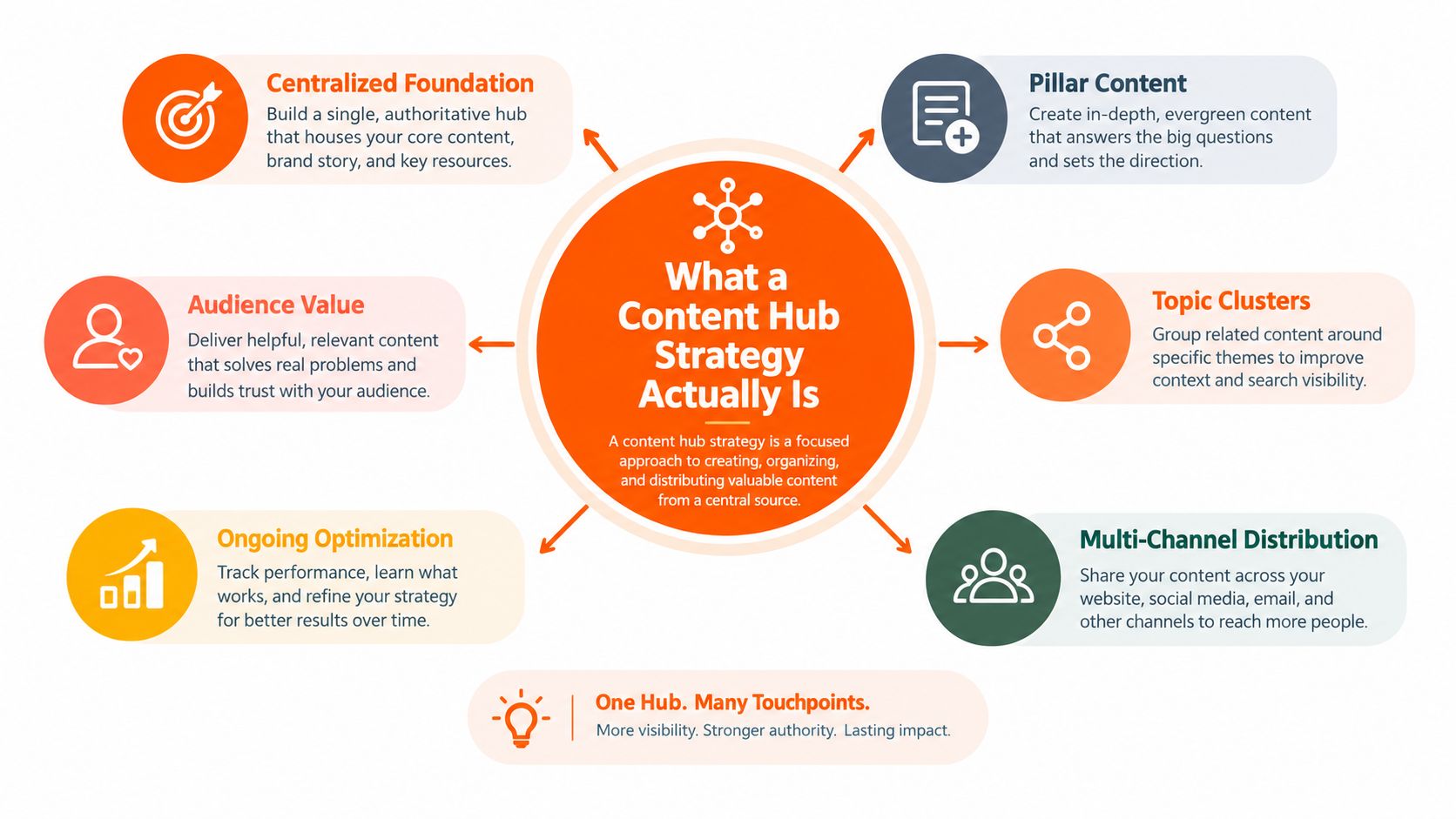
Put the canonical source on a URL you control, such as your website or a long-form newsletter archive. A rented platform can distribute the idea, but it should not be the only record of it. One source address gives search signals, social engagement, referrals, and assisted conversions a common destination. It also lets you judge whether a post created movement beyond its own impressions.
A traditional blog behaves like a filing cabinet. Articles compete as separate assignments, and older work becomes difficult to find. A hub creates an editorial route: the pillar frames the subject, focused pages answer specific questions, and distribution posts give people a reason to enter or re-enter the system. The trade-off is operational discipline. You must maintain links, refresh the source, and resist publishing spokes that have no clear relationship to it.
Sibley Digital's guide to content marketing for agencies places content within broader business goals, a useful counterweight to treating each post as an isolated task. Pair that thinking with a practical content distribution strategy so the hub is measured by cross-platform lift and assisted journeys, not rankings alone.
The Four Parts of a Hub That Actually Compounds
A hub doesn't compound because it has a large archive. It compounds when each part solves a different failure mode.
The content model prevents a flat archive
Your content model defines what deserves pillar status and what belongs as a spoke. Without that rule, you can end up with dozens of equally weighted posts and no central resource that deserves links, updates, or promotion.
The minimum viable version is one sentence: “This topic gets one source, and every related piece must answer a narrower question.” For example, a broad guide to newsletter growth might own the topic, while separate pieces cover subject lines, referral loops, welcome sequences, and distribution.
Architecture gives isolated work somewhere to go
Architecture is the linking system. A spoke should point to the pillar when it introduces a focused idea, and the pillar should point to useful spokes when readers need depth. This fixes orphaned content, where a carefully researched article receives a launch push and then disappears.
A live SEO split test found that increasing related-article links on hub pages produced an estimated 11% uplift in organic traffic, with a 90% probability of positive impact across donor and recipient pages (SearchPilot's related-article link test). That result doesn't mean every site will reproduce the lift. It does show why related links deserve testing rather than being treated as decoration.
Governance keeps the wheel moving
Governance assigns ownership, format rules, and a realistic cadence to each spoke. It prevents the familiar burnout cycle where one person tries to publish everywhere every week without a calendar or status system.
The minimum version is a shared sheet with four fields: platform, format, owner, and status. If a LinkedIn post has no owner or a Substack Note has no scheduled date, it isn't part of the system yet.
KPIs replace scattered vanity signals
KPIs should measure whether the hub receives useful attention from its spokes. Track hub-assisted traffic, referral visits from distribution posts, ranking movement for the pillar, and meaningful engagement such as replies, saves, restacks, or clicks.
The hub leaks when one component is missing. Great content without architecture becomes isolated. Architecture without governance becomes inconsistent. Governance without useful KPIs turns into busywork.
| Component | What It Defines | Failure It Prevents | Minimum Viable Version |
|---|---|---|---|
| Content model | Which topic is the pillar and which angles become spokes | Fifty equal posts with no editorial gravity | One source topic and clear spoke criteria |
| Hub architecture | How pillar and supporting pages connect | Orphaned articles and scattered authority | A canonical pillar link in every relevant spoke |
| Governance | Who publishes what, where, and when | Burnout and missed distribution | Owner, platform, format, and status |
| KPIs | Which signals determine the next decision | Optimizing likes without measuring movement | Four recurring metrics reviewed together |
My 90-Day Build Sequence for a Working Hub
I rebuilt a stalled publishing system over 90 days, not by filling every gap in the archive, but by making the existing work easier to connect and distribute. The sequence mattered because each phase created an input for the next one.
Weeks 1 and 2 focused on evidence
I pulled existing URLs into a sheet and grouped them by search intent, reader problem, and topic overlap. Then I chose three pillar topics with partial traction already present. Starting with existing evidence made the rebuild less risky than inventing a completely new editorial direction.
I also marked pages that needed consolidation. A hub shouldn't preserve every weak article because someone spent time writing it.
Weeks 3 and 4 defined the rules
I wrote a one-page hub specification covering the pillar's scope, the formats each spoke could take, internal-link requirements, and ownership for edits. The document was intentionally short. If a rule needs a training session to explain, it probably won't survive a busy publishing week.
The specification also answered practical questions: Which posts get republished? Which become short-form notes? What must appear in the first paragraph? Who checks links before scheduling?
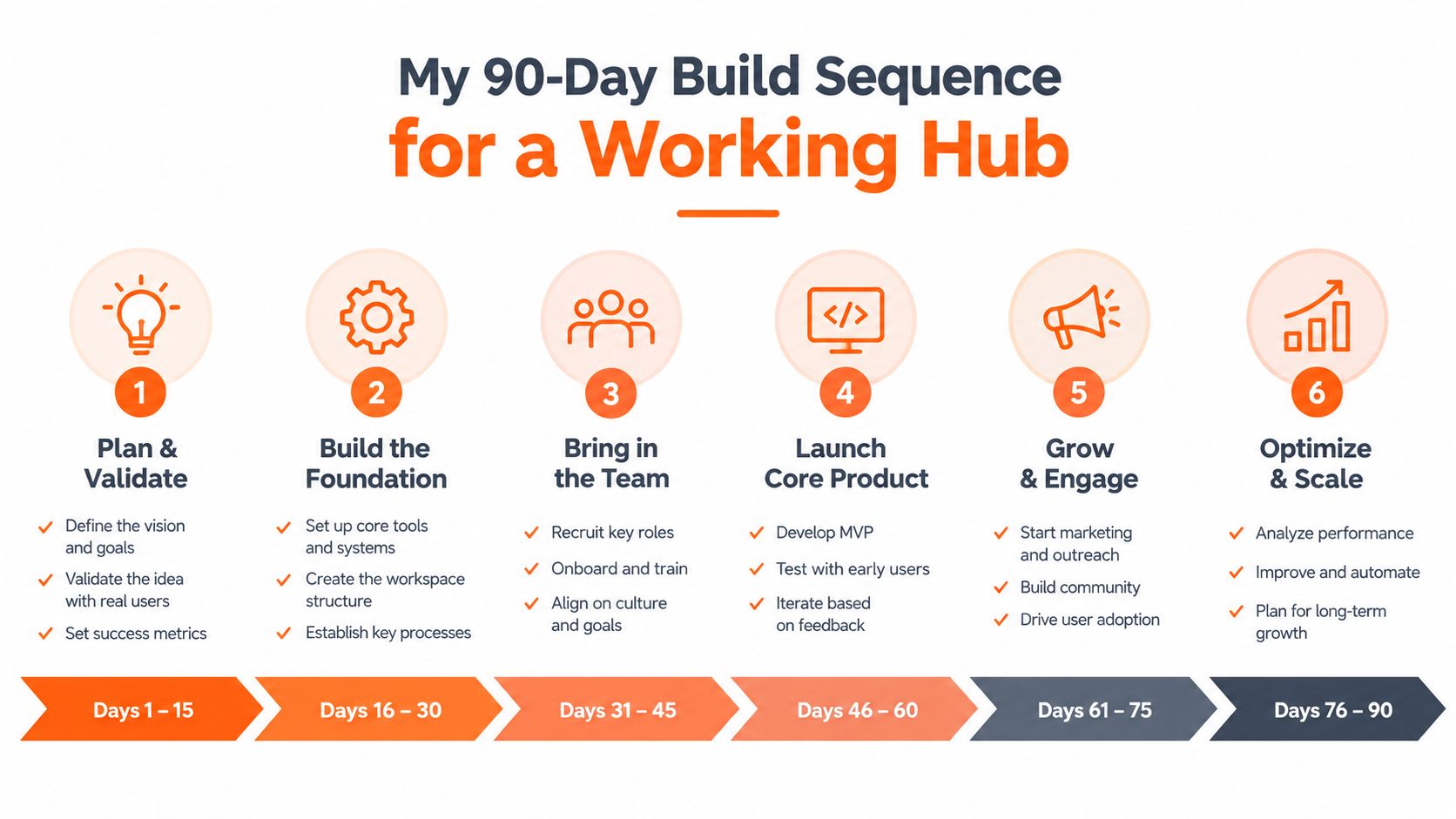
Weeks 5 through 8 shipped the first batch
I published the first pillar and its supporting pieces in the same publishing cycle. Substack, Medium, LinkedIn, and X each received a platform-native version rather than a blind copy. The point wasn't to make every asset identical. It was to make every asset recognizably part of the same argument.
The difficult moment came around week 7. Traffic hadn't visibly moved, and the output felt repetitive because I was seeing the same source idea every day. That's when many quit. The audience isn't experiencing the work in the same sequence as the operator, so internal repetition can be strategically useful even when it feels personally monotonous.
Weeks 9 through 12 added operating discipline
I added an editorial calendar, a repurposing checklist, and a weekly metrics review. The checklist included link verification, platform formatting, source attribution where needed, and a clear next action for the reader.
For a separate look at reducing friction between drafting and publishing, the content creation workflow guide provides a useful operational reference. My key lesson was simple: schedule distribution while the pillar is still fresh, not after the idea has already left your attention.
Repurposing One Pillar Into Platform-Native Content
A 1,800-word pillar can become a useful distribution set without becoming four copies of the same article. The source supplies the argument. Each platform version earns attention through its own opening, pacing, and reader payoff.
Substack carries the personal interpretation
I turn the pillar into a 600-word newsletter with a personal anecdote near the opening, one practical insight, and a clear reason to continue reading. The ending can point interested readers toward a paid tier, an additional resource, or the full pillar, but it shouldn't read like a truncated sales page.
Substack Note timing data cited in available studies identifies 8–9 AM as the window for 28% of daily Note views, 12–1 PM for 19% of interactions, and 7–8 PM for 23% of weekly restacks (Substack Note engagement timing analysis). These are scheduling targets, not guarantees, so I treat them as test windows and compare results against the audience's own activity.
Medium needs editorial separation
For Medium, I use a new headline, place the canonical link in the first paragraph, and review the tags before publishing. I don't publish the same headline twice. The repost should feel edited for Medium's reading environment, not exported from a CMS with broken spacing and redundant introductions.
LinkedIn needs a sharp entry point
A LinkedIn version can fit within roughly 1,200 characters when the argument is compressed carefully. I open with a contrarian line, develop three short insights, and place the pillar link in the first comment when that fits the distribution approach. The post must stand on its own. “Read my article” isn't a hook.
X rewards sequence
An X version becomes a five-tweet thread, with one idea per tweet and the pillar URL in the final tweet. Each post should create a reason to read the next one. The thread isn't an index of headings. It's a compact argument with a conclusion.
| Platform | Format | Length | Hook Style | Link Placement |
|---|---|---|---|---|
| Substack | Newsletter plus Notes | 600-word newsletter | Personal anecdote and practical tension | End of newsletter or relevant Note |
| Medium | Edited repost | Adapted from the pillar | New headline and revised opening | First paragraph |
| Standalone post | 1,200 characters | Contrarian line and three insights | First comment when appropriate | |
| X | Thread | Five tweets | One idea per tweet | Final tweet |
The rule across all four platforms is the same: a spoke must earn engagement before it asks for a click. The content repurposing guide is useful when you're turning one source into multiple formats without flattening the voice.
Metrics That Prove the Hub Is Working
A content hub proves its value when distribution improves the source, not when every channel produces another post. I review four signals, then check whether they reinforce one another.
Organic sessions to pillar pages show whether the owned resource is earning discovery. I track clicks, impressions, CTR, and ranking position in Google Search Console and GA4. Together, these metrics separate a visibility problem from a click problem. A page with impressions but few clicks needs a stronger search result. A page with neither needs better topic coverage or distribution.
Referring traffic from spokes measures the cross-platform lift the system is meant to create. Reach alone is a weak result. A post with modest exposure can still matter if it sends qualified readers to the pillar. Use consistent link tags so Substack, LinkedIn, Medium, and X remain distinguishable in analytics.
Keyword movement belongs to the pillar, not only to individual spokes. Review whether the central page is becoming more relevant for the topic it owns, and whether supporting pages strengthen that relationship. Related-link tests, such as the example discussed by SearchPilot, show why internal connections belong in the review rather than in a one-time publishing checklist.
Engagement per spoke reveals whether the format fits its platform. Track comments and saves on LinkedIn, restacks on Substack, replies on X, and meaningful reading or referral behavior on Medium. A like without a next action is context, not proof that the hub is growing.
Published industry summaries report that content hubs can drive up to 300% more organic traffic, improve average session duration by 25%, reduce bounce rates by 18%, and generate 97% more organic backlinks than disorganized content (Jottler's hub-and-spoke summary). Those figures come from case-study summaries, so I treat them as directional benchmarks, not promises for a new site.
| KPI | What It Measures | Starting Baseline | 90-Day Result |
|---|---|---|---|
| Pillar organic sessions | Owned discovery | Record current sessions | Compare against the pre-build period |
| Spoke referral traffic | Distribution-to-hub movement | Tag each platform | Identify the strongest referring format |
| Pillar keyword position | Topic relevance | Record current position | Review movement by target query |
| Engagement per spoke | Platform fit | Record native interactions | Keep, revise, or retire formats |
The weekly review takes 15 minutes in one sheet. I record four numbers, note what changed, and choose one distribution adjustment for the next cycle. The content performance metrics guide offers a wider framework for separating publishing activity from useful outcomes.
How Narrareach Fits Into a Hub Workflow
A scheduling tool earns its place after the editorial system exists. It shouldn't decide what your pillar means, repair weak writing, or compensate for a distribution channel that never reaches the right audience.
The useful jobs are operational:
- Queue native variants: Schedule adapted posts for LinkedIn, X, Medium, and Substack on staggered dates instead of publishing every derivative at once.
- Track referral behavior: Connect spoke activity with traffic and engagement returning to the hub.
- Maintain one status view: Keep drafts, scheduled posts, published assets, and repurposing tasks visible without switching between separate spreadsheets.
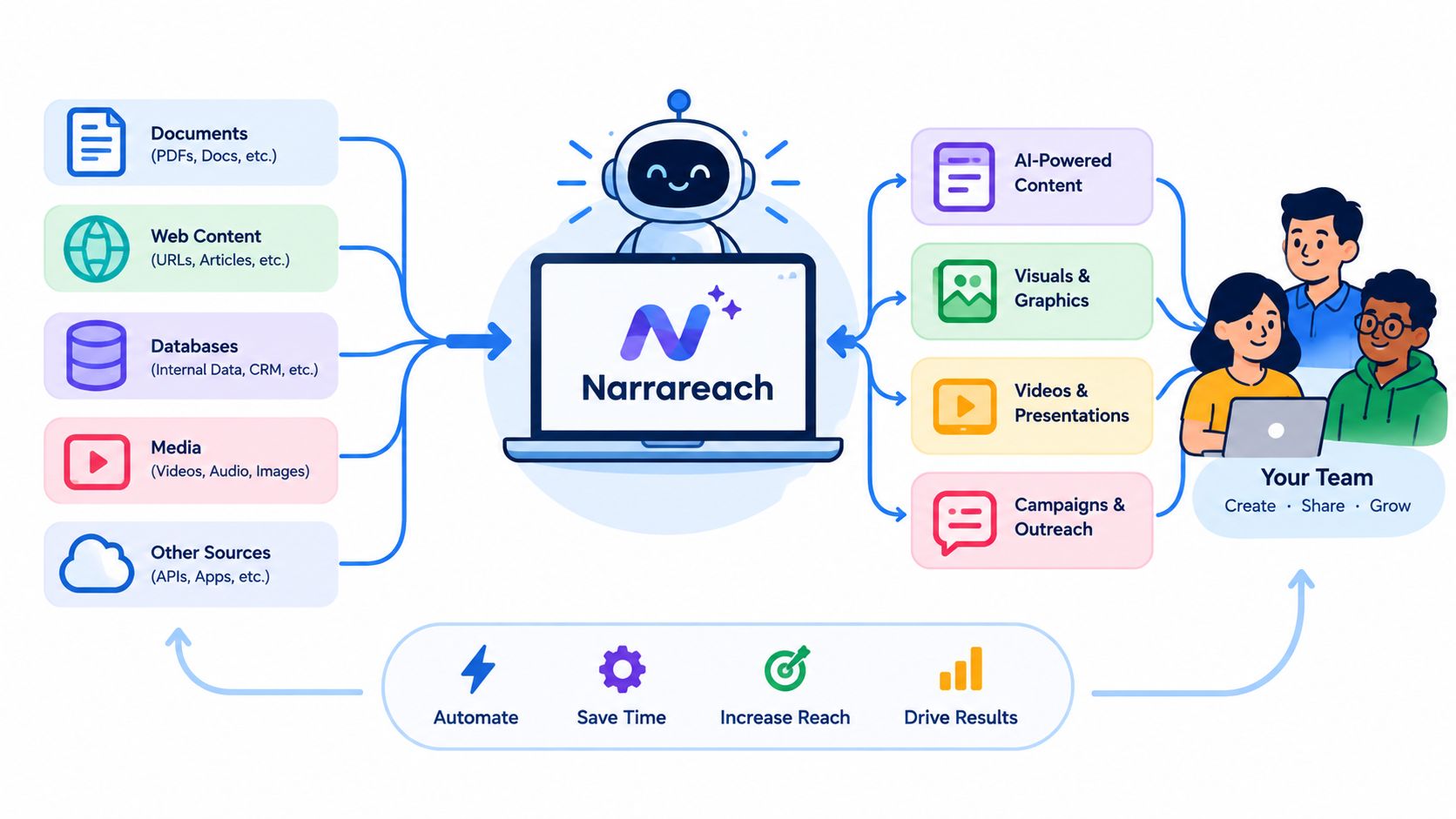
My weekly operating rhythm is straightforward. I draft the pillar on Monday, generate platform variants on Tuesday, schedule distribution from Wednesday through Friday, then review the metrics on Sunday. The tool handles scheduling and coordination, but the editorial judgment remains mine.
Narrareach supports scheduling Substack Notes, Medium articles, LinkedIn posts, and X content from one dashboard, along with content repurposing and cross-platform analytics. Its workflow overview is the right place to assess whether those functions match your publishing process.
The trade-off is control versus convenience. Centralizing distribution reduces copy-paste work and makes missed posts easier to spot, but it doesn't remove the need to edit each variant for its audience. Automation should protect the system's consistency, not turn every spoke into identical text.
Your Hub Checklist and Where to Go Next
Print this checklist or place it beside your editorial calendar. It captures the minimum system I'd want before publishing another disconnected post.
Build the source
- Choose the pillar: Select one broad topic with a clear reader problem.
- Map the spokes: List specific questions, objections, examples, and formats that support it.
- Set the canonical URL: Decide where the source will live and keep that address stable.
- Write the link rule: Every relevant spoke points to the pillar or to a closely related supporting page.
Create the operating layer
- Assign ownership: Name the person responsible for drafting, editing, scheduling, and review.
- Define platform formats: Use a newsletter interpretation, an edited Medium version, a focused LinkedIn post, and a structured X thread.
- Schedule the cycle: Distribute the variants across a deliberate sequence instead of launching everything simultaneously.
- Review the four signals: Check pillar discovery, spoke referrals, keyword movement, and native engagement.
Improve the loop
A content hub becomes more valuable when you update decisions based on evidence. Keep the spokes that create useful attention, revise the ones that attract engagement but no qualified movement, and merge or retire pieces that add maintenance without adding clarity.
The broader direction is moving beyond traditional rankings. Recent guidance on content strategy for 2026 argues that teams need to audit visibility across Google and LLM surfaces, measure citations, and decide whether each page works on Google, AI search, both, or neither (Search Engine Land's 2026 content strategy guidance). That makes consolidation more important. Publishing more pages isn't automatically better than strengthening the pages that already help readers.
Distribution also needs to extend beyond site navigation. Current 2026 discussion emphasizes modular content, owned channels, multimedia reuse, and interconnected assets that build trust across formats (Smart Business Revolution's AI-first hub perspective). Your pillar is source code. The spokes are executable versions of the idea. The measurement loop tells you which versions deserve another release.
Start with one topic, one source, and one publishing cycle. If you're ready to execute, create a free Narrareach account and use it to schedule the first hub's Substack Notes, Medium article, LinkedIn posts, and X thread from one workflow. If you're still evaluating the model, follow the upcoming experiments and teardowns, then build your own checklist before adding another platform.
Narrareach helps writers turn a central article into scheduled, platform-native distribution across Substack, Medium, LinkedIn, and X while keeping performance evidence in view. Visit Narrareach to start building a measurable content hub workflow instead of managing every channel as a separate publishing job.