
How to Identify Content Gaps That Actually Move
You publish regularly, polish every headline, and still watch your audience inch forward one or two subscribers at a time. Your best article may earn a few...
By Ian Kiprono
You publish regularly, polish every headline, and still watch your audience inch forward one or two subscribers at a time. Your best article may earn a few replies, but the next post starts from zero again. Search Console shows impressions without a clear reason to celebrate, while your competitors seem to cover the same subjects with more momentum.
I spent 60 days auditing my own newsletter and distribution channels because I couldn't explain that plateau. I expected to find a missing keyword. Instead, I found missing answers, missing proof, and a distribution gap hiding behind articles that looked “covered” on paper.
The Plateau Problem I Lived With for 18 Months
For 18 months, my publishing routine looked responsible from the outside. I wrote a newsletter, edited it carefully, shared the link, and moved on to the next idea. Subscribers trickled in at roughly 1 to 2 per day, but the graph never developed a slope I could trust.
The frustrating part wasn't a broken page or an obvious technical problem. I opened Google Search Console, sorted through impressions and clicks, and found plenty of activity that didn't translate into a clear audience path. Some pages appeared in search, yet readers didn't move from those pages to the newsletter. Other posts performed well with existing subscribers but barely reached new people.
I initially blamed topic selection. Then I blamed headlines. Then I collected competitor keywords and produced a list large enough to keep me busy for months. None of those explanations answered the more useful question: what was the reader still trying to do after seeing my page?
The question that changed my audit: What does the reader need next that my page doesn't make easy?
My 60-day experiment started with a simple rule. I wouldn't publish a new article just because a competitor ranked for a phrase I didn't. I would first inspect the search result, the audience conversations, the page itself, and the distribution that followed publication.
The broader search environment made that decision harder to ignore. Pew Research Center found that users clicked a traditional result in only 8% of visits when an AI Overview appeared, compared with 15% without one, while 26% of AI-Overview sessions ended immediately, compared with 16% of sessions without one, as reported in this summary of the Pew Research Center browsing study.
That meant a ranking could be real and still fail to create a relationship. My audit had to examine not only whether a page appeared, but whether it gave readers a reason to continue, subscribe, reply, or share.
The Five-Stage Content Gap Audit
I turned the audit into a recurring cycle rather than a giant spreadsheet project. Each pass combined a different kind of evidence, because no single report can show what readers want, what search engines display, and what your business can realistically support.
Start with an outcome signal
I began by defining the result I wanted from each topic. For a newsletter, that might be qualified subscribers, replies from the intended audience, or readers who return for a related article. For a service business, it could be consultation requests or product-page visits.
Then I recorded the baseline available before making changes. The useful baseline includes impressions, clicks, average position, assisted subscribers, and conversions, with a comparable period before publication and follow-up checks after publication. Rank movement alone isn't enough, because visibility can rise without qualified action.
Mine your own archive
Next, I reviewed existing articles, drafts, and social posts. I marked repeated themes, weak transitions, outdated examples, unanswered follow-up questions, and articles that attracted attention but had no related distribution.
This stage often reveals a subtask gap. An article may explain newsletter growth but omit the workflow for turning that explanation into a Note, a LinkedIn post, or a short thread. The missing content isn't another definition. It's the bridge from understanding to execution.
Listen for language readers repeat
I collected questions from replies, direct messages, comments, and conversations around posts. Repeated wording matters because readers rarely describe a problem using the polished phrase you put into a keyword tool.
Look for objections, comparisons, “how do I” questions, and moments where people ask for examples. A question that appears across more than one channel deserves attention even if it doesn't look like an obvious search term.
Inspect the result page manually
For each promising query, I looked at the actual results. I recorded the format, recurring headings, examples, update signals, evidence, calls to action, featured snippets, and AI-generated summaries when present.
The audit asks whether the current results complete the reader's task. If they provide a shallow definition but no workflow, template, edge case, or decision support, the gap is depth rather than absence.
Compare genuinely similar competitors
Finally, I selected 3 to 10 comparable domains or URLs, rather than collecting every site that happened to rank. I exported queries where competitors appeared and the target didn't, then grouped them by topic, funnel stage, intent, and SERP format.
Intersection filters help separate structural coverage from a one-page accident. For a practical walkthrough of comparing content patterns on another platform, this competitive TikTok analysis guide provides useful context. The final check remained manual: I compared task completion, freshness, first-hand evidence, author expertise, and unanswered subquestions.
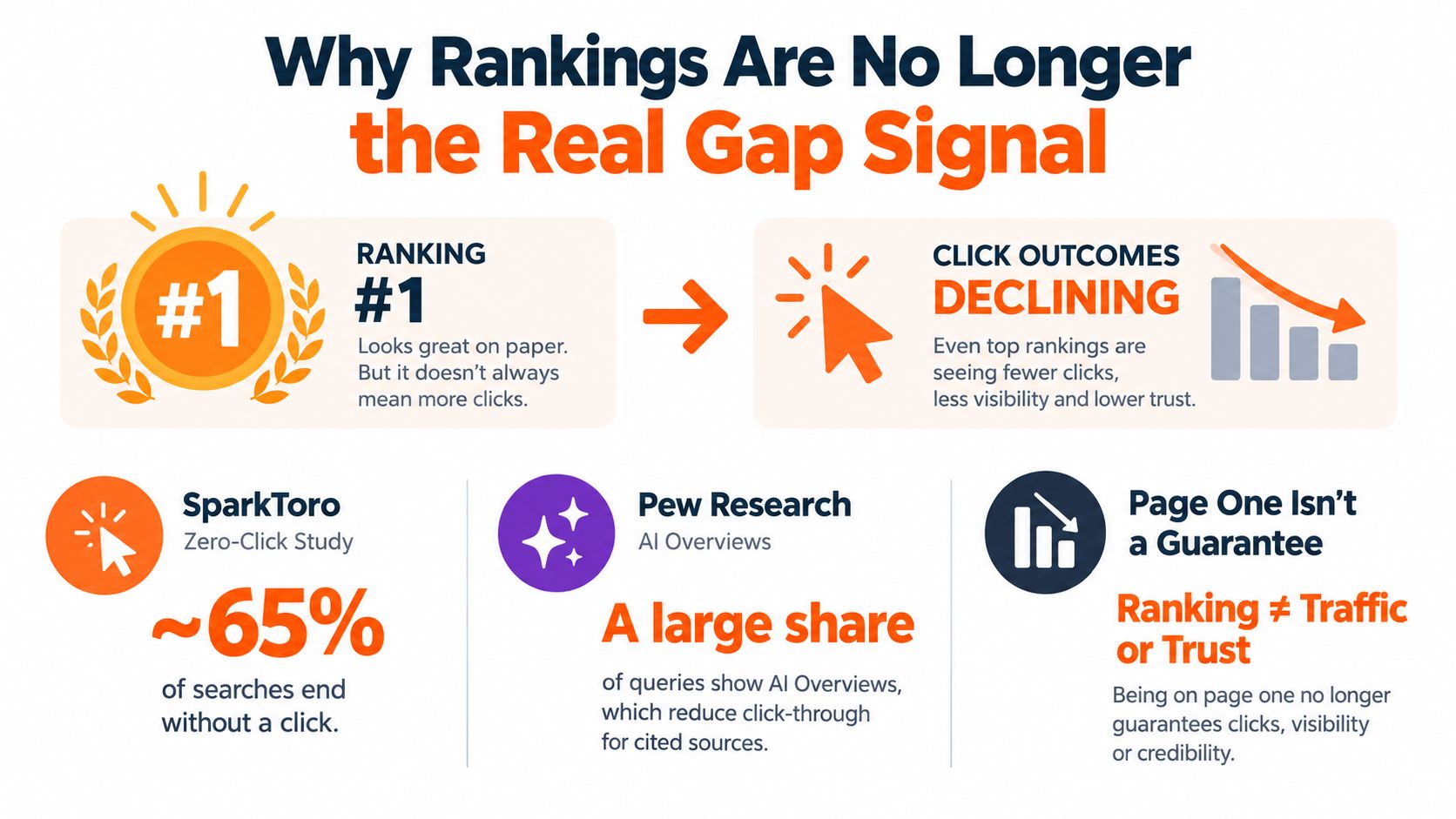
Why Rankings Are No Longer the Real Gap Signal
The first surprise from my audit was that “covered” didn't mean “resolved.” A page could rank, appear in a featured result, or get summarized by an AI system while still leaving the reader without the evidence or next action needed to make a decision.
SparkToro's 2024 analysis of clickstream data found that 58.5% of U.S. Google searches and 59.7% of European Union searches ended without a click to an external site. In practical terms, only about 360 of every 1,000 U.S. searches reached the open web, according to SparkToro's zero-click search analysis.
That changed how I read my own top queries. I reviewed 20 of them and compared the visible answer with the page that supposedly satisfied the search. 11 of the 20 produced no click through to a cited page in my review. The useful question wasn't “why didn't I rank higher?” It was “what would make someone leave the summary and choose this page?”
A real gap can exist underneath a ranking when the visible answer is accurate but too generic to help someone act.
I started recording four missing elements:
- Proof: Does the page support its recommendation with firsthand evidence, credible sources, or a transparent method?
- Examples: Can a reader see the idea applied to a newsletter, a creator workflow, or a specific platform?
- Edge cases: Does the page explain what changes when the audience, format, or distribution channel is different?
- Next steps: Can the reader complete the task without opening several more searches?
This is why I now separate a keyword gap from a content gap. A keyword gap tells me that another site appears for a query I don't target. A content gap tells me that a meaningful user task remains incomplete, poorly evidenced, outdated, or difficult to execute.
For a deeper look at using performance evidence to shape editorial decisions, see this data-driven content analysis guide.
Four Signal Sources and What Each One Catches
I kept four evidence sources in separate columns because combining them too early made weak ideas look important. The table below became the fastest way to see which gaps had support and which existed only because a tool had produced a long list.
| Signal source | Best at detecting | Common blind spot | Time to gather |
|---|---|---|---|
| First-party analytics | Existing pages with visibility, engagement, or conversion signals | Misses questions people haven't searched or clicked yet | A focused review |
| Audience feedback | Repeated language, objections, examples, and unresolved tasks | Can overrepresent the loudest readers | An ongoing collection habit |
| SERP inspection | Search intent, result format, summaries, citations, and shallow answers | Shows what search displays, not every audience need | Manual review for each priority query |
| Competitor pages | Topics, subtopics, formats, and examples your site lacks | Competitor coverage doesn't prove business value | A comparison pass |
Analytics show where attention already exists
Search Console can reveal pages with impressions but weak click behavior. Substack statistics can show which editions prompt responses, while LinkedIn impressions can expose ideas that travel outside the newsletter.
I used analytics to find underdeveloped winners, not just failures. One post had a useful argument and steady reader response, but no supporting short-form posts. That made it a distribution candidate before it became a rewrite candidate.
Audience feedback reveals the untyped problem
Replies and comments showed me where readers got stuck. They didn't ask for “a content gap analysis framework.” They asked how to decide whether an idea belonged in a newsletter, a Note, or a social post, and how to avoid repeating the same point in every format.
Those questions exposed a practical gap that keyword data couldn't see. I logged the exact language, the context, and the action the person was trying to take.
SERPs expose the answer's limits
I opened the top results instead of trusting position data. I checked whether the page offered a usable process, current examples, evidence, and a clear next decision. I also noted whether the search result itself already answered the basic question.
Competitors provide comparison material
Competitor pages helped me identify recurring subtopics and missing formats. I treated them as prompts for investigation, not proof of demand. A competitor's ranking can reflect brand strength, historical links, or a query that has no meaningful connection to my readers.
This content analysis for social media resource is useful when the gap crosses from search content into recurring social themes. The strongest candidates in my audit appeared in at least two signal sources, and the most valuable appeared in three or four.
Prioritizing Gaps With a Simple Scoring Formula
By the end of the audit, I had more candidates than time. I needed a decision rule that protected me from publishing the most interesting idea instead of the most useful one.
My formula was:
Opportunity = business relevance × intent fit × competitor coverage × achievable ranking probability, minus duplication risk and production cost.
I didn't pretend the result was scientific. I used a consistent qualitative scale for each factor, then wrote a short justification beside the score.
Three candidates competed for attention
The first candidate was newsletter growth basics. It had strong business relevance and broad competitor coverage, but my existing archive already addressed much of it. Duplication risk was high.
The second was how to turn one newsletter article into platform-specific distribution. It connected directly to the audience's recurring questions, fit the existing archive, and created a path from one long-form idea to Notes, LinkedIn posts, and X threads. Production cost was manageable because the source material already existed.
The third was a general guide to content gap analysis. It had clear search relevance, but the generic version would add little originality. The stronger version had to address AI summaries, zero-click behavior, validation, and distribution.
The second and third candidates survived. I combined their useful parts into one editorial project: identify the unresolved task, publish the missing depth, and distribute the answer in formats where follow-up questions already appear.
My working rule: Don't ask whether a topic can become an article. Ask whether it can become an article, a useful conversation, and a measurable audience path.
That decision also changed the production brief. The winning idea needed:
- One long-form article with examples and evidence.
- Substack Notes that extracted an argument, an example, and a question.
- LinkedIn posts with a professional application.
- X threads with a compact sequence of observations.
- A measurement plan that tracked replies, profile visits, subscribers, and assisted actions.
A 2025 survey of 58 content teams found that 71% considered their attribution data only “sort of accurate,” 52% said tracking ended at conversion, and 28% couldn't reliably track conversions, according to the 2025 content attribution report. I treated that limitation as a reason to use several signals, not as permission to measure nothing.
For organizing those signals across content and distribution, this content analytics dashboard guide shows the kind of evidence I wanted in one view.
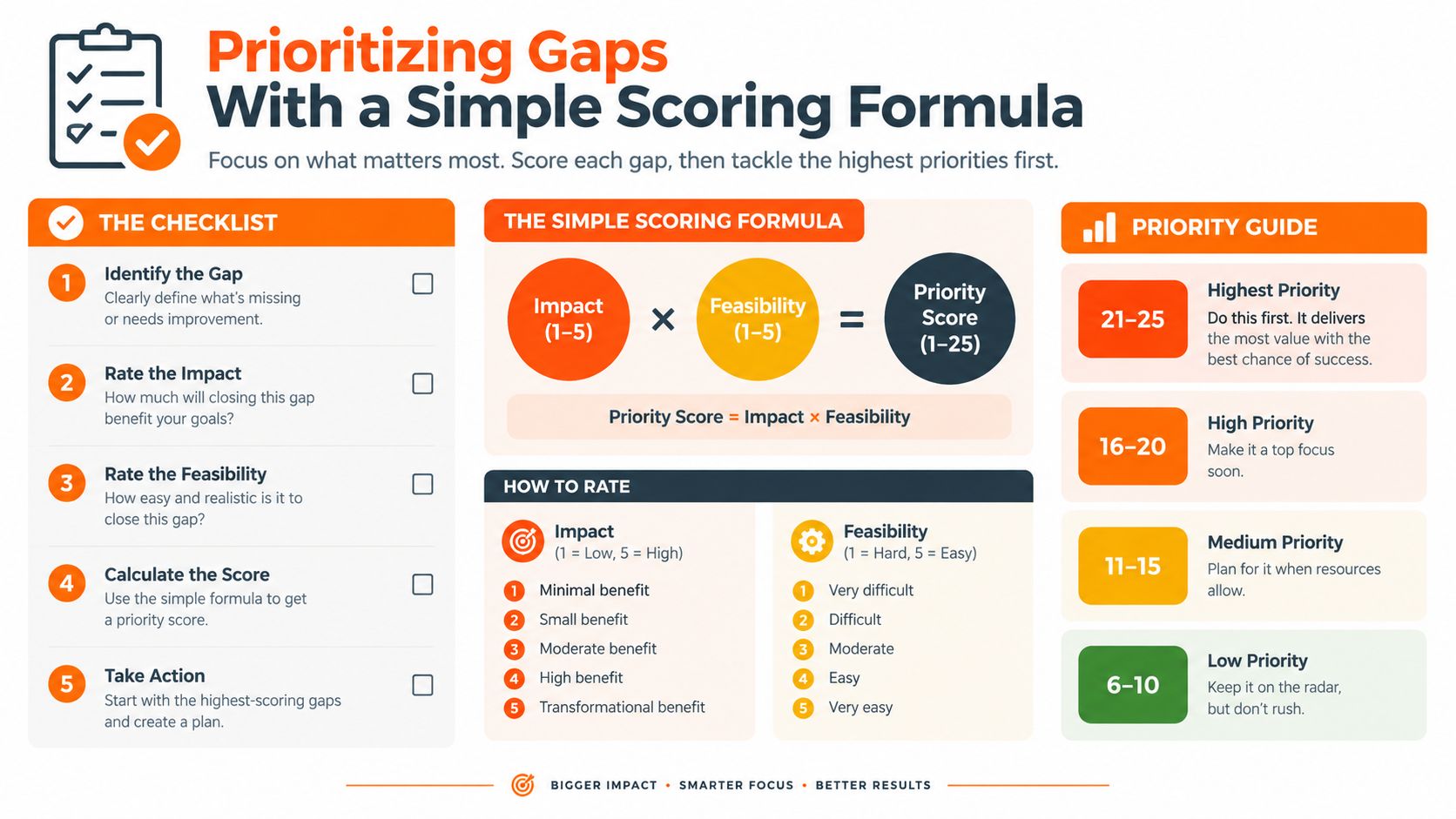
The scoring model is also easier to apply when you can see the full process represented visually:
My 30-Day Gap-to-Distribution Execution Plan
I gave the winning idea 30 days instead of treating publication as the finish line. The calendar had four distinct jobs.
Week one turned the gap into a durable page
I drafted the long-form article around the unresolved task, not the keyword list. Each section had to answer a primary question, a likely follow-up, or a decision-stage objection. I added examples wherever a general recommendation would have forced the reader to search again.
Week two created a Substack distribution layer
Substack introduced native Notes scheduling on March 23, 2026, allowing creators to draft a Note, choose an exact publication time, and schedule it on web, iOS, or Android. Scheduled Notes remain editable in Drafts until they go live, as described in Substack's announcement about Notes scheduling.
I prepared article-derived Notes in batches. One stated the central argument, another showed the audit mistake, and another asked readers how they handled the same problem. The goal wasn't to repeat the article. It was to create several entry points into the idea.
Week three adapted the idea for other conversations
I reshaped the same research into LinkedIn posts and X threads. LinkedIn received the operational lesson and the scoring formula. X received the sharper observations and a sequence readers could follow quickly.
The difference was important. Repurposing wasn't copying a paragraph into another box. It was preserving the insight while changing the opening, pacing, and reader action. This PostPulse repurposing strategy offers a useful reference for thinking about that transformation.
Week four measured the path, not just the post
I reviewed replies, saves or shares where available, profile visits, return visits, subscriber actions, and assisted conversions. I also recorded which derivative created the next conversation.
A repeatable content repurposing framework helped me keep the source article connected to every derivative instead of losing the relationship between the original idea and its distribution.
Your Monthly Gap Loop and What to Do Next
Each month, collect analytics, audience questions, SERP evidence, and competitor patterns, then score the gaps before writing. Run a content performance analysis to decide what deserves another distribution cycle.
How often should you audit? Review signals monthly and run a deeper comparison quarterly. Do AI Overviews make audits pointless? No, they make depth, proof, and next steps more important. How do you know a gap is worth the effort? Look for repeated audience need, business relevance, and evidence across more than one channel.
Narrareach helps writers identify recurring themes, repurpose proven ideas, schedule Substack Notes and social posts, and track how content moves across platforms. If you're ready to turn one strong article into a consistent distribution system, visit Narrareach to start free with no credit card required, or follow the next experiment if you want to keep learning before you change your workflow.