Substack Notes vs Twitter: Where Writers Should Post
You spend hours finishing an essay, publish it on Substack, and keep checking for signs that it landed. Say the result is three new subscribers and a handful...
By Ian Kiprono
You spend hours finishing an essay, publish it on Substack, and keep checking for signs that it landed. Say the result is three new subscribers and a handful of likes. You paste an excerpt into Notes, shorten it for X, fix the formatting, and check again. Now you've spent your writing time managing feeds, and you still can't tell which effort brought readers who'll return. The frustrating part isn't just the quiet response. It's not knowing whether to improve the idea, change the packaging, or stop posting somewhere altogether.
Why Posting Everywhere Still Leaves Writers Flat
Substack Notes vs Twitter is a question about jobs, not just feeds. Both give you a box for short-form writing. That similarity encourages a copy-and-paste workflow, even though the people reading each version may want different things.
Twitter launched in 2006 as a real-time public conversation network, while Substack introduced Notes on April 5, 2023, and opened it to all writers and readers on April 11, 2023, connecting short-form sharing to its existing publication ecosystem, as described in Substack's Notes announcement.
For a newsletter writer, that distinction changes what a successful post looks like. A public argument can help people recognize your expertise without producing an immediate subscription. A newsletter-linked observation can bring fewer visible reactions but attract readers who want the longer work.
The costs worth separating
- Production cost: Time spent extracting an idea, rewriting the opening, formatting links, scheduling, and answering replies.
- Uncertainty cost: Continuing that work without knowing which posts produce subscribers rather than applause.
Practical rule: Don't give a channel more work until you can name the outcome you expect from it.
I'd compare both platforms on audience, format limits, discovery, measurement, and repurposing, then judge each against its intended job. That's more useful than asking which feed has the most enthusiastic users.
Start with a simple exercise: write down the subscribers attributed to each feed last month, alongside the time you spent there. Leave unknown values blank rather than assigning every unexplained signup to your latest post. A sustainable growth strategy starts with a workload you can maintain and an outcome you can recognize.
Substack Notes and X Side by Side
| Factor | Substack Notes | X (Twitter) |
|---|---|---|
| Launch | April 5, 2023, open to all writers and readers April 11, 2023 | 2006 |
| Audience scale | 831,000 Notes published in June 2026, posts, not users | 259.4 million daily active users in November 2022, according to Search Engine Land's historical Twitter figures |
| Character limit | Up to 10,000 characters, with links counting toward the limit | 280 characters; longer posts need Premium |
| Access control | Cannot be fully paywalled; replies can be restricted to anyone, subscribers, or paid subscribers | Public posts |
| Conversion path | Subscribe action inside the platform | Usually a profile visit plus an external click |
| Per-post results | Revenue, free and paid subscribers, followers, clicks, and shares within 24 hours | Impressions and engagement; track newsletter attribution separately |
| Best known for | Newsletter-linked discovery and subscriptions | Broad real-time public conversation |
Notes puts short-form attention close to a newsletter subscription. X puts your ideas into a broader public conversation. Each needs its own scorecard, because the same visible response can have a different business value.
The audience row needs particular care. Published Notes and active users measure different things, so dividing those figures wouldn't produce a meaningful comparison of platform size. The dates also differ, making this a description of available historical measurements, not a current head-to-head audience census.
Read each row as an operating question
The character row asks how much rewriting an idea needs. The conversion row asks how far a reader must travel before becoming a subscriber. The results row asks whether you can connect that journey to a particular post.
These distinctions matter more than a blanket verdict that one platform is better for writers. If your essay requires substantial explanation, a short excerpt may need rewriting rather than compression. If your objective is professional visibility, an informed reply from a relevant person may matter even before a subscription appears.
- For acquisition: Evaluate attributed subscribers and the effort required to attract them.
- For awareness: Evaluate relevant exposure, conversations, and subsequent visits.
- For workflow: Evaluate preparation and follow-up time, not just how quickly you can press Publish.
Don't treat every field as equally important. Choose the outcome first, then use the platform characteristics to decide whether the route makes sense.
Who Sees Each Post and How Discovery Works
Strangers represented roughly 33%–35% of viewers for most Notes in Alesia Zakharova's large Notes analysis. That's useful evidence that Notes can reach beyond an author's existing readership, but it doesn't mean those viewers resemble the broader audience you might encounter on X.
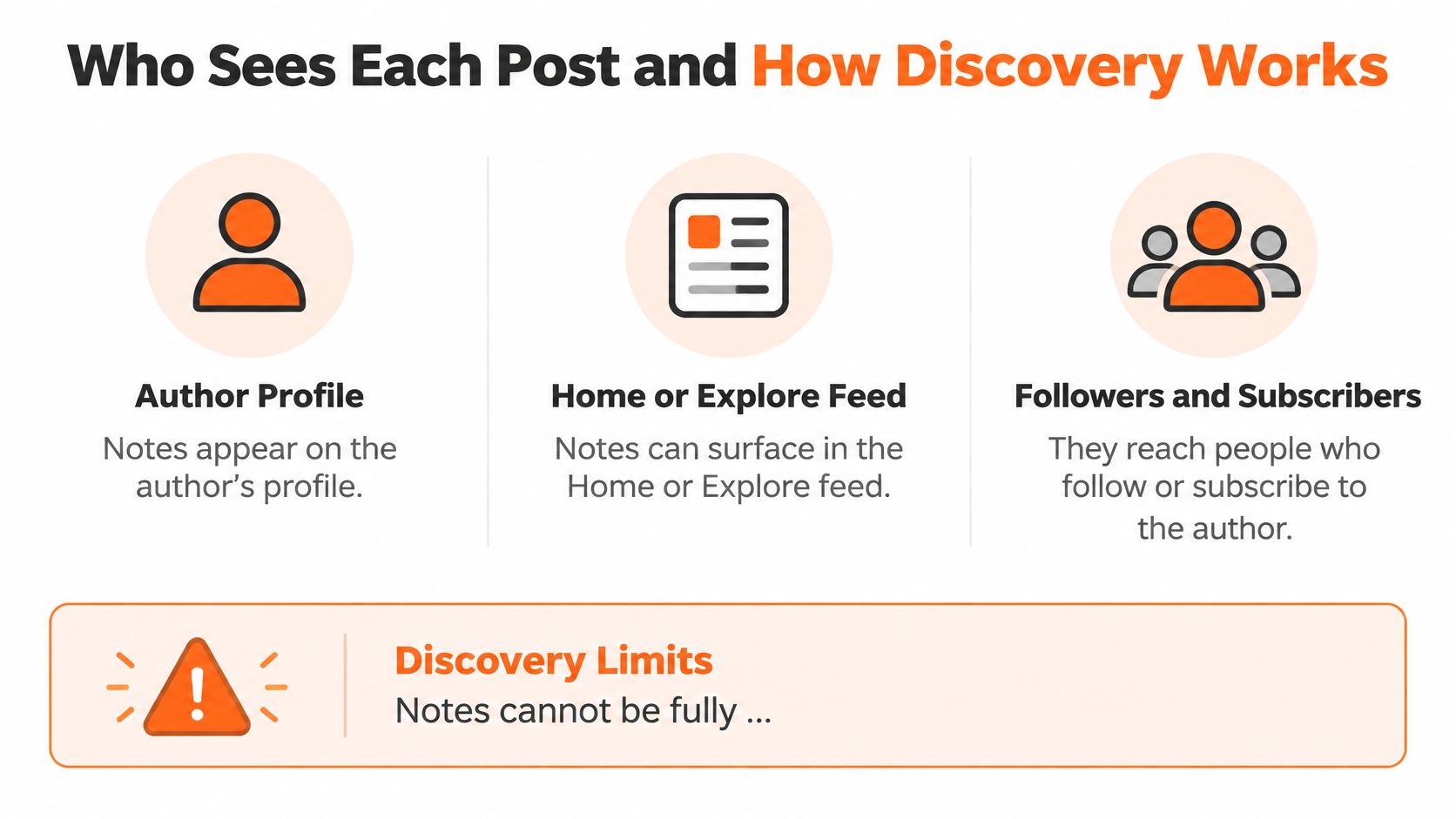
According to Substack's Notes and Chat guide, Notes appear on the author's profile and can surface in Home, Explore, and followers' or subscribers' feeds. Creators and readers can publish them without owning a publication, and Notes can't be fully paywalled, although authors can restrict replies.
Match the opening to the reader's context
Say you write an essay about why freelance proposals fail. On Notes, you could explain the mistake, include a useful example, and connect it to the full newsletter. The reader is already inside an environment organized around writers and publications.
On X, the same idea might meet a consultant, an agency owner, or someone participating in a discussion about sales. Lead with the actual problem, not an announcement that you've published a newsletter. A post that helps someone recognize a bad proposal has value before they know anything about your publication.
X distribution can extend through replies and reposts into topical and professional networks. Notes discovery happens within a writing-centered environment, so audience relevance and audience breadth aren't interchangeable.
A stranger seeing your post is discovery. A stranger understanding why your next essay matters is the beginning of readership.
Give discovery a destination
Use a profile description and publication promise that match the post. If you attract readers with practical freelance advice, don't send them to a vague subscription page promising assorted thoughts.
Keep paid analysis protected and use public posts to demonstrate the quality of your reasoning. Treat Substack traffic sources separately so you can distinguish feed discovery from recommendations, direct visits, and external referrals.
Also record when a post receives its initial response. Testing publication time and your availability to reply is more useful than assuming every quiet opening means the idea failed.
Metrics That Show Real Subscriber Growth
A high impression count measures distribution, not readership. To compare Substack Notes and X, track how many readers each channel brings in and how much time it takes to get them there.
Substack's post-level analytics can show revenue, new free and paid subscribers, followers, clicks, and shares attributed to a Note. The Substack guide to Notes analytics says the initial data appears within 24 hours, with generally hourly refreshes afterward. Use those figures to separate a widely shared observation from a Note that leads readers toward paid work.
Benchmarks to set your own baseline
| Benchmark | Platform | Value | Use it to |
|---|---|---|---|
| Average engagement rate, January 2024 | X | 3.47%, reported in Ordinal's Twitter analytics overview | Establish an earlier-period reference |
| Average engagement rate, January 2025 | X | 2.15%, in the same benchmark | Recognize the reported decline |
| Average likes per Note, June 2025 to June 2026 | Substack Notes | 22.5 to 18.8, according to The Writing Edge's Notes analysis | Watch for changing response |
| Monthly Notes volume, June 2025 to June 2026 | Substack Notes | 516,000 to 831,000, up 61%, in the same analysis | Track changes in content supply |
| Subscribers per 1,000 impressions | Both | Attributed subscribers ÷ impressions × 1,000 | Compare your own channel results |
Treat these as reference points, not targets. The X averages and Notes figures come from different analyses, and likes are not equivalent to engagement rate. Shorter X posts can show different engagement rates, so test post lengths against your own audience rather than applying a benchmark from another analysis.
Keep separate scorecards
For Notes, track attributed free and paid subscriptions, then add revenue when relevant. Reactions and shares help explain distribution, but they do not show whether readers subscribed.
For X, record impressions, interactions, link activity, and signups tied to a dedicated link or signup-source field. If you cannot connect a signup to X, mark its source as unknown.
Include time spent on both scorecards. A channel may bring more readers but cost more time to prepare posts and manage replies. Compare subscriber yield with that workload before deciding how often to post.
Use a subscriber-conversion tracking approach to assess which topics and promises bring readers who stay. Check whether new subscribers open later work, remain subscribed, or buy. Change one factor at a time, such as the opening or publication time, so you can judge its effect.
Which Platform Fits Your Writing Goal
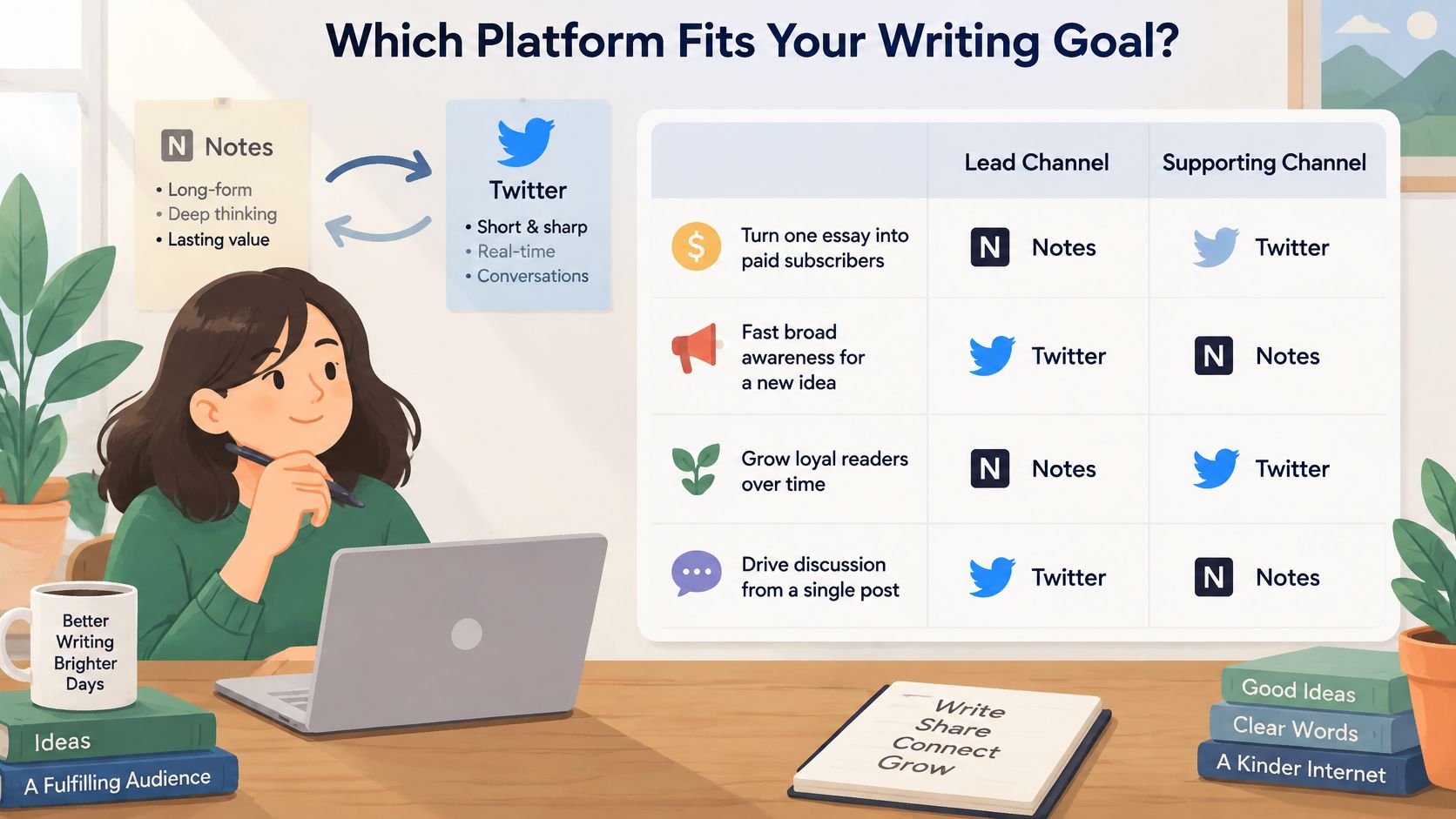
Choose a lead channel, not an obligation to maintain every channel equally. The following recommendations give each feed a specific role while leaving room for your own results to overturn the starting assumption.
Lead channel by writing goal
| Writing goal | Lead channel | Supporting channel |
|---|---|---|
| Turn an essay into paid subscribers | Substack Notes, linking into the newsletter | X thread for extra reach |
| Fast broad awareness for a new idea | X | Notes for readers already in newsletters |
| Grow inside the Substack writing community | Substack Notes | X for distributing proven ideas |
| Team or founder running several channels | Notes as the owned-readership channel | X as the broad conversation layer |
| Writer with limited posting time | The platform with stronger measured results | The other only when subscriber yield and time cost justify it |
For paid readership, start by demonstrating the value of the longer work. A Note should deliver something useful and make the additional value of subscribing specific, rather than withholding the entire argument behind a promotional sentence.
For broad awareness, let the idea travel independently of your publication. On X, a clear position that other people can discuss is a stronger starting point than a newsletter announcement.
A practical allocation
Say you publish a weekly essay and want more paid readers. Lead with a Note that explains a useful finding and points toward the deeper newsletter argument. Adapt the strongest claim into an X thread only when it can stand on its own.
For a team, coordination matters as much as channel choice. Narrareach can serve as the operating layer while the team keeps Substack, Medium, LinkedIn, and other channels. It doesn't replace those publishing and audience destinations.
- Protect writing time: Don't add a supporting channel that regularly delays the main publication.
- Separate revenue questions: Choosing which platform pays the most isn't identical to choosing where to promote an essay.
- Keep channels accountable: Retain both only when their distinct contributions justify the work.
Neither platform is a universal replacement for the other. But neither deserves a permanent place in your schedule merely because other writers use it.
Repurpose and Schedule Notes and X Posts
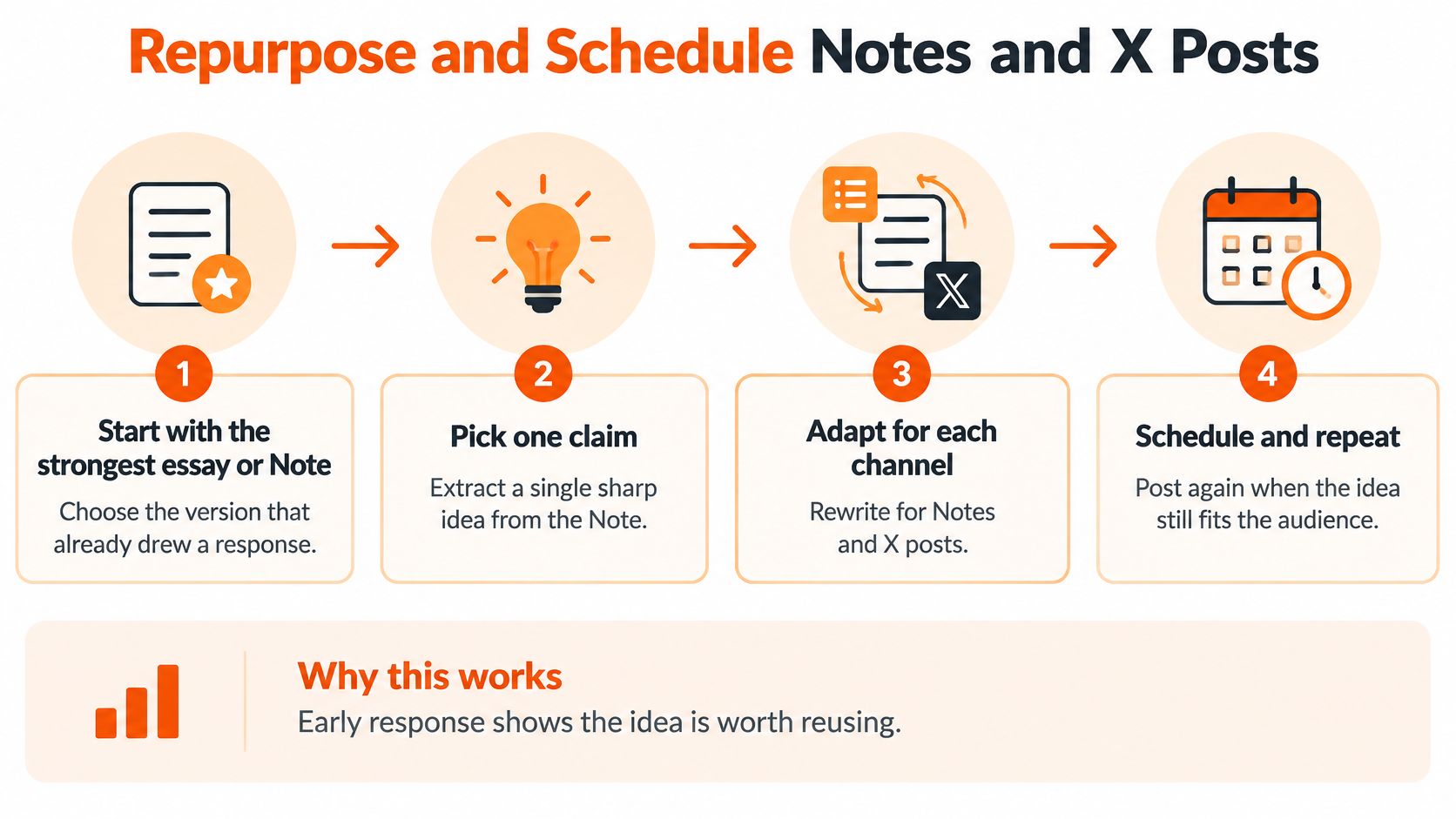
Start with an essay or Note that already prompted a meaningful response: subscriptions, thoughtful replies, or readers asking for more detail. Early response gives you a reason to reuse the idea, not a guarantee that identical wording will work elsewhere.
Repurposing preserves the argument while changing the entry point. Cross-posting wastes effort when you distribute the same weak opening more efficiently or spend longer polishing derivatives than developing the original work.
Build channel-specific versions
Extract a claim, not a paragraph. Choose the point a reader should remember and write it without the essay's setup. The common mistake is cutting off an excerpt at the character boundary, leaving the reader with background but no conclusion.
Draft contrasting X candidates. Write a compact, self-contained argument and a shorter, curiosity-driven opening. Don't assume the shorter version is better merely because it's easier to scan; compare relevant response and downstream visits.
Use a thread when the reasoning needs room. Make the opening useful by itself, then add the example, qualification, and destination. Keep the Substack link out of the opening line so the reader encounters the claim before the invitation to leave.
Check the destination's constraints. Buffer's character-limit guide lists 10,000 characters for Notes, including links, and 280 characters for standard X posts. Leave space for the complete destination link and review the final formatting rather than treating the maximum as a recommended length.
A practical adaptation might turn an essay about freelance proposals into a Note explaining why premature pricing creates confusion. The X version could isolate the actionable claim: explain the client's problem and intended outcome before presenting the fee. Neither version needs to summarize the entire essay.
Editing test: If someone never clicks, have you still given them a useful idea?
Schedule the work without multiplying it
Connect and verify the accounts. In Narrareach, connect Substack and your other platforms from Settings, then confirm the intended publication and X account before scheduling. Every plan schedules Substack Notes and articles; the publishing destinations also include Medium, LinkedIn, X, Bluesky, and Threads.
Batch the week's drafts, then separate publication times. Draft in the dashboard, schedule the Note around your audience's activity, and give the X candidates distinct slots. Scheduling everything simultaneously makes follow-up and attribution harder, particularly when the same readers follow you in both places.
Review after a consistent observation window. Record exposure, interaction, attributed subscriptions, and preparation time, then retain the stronger version as a working template. Reuse the reasoning and structure, not an opening that has become repetitive to returning readers.
If you need help building the scheduling habit, DMpro's guide explains how to save time with scheduled X posts. For the adaptation itself, use a Substack-to-X cross-posting workflow that preserves the claim rather than mechanically shortening text.
Keep short-form scheduling separate from long-form distribution decisions. You can draft inside our publishing desk, schedule the Substack post, and publish the article to Medium, LinkedIn, X Articles, WordPress, and Ghost at the same time. That doesn't mean every short-form derivative should also appear simultaneously.
Measure the operational benefit against your own baseline. Check whether batching lets you maintain your intended cadence without extending your working hours. The purpose of automation is to recover writing time and distribute useful ideas consistently, not to fill every available slot.
Choose Your Platform Mix and Test It This Week
I'd start with a bounded experiment rather than a permanent commitment to either feed. Use the same underlying claim so you're testing distribution and packaging, not comparing an excellent essay on one platform with a weak idea on the other.
A four-week experiment
- Week one, choose the job. Select your lead channel based on whether the next essay needs newsletter acquisition, professional visibility, or broader awareness. Record your existing posting workload and decide what result would justify continuing.
- Week two, prepare the variants. Draft a Note, a compact X argument, and a shorter X hook from the same claim. Keep the destination and subscription promise consistent so readers encounter the same offer.
- Week three, publish separately. Schedule the variants at distinct times and record their publication details. Use Note-level attribution for Substack and a separately tracked destination or signup-source field for X.
- Week four, evaluate the return. Compare normalized subscriber yield, subscriber quality, and time spent. Keep the channel that produces the more useful outcome for the effort, while preserving the supporting channel only if it contributes something additional.
This is a proposed test schedule, not a claim about how quickly audience growth should happen. A short experiment can expose workflow problems and obvious mismatches, but it won't establish the permanent value of a platform.
Decide what to stop doing
Suppose X brings relevant professional conversations but no attributable newsletter signups. You can retain it as a networking channel, but don't count that activity as proven subscription acquisition. If Notes produces subscribers who don't return to your essays, revisit the promise attracting them.
Don't make the winning platform the one with the biggest screenshot. Make it the one that earns its place in your working week.
Watch for duplication, too. When both feeds reach existing readers, the second post may add familiarity without adding acquisition. That can be worthwhile, but it shouldn't be mistaken for incremental audience growth.
Choose one lead channel and make the other earn its supporting role. Writers ready for a coordinated workflow can run the experiment through a shared scheduling desk. Readers who prefer to observe before adopting a tool can follow the author on Substack and X using the handles in the author bio; seeing how the approach develops is a valid next step.
Ready to put the experiment into practice? Visit Narrareach to draft, adapt, and schedule Substack Notes and X posts from one place, keeping more time for the writing that attracts subscribers. If you're not ready for a tool, follow the author on Substack and X through the author bio and use the scorecards above with your existing workflow.