
How to Schedule Social Media Posts That Actually Grow
At 11 p.m., you're staring at four dashboards with the same idea open in four tabs. The Substack Note still needs trimming, the LinkedIn post sounds too...
By Ian Kiprono
At 11 p.m., you're staring at four dashboards with the same idea open in four tabs. The Substack Note still needs trimming, the LinkedIn post sounds too formal, the X thread has no ending, and the Medium article hasn't been scheduled. By the time you finish rewriting everything, the audience window has passed, your draft queue is empty, and the work that should have grown your readership has consumed the time you reserved for writing.
I tested a different approach for 90 days across Substack, Medium, LinkedIn, and X. The experiment used one weekly idea, four platform-native formats, scheduled publishing, and timing tests instead of intuition. The useful lesson wasn't which scheduler to use. It was that distribution works better when you treat one idea as an engine, not as four unrelated calendars.
The Scheduling Trap Most Writers Fall Into
The trap begins on Monday morning. You have a strong idea, perhaps a point from a draft essay or a question a subscriber asked, but no clear path from that idea to publication. You open LinkedIn first, write a post, copy part of it into X, realize the tone is wrong, then move to Substack Notes and start again.
By Friday, the idea exists in several half-finished versions. None of them has a clear role. One post asks for comments, another sends readers to the article, and a third repeats the thesis without adding anything. Scheduling didn't remove the work because the workflow treated every platform as a separate writing assignment.
What I measured during the experiment
Each week, I chose one long-form anchor for Substack or Medium. From that anchor, I created a Note sequence, a LinkedIn post, and an X thread. I recorded the publish time, format, clicks, comments, replies, saves, and subscriber actions in one tracking sheet.
The test had three controls:
- One central idea: Every format came from the same thesis, so I could compare distribution rather than compare unrelated topics.
- Platform-native editing: I changed the opening, pacing, and call to action for each network instead of pasting the original everywhere.
- Measured timing: I tested a small number of time slots rather than filling every available hour.
The largest friction was cognitive, not technical. Switching between platforms made me forget why the idea mattered. I also spent too much time polishing low-value variations before knowing whether the original angle deserved more distribution.
Practical rule: If you can't describe the purpose of a scheduled post in one sentence, it isn't ready for the queue.
A single distribution engine fixes the sequence. Capture the idea once, define its audience and purpose, shape it for each surface, then schedule each version around audience activity. That approach protects writing time while giving a promising idea more than one opportunity to find readers.
The broader timing evidence supports treating scheduling as a distribution decision. A 2026 Sprout Social benchmark covering nearly 2 billion engagements across 307,000 social profiles identified 11 a.m. to 6 p.m. local time as the strongest overall window, with Tuesdays and Wednesdays performing consistently well and Sunday weakest overall. Those findings don't replace your own analytics, but they do show why random publishing creates avoidable friction.
Native Scheduling on Each Platform and Where It Breaks
Native schedulers are useful when you publish occasionally. They become awkward when one writer manages a connected distribution sequence across four platforms.
Substack lets publishers schedule Notes on web and mobile by selecting the calendar icon, choosing a date and time, and selecting Schedule. Substack displays the selected time in the user's local timezone, as described in the Substack Notes scheduling announcement. That's convenient for a Note, but it doesn't create a cross-platform queue for the related LinkedIn post, X thread, or Medium article.
Medium's post scheduler handles the basic act of setting a publication time. The limitation is workflow visibility. It doesn't give a writer a unified view of how that article connects to the short-form posts promoting it, so the surrounding distribution still lives in separate drafts, documents, or reminders.
LinkedIn's native scheduler supports personal posts and company-page publishing, but its usefulness depends on the type of content you create and how much coordination you need. It won't automatically turn an article into a carousel concept, split a thesis into an X thread, or show the complete journey from scheduled post to subscriber action. Writers who want a more detailed LinkedIn workflow can use this guide to schedule posts on LinkedIn.
X provides scheduling inside its composer, while account features and editing behavior can affect how comfortable the workflow feels. Threads still require careful sequencing, link placement, and review. A scheduled first post doesn't solve the editorial problem of making the entire thread coherent.
Native tools compared
| Platform | Scheduling Support | Key Limitations |
|---|---|---|
| Substack | Notes can be scheduled on web and mobile, with local-time display | No shared queue for related posts on other platforms |
| Medium | Basic article scheduling | Limited cross-platform planning and time-zone control |
| Scheduling for personal and company-page posts | Few connected repurposing and analytics workflows | |
| X | Scheduled posts and thread workflows | Thread editing and review remain manual |
The break happens at the handoff. You publish the article in one place, open another dashboard for LinkedIn, move to X for the thread, then return to Substack to check whether the Note supports the article. No native scheduler owns the idea as a complete unit.
A native scheduler publishes a post. A useful distribution workflow manages the relationship between posts.
That gap is where a layer above native tools becomes practical. You need one place to assign the idea, preserve platform-specific versions, schedule local times, and see whether the distribution sequence is doing its job. The scheduler should reduce repetition, not encourage identical cross-posting.
Building a Planning Workflow Before You Schedule Anything
Scheduling poor drafts faster won't grow an audience. Before a post enters a queue, it needs a destination, a reason to exist, and a relationship to the original idea.
Start with one inbox. Every candidate idea should land in the same note dump within 24 hours, whether it comes from a reader reply, a sentence in your manuscript, or a conversation. The inbox can be Notion, Google Docs, Apple Notes, or a plain text file. The important decision is eliminating the question, “Where did I put that thought?”
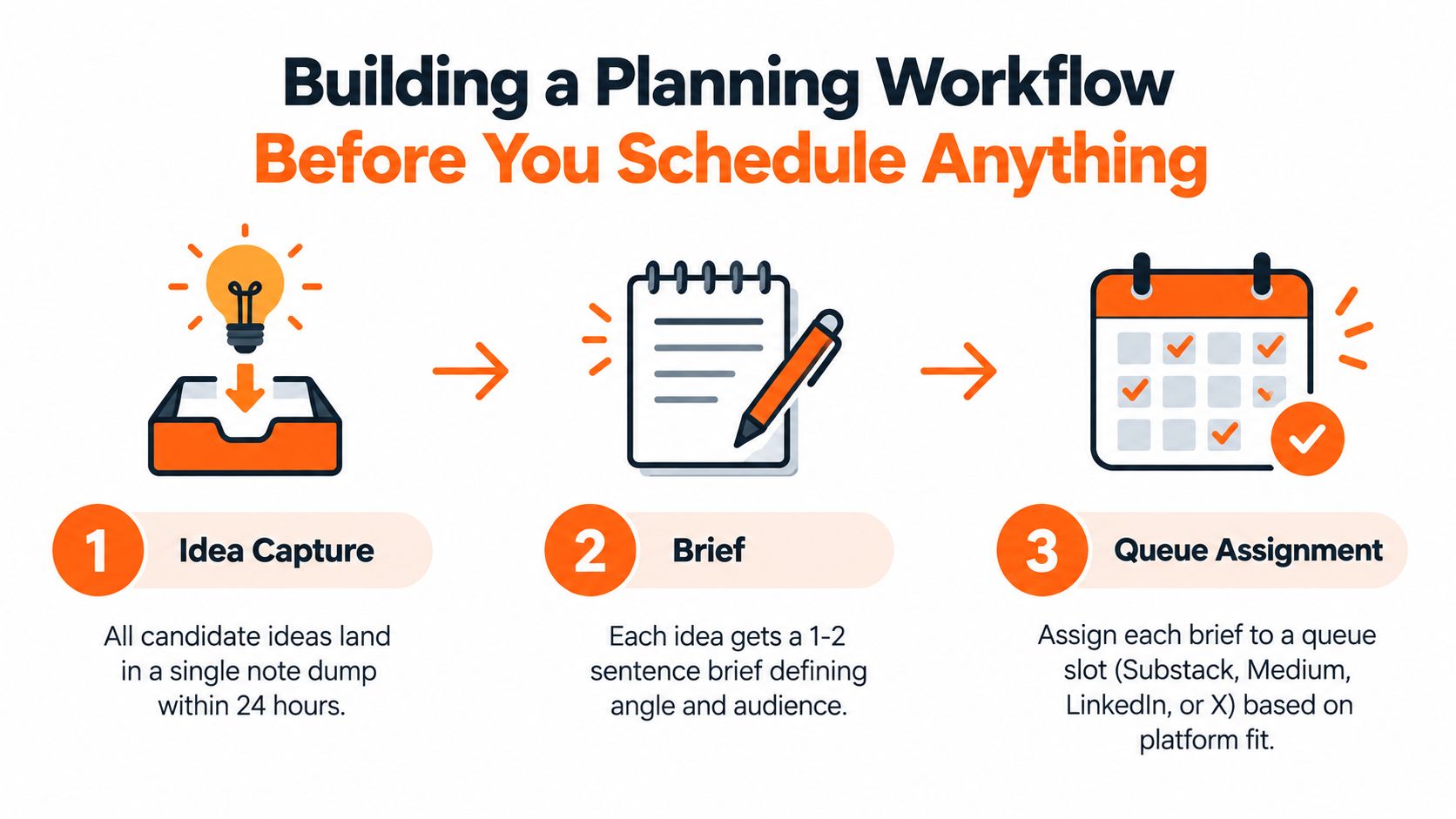
Give each idea a brief
Turn the raw note into a one-line brief containing four elements:
- Platform: Choose the primary surface first. A Substack Note can test a sharp observation, while Medium may carry the complete argument.
- Hook angle: State the tension or unexpected conclusion.
- Call to action: Decide whether readers should reply, click, subscribe, or remember the point.
- Repurposing intent: Name the formats you'll derive later.
Here's a worked example:
Idea: Most writers don't need more content ideas, they need a better distribution loop.
Primary format: Substack Note.
Hook: The problem isn't ideation, it's abandoning strong ideas after one post.
CTA: Reply with the platform where distribution breaks.
Derivatives: LinkedIn post, X thread, Medium companion article.
That brief prevents three common mistakes. You won't ask for a subscription when the post is designed to generate discussion. You won't force a long-form argument into a short Note. You also won't finish the article and discover that you have no clear material for the supporting formats.
Batch the anchor and its derivatives
Choose the long-form anchor first. Then extract three derivatives and assign them to a shared calendar. A practical planning workflow should make it easy to manage a content calendar without turning the calendar into a second writing project.
The same principle applies beyond these four platforms. If short-form video is part of your distribution mix, a separate guide on how to plan and publish TikTok content can help you adapt the same idea for a different format.
Nothing enters the scheduler without a brief. That rule sounds strict, but it keeps the queue purposeful. A full calendar isn't evidence of strategy. A calendar where every post has a job is.
Finding the Best Times to Post Without Copying Generic Charts
Generic timing charts are useful starting hypotheses, not publishing laws. Your readers may check LinkedIn during a work break, open Substack before work, read Medium at lunch, and use X late in the evening. The same person can behave differently on each platform.
Start with first-party evidence. Review Substack analytics for opens and clicks, LinkedIn analytics for reactions, comments, and profile visits, X analytics for replies and bookmarks, and Medium stats for reading behavior and follower activity. Record the day, local time, format, audience location when available, and the action you care about.
Run a controlled timing test
Use 2–3 weeks of testing with only 2–3 posting slots per platform, as recommended in Emplifi's 2026 scheduling guidance. Keep the content type and call to action as consistent as possible. If you change the topic, format, and time simultaneously, you won't know what caused the result.
Track the metric closest to your objective. For a newsletter writer, opens and clicks matter more than raw impressions. For LinkedIn, thoughtful comments and profile visits can reveal stronger intent than likes. For X, replies and bookmarks may tell you more about usefulness than reach alone.
Use these broader benchmarks to choose your initial slots:
| Platform | Best Day | Best Time Window | Winning Metric |
|---|---|---|---|
| Substack | Tuesday | Early morning or midday, then validate locally | Opens and clicks |
| Medium | Thursday | Late morning or midday, then validate locally | Read behavior and follower gain |
| Wednesday | Morning or later workday, then validate locally | Comment quality and profile visits | |
| X | Sunday or a tested weekday slot | Evening or platform-specific peak, then validate locally | Replies and bookmarks |
The table is a test plan, not a claim that these windows will win for every account. Buffer's 2026 Instagram analysis of 9.6 million posts found specific high-performing slots including Thursday at 9 a.m., Wednesday at 12 p.m., and Wednesday at 6 p.m. That platform-specific pattern is exactly why copying one universal schedule fails.
Metricool's separate 2026 analysis found a 9 p.m. peak for X from more than 2 million posts and an evening window for TikTok based on more than 2 million posts across 92,000 accounts, illustrating how materially timing can differ by network. You can use best-time scheduling guidance to form your initial hypothesis, then let your own heat map replace it.
Repurposing One Idea Into Platform-Native Posts
Repurposing doesn't mean publishing the same paragraph four times. It means preserving the argument while changing the entry point, rhythm, and reader action for each platform.
Begin with extraction. From the long-form article, pull out the thesis, three supporting points, and one contrarian line. That gives you a compact source document. You're not asking an AI tool or a blank page to invent four new pieces. You're selecting the parts that already carry meaning.
One source, four transformations
For Substack Notes, create a sequence of 4–6 short hooks. Each Note should stand alone, but the sequence should move from problem to insight to reader response. End the final Note with a question or a link to the complete article.
LinkedIn needs more breathing room. Use a single-line hook, a blank line, three concise paragraphs, and a question CTA. The post should explain why the idea matters to professional readers rather than summarize every section of the source article.
For X, build a 7–10-post thread. Let post one mirror the central LinkedIn hook, but use shorter sentences and a stronger progression. Place the article link in post eight or near the point where the reader has received enough context to want the deeper argument.
Medium can support a comment-style response to a related story. Add one useful observation, connect it to the broader argument, and reference the full article only where it extends the discussion.
Repurposing test: If removing the link makes the short-form post useless, you've written an advertisement, not a native post.
During the experiment, I aimed to keep each transformation within 10–15 minutes. The point wasn't to force every format into a precise word count. It was to stop polishing a derivative until it became a second article.
A useful before-and-after pattern looks like this:
| Source material | Native version | Editing focus |
|---|---|---|
| Long-form thesis | Substack Note hook | Curiosity and reply |
| Three supporting points | LinkedIn paragraphs | Clarity and professional relevance |
| Thesis plus evidence | X thread | Sequence and momentum |
| Contrarian line | Medium response | Conversation and context |
This workflow keeps your voice because the underlying argument remains yours. The platform changes the packaging, not the conclusion. A detailed content repurposing workflow can help you build reusable extraction prompts and review checkpoints.
Tracking Performance Across Substack, Medium, LinkedIn, and X
A post can look successful and still fail its actual job. Impressions may rise while clicks remain flat. Likes may accumulate while no reader subscribes. Cross-platform tracking matters because writers need to know which ideas create durable audience movement, not which dashboard produces the most flattering number.
Use a weekly sheet in Google Sheets or Notion. Give every idea one row, then record the anchor article, derivative formats, publish times, reach, and meaningful actions. Keep the original idea ID in every row so the Note, LinkedIn post, X thread, and Medium response remain connected.
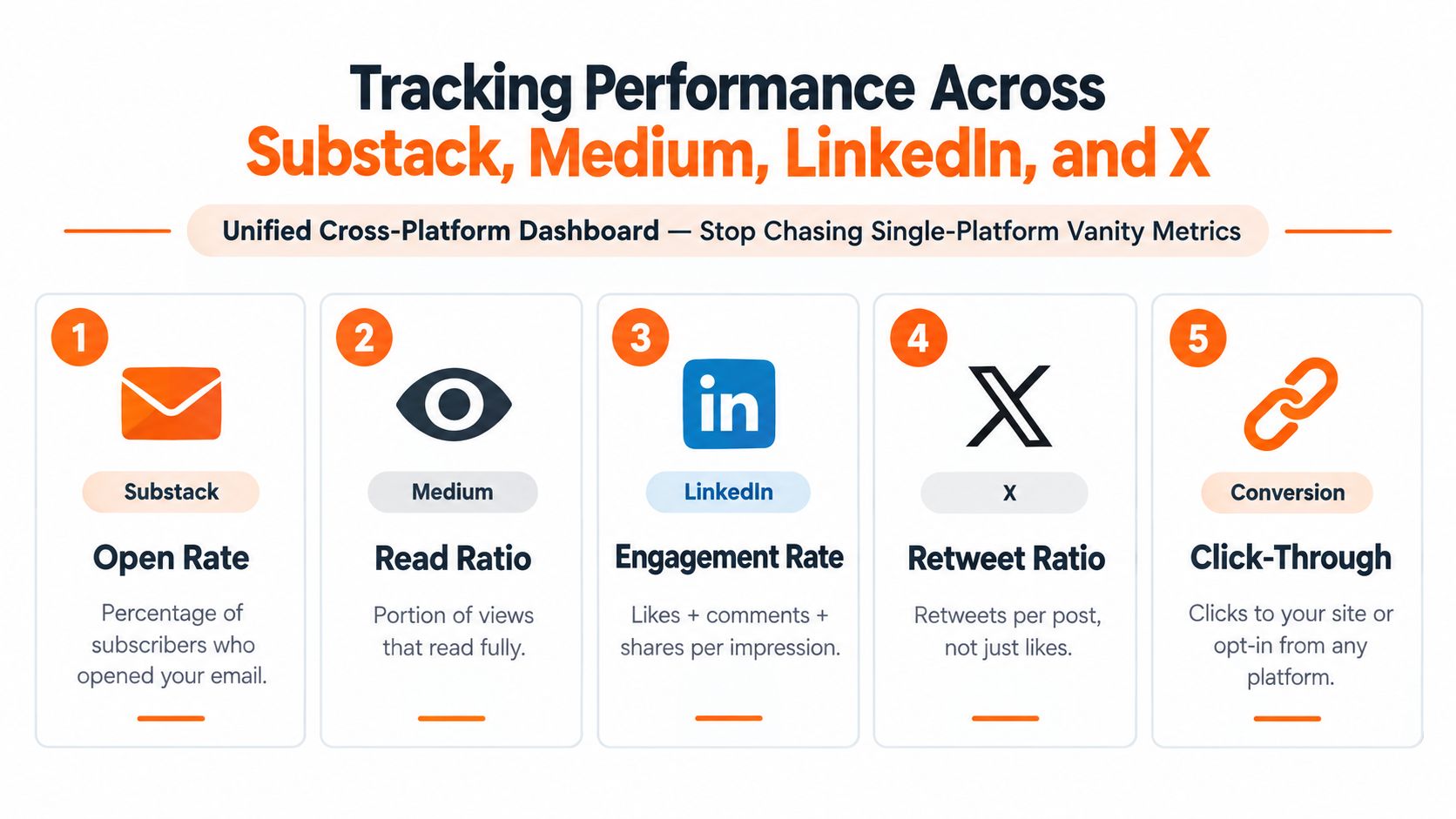
Track the action behind the metric
Substack gives you open and click behavior. Medium shows whether readers continue through the article and whether your follower base grows. LinkedIn reveals the quality of discussion and profile visits. X can show whether readers reply, bookmark, or share the thread.
Your sheet should answer four questions:
- Did people notice it? Record impressions or views as context, not as the final verdict.
- Did they engage? Track opens, read behavior, comments, replies, saves, and bookmarks.
- Did they move? Record clicks to the article, newsletter, or opt-in.
- Did the idea deserve more distribution? Compare actions across all derivatives.
Create a simple distribution score using the outcomes that matter to your business. You don't need a complicated model. You can assign more weight to clicks, replies that reveal a problem, or subscriber actions than to passive reactions. The score is useful only if you apply the same rules to every idea.
High impressions with flat saves and shares usually means the hook attracted attention, but the substance didn't earn distribution.
Review the sheet every Friday. Double down where comments reveal purchase intent, recurring questions, or requests for the full argument. Reduce effort on platforms where reach stays high but readers don't click, save, reply, or subscribe. The cross-platform analytics framework is useful when you need to connect these signals instead of checking each network in isolation.
The 90-day experiment changed how I judged a scheduled post. A post wasn't successful because it went live on time. It succeeded when its timing, format, and call to action moved readers toward the next meaningful action.
Your Weekly Scheduling Loop and What to Do Next
A repeatable schedule should fit around writing, not replace it. My weekly loop used Monday for decisions, midweek for production, Thursday for queue management, and Friday for learning. The weekend stayed mostly clear so the system didn't become another always-on obligation.
Use this rhythm as a starting template:
- Monday, 90 minutes: Capture new ideas, select the weekly anchor, and write the brief. Delete ideas that don't have a clear audience problem or reader action.
- Tuesday and Wednesday, 2 hours: Draft the long-form piece, extract the thesis and supporting points, then create the Substack Note sequence, LinkedIn post, and X thread.
- Thursday, 45 minutes: Load the approved drafts into the relevant queues, check local time zones, review links, and confirm that each derivative sounds native.
- Friday, 45 minutes: Review the previous week's metrics, update the distribution score, and choose which idea or format deserves another iteration.
Keep a small space for real-time responses. A scheduled system shouldn't prevent you from replying to a strong comment, addressing breaking news, or pausing a post when the context changes.
For a writer managing Substack, Medium, LinkedIn, and X, Narrareach can serve as the distribution layer for scheduling platform-specific posts, tracking queue state, repurposing long-form material, and reviewing cross-platform performance from one workflow. If you're ready to run the same experiment, download the scheduling checklist and 90-day test log, then visit Narrareach to schedule your first idea across the platforms that matter to your audience. If you're not ready for a tool, subscribe to the weekly distribution digest for timing data, repurposing templates, and workflow tweaks tested across Substack, Medium, LinkedIn, and X.