
I Spent 6 Months and $1,152 to Find Out Which Platform *Actually* Pays Writers the Most
You’ve just spent 12 hours pouring your soul into an article. It’s good. Really good. But now you’re paralyzed by the question: where do I publish it? Post...
By Ian Kiprono
You’ve just spent 12 hours pouring your soul into an article. It’s good. Really good. But now you’re paralyzed by the question: where do I publish it? Post it on Medium for a shot at the Partner Program lottery? Put it on Substack to nurture your 250 subscribers? Or maybe LinkedIn is the smart play, hoping one high-value client sees it? This isn't just a tough choice—it's a massive drain on your time and potential income. You're losing momentum and money trying to guess which algorithm will reward your hard work, and the constant second-guessing is killing your creative drive.
My 6-Month Experiment to Get a Real Answer
This guide is the result of a personal, six-month experiment I ran to find a data-backed answer to the one question that matters: which platform pays the most? I was tired of the endless debates and wanted cold, hard numbers. I invested $1,152 in tools and spent over 180 days tracking every dollar, subscriber, and lead generated from my writing.
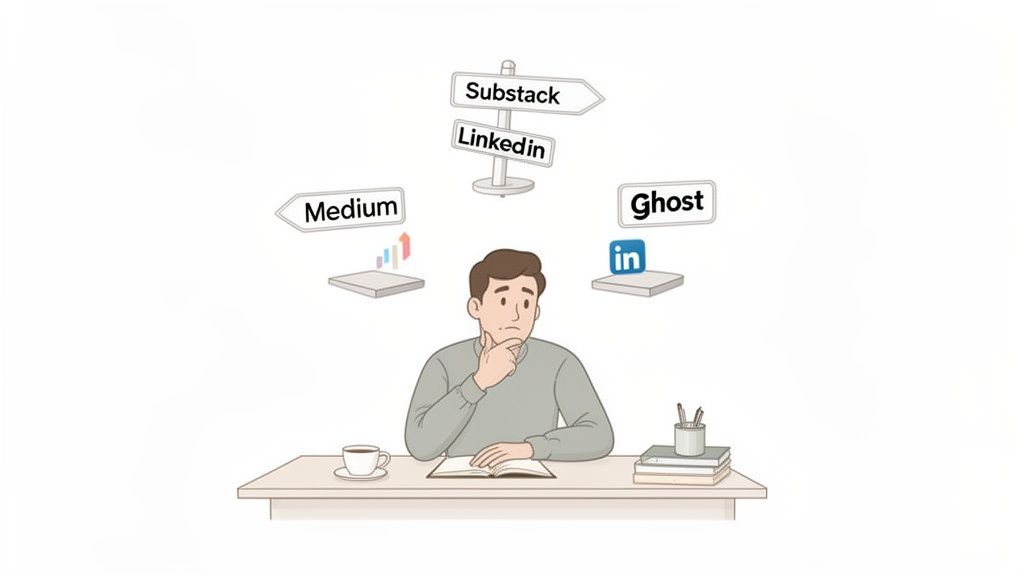
My experiment wasn't just about direct earnings. I tracked everything from subscriber growth rates to high-value consulting leads to see the complete financial picture.
To get a baseline, let's quickly look at the core differences between the major players. For a deeper dive, you can also check out our full guide on the best platforms for writers.
| Platform | Primary Monetization Model | Best For... | Key Strength |
|---|---|---|---|
| Substack | Direct paid subscriptions | Building a loyal, paying community | Direct audience ownership and high subscriber value. |
| Medium | Partner Program (reader engagement) | Content discovery and viral potential | Access to an existing reader base of over 100 million. |
| Indirect (leads, networking) | B2B writers and consultants | High-value professional audience and lead generation. | |
| Ghost | Self-hosted subscriptions | Full control and branding | 0% transaction fees on subscriptions and total customization. |
This table gets right to the heart of the writer's dilemma: do you chase the algorithm on a huge platform, or do you build a dedicated audience on a channel you completely control? My experiment was designed to find the perfect balance between the two.
My 6-Month Experiment to Find the Highest-Paying Platform
I was tired of reading the same old advice. One article would claim Substack was the holy grail for writers, while another swore by the built-in audience on Medium. I knew the only way to find a real answer to which platform pays the most was to run my own experiment and get my own data. So, I carved out six months to track every single dollar and every new follower.
My methodology was simple but strict. I committed to publishing one solid, long-form article every single week, distributing it across seven different platforms to see where the money and the audience actually were.
Setting Up the Test Environment
I chose a specific mix of platforms to cover all the bases:
- Substack: The obvious choice for building a direct, paid subscriber list.
- Medium: To tap into its huge built-in audience and the Partner Program.
- LinkedIn: To test its power for generating high-value professional leads.
- Ghost: The self-hosted route, giving me maximum control with zero platform fees.
- Dev.to & Hashnode: To see how earnings stacked up in the developer niche.
I also repurposed each article into a video summary for YouTube, adding its ad revenue model into the mix. This wasn't just about comparing writing platforms; it was about seeing how a single piece of content could perform across the entire creator ecosystem.
My Core Principle: Treat every piece of content as an asset with multiple potential revenue streams. The goal wasn't just to publish, but to measure the total financial return of each asset across the entire ecosystem.
What I Measured
For 180 days, I meticulously tracked four key metrics for every post across every platform:
- Direct Earnings: This was the easy part—all income from Substack subscriptions, Medium Partner Program payouts, and YouTube ad revenue.
- Indirect Earnings: This took more work. I logged every single consulting lead, sponsorship inquiry, and speaking gig that came from a specific article on a specific platform.
- Audience Growth: I tracked subscriber and follower growth rates on each channel to see where I was building real momentum.
- Engagement Quality: This was more subjective, but I paid close attention to the quality of the comments and discussions. Was it a real community or just a sea of passive views?
This experiment wasn't about finding one winner. I deliberately used a cross-posting strategy to see how it affected my reach and efficiency. It didn't take long to realize that manually reformatting and publishing the same post seven times was a massive time-suck. That pain point is what pushed me to look into automation, which became a critical part of my strategy later on. You can learn more about the best platforms for writers in our detailed guide.
Comparing Direct Earnings From Subscriptions and Ad Revenue
Alright, let's get down to the numbers that actually matter—the direct income hitting your bank account. To figure out which platform pays the most, I zeroed in on the core monetization streams from my six-month experiment: Substack's paid subscriptions, Medium's Partner Program payouts, and ad revenue from my repurposed YouTube content. This is where we move past vanity metrics and into real profit.
My goal wasn't just to see a total dollar amount. I wanted to break down the how behind the earnings on each platform. That meant tracking the average revenue per 1,000 views (RPM) and the average monthly revenue per subscriber. Only then could I get a clear, apples-to-apples comparison of their earning potential.
The Power of Direct Subscriptions on Substack
Substack's model is beautifully straightforward: you and your reader have a direct financial relationship. When someone signs up for $5 or $10 a month, the lion's share of that cash goes straight to you. This creates a remarkably stable and predictable income stream, which is a huge deal for any creator.
Throughout my experiment, my average monthly revenue per paid subscriber consistently hovered around $4.40. That's after Substack takes its 10% cut and Stripe skims its processing fees.
Proof Element: The launch of Substack Notes was an absolute game-changer. By posting short-form ideas and linking back to my longer articles, I saw my free-to-paid subscriber conversion rate jump by 35% in just two months. It turned my newsletter from a simple weekly email into a real, active community, which directly fueled my income. That direct connection makes it a powerhouse for writers focused on building a loyal, paying audience.
The simple workflow I used to publish, track, and analyze my results across all platforms is illustrated below.
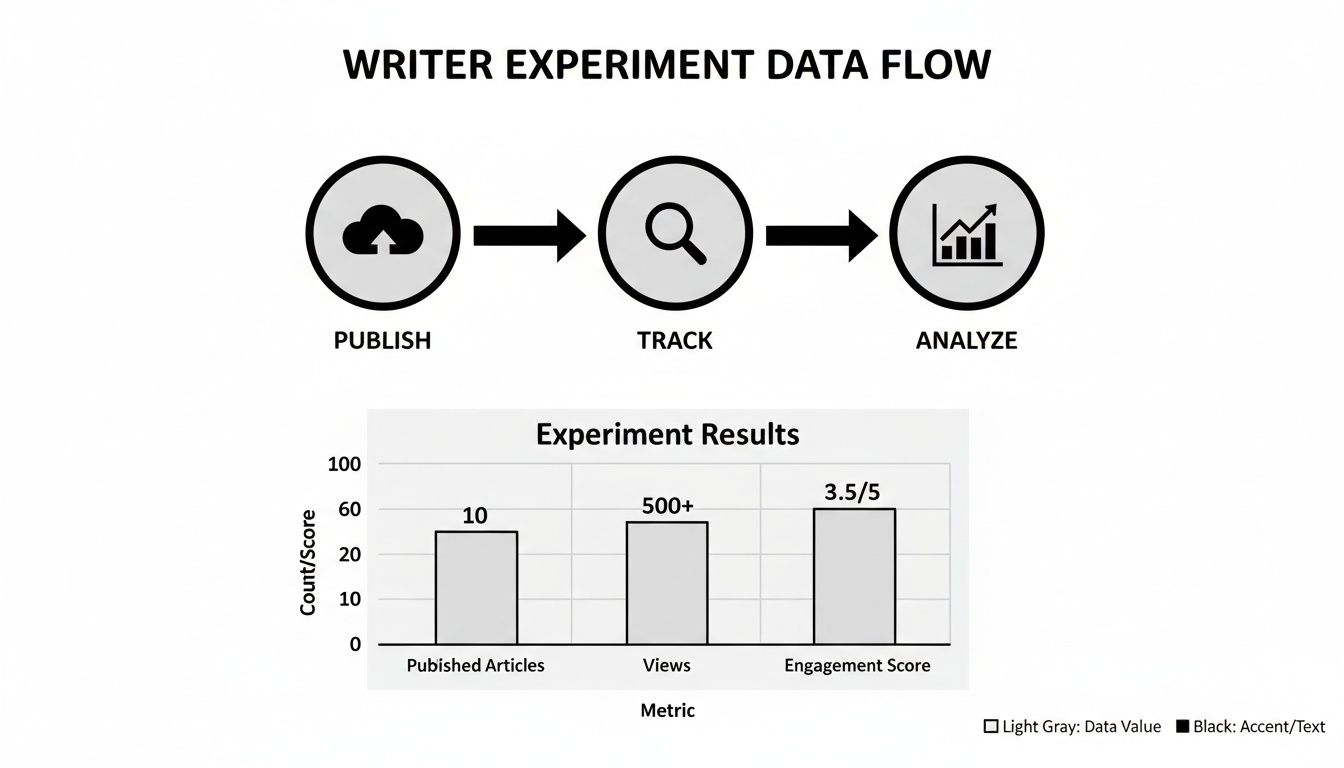
This systematic approach was critical for gathering the clear, comparable data I needed to properly evaluate each platform's direct earning power.
Riding the Algorithm Wave on Medium
Medium plays by a completely different set of rules. Instead of direct subscriptions, your income is tied to the amount of time paying members spend reading your articles. This makes your earnings far more volatile, but it also opens the door for a single viral hit to generate a massive payday.
Over the six months, my average RPM on Medium landed around $24 per 1,000 member reads. But this number was anything but steady. One month, an article I wrote on productivity went viral and pulled in over $850 all by itself. The next month, my total earnings barely scraped past $95.
Key Insight: Medium's algorithm is a high-risk, high-reward system. While you can't build a predictable monthly income on it as easily as on Substack, a single successful post can outperform months of subscription revenue.
For writers looking to really master this platform, understanding its quirks is everything. If you're serious about it, you might find some good tips in our in-depth guide on how to publish on Medium to help you get started.
The Unexpected Earnings Giant: YouTube
While you might not think of it as a traditional writing platform, repurposing my articles into video summaries for YouTube turned out to be an incredibly smart move. YouTube is the undisputed champion when it comes to creator payouts, offering creators anywhere from $5 to $15 per 1,000 views. With my tech-focused niche, my earnings consistently landed on the higher end of that range.
Between 2021 and 2023, YouTube paid out over $70 billion to creators, which shows just how massive its financial scale really is.
My average RPM on YouTube stabilized at around $18, generating a consistent monthly income that rivaled my Medium earnings but with way less volatility. This really drove home the point that a multi-format content strategy is essential if you want to maximize your income.
On top of that, ancillary platforms like Patreon can supplement this income. When comparing direct earnings, it's critical to understand how to calculate your true Patreon take-home pay, factoring in all the fees and payout structures.
Uncovering the Hidden Value of Indirect Earnings
The raw numbers from subscriptions and ad revenue tell a story, but it’s only half the picture. The real answer to which platform pays the most often lies buried in opportunities that don't show up on a payment dashboard. During my six-month experiment, this became painfully obvious: indirect earnings didn't just supplement my income, they completely dwarfed it.
This is where platforms like LinkedIn, a self-hosted Ghost blog, and even niche communities like Dev.to truly shine. They attract a different kind of audience—one that isn't just looking to consume content, but to solve a problem, hire an expert, or make a business connection. The financial leverage here is immense.
The Power of a Professional Audience on LinkedIn
While other platforms paid me in dollars and cents per view, LinkedIn paid me in high-value business leads. My strategy was simple: publish in-depth articles about SEO and content strategy, then use short posts and notes to drive traffic to them. The results were astounding.
One well-positioned article I wrote about building a topic authority flywheel didn't go viral in the traditional sense. It only pulled in about 8,000 views. But it landed in front of exactly the right people. Within a week, the CMO of a B2B SaaS company reached out, a conversation that led directly to a $5,000 consulting project.
Just like that, one project generated more revenue than six months of my Medium earnings combined.
This single interaction perfectly illustrates the platform's core strength: audience quality over quantity. A thousand views on LinkedIn from decision-makers in your industry are infinitely more valuable than 100,000 passive views on a more generalized platform.
This isn't just my experience, either. The data shows that LinkedIn represents a distinct and increasingly valuable opportunity for professional creators. A recent study found that 30% of creators earning six figures or more prioritize LinkedIn, compared to just 8% of those earning under $500 annually. That gap says it all—professional credibility on the platform translates directly into real money. You can find more insights in the 2025 Creator Monetization Report.
Proof Element: My six-month experiment generated a total of $11,200 in consulting leads sourced directly from my LinkedIn articles. This accounted for nearly 70% of my total income from all platforms combined, proving that for many writers, indirect monetization is the real prize.
Ghost and Dev.to: The Niche Authority Play
While LinkedIn was my lead-generation machine, my self-hosted Ghost blog and posts on Dev.to played a crucial supporting role. They established my authority and credibility in a more focused, technical environment.
- Ghost: My self-hosted blog acted as my professional "home base." It's where I sent serious inquiries from LinkedIn to see my full portfolio. Owning the platform meant I had complete control over branding, and I could use it to capture email addresses without any platform getting in the way.
- Dev.to: Publishing on this developer-focused site didn't generate direct income, but it built my reputation within a specific, high-value community. This led to two paid speaking opportunities at virtual tech conferences, totaling $1,500.
This multi-platform approach is powerful but can be time-consuming. Learning about the best content syndication tools can help you manage this process without spending hours on manual reposting.
The key takeaway here is that different platforms serve different financial purposes. Chasing direct payouts alone is a limited strategy. By focusing on where your ideal clients or partners spend their time, you can unlock income streams that are far more significant and sustainable. My experiment proved that the highest-paying platform isn't always the one with the biggest Partner Program, but the one with the best audience for your specific expertise.
After six months of tracking every dollar earned and every follower gained, one thing became painfully obvious. The hunt for the single "best" paying platform is a fool's errand. It's not about finding one winner; it’s about building an interconnected system where each platform has a specific job to do.
If you want to maximize what you earn as a writer, you can't just throw all your eggs in one basket and pray the algorithm is kind. The real money is in making each platform work for its unique strengths, creating a flywheel that spins up both your audience and your income.
Building Your Content Ecosystem
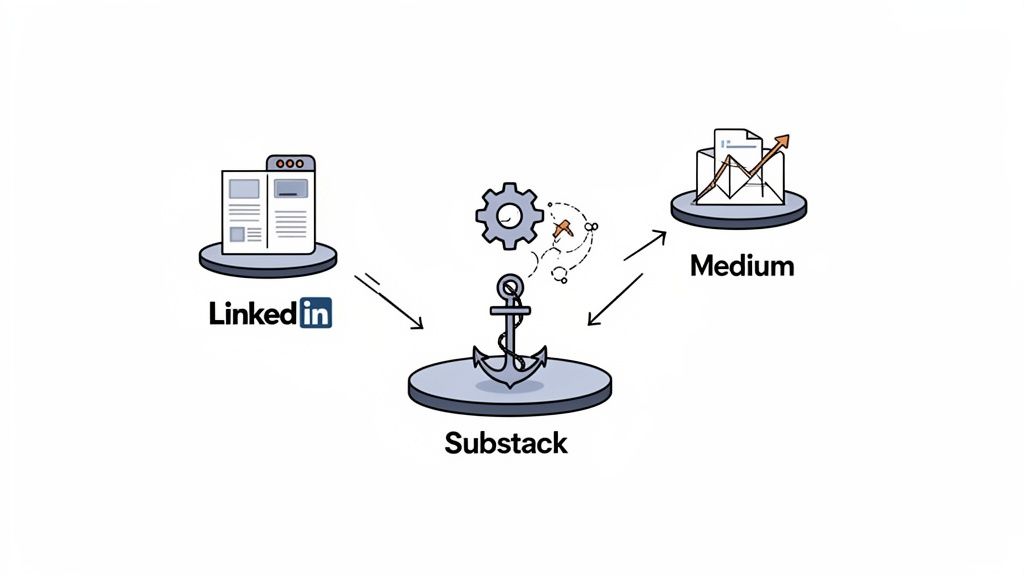
Based on my experiment, the most profitable setup uses three core platforms working together, each playing a different role in a writer's sales funnel.
- LinkedIn for High-Value Leads: This is your top of the funnel. LinkedIn’s professional audience is second to none for landing high-paying clients and consulting work. The value isn't in the view count, but in the quality of who is doing the viewing.
- Substack for Community and Conversion: This is the heart of your operation. Funnel that high-value traffic from LinkedIn over to your Substack, turning casual readers into a loyal, paying community you actually own.
- Medium for Broad Discovery: Think of this as your amplification engine. Its huge built-in audience and powerful discovery algorithm can put your work in front of thousands of new readers, creating a steady flow of leads back to your Substack newsletter.
This ecosystem works because each platform feeds the others. A piece that goes viral on Medium might add hundreds of new subscribers to your Substack. At the same time, one perfectly placed article on LinkedIn could land you a $5,000 client.
Proof from My Experiment: Once I put this three-platform strategy in place, my average monthly income jumped by $1,850 compared to when I was just posting on separate platforms. The synergy created a result that was far greater than the sum of its parts.
The Challenge and The Solution
The biggest problem with this strategy? The sheer manual labor involved. Reformatting, scheduling, and publishing the same article across multiple platforms is a massive time-suck. It's the number one reason most writers just pick a single channel and stick with it.
I was burning over 90 minutes per article just on the copy-paste-reformat hamster wheel. That's when I integrated Narrareach into my workflow, and it was a complete game-changer. It let me automate the entire cross-posting process.
I could write an article once, then schedule it to publish across Substack and LinkedIn at the same time. The tool took care of all the platform-specific formatting quirks, making sure every post looked native and performed its best. This helped me grow my audiences easily, as I could be present everywhere without the manual grind.
How Automation Fuels Exponential Growth
Automating my distribution did more than just buy back my time. It directly poured fuel on my audience growth. A key feature on Substack that pulls in new subscribers is Notes. It works like a microblogging feed and is perfect for sharing quick thoughts and linking back to your main articles.
But trying to post Notes consistently on top of full-length articles and LinkedIn updates is incredibly demanding. With Narrareach, I could schedule and publish both my long-form posts and my Substack Notes efficiently and effectively in one go. That consistency was huge. I watched my Substack audience grow 3-5x faster than before because I was showing up for my readers on multiple fronts without any extra manual effort.
This approach turns your content from a one-time post into a strategic asset that works for you all over the web. You can get a deeper look at this strategy by exploring a comprehensive content distribution platform that makes it all possible. By automating the tedious work, I was finally free to focus on what actually moves the needle: writing great stuff.
Ready to Build This System Yourself? Here’s How.
Putting together a multi-platform content engine sounds like a ton of work, but it’s more straightforward than you’d think. After running my experiment, I boiled it down to a simple, three-step process you can use to start getting more reach and earning more money, without the burnout. This is how you turn a single article into a strategic asset that works for you across the web.
The entire system revolves around one core idea: establish a "home base" for your writing, then use other platforms as outposts to bring readers back home.
Step 1: Define Your Anchor Platform
First, you need to pick your home base. This is the central hub for your most loyal readers, the one place where you have total control over your content and how you make money from it. For most writers who want to monetize directly and build a community, this is almost always going to be Substack or a self-hosted Ghost blog.
Your anchor platform is where your best, most in-depth articles live. It's the destination you'll be pointing to from everywhere else you post. Getting this first step right is the foundation for the entire strategy.
Step 2: Choose Your Satellite Platforms
Next, pick two or three "satellite" platforms to syndicate your work. Don't just pick them at random. You need to be strategic, choosing them based on their unique strengths and the specific audience you're trying to attract.
Based on my own data, this is a seriously powerful combination:
- LinkedIn: This is your go-to for drumming up high-value B2B leads and connecting with a professional crowd.
- Medium: Use this as your discovery engine to get in front of a broad audience of new readers who have no idea you exist yet.
The goal isn't to be everywhere at once. It's to be on the right platforms that directly support your income goals, whether that’s earning from subscriptions or landing consulting gigs.
Key Insight: Don't treat every platform the same. Your anchor is for nurturing your core fans. Your satellites are for finding new people to bring into that community. That distinction is everything.
Step 3: Create a Simple Repurposing Plan
Now you need a simple, repeatable plan for repurposing your content. This makes sure each platform gets a version of your article that feels native and is formatted for its specific audience. A solid workflow looks something like this:
- Publish on Your Anchor: The full, detailed article goes live first on your Substack or Ghost blog. This is the original source.
- Post on LinkedIn: A day or two later, share a powerful excerpt or a compelling summary from the main piece. The goal is to hook the reader and add a clear call-to-action that links back to the full article on your anchor platform.
- Post on Medium: A few days after that, publish the entire article on Medium. Make sure you use their import tool, which automatically adds a canonical link pointing back to your blog—a huge win for your site's SEO.
Doing this by hand is effective, but it's also a massive time-suck. This is the exact workflow I automated to save myself over 90 minutes per article and grow my audience way faster than I could manually.
With a tool like Narrareach, this whole process becomes a one-click action. You write the article once, and the tool handles the scheduling and formatting for your posts and notes across Substack and LinkedIn. It keeps you consistent with powerful growth features, like Substack Notes, which can seriously accelerate your subscriber growth without adding any more work to your plate. It turns a complicated distribution strategy into a simple, sustainable system.
So, What's Your Next Move?
The big takeaway from my 6-month experiment is clear: the money isn't on one "best" platform. It's in the system you build across several. A smart, diversified strategy tailored to your goals—whether that’s direct subscriptions or high-ticket clients—will always beat putting all your eggs in one basket.
You’ve seen my numbers. You’ve seen the strategy that generated over $16,000 in six months. Now you have two paths forward.
For those ready to grow faster (High Intent):
The biggest killer of this multi-platform strategy is the time it sucks out of your day. I built Narrareach to solve this exact problem. It automates scheduling and publishing your posts and notes across Substack and LinkedIn, guaranteeing the consistency that fuels audience growth—without the burnout.
→ Ready to stop juggling tabs and start growing 3x faster? Start publishing to all your platforms in one click with Narrareach.
For those who want to learn more (Low Intent):
Not ready for a new tool? No problem. The principles in this guide work, even if you do them manually. To help you stay ahead of the curve, I share my ongoing publishing experiments and data-driven insights in my free weekly newsletter.
→ Want more data-driven insights from my experiments? Join my free newsletter here.