LinkedIn Post Time: Best Windows for 2026
You published at 9:47 p.m. because that's when the draft was finally good. By breakfast the post had a few dozen impressions, nearly all of them from people...
By Ian Kiprono
You published at 9:47 p.m. because that's when the draft was finally good. By breakfast the post had a few dozen impressions, nearly all of them from people who already follow you, and the point you spent two hours sharpening had never left the room.
That's the most common failure in LinkedIn publishing, and it has nothing to do with the writing. Writers treat the posting hour as whatever is left over after the draft is finished, so a post goes out when the author is free rather than when the audience is at work. Professional feeds are busy during working hours and thin on a Saturday night. A post dropped into the thin part still gets judged, still gets read by a ranking system that weighs early engagement, and still gets compared by you against posts that had a full audience in front of them.
The Post That Died After Dinner
A bad hour does more damage than a bad draft because it changes what you learn. A solid idea published at 10:00 p.m. reads like a weak idea, so you retire a topic that would have landed at 8:30 a.m. on a Tuesday. Do that three times and you decide LinkedIn does not work for your niche, when the niche was never the problem.

Stop guessing about the hour the same way you stop guessing about headlines: turn it into a short, boring test with a log attached. The test rests on three inputs, and you can check every one of them this week without a paid tool or a consultant.
- A weekday baseline from the large post scans, which tells you where to aim before you have any data of your own.
- Your own analytics, which tell you which window moved the people who follow you rather than the people in someone else's sample.
- A trajectory rule, which keeps a fresh post from stepping on one that is still climbing and keeps a dead slot from getting a second idea it did not earn.
Practical rule: Do not retire a topic until you have moved one post on it into a busy window. A weak slot and a weak idea look identical in your analytics, and only one of them deserves to be abandoned.
The cost is the evidence you build against yourself, post after post, until the record says your ideas do not land on LinkedIn. That record is measuring the clock as much as the content. Timing will never rescue a flat idea. It gives a good one a fair test, and a fair test is what tells you to keep going or change direction.
Weekday Windows the Big Datasets Agree On
The largest post scans point the same way even when they disagree on the hour: LinkedIn distribution is strongest while your audience is already in a work context. Omnicreator's analysis of more than 1 million LinkedIn posts put the broadest high-engagement band at roughly 9:00 a.m. to 5:00 p.m. on weekdays, with Friday slightly ahead of Thursday and Wednesday, and Saturday at about two-thirds of Friday's engagement level.
| Dataset | Sample | Strongest window | Notable shift |
|---|---|---|---|
| Million-post weekday scan | More than 1 million posts | Weekdays about 9:00 a.m. to 5:00 p.m.; Friday slightly ahead of Thursday and Wednesday | Saturday about two-thirds of Friday |
| 2024 multi-country profiles | 1.5 million posts, 34,000 profiles, 26,000 company pages, 50+ countries | Tuesday to Thursday 8:00 to 11:00 a.m. local; Tuesday and Thursday 7:00 to 9:00 a.m. | About 13% to 16% higher than weaker periods |
| Sprout Social engagement benchmark | Nearly 2 billion engagements, about 307,000 profiles | Tuesday 11:00 a.m. to 5:00 p.m.; Wednesday 11:00 a.m. to 4:00 p.m.; Thursday 1:00 to 5:00 p.m. | Windows sit later in the day than the smaller scans |
| Adobe 2025 likes and shares | 2025 LinkedIn research | 6:00 to 9:00 a.m. most likes; Friday highest average likes, comments, and shares | Evening and early-morning posts drew more shares |
The widest geographic sample comes from a 2024 analysis that examined 1.5 million posts from 34,000 individual profiles and more than 26,000 company pages across 50-plus countries and 25 languages, summarized in LinkedIn's marketing guide to posting times. It places peak engagement on Tuesday to Thursday mornings, especially between 8:00 and 11:00 a.m. local time, and reports that posts published around 7:00 to 9:00 a.m. on Tuesdays and Thursdays drew engagement rates about 13% to 16% higher than less favorable periods. The breadth matters more than the hour: 50-plus countries is a far more useful sample for a distributed audience than any single-account study.
Sprout Social's data-science team went wider still, reviewing nearly 2 billion engagements across roughly 307,000 social profiles, and their best-times-to-post benchmark lands on Tuesday 11:00 a.m. to 5:00 p.m., Wednesday 11:00 a.m. to 4:00 p.m., and Thursday 1:00 to 5:00 p.m. local time. Read down the first three rows and a pattern shows up: the bigger the sample, the later the window drifts. Each row sits inside working hours, but only some of these studies convert their results to the audience's local time, so check how each one defines its clock before you borrow its window.
How to use the grid this week
Don't lift a single timestamp from that table. Use it to nominate two candidates, then let your own numbers break the tie. I'd take one slot from the early-morning cluster and one from the midday band, because that is exactly where the scans disagree.
- Convert to the audience's clock. Pick the time zone where most of your buyers, subscribers, or clients live, and remember that some of these windows were reported in a different clock than yours.
- Test two midweek sub-windows a few hours apart, say Tuesday late morning and Thursday mid-afternoon, and give each two or three posts before judging it.
- Hold everything else still. Similar length, same format family, one clear point per post, or you end up measuring the topic instead of the hour.
- Expect the exact minute to be noise. A multi-hour band is the honest signal. Any article selling you 8:17 a.m. is selling you their audience.
The table is a starting grid. Adobe's row is the one that breaks formation, because it counts likes and shares separately, and the hour that wins depends on which of those numbers you are chasing.
Match the Hour to the Result You Want
A post misses when the feed is full of people doing a different kind of attention. A like costs one tap. A share costs enough attention to decide someone else should see it. A click costs intent.
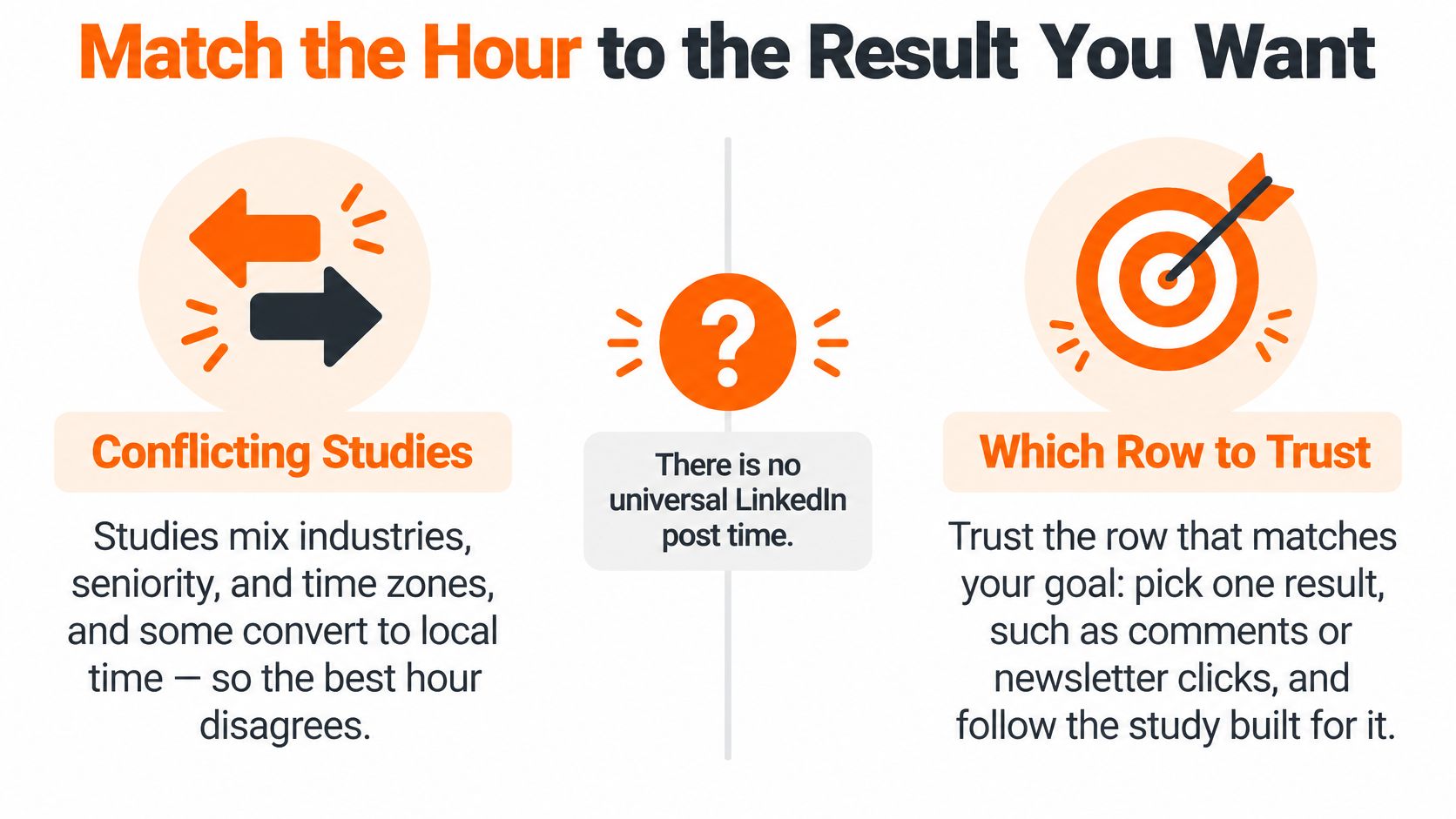
Hootsuite's comparison of the major LinkedIn timing studies says it directly: there is no universal best time, because the analyses sample different industries, seniority levels, and geographies, and only some convert results to the audience's local time. One analysis can favor weekday mornings while another favors an off-peak window. Both can describe real behavior inside different samples.
The useful lesson from the timing research is that likes and shares do not necessarily rise together. A crowded feed can produce quick reactions, while a quieter slot can give readers enough attention to pass a post along. The result you want decides which window deserves the first test.
At 8:15 a.m., the commuter train is packed with people skimming: quick reactions, low attention, plenty of thumbs. At 8:00 p.m., some of those same people are at a table with one friend and a link worth passing along. The first room produces likes. The second produces shares and subscribers, more slowly but from people who read.
Four goals, four first tests
- If you want likes, test an early weekday slot. Likes are a volume metric, and volume is easiest to earn when people are moving quickly through the feed.
- If you want comments, test the part of the morning when readers are settled at a desk and can type a reply instead of tapping and leaving.
- If you want shares, test an evening or off-peak slot. A forward to a colleague takes a slower moment than a reaction does.
- If you want profile visits or newsletter clicks, test the midweek work block. A reader already in a working mindset is more likely to treat a subscribe page as a work-shaped action.
Geography can reorder that list. If your followers sit across North America, Europe, and Asia, your morning is somebody's midnight. Pick the zone that contains the people most able to produce the goal you chose, then tighten the post itself with these LinkedIn posting best practices. A strong hook still cannot rescue a post that lands while the right readers are asleep.
Before you schedule anything, write the metric you are trying to move this month at the top of your test sheet. If that line is blank, the hour cannot help you, because you have no way to tell whether the window won.
How to Read Your Own Best Hour
The big studies get you a shortlist. Only your account picks the winner, and the reading takes about twenty minutes a week once you set it up.
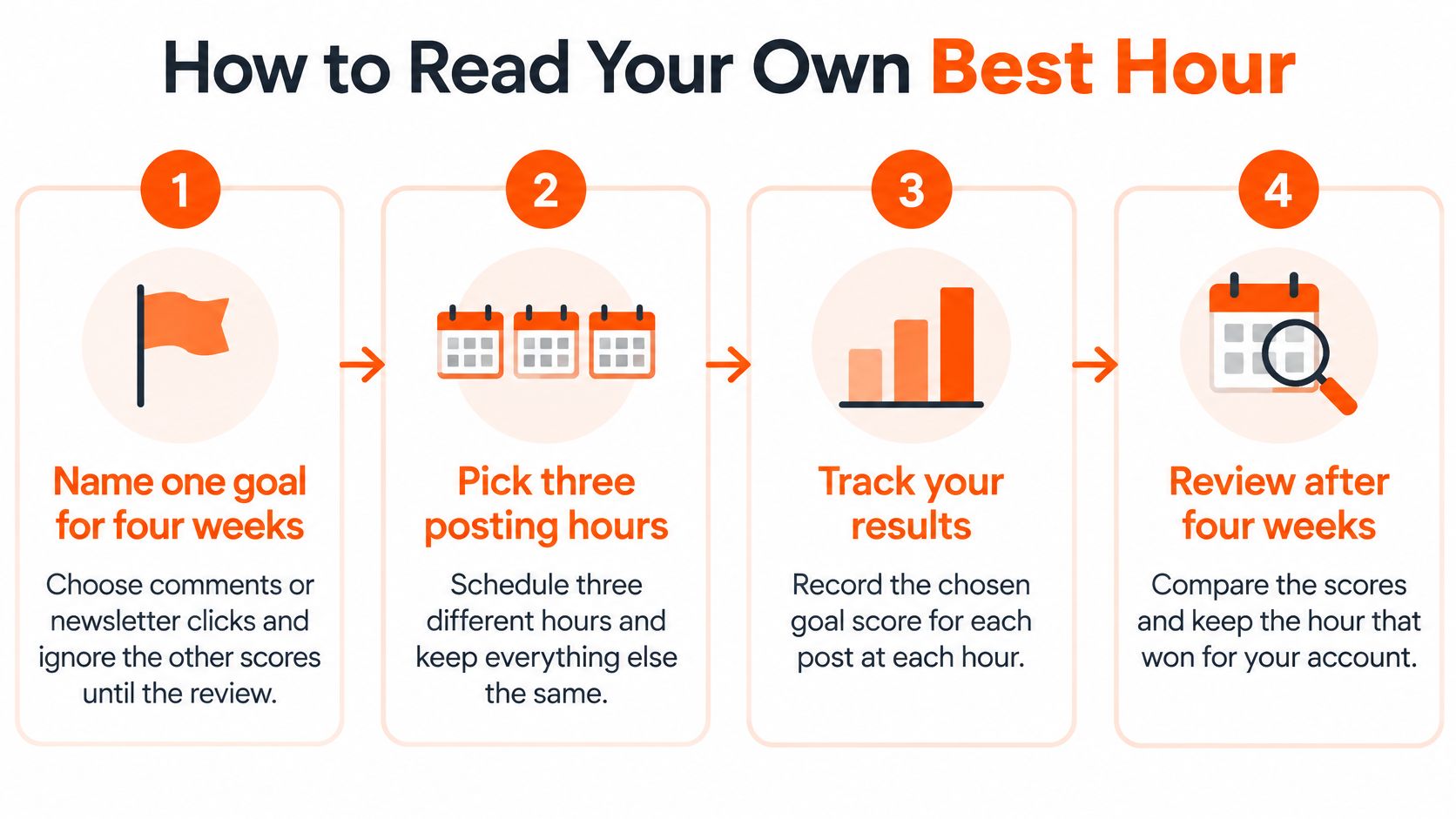
Here's the loop I run, with the metric each step exists to protect.
- Name one goal for four weeks. Comments, or newsletter clicks, or profile visits. Not all three. This protects your judgment from noise, because a window that wins on likes and loses on clicks will confuse you into keeping both.
- Pick three weekday windows inside the band. Tuesday 8:00 a.m., Wednesday 12:00 p.m., Thursday 3:00 p.m., all converted to your audience's local time. This protects comparability, since three windows is enough to see a pattern and few enough to keep the test short.
- Publish one comparable post per window each week. Similar length, one clear point, same format family. This protects you from topic quality swamping the clock, which is the single most common way these tests fail.
- Record impressions and members reached as separate numbers. LinkedIn defines impressions as the number of times a post was shown, and members reached as the estimated number of distinct members or Pages that saw it, so repeat displays don't inflate the second figure (LinkedIn's post analytics help page). This protects you from mistaking repeat views from the same small circle for a bigger audience.
- Open the demographics and check who arrived. LinkedIn surfaces demographic information alongside post analytics, so you can see whether the extra reach is the profession or seniority you write for. This protects against winning the wrong room.
- Read the follower split on the combined view. Impressions from people who follow or connect with you get counted separately from impressions from people who don't. This protects against a window that only recirculates your existing audience while looking like growth.
- Keep the winner and rerun it for two more weeks before you call it yours. This protects against a lucky post. Four weeks of a stable pattern is a finding, two posts is a coincidence.
Compare posts at the same age when you do the review, or the newest post will always look like the loser.
If you'd rather watch the review before you build it, this walkthrough covers the same loop in about the time it takes to schedule a post.
You finish this with a three-row log and a decision, not a borrowed Tuesday rule. When you want to go deeper on which numbers deserve your attention, the guide to LinkedIn engagement metrics covers what each one measures.
A 30-Day Timing Scorecard
Run the month like a test, not a diary. Week 1 keeps your current habit as the control, including the late-evening posting you already do, so you have a baseline to compare against rather than a vague memory of how things used to go.
Week 2 rotates to the first candidate window, Tuesday 8:00 a.m. in your audience's local time. Week 3 moves to Wednesday 12:00 p.m. Week 4 takes Thursday 3:00 p.m. Use posts of similar length with one clear point each. A long carousel and a two-line question measure different things, and mixing them means you end up comparing formats instead of hours.
Log every post at the same age, say 72 hours after publishing, and freeze the number at that point. LinkedIn's combined post analytics let you evaluate your content over a selectable period from the previous 7 days to 365 days and compare using either impressions or engagements (LinkedIn's combined analytics guide). Keep the review window identical for all four weeks or the comparison collapses.
| Week | Window | What you log at 72 hours |
|---|---|---|
| Week 1 | Late evening control, the habit you already have | Impressions, members reached, reactions, comments, link clicks |
| Week 2 | Window A, Tuesday 8:00 a.m. audience local | Same five fields, same post length, same format family |
| Week 3 | Window B, Wednesday 12:00 p.m. | Same five fields, no changes to the topic mix |
| Week 4 | Window C, Thursday 3:00 p.m. | Same five fields, plus the follower split |
The three signals worth watching
Members reached falling well below impressions means the same post is circulating inside a small circle. That is a reach problem, not a timing win, and no window fixes it on its own.
The out-of-network share of impressions rising as the schedule repeats is the signal you want. It means distribution is pushing past your current followers, which is what a better hour is supposed to buy you.
Comments and link clicks climbing in a window while instant likes stay flat tells you the post found the right readers, even without a first-hour reaction spike. A window that produces slower but deeper responses often beats one that spikes and dies.
Weekend posts stay in the control set only if you want your own proof that they underperform. Otherwise drop them and spend the month on weekdays, where the candidate windows live. Fill the scorecard with your real numbers, and leave any cell empty until that post has been reviewed. A guess in the table is worse than a blank.
For a repeatable way to read the results across formats, this guide to analyzing content performance walks through the same fields.
When the Next Post Should Wait
The next post isn't a calendar question. It's a decision about the post you already published, and there are only three answers.
- Still compounding. Impressions and comments are climbing. Leave it alone. A second post now competes with your own for the same readers and splits the attention you just earned.
- Flat but useful. The idea landed but stopped moving. Repurpose the angle instead of repeating it, into a follow-up, a Note, or a longer piece that gives the point room.
- Flat and ignored. Change the subject before you change the hour. Moving a dead idea from Thursday afternoon to Tuesday morning buys you nothing but a second disappointment.
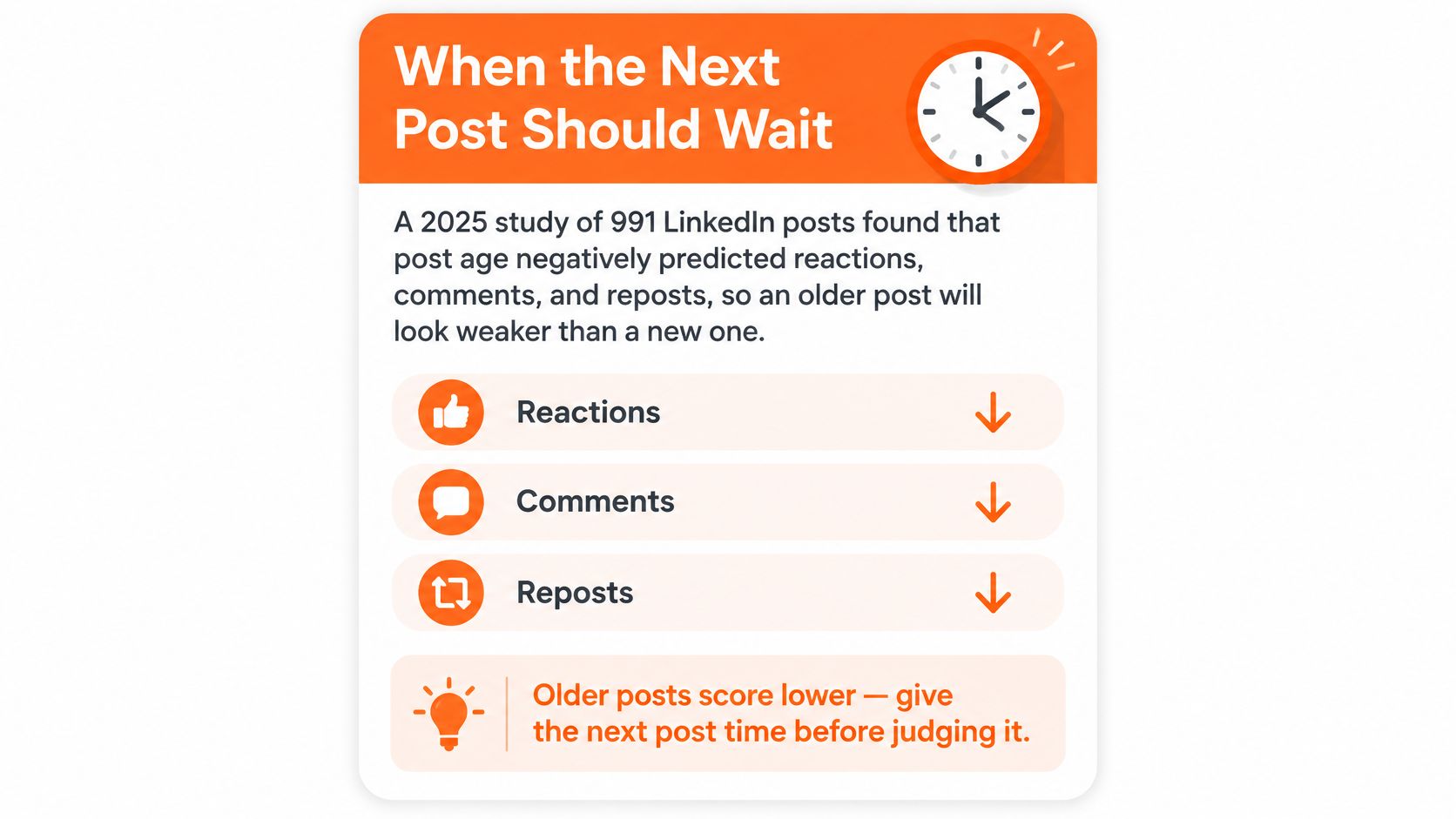
A 2025 peer-reviewed study analyzed a random sample of 991 LinkedIn posts using negative-binomial regression and found that post age negatively predicted reactions, comments, and reposts, so an older post should never be compared casually with a newer one that has had less exposure (the study in SAGE). That single finding undermines most same-day verdicts. The study also found that tags and hashtags significantly increased expected reactions, tags substantially increased comments, and follower count carried a smaller positive association than is often assumed.
The usual spacing advice is a gap of roughly 12 to 24 hours between posts, as Adobe's guidance on LinkedIn timing sets out. Treat that as a floor for frequency rather than a rule about when a post is done. The gap tells you when you're allowed to publish. The curve tells you whether you should.
A post with a modest like count and a heavy share count is usually the one worth expanding. Shares move the idea further than a stack of quick reactions ever will.
For a newsletter writer, the useful trailing signal sits outside the post itself. Watch profile visits and link clicks for a full day before you decide the idea deserves a follow-up. If the clicks are still arriving, the post is still working, and your next move is to give it more surface area rather than to change the subject.
A fixed content calendar hurts most at this point. A three-a-week schedule that ignores whether Tuesday's post is still climbing will bury your best material under your newest material. If you want a cadence that leaves room for that judgment, this piece on how to post on LinkedIn three times per week sets out a rhythm that doesn't treat the clock as the boss.
Lock the Window and Grow From There
Once a window has won twice, stop testing it and start filling it. Batch next week's posts into that slot, then stagger the Substack Notes so a Note doesn't land while your LinkedIn audience is reading the post. Narrareach handles that handoff directly, scheduling the LinkedIn post at its tested local time and the Notes on their own clock, which is why writers report that the scheduling value shows up quickly once they batch content.
The compounding effect is real, and it isn't about posting more. A Substack writer using Narrareach now schedules a week of Notes in 15 minutes and moved from 2 posts a week to 7. A LinkedIn writer says cross-posting no longer takes their morning, and their Notes go out on time with no effort. Neither of them found a better hour. They removed the friction that was eating the hour they already had.
Practical rule: the window you keep is worth more than the window you find. One tested slot, filled every week for a quarter, beats five experiments you never finished.
If you're not ready for another tool, save the weekday table and the scorecard from this article and rerun the three-window test next month, on your own numbers. Two full cycles will tell you more about your account than any benchmark ever could, and you'll know which hour to protect before you spend a dollar on scheduling anything. Nothing here asks you to post more often than the idea deserves.
Whichever path you take, the sequencing guide on how to schedule posts on LinkedIn covers the mechanics of holding a slot once you've found it.
If you want the tested hour to become a system rather than a note in your phone, Narrareach schedules your LinkedIn posts and Substack Notes from one queue, fits each version to its platform in your own voice, and shows you which window moved subscribers. Draft once, place the post in the local window that won your test, and let the Notes and longer pieces go out on their own schedule. Start free at Narrareach, no credit card needed, and run the next 30 days with the data on your side.