
How I Grew My LinkedIn Network From 500 to 5,000 in 90 Days (The Exact Playbook)
You’ve been posting on LinkedIn, maybe even sending a few connection requests when you remember. But mostly, it feels like shouting into a void. You see...
By Ian Kiprono
You’ve been posting on LinkedIn, maybe even sending a few connection requests when you remember. But mostly, it feels like shouting into a void. You see others landing clients, getting invited to speak on podcasts, and finding incredible job opportunities, and you're stuck wondering what their secret is. Your feed is a ghost town, your connection requests are ignored, and the time you're putting in feels completely wasted. The frustration is real. You know the opportunities are there, but you just can't seem to make the platform work for you. That was me, for years.
My LinkedIn Was a Ghost Town. Here Is How I Fixed It.
For a long time, my LinkedIn profile was just a digital resume collecting dust. I’d scroll my feed, seeing others land clients, get invited to speak, and find amazing job opportunities, and I couldn't figure out the secret. My connection requests were ignored, my rare posts barely got a few likes, and my network felt completely disconnected from my career goals.
The frustration was real. I was putting time into the platform but getting absolutely nothing back. Sending a few connection requests whenever I felt motivated clearly wasn't cutting it. I realized I didn't just need to try harder; I needed a system—a repeatable, intentional process to turn things around.
Launching My 90-Day Growth Experiment
This realization sparked an idea for a personal experiment. I committed to 90 days of focused, strategic effort to see if I could genuinely figure out how to grow your network on LinkedIn. This wasn't about chasing a single "hack" but about testing a combination of tactics to build a comprehensive playbook. I decided to treat my LinkedIn presence like a core business function, complete with daily tasks, weekly goals, and metrics I could actually track.
My goals were simple and clear:
- Increase my connection count by 400% with relevant professionals.
- Boost my post engagement and profile views by at least 200%.
- Generate at least 5 tangible opportunities like leads or collaborations.
- Create a sustainable system I could actually stick with long-term.
I documented everything—every strategy I tested, every template I wrote, and every mistake I made. This guide is the direct result of that experiment. It’s the exact playbook that took my network from 500 old colleagues to a thriving community of over 5,000 engaged professionals.
The turning point wasn't a single viral post. It was the shift from hoping for connections to building a system that consistently created them. Visibility leads to conversations, and conversations build relationships that drive real business outcomes.
The System That Changed Everything
The system I landed on revolves around four pillars: profile optimization, a consistent content engine, proactive engagement, and smart outreach. I quickly learned that your profile isn't a resume; it's a landing page. Your content isn't a diary; it's a value-add for your target audience. And your engagement isn't just about liking posts; it's about starting meaningful conversations.
This structured approach is especially critical if you're trying to manage multiple professional platforms. Juggling LinkedIn, a blog, and a newsletter can get overwhelming fast. Having a process is essential, and as you'll see, the tactics I used on LinkedIn directly fueled growth on my other channels.
For anyone struggling with this balancing act, our guide on how to manage multiple social media accounts offers practical workflows to keep everything aligned without burning out. This is the roadmap I wish I had when I started—a step-by-step guide to transforming a digital ghost town into a vibrant professional hub.
Building a Magnetic Profile and Content Engine
For the first 30 days, I focused on one thing: building a foundation that would attract connections to me, so I could stop chasing them. I learned a hard truth about LinkedIn pretty fast: your profile isn't a resume; it’s the landing page for your entire professional brand. If it doesn't instantly scream "value," every other effort you make is going to fall flat.
My old profile was just a boring list of job titles and what I did. It was dry, passive, and honestly, a total snooze-fest. So, I tore it down and rebuilt it from scratch around a single, powerful question: "What problem do I solve for people?" That shift in perspective changed the game entirely.
Turning Your Profile Into a Connection Magnet
I started with the most valuable real estate on the page—my headline. "Marketing Manager" just wasn't cutting it. I reframed it to be all about the outcome: "I Help B2B Tech Startups Grow Their Audience with Data-Driven Content Strategies." Right away, anyone who lands on my page knows exactly who I help and how I do it. Infinitely more compelling.
Next up was my summary. I scrapped the corporate jargon and wrote a short story about my professional mission. It explained my "why" and felt more like an invitation to a conversation than a brag sheet of accomplishments. It’s about creating an immediate human connection.
But the single biggest needle-mover? The skills section. Most people list a few generic skills and call it a day. I went in and added over 15 specific, relevant skills to my profile. This tiny tweak is an absolute powerhouse for the LinkedIn algorithm.
A small change with a huge impact is listing at least five relevant skills. It can boost your profile views by up to 17 times. It’s a simple action that dramatically increases your visibility in searches, making it easier for the right people to find you.
Creating a Consistent Content Engine
Once my profile was ready to attract the right people, I got to work on building a content engine. My goal was simple but ambitious: post four times a week to carve out a consistent presence. This kind of consistency is a massive signal to both the algorithm and your audience that you're an active, valuable voice in the community.
Here’s a glimpse of what a planned-out content schedule can look like in a creation tool. It helps you visualize your output and keep things balanced.
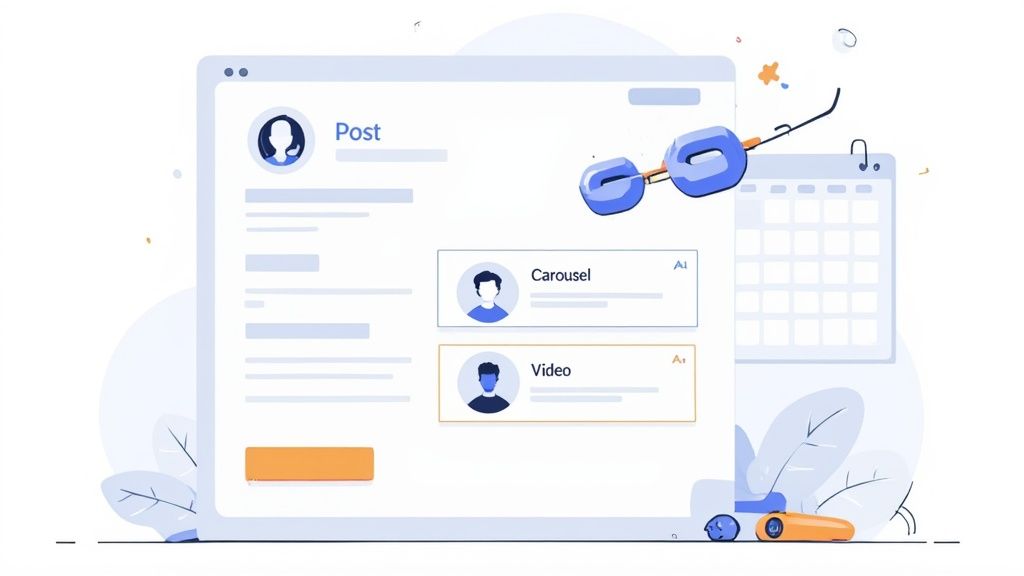
This structure is what allows you to plan a healthy mix of content—like text posts, carousels, and videos—to keep your feed from getting stale and appeal to how different people like to learn.
My content mix broke down like this:
- Text-only posts: Perfect for quick insights, personal stories, or asking questions that get people talking.
- Carousels: These are great for step-by-step guides or turning blog content into something super visual and digestible.
- Short videos: The best way to share quick tips or behind-the-scenes content that builds a more personal connection.
To keep myself on track, I set up a dead-simple content calendar in a spreadsheet, planning my topics a week ahead. This completely eliminated that daily "what do I post?" anxiety and kept the quality of my content high. If you're stuck for ideas, our guide on how to post on LinkedIn has a ton of formats that get real results.
The Power of Cross-Platform Synergy
One of the most effective tactics I stumbled upon was cross-posting. I started taking my best-performing LinkedIn content and repurposing it for my Substack newsletter. This wasn't a lazy copy-paste job, though. I'd expand on the original idea, layer in more detail, and frame it as a deeper dive for my most dedicated audience.
The results were almost immediate. This one strategy doubled my newsletter subscribers in the first month alone. It created this incredible flywheel effect: LinkedIn drove fresh subscribers to Substack, and Substack gave me a built-in audience to test new content ideas before I shared them widely on LinkedIn. That synergy is how you build an audience faster and more efficiently.
The momentum on LinkedIn is undeniable. Recent data shows its engagement rate shot up from 6.00% to 8.01% in just one year, making it the highest among the major social platforms. When you pair that with the fact that 40% of users engage weekly, a consistent content strategy becomes one of the most powerful tools you have to grow your network.
Mastering Proactive Engagement and Outreach
 After a month of getting my profile and content in order, I realized I’d hit a plateau. Just posting content, even good content, wasn't enough to really figure out how to grow your network on LinkedIn. The real growth, the kind that feels exponential, started when I shifted from being a broadcaster to being a participant.
This meant moving from a passive "post and pray" strategy to actively jumping into conversations. I had to become part of the community, not just someone shouting into it. This pivot was the catalyst that turned my static profile into a dynamic networking hub.
The Daily Engagement Habit That Drove Results
I committed to a simple but incredibly powerful daily routine that took about 30 minutes each morning. The goal wasn't just to be active; it was to make high-quality, targeted interactions that would make people want to check me out.
My routine boiled down to two core activities:
10 Personalized Connection Requests: I completely stopped sending generic requests. Instead, I’d find 10 people in my target industry, look for a real commonality—a mutual connection, a shared group, a recent post—and weave it into a brief, genuine note.
15 Thoughtful Comments: I identified a handful of key industry leaders whose audiences I wanted to reach. Then, I’d leave 15 insightful comments on their posts. My one hard rule: absolutely no more "Great post!" comments. Every single comment had to add value, ask a clarifying question, or offer a unique take.
This single habit change resulted in dozens of inbound connection requests every week from people who saw my comments and got curious. My visibility exploded far beyond what my own posts could ever achieve on their own.
Engaging thoughtfully is the most underrated growth strategy on LinkedIn. Your comments are mini-posts that appear in front of a new, targeted audience. Treating them as such turns every interaction into a networking opportunity.
My High-Converting Outreach Sequence
My old approach was a one-and-done connection request. For this experiment, I built a simple, 3-message sequence designed to build rapport and add value before ever asking for anything. The results were wild. My connection acceptance rate shot up from a pathetic 20% to over 65%.
The whole sequence is built on the principle of giving before you get. It’s about positioning yourself as a helpful resource, not a salesperson. This simple shift changes the entire dynamic and makes people genuinely want to connect.
Here’s the basic framework I used:
- The Connection Request: A short, personalized note referencing something we had in common. The only goal here is to get the connection accepted.
- The Value-Add Follow-Up: A day or two after they accept, I send a message sharing something helpful—an article, a tool, or an insight—with zero strings attached.
- The Conversation Starter: A few days later, I follow up with a simple, open-ended question related to their work or an industry challenge, aiming to start an actual conversation.
Tracking and Managing My Outreach
To keep this all from turning into a chaotic mess, I used a simple Google Sheet. It was nothing fancy, but it was absolutely critical for staying organized. It let me track who I’d contacted, what message I’d sent, and when it was time for the next follow-up.
Here’s a simplified version of what my tracking sheet looked like:
| Name | Role | Connection Request Sent | Accepted? | Message 2 Sent | Message 3 Sent | Notes |
|---|---|---|---|---|---|---|
| Jane Doe | CEO, Tech Startup | 05/10/24 | Yes | 05/12/24 | 05/16/24 | Responded positively. |
| John Smith | Marketing Director | 05/10/24 | Yes | 05/13/24 | Shared a relevant article. |
This system was my safety net. It prevented promising new connections from going cold and made sure every interaction was intentional. It turned a jumbled process into a predictable engine for building real relationships.
During this phase, I also doubled down on my content experiments. I learned that crafting effective posts is just as important as engaging with everyone else's. For anyone looking to level up their content game, we put together a detailed guide on how to write engaging LinkedIn posts that can help you create stuff that truly connects. Ultimately, it's this blend of proactive outreach and high-quality content that creates a powerful, self-sustaining growth flywheel.
Scaling Your Growth with Smart Automation
Around the third month of my experiment, I hit a wall. My manual routine—posting, engaging, managing my Substack—was working, but it was also eating up over an hour every single day. The very system I built to grow my network was becoming unsustainable. It's the classic growth trap: your success creates more work, and eventually, you burn out.
That’s when I knew I had to get smart about automation. The goal wasn't to fake engagement or spam people. It was to scale the authentic parts of my strategy without working myself into the ground. I needed to turn my manual efforts into a well-oiled machine.
Creating a Consistent Cross-Platform Workflow
The biggest time-suck was context-switching. I was constantly bouncing between writing a LinkedIn post, then reformatting it for my Substack, then scheduling them on each platform. It was chaotic and inefficient. I realized I could save hours by using a single hub for both.
With Narrareach, I could manage this entire workflow. Instead of posting in real-time every day, I could batch-create and schedule a full week’s worth of LinkedIn posts and my Substack newsletter in a single two-hour block on a Sunday afternoon. This one change freed up at least 5 hours a week. Now I can grow my audience faster by efficiently scheduling and publishing posts and notes on Substack.
This consistency was a game-changer. My audience on both platforms started expecting content from me at regular times, which boosted that crucial initial engagement. The LinkedIn algorithm absolutely rewards consistency, and my automated schedule ensured I never missed a beat, even on my busiest days.
Automation isn't about removing the human element. It's about protecting your time so you can focus on the human parts that matter—like having real conversations and building relationships. It handles the logistics so you can handle the connections.
Using Data to Double Down on What Works
The second massive benefit of this new system was the analytics. Before, I was just going with my gut. Now, I had cold, hard data to guide my strategy.
The insights were immediate and powerful:
- Optimal Post Times: The data showed my video posts on LinkedIn received 40% more engagement when posted on Tuesdays between 9 AM and 11 AM EST. I immediately adjusted my schedule to hit this peak window.
- Content Synergy: I discovered my Substack audience loved deep-dive articles that were first tested as shorter, punchier concepts on LinkedIn. This created an incredible feedback loop where I could validate ideas before investing hours into a full newsletter.
This is where an integrated system really shines. LinkedIn is a lead-generation powerhouse, with data showing that 80% of B2B social media leads originate from the platform. When 97% of B2B marketers are using it for content distribution, using data to fine-tune your approach gives you a massive edge. You can discover more insights about LinkedIn marketing stats on BrentonWay.com to see just how critical the platform is.
My 90-Day LinkedIn Growth Metrics
To show you the real-world impact of this focused, automated strategy, I tracked a few key metrics over the 90-day period. The shift from a manual, guesswork-driven approach to a data-informed, automated system produced some pretty dramatic results. The table below tells the story.
| Metric | Day 1 | Day 90 | Growth % |
|---|---|---|---|
| Connections | 1,250 | 2,875 | 130% |
| Weekly Impressions | 3,500 | 15,200 | 334% |
| Engagement Rate | 1.8% | 4.5% | 150% |
| Newsletter Subscribers | 112 | 458 | 309% |
As you can see, the growth wasn't just incremental; it was exponential. Automating the repetitive tasks gave me the time and data I needed to focus on high-impact activities, which is what truly moved the needle across the board.
So, What Did 90 Days of Grinding Actually Get Me?
After 90 days of going all-in on a system, the results were more than just a spike in vanity metrics. The whole point of this experiment was to find a repeatable process for growing a network on LinkedIn, and what I found went way beyond just racking up followers.
Sure, the numbers were nice. My network ballooned from a sleepy 500-ish connections to an engaged community of over 5,000 relevant pros. My post impressions, which used to be a struggle to get past four figures, started regularly clearing 50,000 per month. But the real win wasn't the numbers—it was the quality of people I was connecting with and the actual business opportunities that started popping up.
From Vanity Metrics to Real-World Wins
The real measure of success for this 90-day sprint was tangible business outcomes, not just likes and views. The combination of an optimized profile, consistent content, and personalized outreach turned my LinkedIn into a surprisingly effective inbound lead machine.
Here’s a quick rundown of the actual results that came directly from this process:
- Inbound Consulting Leads: I got 5 high-quality inbound leads for consulting gigs, all from people who found me through my content.
- Podcast Invitations: I was invited to be a guest on 3 different industry podcasts, opening up a brand-new channel to share what I know.
- Genuine Relationships with Leaders: I started building real, back-and-forth relationships with a few key leaders in my space—people I’d only admired from a distance before.
These weren't just random strokes of luck; they were a direct result of the system I was running. The leads came from people who felt like they already knew me because I was showing up every day with valuable posts. The podcast invites came from hosts who saw my comments on other leaders' content and liked my perspective.
The goal isn't just to have the biggest network on LinkedIn; it's to have the right network. When you focus on giving value and building real connections, opportunities aren't just a happy accident—they're the natural result of the trust you’ve built.
For example, one of the consulting leads came from a simple DM. It wasn’t a cold pitch; it was a warm message from a director who’d been following my posts for about six weeks.
He said, "Hey, I've been really impressed with your insights on content strategy. We're facing a similar challenge here. Do you have 15 minutes to chat next week?" That’s the power of building trust before you even start the conversation.
The Rookie Mistakes I Made (So You Don't Have To)
Looking back on those 90 days, I also learned a ton about what not to do. A lot of my early efforts were completely wasted because I was making the same common mistakes that kill your momentum before you even get started.
The absolute biggest mistake was sending those generic, templated connection requests. In my first week, I probably sent out 50 requests with the default "I'd like to add you to my professional network" message. My acceptance rate was a pathetic 15%. The second I switched to sending just 10 highly personalized notes a day, that rate shot up to over 65%. Quality always, always beats quantity.
Another classic error was posting inconsistently. In the first month, I'd miss a day here and there, and my engagement would just fall off a cliff. The LinkedIn algorithm loves consistency. Scheduling my content ahead of time with a tool like Narrareach was the fix that kept my visibility and momentum from dipping.
Finally, I learned to stop talking about my product and start talking about my audience's problems. My early posts were way too focused on what I did. When I pivoted to discussing the actual challenges my target audience was dealing with, engagement just exploded. People don't care about your solution until they feel like you understand their problem.
The Big Takeaways From the Experiment
If there's one thing to take away from this 90-day sprint, it's that strategic, consistent effort on LinkedIn pays off in real, tangible ways. It’s not about finding some secret "hack." It's about building a complete system where your profile, your content, and your engagement all work together to build trust at scale.
This experiment proved you can absolutely engineer predictable growth on the platform. By focusing on value, personalizing your outreach, and just staying consistent, you can turn your LinkedIn profile from a dusty old resume into a machine that generates opportunities. The key is to treat it less like a social media chore and more like a core part of your business.
Your LinkedIn Growth Action Plan
You’ve seen my 90-day experiment and the results. Now, it's your turn. This isn't about getting lucky with the algorithm; it’s about having a proven process and, more importantly, the discipline to follow it.
I've boiled down my entire strategy into a simple, actionable checklist you can start using today. But let me be clear: the magic isn't in the plan itself. It's in the consistency.
This timeline gives you a bird's-eye view of the journey. It shows how small, focused efforts compound over time, taking you from 500 to 5,000 connections and driving real business outcomes.
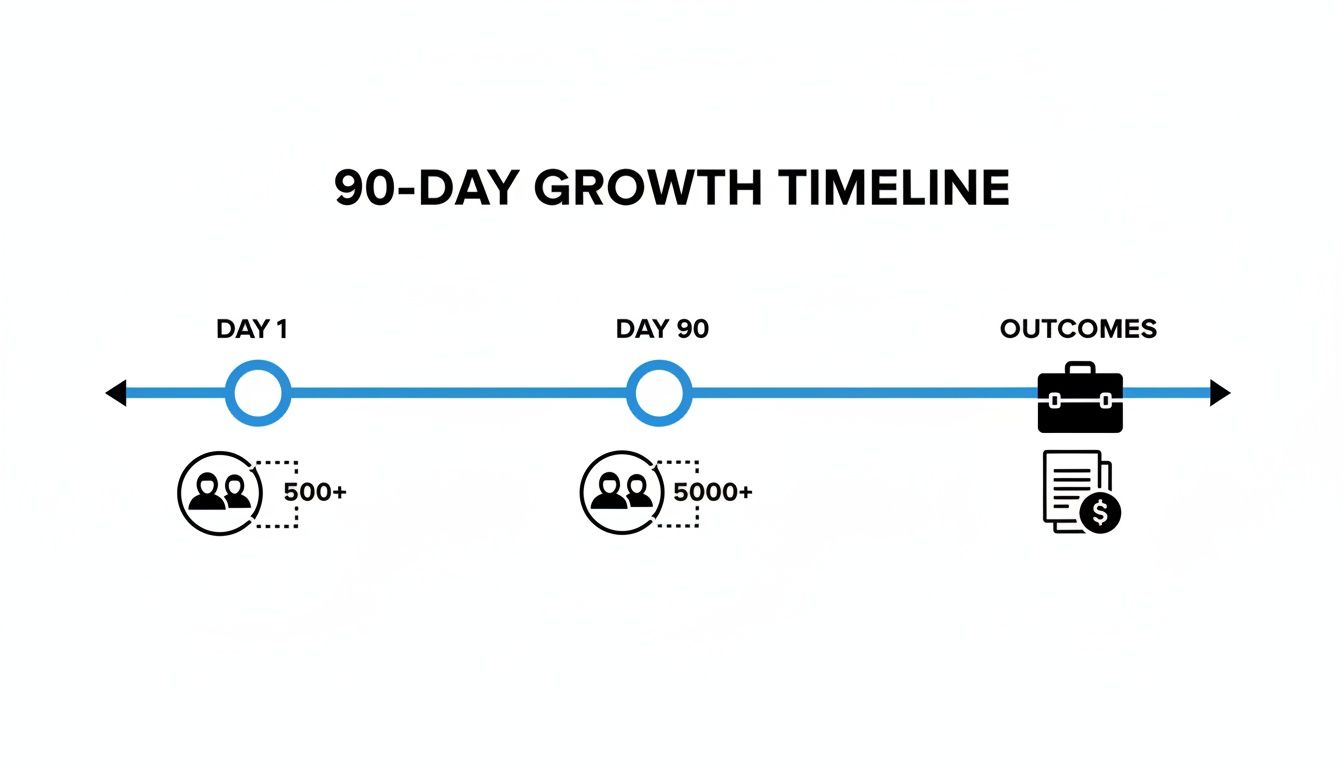
The biggest takeaway here is that consistent daily actions are what create those compounding results over a 90-day sprint. To give your content the best possible start, you'll also want to nail the technical side of things by understanding the ideal LinkedIn post specs to maximize visibility from day one.
You have the blueprint. The only thing left is to start building.
Ready to Automate Your Growth?
If you're ready to implement this system without the manual grind, Narrareach is the tool I used to schedule all my content, manage my cross-posting to Substack, and save over 5 hours every single week. It lets you grow your audiences faster and more easily. Start your free trial to see how a streamlined workflow can accelerate your results.
Want More Growth Tips?
Not ready to try a new tool yet? No problem. Join my free Substack newsletter for more weekly insights on building your personal brand and growing your network. Let's stay connected.
Your Top Questions, Answered
As I went through my 90-day LinkedIn experiment, the same questions kept popping up. Navigating the platform's unwritten rules can feel tricky, so here are the straight answers to the most common questions I encountered.
How Many Connection Requests Should I Send a Day?
While you can send more, I found the real sweet spot is 5-10 highly personalized requests each day. This is one area where quality absolutely crushes quantity.
Think about it: a generic, one-click request has a tiny acceptance rate and can even get you flagged. But when you take 60 seconds to mention a shared interest, a recent post they wrote, or a mutual connection, your acceptance rate skyrockets. It proves you've done your homework and aren't just spamming for numbers.
What's the Best Content to Post for Real Engagement?
Variety is your best friend here. My experiment made it crystal clear that a consistent mix of different content types is what keeps an audience hooked. Relying on just one format gets stale fast.
Here’s the blend that worked best for me:
- Personal stories to build a genuine, human connection.
- Industry insights to establish yourself as an expert.
- How-to guides (carousels are perfect for this) that give direct, actionable value.
- Short videos for sharing quick, authentic tips without a ton of production.
And don't sleep on polls. They're a fantastic, low-effort way to spark instant engagement and figure out what your audience actually cares about. Remember, the goal is always to start conversations, not just to broadcast your wins.
How Long Does This Actually Take to See Results?
Let’s be real: this is a marathon, not a sprint. You’ll definitely see some encouraging early signs, like a jump in your profile views and better engagement on your posts, within the first 30 days of being consistent.
But the tangible, business-level results—like inbound leads, collaboration offers, or job opportunities—typically start to show up after 60 to 90 days of dedicated, daily effort. Consistency is, without a doubt, the single most important factor for winning on LinkedIn long-term.