
How I Gained 257+ Relevant LinkedIn Connections in 30 Days (My Exact Playbook)
Does your LinkedIn connection count feel stuck? You post once in a blue moon, accept a few random requests, and maybe toss out a generic invite here and...
By Ian Kiprono
Does your LinkedIn connection count feel stuck? You post once in a blue moon, accept a few random requests, and maybe toss out a generic invite here and there, but the needle never moves. Your engagement is dead, your new connections feel totally irrelevant, and your feed looks more like a ghost town than a professional hub. It feels like you're shouting into the void, with your profile views flatlining and your content getting maybe a dozen likes from the same handful of people. You know it's a goldmine, but you just can't seem to crack the code.
The Stagnant LinkedIn Profile Problem We All Face
That was my exact situation. My LinkedIn presence was a liability, not an asset. It wasn't sparking conversations, generating leads, or opening any doors. It was just… there. I knew LinkedIn was a goldmine for clients, career moves, and partnerships. Yet it felt like everyone else had the map and you’re just wandering around in the dark.
This was my exact situation. I was tired of having a passive network that did nothing for me. It felt like I was shouting into the void, with my profile views flatlining and my content getting maybe a dozen likes from the same handful of people.
My Breaking Point and the 30-Day Experiment
The moment of truth came when I realized my LinkedIn presence was a liability, not an asset. It wasn't sparking conversations, generating leads, or opening any doors. It was just… there. So, I decided to run a personal 30-day experiment to see if a dedicated, strategic approach could finally make a difference.
I committed to a structured plan with some clear, no-fluff goals:
- Add at least 200 relevant connections.
- Boost my profile views by over 50%.
- Start 10 meaningful conversations with people in my target industry.
This wasn’t about vanity metrics. This was about building a network that could deliver tangible results. I wanted to figure out how to grow my LinkedIn network in a way that felt authentic and sustainable, not like another chore on my to-do list.
The whole idea was to create a system I could manage alongside a packed schedule—a challenge many of us face. Juggling multiple platforms requires the same discipline as learning how to manage multiple social media accounts without completely burning out.
My hypothesis was simple: Consistent, intentional action would outperform passive, sporadic activity every single time. It was time to put it to the test.
This is the story of what happened when I stopped hoping for growth and started systematically building it. In the next sections, I’m laying out the exact playbook I used, the message templates that actually got replies, and the surprising results that turned my stagnant profile into a dynamic networking engine.
My 30-Day LinkedIn Growth Experiment: The Ground Rules
Jumping onto LinkedIn without a plan is like shouting into the wind. Random activity gets you random results, and I was tired of guessing. My goal wasn't just to bloat my connection count; it was to build a relevant network that would actually lead to something tangible—more profile views, better engagement, and real conversations.
So, I set one simple, non-negotiable rule: 30 minutes every single day dedicated to nothing but LinkedIn growth. This time-boxed approach kept the experiment from swallowing my entire schedule and forced me to be incredibly focused.
Defining My Battlefield
First things first: who was I actually trying to connect with? Sending a blast of generic requests is a fast track to a noisy, useless feed. I got specific and narrowed my focus down to three professional profiles—people who would genuinely benefit from my insights and vice-versa.
Next, I needed to figure out what I was going to talk about. To keep my content consistent and relevant, I built my strategy around three core content pillars:
- Actionable Growth Tactics: Sharing the specific, real-world strategies I was using myself.
- Behind-the-Scenes Learnings: Documenting the messy middle—the failures and lessons from my own business journey.
- Industry Commentary: Offering a unique take on current trends and news.
This structure helped me stay on message and attract the right kind of people. If you're building out your own pillars, our guide on how to post on LinkedIn is a fantastic starting point.
This simple process is what took me from feeling stuck to seeing actual, measurable growth.
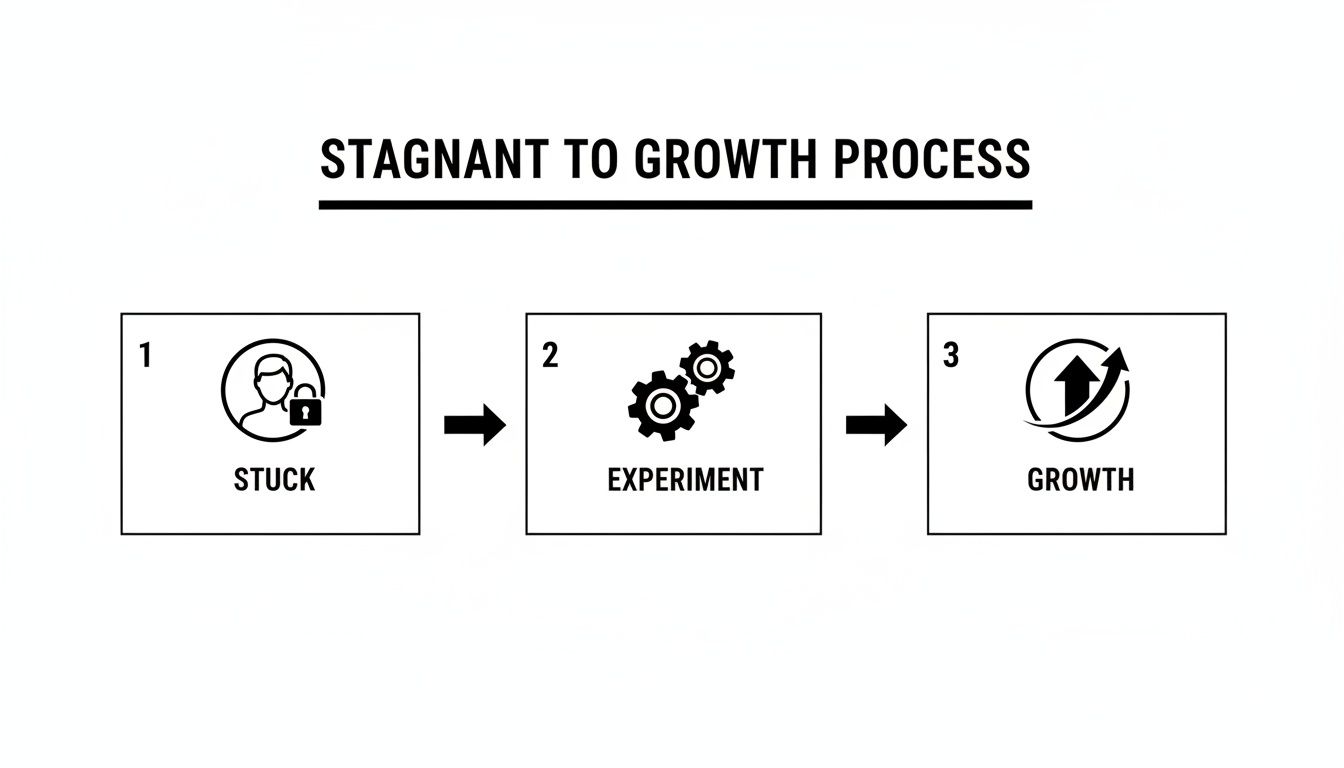
As you can see, growth isn't a single event. It’s a loop that starts by admitting something isn't working, committing to an experiment, and then showing up every day to execute.
Setting Measurable Goals and Tracking Progress
To keep myself honest, I knew I needed to track my progress. Vague goals like "get more connections" are useless. I needed hard numbers to tell me if what I was doing was actually working.
And let's be clear, the opportunity here is massive. The pool of potential connections is constantly expanding. Between 2019 and 2025, LinkedIn’s global user base swelled from around 644 million to over 1.1 billion users. That’s a nearly 65% increase, which means proactive, targeted outreach is more effective than ever simply because the number of professionals you can reach has exploded. You can explore detailed LinkedIn statistics on Cognism.com to see the full picture.
To keep things simple and actionable, I created a small spreadsheet to track the Key Performance Indicators (KPIs) that mattered most for this experiment.
My 30-Day LinkedIn Growth Experiment KPIs
This table breaks down the key performance indicators I tracked daily and weekly to measure the success of my experiment. It turned abstract goals into concrete targets.
| Metric | Starting Benchmark (Day 0) | Goal (Day 30) | Tracking Frequency |
|---|---|---|---|
| New Relevant Connections | 0 / day | 7 / day | Daily |
| Profile Views | 112 / week | 50% increase | Weekly |
| Post Engagement Rate | 1.8% average | 3.5% average | Weekly |
| Meaningful DM Conversations | 1-2 / week | 10 new conversations / week | Weekly |
This wasn't about complex analytics; it was about having a clear scoreboard. Seeing these numbers tick up, even slowly, was the fuel that kept me going.
I tracked everything daily in a Google Sheet. This simple act of measurement was the single most important factor in keeping me consistent. Seeing the numbers tick up, even slowly, provided the motivation to keep going.
This blueprint gave my 30-day sprint the structure it needed to succeed. It wasn't about a magic bullet; it was about defining the target, setting the rules, and showing up. With this foundation in place, I was ready to dive in.
Weeks 1-2: Igniting the Content and Engagement Flywheel
With a polished profile and clear goals, it was time to get to work. The first two weeks were all about building momentum—the kind that separates the people who succeed on LinkedIn from those who don't. The mission was simple but tough: create a consistent, unbreakable habit of both creating content and engaging with others.
This is the exact point where most people give up. They'll post once, get a few likes, feel good about it, and then disappear for a month. That doesn't work.
My entire strategy was built around kickstarting what I call the content and engagement flywheel. The concept is straightforward: consistent content makes you visible, and smart engagement pulls new, relevant people into your orbit to see that content. Each action feeds the other, creating a self-sustaining growth loop.
My Initial Content Strategy: What Worked and What Flopped
To get things rolling, I committed to posting three times per week. I knew trying to post daily right out of the gate was a recipe for burnout, so I focused on quality over sheer quantity. I wanted to test a mix of content types to see what would actually stick with the audience I was trying to build.
Here’s a quick breakdown of what I tried and the immediate results:
- Text-Only Posts: These were the surprise winner, by a long shot. My most successful post of the entire first week was a simple, 7-line story about a mistake I made early in my career. It was vulnerable and relatable, and it pulled in 12 comments and over 4,200 views.
- Image Posts: Posts with a clean graphic or a relevant photo performed okay, but they never really sparked a conversation. They were fine for sharing a quick tip but didn't build the same kind of human connection.
- Polls: I ran a single poll asking about people's biggest networking challenge. It got over 80 votes and handed me a goldmine of ideas for future content, but the overall views were lower than my text posts.
The big lesson from Week 1 was undeniable: Raw, authentic storytelling in simple text posts outperformed everything else. People on LinkedIn are hungry for genuine connection, not just polished corporate graphics.
Juggling this content mix could have easily eaten up my entire day. This is where a little bit of planning made all the difference. To make sure I never missed a post, I batched the creation of my three weekly posts every Sunday afternoon. I then used scheduling tools to queue them up in advance, which was a total game-changer. This single move freed up my daily 30-minute block to focus completely on the other, more critical side of the flywheel: engagement. It's the secret to scaling your efforts—automating the publishing lets you focus on the manual, high-impact work of building actual relationships.
The 20-Minute Strategic Commenting Routine
Just posting content and walking away is like shouting into an empty room. You're missing the most powerful growth lever on LinkedIn. My real secret weapon during these first two weeks was a daily 20-minute strategic commenting routine.
This wasn't about mindless scrolling and liking. I had a system:
- Identify 5-10 Industry Leaders: I curated a list of influential people whose audience I wanted to get in front of.
- Turn on Notifications: I flipped on post notifications for these key accounts so I'd know the second they posted.
- Leave Thoughtful Comments: When they posted, I made it my goal to be one of the first people to leave a comment that genuinely added to the conversation. No "Great post!" nonsense. I'd add a related insight, ask a thoughtful question, or share a quick personal story.
The goal was to make my comments mini-posts in their own right—valuable enough that other people would see them, react, and feel compelled to click on my profile. It worked like a charm. I saw a direct link between my commenting activity and the number of inbound connection requests I got. On days I left thoughtful comments on just three popular posts, I’d receive 5-7 new connection requests from ideal prospects.
This isn't just a hunch; the data backs it up. LinkedIn drives massive professional outcomes when activity is consistent. Industry reports show the platform attracts between 1.4 and 1.77 billion site visits in a single month. To get a piece of that action, the consensus is clear: post at least 2–5 times per week and engage daily. You can find more data-driven insights in this compilation of LinkedIn statistics.
Why the Flywheel Started Turning
By the end of the second week, the results were impossible to ignore. My profile views were up by 35%, and I had received over 60 inbound connection requests without sending a single one myself.
The flywheel effect was officially in motion:
- My content was establishing my expertise and giving people a reason to connect with me.
- My strategic comments were putting my profile in front of hundreds of relevant professionals who weren't in my network yet.
- Those new connections would then see my scheduled content, leading to more engagement, which boosted my visibility even further.
This two-pronged attack—scheduling valuable content and pairing it with daily, high-quality engagement—is the foundation for sustainable network growth. Understanding different social media content categories also helps keep your feed fresh and engaging for your growing audience. With this initial momentum building, I was ready to move into the next phase: proactive and personalized outreach.
Weeks 3-4: Scaling Outreach Without Sounding Like a Robot

The content flywheel was finally spinning. Profile views were up, and a nice, steady trickle of inbound connection requests started hitting my inbox. But I knew that to hit my 30-day goals, I couldn't just sit back and wait for people to find me. It was time to go on offense.
This is the part that makes most people freeze up, and for good reason. We’ve all gotten those awful, cringe-worthy connection requests. The default "Hi, I'd like to add you to my professional network" is just lazy. Even worse is the instant sales pitch from a total stranger.
I refused to be that person. My goal for these two weeks was simple: figure out how to send connection requests that people actually wanted to accept. I needed a system that felt human but was still scalable enough to do every day.
My 3-Step Process for Personalization That Actually Works
My entire outreach strategy boiled down to one non-negotiable rule: every single connection request must be personalized. To make this possible within my 30-minute daily time block, I created a quick, repeatable 3-step process to find a unique talking point for every single person.
- Scan Recent Activity: I’d take 60 seconds to scroll through their latest posts and comments. Did they share a cool article? Post about a project they were proud of? This was the goldmine for easy and effective personalization.
- Check the "About" Section: If they weren't very active, their "About" section was my next stop. People often drop clues about their professional mission or passions here. Referencing a specific line shows you actually took the time to read their profile.
- Find Mutual Connections or Groups: As a last resort, I'd look for a shared connection or group. Mentioning a respected colleague or a shared community is a powerful way to build instant rapport and common ground.
This whole process took maybe two to three minutes per person. It wasn't about writing a biography; it was about finding one genuine point of connection to prove I wasn't just another bot. The results were immediate.
My connection acceptance rate shot up to 73% using this method. It’s proof that spending an extra two minutes to show you’ve done your homework is the single highest-ROI activity in LinkedIn networking.
The High-Converting Connection Request Template I Used
I tinkered with a few different templates, but this simple structure was the clear winner. It's direct, respectful, and puts the focus on them, not me.
- The Opener: Start with the specific thing you found in your 3-step research.
- The Bridge: Briefly explain why that point resonated with you.
- The Ask: A simple, no-pressure request to connect.
Here’s a real request I sent to a marketing director:
"Hi Sarah, I saw your recent post on the challenges of content attribution and it really hit home. Your point about tying blog posts to pipeline is something my team has been focused on. Would love to connect and follow your insights on the topic."
It’s short, it’s specific, and it gives a real reason for connecting. This is the difference between building a network and just collecting contacts.
The right message makes all the difference. It's easy to fall into lazy, generic habits, but a little personalization goes a long way. Here’s a quick comparison of what separates a request that gets ignored from one that gets accepted.
Effective vs. Ineffective LinkedIn Outreach Messages
| Element | Ineffective (Low Acceptance) | Effective (High Acceptance) |
|---|---|---|
| Opener | "Hi, I'd like to connect." (Default message) | "Hi [Name], I saw your recent post on..." (Specific observation) |
| Reason | "I'm looking to expand my network." (Self-serving) | "Your point about [topic] really resonated with me because..." (Genuine connection) |
| Call-to-Action | No specific CTA, just the request. | "Would love to connect and follow your work." (Low-pressure, value-focused) |
| Tone | Generic, robotic, impersonal. | Personal, respectful, conversational. |
As you can see, the effective approach isn't about complex sales copy. It's about being a real human who took a minute to pay attention.
My Follow-Up Sequence That Sparked Real Conversations
Getting the connection accepted is just the first step. The real value is in turning that new contact into a meaningful conversation. I created a simple, non-pushy follow-up sequence to build rapport.
Message 1 (Within 24 hours of connecting):
"Thanks for connecting, Sarah! Great to have you in my network. I'm looking forward to keeping up with your work."
This is just a simple thank-you. No ask. It's polite and keeps you top-of-mind without being annoying.
Message 2 (3-5 days later, only if they engaged with my content):
If they liked or commented on one of my posts, I'd follow up.
"Hey Sarah, thanks for the comment on my post about content scheduling! Glad it resonated. Curious, what's the biggest challenge you're seeing in that area right now?"
This is the pivot from a passive connection to an active conversation. By using tools to manage my posting schedule, I freed up mental energy to focus on having these kinds of valuable interactions. If you're looking to do the same, there are some great content marketing automation tools that can help.
Turning Connections into Actual Business Results
This systematic approach did more than just inflate my connection count; it led to real business opportunities. In week four, I connected with the head of growth at a B2B SaaS company using my exact template. He accepted, and a few days later, he liked one of my scheduled posts about repurposing content.
I sent him my second follow-up message, and he replied with a detailed question about cross-posting from LinkedIn to Substack. That one DM turned into a 30-minute video call where we mapped out his team's content strategy. While it wasn't an immediate sale, it built a valuable relationship and positioned me as a helpful expert.
This is the real power of a strong network. Study after study confirms that LinkedIn is a B2B monster, generating an estimated 80% of all B2B social media leads. Some data even suggests it's 277% more effective for lead generation than other platforms. This experiment was my proof. By focusing on personalization and genuine conversation, I was tapping into that potential one connection at a time.
The Final Results: A 30-Day LinkedIn Transformation
After 30 days of putting my head down and sticking to the plan, what actually happened? Talk is cheap, so let's look at the numbers. This was never about chasing vanity metrics; it was about proving that a methodical, daily effort could create a real, measurable shift in my professional network.
I'm laying it all out here—a completely transparent, numbers-driven breakdown of my key metrics. This is the "before and after" snapshot that shows the true impact of the experiment.

The Quantifiable Wins: A Snapshot of My Growth
The proof, as they say, is in the data. By committing to a daily system of creating content, engaging thoughtfully, and doing targeted outreach, I saw the needle move across every metric I tracked. The goal was to prove that consistent, focused action is the secret to learning how to grow your network on LinkedIn effectively.
Here’s the final tally of my 30-day transformation:
| Metric | Day 0 Benchmark | Day 30 Result | Percentage Increase |
|---|---|---|---|
| Relevant Connections | 1,254 | 1,511 | +20.5% |
| Weekly Profile Views | 112 | 287 | +156% |
| Average Post Engagement | 1.8% | 4.1% | +127% |
| Meaningful Conversations | 1-2 / week | 11 | +450% |
The 156% jump in profile views was the most eye-opening metric. I can trace that directly back to the "strategic commenting" routine I put in place during the first two weeks. By consistently showing up in the comments of industry leaders, I put my profile in front of thousands of new, highly relevant people.
This experiment proved one thing loud and clear: growth isn't random; it's engineered. The metrics show that my daily 30-minute commitment delivered a serious compound return on investment.
Qualitative Victories: Beyond the Numbers
While the numbers were great, the qualitative wins were just as valuable. These were the moments that showed my network was evolving from a simple list of contacts into a genuine community.
Here are a few unexpected benefits that popped up:
- Unsolicited Compliments: I received 4 direct messages from brand-new connections who went out of their way to compliment my content. One person even said my posts were "a breath of fresh air."
- Inbound Opportunities: A new connection I made in week 3 reached out about a potential collaboration. That conversation never would have happened without this experiment.
- Increased Confidence: My own confidence in creating content and starting conversations grew immensely. LinkedIn went from feeling like an intimidating platform to an exciting one.
These moments are a testament to the power of showing up authentically. They prove that when you lead with value, people really do notice and respond. A massive part of this is knowing your numbers; you can learn more about how to analyze content performance to replicate these kinds of results for yourself.
Lessons Learned: What I’d Do Differently
No experiment is perfect, and I definitely learned a few valuable lessons along the way. While the overall strategy was a success, a couple of tweaks could have made it even more effective.
If I were to run this 30-day sprint again, I’d make two key changes:
- Double Down on Text-Only Posts Sooner: My text-based stories and insights consistently outperformed every other content type. I would have leaned into this format from day one instead of wasting time on less effective image posts.
- Use a More Robust Follow-Up System: My simple follow-up sequence worked, but a more structured system for tracking conversations would have been a game-changer. I’m pretty sure I left a few opportunities on the table simply by losing track of DMs.
This 30-day journey was a powerful reminder that strategic, consistent action is the true engine of growth on LinkedIn. It’s not about finding a magic bullet or a viral hack. It’s about showing up every single day with a clear plan and a genuine desire to connect.
Putting Your LinkedIn Growth on Autopilot
My 30-day experiment delivered some fantastic results, but let's be real—it took a ton of daily effort. The content creation and scheduling alone felt like a part-time job. This is where a smarter workflow, powered by a tool like Narrareach, becomes an absolute game-changer for anyone serious about growing their LinkedIn network.
Imagine running the entire content strategy I just laid out, but spending 80% less time on all the manual grunt work. That’s not an exaggeration; it’s what happens when you automate the tedious parts of the process.
Get Better Results with Way Less Effort
With Narrareach, you can schedule all of your LinkedIn posts in one go. This helps you lock in that crucial consistency—the very foundation of the flywheel effect—without the daily pressure of figuring out what to post. It turns your content strategy from a daily chore into a manageable, once-a-week task.
Even better, it helps you grow your audience faster and more efficiently. You can instantly repurpose your best LinkedIn content as Substack notes, reaching a completely new audience with zero extra work. This cross-platform approach amplifies your voice and builds your personal brand on multiple fronts at the same time.
By automating the publishing and cross-posting, you free up your most valuable time to focus on the things you can't automate: personalized outreach and building real relationships.
This is the whole point. Narrareach handles the logistics so you can pour your energy where it actually matters—connecting with people one-on-one. You end up with better results from a fraction of the daily effort, turning your growth strategy from a frantic sprint into a sustainable marathon.
Got Questions? Let's Talk Specifics
As you start putting these strategies into action, a few common questions always come up. Here are the answers I've found work best in the real world.
How Many LinkedIn Connections Should I Aim For?
Everyone gets hung up on the number, but it’s the relevance that truly matters. Yes, getting to 500+ connections is a great first milestone—it changes how your profile displays that number and gives you a broader reach. But that's just the start.
The real goal is quality over quantity, hands down.
Focus on building a network filled with people who are actually in your target market, your industry, or fields that genuinely interest you. Trust me, a tight, highly engaged network of 500 relevant people is infinitely more valuable than a list of 5,000 random connections who scroll right past everything you post.
Is It Better to Post Content or Engage with Others?
This is like asking if a car needs an engine or wheels. They are two sides of the same coin, and you can't get anywhere without both working together. A balanced approach is non-negotiable for real growth on LinkedIn.
- Posting your own content is how you build your authority and establish your voice. It gives people a reason to follow you and see you as someone who knows what they're talking about.
- Engaging with others' content is how you get discovered. Thoughtful, insightful comments put you directly in front of new, relevant audiences who have no idea you exist yet.
During my own experiments, the most effective strategy was scheduling my own posts 2-3 times per week and then setting aside 15-20 minutes every single day for strategic commenting. That combination is what creates momentum.
Should I Accept Every Connection Request I Receive?
Absolutely not. Be selective. Your network is a professional asset, and your newsfeed is valuable real estate. Guard both of them.
Before you hit "Accept," take 30 seconds to vet the person's profile. I ask myself these quick questions:
- Are they in a relevant industry or role that aligns with my goals?
- Do we share mutual connections I know and trust?
- Does their profile look legitimate, professional, and active?
Accepting every request just clutters your feed with irrelevant content, making it that much harder to find and engage with the people who actually matter to your career or business. Think of it as curating a powerful professional tool, not just collecting contacts.
Ready to spend less time scheduling and more time connecting? Narrareach helps you automate your content publishing to LinkedIn and Substack so you can focus on building your audience.
- Ready to automate your content? Try Narrareach for free and grow your audience with less effort.
- Want more growth tips? Follow our journey and get more actionable insights on our blog.