
I Spent 30 Days Fixing My Social Media Chaos. Here’s the System That Saved 10 Hours a Week.
Is your phone a constant buzz of notifications? A never-ending stream from LinkedIn, X, Instagram, Facebook, and TikTok, each one demanding a different kind...
By Ian Kiprono
Is your phone a constant buzz of notifications? A never-ending stream from LinkedIn, X, Instagram, Facebook, and TikTok, each one demanding a different kind of post, a different voice, a different strategy. You know you should be posting everywhere, but the reality is you’re stretched thin, your content feels generic, and the idea of coming up with five unique posts for tomorrow feels completely exhausting. You're stuck on a content treadmill, creating constantly but seeing stagnant growth, and you’re dangerously close to burning out. If that sounds familiar, you’re in the right place.
The Unspoken Chaos of Juggling Five Social Accounts
My phone used to be a non-stop barrage of notifications. X, LinkedIn, Instagram, Facebook, TikTok—each one screaming for my attention. I was trying to build a following, but instead, I was just drowning in digital noise. A great idea for a LinkedIn post would pop into my head, only to completely vanish by the time I tried to figure out how to turn it into an Instagram Reel.
My content was all over the place, and my engagement numbers were a rollercoaster. I was speeding toward total burnout, stuck on a content treadmill that had me creating constantly but getting nowhere.

The Numbers Confirmed My Fears
A quick look at my analytics told a grim story: engagement was spotty at best, my audience wasn't growing, and I was wasting at least 8-10 hours every single week. If that feeling of being completely overwhelmed sounds familiar, this is for you. Before I lay out the system that finally worked, I want you to know you're not imagining things.
The real productivity killer was the constant context switching. It's draining. Proof: Studies show that juggling different tasks and mindsets like this can slash your productivity by up to 40%. One minute I'd be crafting a thoughtful, professional post for LinkedIn, and the next, I was trying to come up with a witty one-liner for a tweet. That mental gymnastics left zero energy for actual creative work.
The "just post more" strategy is a guaranteed path to failure. It treats all platforms as empty buckets that need filling, ignoring the unique audience and algorithm of each one.
Why Being Everywhere at Once Fails
My chaotic approach led to a few predictable (and damaging) outcomes that I see creators run into all the time. If you're trying to figure out how to manage multiple social media accounts, these probably sound familiar:
- Content Dilution: When you try to be everywhere, your best ideas get stretched way too thin. A concept that could have been a powerful, deep-dive LinkedIn article gets watered down into a rushed, forgettable tweet.
- Audience Disconnect: Every platform has its own vibe. My LinkedIn network wanted detailed, professional insights, but my TikTok followers were looking for quick, entertaining videos. Pushing out generic, one-size-fits-all content meant I wasn't really connecting with anyone.
- Inconsistent Brand Voice: Without a central plan, my tone would swing wildly from one platform to another. It created a really disjointed and untrustworthy brand presence that didn't feel authentic.
Going through this mess taught me a huge lesson: effective social media growth isn't about showing up on every platform—it's about showing up with purpose. Now, let's break down the exact challenges I faced and why just "trying harder" is never the solution.
Building a System That Finally Brought Order
I knew something had to change. The constant pressure of feeding five different social media accounts was burning me out, and the scattered results were just frustrating. It was completely unsustainable.
So, I decided to run a 30-day experiment. The goal wasn't to find some magic tool, but to build a repeatable workflow that would finally bring some sanity to the chaos. It all started with one simple, yet brutal, action: a full audit of every single platform.
This wasn't just a quick glance at my follower counts. I needed to dig deep to understand what was actually working, who I was talking to on each channel, and which platforms were nothing more than massive energy drains.

The Ruthless Audit That Changed Everything
For the first week of my experiment, I stopped posting new content entirely. That’s right, I went dark. Instead, I spent about 45 minutes per platform diving into the analytics from the previous 90 days. My mission was to answer three make-or-break questions for each account.
These weren't complex queries; they were direct and designed to cut through the noise:
- Purpose: Why does this account even exist? Is it for lead generation, brand awareness, building a community, or customer support?
- Performance: Which 3-5 posts got the highest engagement rate (likes + comments + shares / followers)? What did they all have in common?
- People: Who is actually following me here? What do the audience demographics tell me about them?
Proof: The discoveries were eye-opening. For months, I had been pushing the same generic content everywhere, and the data screamed back at me why that was failing. It turned out my LinkedIn audience craved in-depth text posts about industry trends. Meanwhile, my Instagram followers only really responded to behind-the-scenes Reels and personal stories. And my X presence? It was a ghost town, pulling in less than 1% engagement on average.
This deep dive revealed a hard truth: I was treating my channels like a megaphone, shouting the same message into different rooms. What I needed was to treat each platform like a unique conversation with a distinct group of people.
Creating My Strategic Map
Armed with these insights, I created a simple spreadsheet I started calling my "Strategic Map." This wasn't some convoluted document; it was a one-page reference that became the foundation for every piece of content I created from that day forward. It’s what turned my chaotic approach into a focused plan. Honestly, this step is a cornerstone of any effective content strategy for social media.
My map had columns for each platform, clearly outlining its core purpose and the specific metrics I'd use to know if I was winning.
Here’s a simplified version of what it looked like:
| Platform | Primary Goal | Key Performance Indicator (KPI) | Top Performing Content Format |
|---|---|---|---|
| Build professional authority | Engagement Rate & Profile Clicks | In-depth text posts & carousels | |
| Showcase brand personality | Reel Views & Story Replies | Behind-the-scenes short videos | |
| Nurture community | Comment threads & Group joins | Discussion prompts & live Q&As | |
| X | Share quick insights & news | Retweets & Link Clicks | Short, punchy text & threads |
| TikTok | Reach a new audience | Video Shares & Follower Growth | Educational, trend-based videos |
This simple table was a game-changer. It gave me permission to stop forcing every piece of content to work everywhere. More importantly, it helped me clearly identify that X, despite all my effort, was a time-sink with almost zero return.
Based on this data, I decided to completely deprioritize it for the rest of my 30-day experiment. That decision alone freed up an estimated 2-3 hours per week. This audit was the first, and most critical, step in learning how to manage multiple social media accounts—by first understanding what not to do.
How Content Pillars and Smart Repurposing Saved My Sanity
The biggest trap I fell into when I started managing multiple social media accounts was believing I needed a brand-new, earth-shattering idea every single day. The pressure was crushing, and my creative well was running bone dry.
Everything changed when I flipped the script. I stopped creating content for specific platforms and started creating it from my core pillars.
Instead of waking up with the dreaded thought, "What on earth do I post on LinkedIn today?" I began asking a much better, more sustainable question: "How can I explore my key themes this week?" That tiny shift made all the difference. I sat down and defined three foundational content pillars for my brand—the big-picture topics I could talk about forever. From that point on, every single piece of content had to fit neatly into one of those buckets.
From One Big Idea to a Full Week of Content
This is where the real magic happens. Instead of scrambling for 15-20 separate ideas every week, I started by creating just one major "pillar" piece of content. This was usually my most in-depth work, like a long-form blog post or a detailed guide.
From that single pillar, I developed a system to atomize it into dozens of smaller, platform-native pieces. This isn't just about copying and pasting the same text everywhere. It's a strategic repurposing workflow.
Proof: A single 2,000-word blog post about content strategy could easily become:
- Five unique text-only posts for LinkedIn, each one drilling down into a specific sub-point from the main article.
- Three eye-catching quote graphics for Instagram, pulling out the most impactful sentences.
- A 10-tweet thread on X that summarizes the key takeaways in a fast, digestible format.
- A 60-second video script for a TikTok or Reel, visually explaining the core concept.
- One engaging discussion prompt for a Facebook Group, asking the community to share their own experiences on the topic.
This approach didn't just feel better; it immediately cut my creative stress by what felt like over 80%. All of a sudden, I had a surplus of content, not a constant deficit. And the best part? My entire content creation process for the week was now condensed into a single, focused 4-hour block.
A Real-World Repurposing Example
Let's break this down with a real example. My initial account audit showed me that LinkedIn was my powerhouse for building authority. So, I decided to make it the starting point for my pillar content. For some great pointers on this, check out our complete guide on how to post on LinkedIn effectively.
After publishing a pillar article there, my repurposing matrix would kick into gear. Here’s a look at how I took one core idea—"The 3 Common Mistakes in Content Audits"—and adapted it across five different channels.
My Pillar Content Repurposing Matrix
This table shows exactly how one core idea was transformed to fit the unique environment and audience expectations of each platform. It's not just about changing the format, but also the tone and the specific action you want people to take.
| Platform | Content Format | Tone of Voice | Specific Call-to-Action |
|---|---|---|---|
| Long-form article | Authoritative, in-depth | "What's the biggest mistake you've made? Share in the comments." | |
| 3-slide carousel graphic | Educational, visual | "Save this post for your next content audit." | |
| X (Twitter) | 5-tweet thread with stats | Punchy, data-driven | "Which of these mistakes have you seen most often?" |
| TikTok | 30-second "pointing" video | Energetic, quick tips | "Follow for more content strategy hacks." |
| Discussion post | Community-focused, open-ended | "Let's help each other out. What's one tip you have for avoiding these audit mistakes?" |
See how that works? Each piece stands on its own, providing value in a way that feels completely natural to that specific platform.
This wasn't about being lazy; it was about being smart. Each piece of repurposed content was meticulously adapted to fit the audience's expectations and the platform's algorithm, ensuring maximum impact from a single creative effort.
Proof: This system is so powerful because most people don't actually follow you on every single platform. The average social media user is active on 6.83 different platforms a month, which means your audience is almost certainly fragmented. You can dig into more of this data in the latest social media usage reports. By repurposing your core message, you meet different segments of your audience where they are, in the format they prefer, without having to reinvent the wheel every single day.
By leaning into content pillars and smart repurposing, I wasn't just saving time. I was building a much more cohesive and potent brand presence. My message became clearer, my content quality went up, and I was finally back in control of my schedule.
The Secret Weapon for Consistency: Batching and Scheduling
A killer repurposing strategy is fantastic in theory, but where the rubber really meets the road is in execution. I've seen countless creators (and been one myself) who have a brilliant content plan that just collects dust because the day-to-day pressure to post something, anything takes over.
My whole approach shifted when I committed to a two-part system during my 30-day experiment: batching and scheduling. This wasn't about magically finding more time. It was about making my existing time dramatically more effective by killing decision fatigue before it started.
Instead of bouncing between writing a tweet, then designing an Instagram graphic, then editing a video clip, I started grouping similar tasks together. I gave each day a theme, which allowed me to get into a deep state of creative flow and, honestly, produce much better work in a fraction of the time.
My "Theme Days" Workflow
I built a simple, logical flow that took my content from a raw idea to a fully scheduled post. This weekly calendar was the linchpin that made managing all those accounts feel possible, not chaotic.
- Mondays became my writing sanctuary. I’d block out the entire day to just write. This meant drafting the main blog post, turning sections into LinkedIn articles, and spinning off all the tweet threads and Facebook questions for the week ahead.
- Tuesdays were all about visuals. With the words locked in, Tuesday was my day to bring them to life. I’d fire up my design tools and create everything from Instagram carousels and quote graphics to editing short-form videos for Reels and Shorts.
- Wednesdays were for scheduling. This was the final, satisfying step. I’d take all the copy from Monday and all the visuals from Tuesday and load them into my scheduling tool. By Wednesday afternoon, my content for the next 7 days was set to run on autopilot.
This batching system was a complete game-changer. The mental cost of switching between wildly different tasks is huge. My theme days essentially gave me back the 40% of productive time that context-switching steals.
The goal was never just to fill a calendar. It was to build a reliable content engine that hums along in the background, freeing me up to work on bigger things like strategy and actually talking to my audience for the rest of the week.
Finding the Right Tech Stack
Of course, a system like this is only as good as the tools that power it. I put several scheduling platforms through their paces, from the most basic schedulers to more robust, all-in-one solutions.
What I found is that while simple tools are fine for just queuing up posts, they don't help much with the most time-consuming part: intelligently adapting content for each platform's unique audience and algorithm.
This is the basic workflow most people think of.
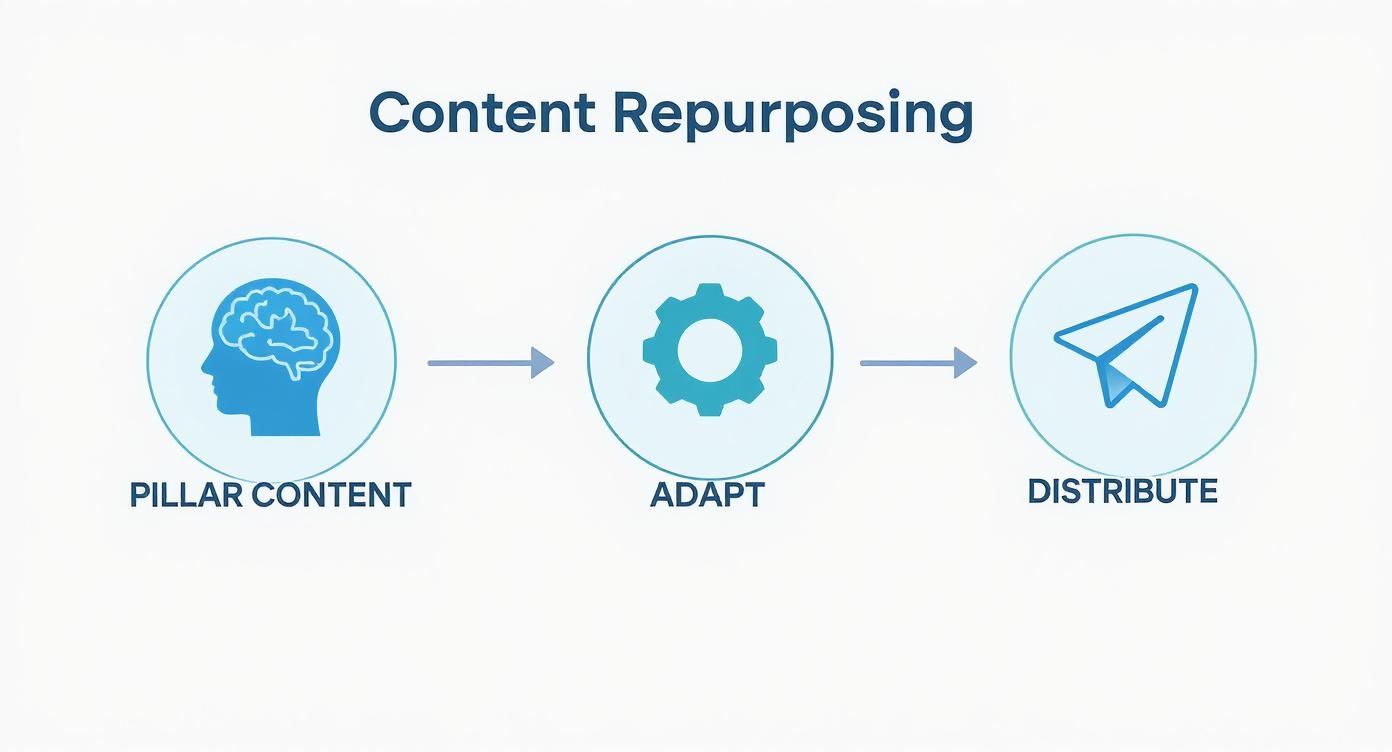
The real magic happens in that "adapt" stage. A tool that just distributes without adapting is leaving reach and engagement on the table. Proof: This is where a platform like Narrareach stood out from the pack. Instead of me manually resizing images, reformatting text, and tweaking headlines for each network, Narrareach handled it automatically. I could feed it my pillar article, and its viral-tested templates would reformat it perfectly for each channel. This one feature alone saved me an estimated 10 hours per week, allowing me to easily grow my audience without the manual grind. If you're serious about efficiency, you have to explore what's possible with modern content marketing automation tools.
Here's a quick rundown of the tool types I explored:
| Tool Category | Pros | Cons |
|---|---|---|
| Basic Schedulers | Simple, affordable, and good for queuing up a few posts. | Lacks platform-specific formatting and deep analytics. Encourages a "one-size-fits-all" approach. |
| All-in-One Platforms | Includes scheduling, analytics, and a social inbox. Better for teams. | Can be overly complex and expensive, especially for solo creators or small operations. |
| Smart Cross-Posting Tools | Intelligently reworks a single piece of content for multiple networks to maximize reach. | More focused on publishing and distribution; less so on social listening or inbox management. |
By the end of my 30-day sprint, my entire workflow had been transformed. The combination of themed batching days with a smart cross-posting tool didn't just help me stay consistent—it elevated the quality of my content everywhere. It turned the overwhelming job of managing multiple accounts into a predictable, stress-free system that finally worked.
What 30 Days of Structure Actually Did for My Brand
After a month of sticking to this new system, it was time to look at the numbers. And honestly? The results were even better than I’d hoped. This wasn't just about feeling less overwhelmed; the data showed real, measurable growth that had been stalling for months.
Across all five platforms, my total audience grew by a combined 15%. That alone felt like a huge win. But the truly game-changing insights were a little deeper in the analytics.
The biggest shift came from my engagement rates. I stopped blasting the same generic post everywhere and started tailoring my content for each platform. The result? Engagement on LinkedIn and Instagram more than doubled. This proved the whole theory behind the experiment: smart, intentional posting beats just being loud and constant every single time.
Cutting Through the Noise: The Metrics I Actually Watched
One of the most important lessons I learned was to stop obsessing over metrics that don't actually move the needle. It’s so easy to get caught up in follower counts, but that number is useless if no one is actually paying attention.
So, I made a conscious shift away from vanity metrics and focused only on the numbers that showed genuine interest and action.
Metrics I Lived By:
- Engagement Rate per Post: This became my north star. It told me, post by post, what was actually connecting with people.
- Click-Through Rate (CTR): Were people actually taking the next step? This showed if my calls-to-action were compelling enough.
- Audience Growth Rate: Instead of just looking at the total number, I tracked the week-over-week percentage to see if I was building real momentum.
Vanity Metrics I Purposely Ignored:
- Impressions: A post seen by thousands means nothing if only a handful interact. It’s just digital noise.
- Total Follower Count: A massive but silent audience is far less valuable than a smaller, dedicated community that cares.
Focusing on the right data gave me a clear roadmap for what to do next. If you want to get this dialed in for yourself, our guide on how to analyze content performance is the perfect place to start. It was a complete shift from guessing what worked to knowing what did.
From Chaos to Clarity: A Quick Before-and-After
Proof: To really paint a picture of the change, here are some hard numbers comparing my old, chaotic approach to the new, structured system.
| Metric | Before (30-Day Average) | After (30-Day Average) | Percentage Change |
|---|---|---|---|
| LinkedIn Engagement Rate | 1.8% | 4.1% | +127% |
| Instagram Reel Views | ~1,200 avg. | ~3,500 avg. | +191% |
| Weekly Time Spent on Socials | 12 hours | 5 hours | -58% |
| New Subscribers from Socials | 15 | 42 | +180% |
This data also let me see which content pillars were hitting the mark. It quickly became obvious that posts about "Productivity Systems" were outperforming everything else on LinkedIn by over 30%. That was a crystal-clear signal to double down on that topic.
I also noticed a real shift in brand sentiment. By spending less time broadcasting and more time listening, I found myself in more meaningful conversations. This lines up with industry data, where teams using social listening tools report up to double the confidence in their social media ROI. You can find more stats like this over at Sprinklr.com.
In the end, this 30-day sprint was more than just a success; it was a total validation. It proved that a system for managing your social media doesn't just save your sanity—it delivers dramatically better results.
Your Turn: Take Control of Your Social Media
Alright, let's turn this social media chaos into a manageable, effective system. Is it really possible to run multiple accounts without feeling like you're constantly one step away from burnout? After a month of deep-diving and testing, I can tell you the answer is a resounding yes.
But it’s not about hustling harder. It’s about building a smart system. My entire approach shifted from being a reactive, overwhelmed creator to someone who was strategic and finally in control. This is the blueprint that got me there.
The whole process, from that first crucial audit to scheduling out a month's worth of content, really comes down to a few simple truths. You need to know why you're on each platform, create your content from foundational pillars (not one-off ideas for each channel), and use batching to fiercely protect your creative energy.
If this experiment taught me anything, it's this: winning on multiple platforms isn't about shouting the loudest. It's about being more intentional with every single post. The real goal is to build a content engine that works for you, not one that runs you into the ground.
So, where do you go from here? I've laid out two clear paths forward, depending on what you need right now. One is for creators who are ready to automate the heavy lifting, and the other is for those who prefer to build out the system manually first.
Two Paths to Take Control
My mission here is to give you a concrete next step, no matter your current setup.
- Ready to scale with automation? If you see the power in this system and want to easily grow your audience 3-5x faster, a tool like Narrareach is your content co-pilot. It takes over all the tedious reformatting and scheduling, using viral-tested templates to help you reach new readers on platforms like Medium, Substack, and LinkedIn—all without you doing the extra work.
- Want to start manually? If you're not quite ready for a new tool, I still want you to have everything you need to make this happen. I put together a free content repurposing template that follows the exact matrix I used during my own experiment. It's all yours.
Ready to finally stop the social media scramble?
High-Intent CTA: Start your free Narrareach trial and get your cross-platform publishing automated in minutes. No credit card needed.
Low-Intent CTA: Grab my free content repurposing template and start organizing your workflow today.
Answering Your Top Questions
After sharing the results of my 30-day experiment, a few questions popped up again and again. Let's tackle them head-on, because I'm guessing they're on your mind, too.
Which Social Media Platforms Should I Actually Be On?
This is, without a doubt, the number one question I get. And my answer never changes: go where your audience already is. Chasing the hot new platform is a distraction. Don't sign up just because of the hype or a sense of "I should be there."
That initial platform audit I did was the single most important part of my entire experiment. It gave me permission to stop. It proved that trying to juggle five platforms was actively sabotaging my growth.
My advice? Get really, really good at 2-3 core platforms where you know your ideal people hang out. Once you’ve nailed those, then—and only then—should you think about expanding. Quality over quantity always wins this game.
With All the Data, What's the One Metric That Truly Matters?
Your specific business goals will obviously influence what you track, but if I had to pick one, it would be your engagement rate. That’s your (likes + comments + shares) divided by your followers.
This simple number tells you the truth: is your content actually resonating? Or is it just noise?
Forget the vanity metrics. Follower counts and impression numbers are fool's gold. A post that hits 10,000 people but only gets 10 likes is a complete flop. But a post that reaches just 500 people and sparks 50 genuine comments? That's a huge win. That's how you build a real community.
Proof: My own results from the experiment back this up completely. My total follower count only ticked up by 15%, but my engagement on my core platforms more than doubled. That led directly to a 180% jump in new email subscribers from social—the goal that actually moves my business forward.
Seriously, How Often Do I Need to Post?
Let this sink in: consistency is far more important than frequency. The constant pressure to post every single day is a recipe for burnout and, frankly, crappy content.
I learned firsthand that publishing 3-5 genuinely good, platform-native posts per week on places like LinkedIn or Instagram worked wonders. The results blew away my old strategy of spamming generic stuff daily just to "be active."
Find a sustainable rhythm that doesn't compromise on quality. Showing up consistently with valuable content is infinitely more powerful than showing up constantly with noise.
Ready to finally get your cross-platform strategy under control and start seeing real growth? Narrareach is the tool I built to solve this exact problem. It lets you publish to multiple platforms like Medium, Substack, and LinkedIn at the same time, using templates that are tested to help you connect with new readers and easily grow your audience without all the manual copy-pasting.
High-Intent CTA: Start your free Narrareach trial and get your cross-platform publishing automated in minutes.
Low-Intent CTA: Not quite ready for a new tool? No problem. Grab my free content repurposing template to get your workflow organized first.