Content and Distribution That Grows Your Audience
You spend nine hours on an article, hit publish, and 40 people read it. By Friday, you're already onto the next draft while that last piece quietly dies...
By Ian Kiprono
You spend nine hours on an article, hit publish, and 40 people read it.
By Friday, you're already onto the next draft while that last piece quietly dies. Turning its best lines into Notes, LinkedIn posts, and X threads becomes another afternoon lost to open tabs.
It's usually not your writing. It's the gap between publishing once and getting discovered over and over.
Why Great Writing Still Gets Ignored
Content is what you make once. Distribution is the system that keeps putting it in front of new readers.
Reach doesn't come from writing harder. It comes from the loop between the two.

Think of it like this: your best article is a reservoir, and distribution is the pipes.
A huge reservoir with one skinny pipe still leaves everyone thirsty.
The Four Stages That Actually Grow Reach
I learned this the hard way during my own test. Every piece needs to move through four jobs:
| Stage | What Happens | Result |
|---|---|---|
| Create | One strong idea is developed | A valuable source asset |
| Adapt | The idea becomes platform-native posts | Multiple useful entry points |
| Distribute | Posts reach selected channels | New readers discover you |
| Capture | Interested readers reach an owned channel | Subscribers and deeper relationships |
Each stage fixes a different leak:
- Create supplies the idea
- Adapt stops copy-paste fatigue
- Distribute creates discovery
- Capture turns passing attention into an audience you can reach again
That difference is everything. Publishing is an event. Distribution is a system.
Launch once and stop, and your momentum dies the second the feed moves on.
What My 90-Day Experiment Proved
I ran a 90-day working experiment built on one article per week.
Each piece became a mini-campaign across Substack Notes, LinkedIn, and X, with a planned follow-up and a clear path back to the publication.
I wasn't writing more hours. I just made one weekly article work across several surfaces, with each channel carrying a different slice of the idea.
You can steal the setup. I tracked it all in a simple spreadsheet:
- Source article
- Derivative posts
- Publish dates
- Channels
- Subscriber results
One row per campaign. That's it.
That one sheet also makes it way easier to get better. If a LinkedIn post takes off but the generic X version flops, you don't guess — you test a sharper hook next time.
For more ideas on moving readers beyond that first click, read practical newsletter promotion strategies.
Narrareach comes in later as the shortcut — turning an approved idea into scheduled posts, notes, and cross-platform campaigns without another round of manual copying.
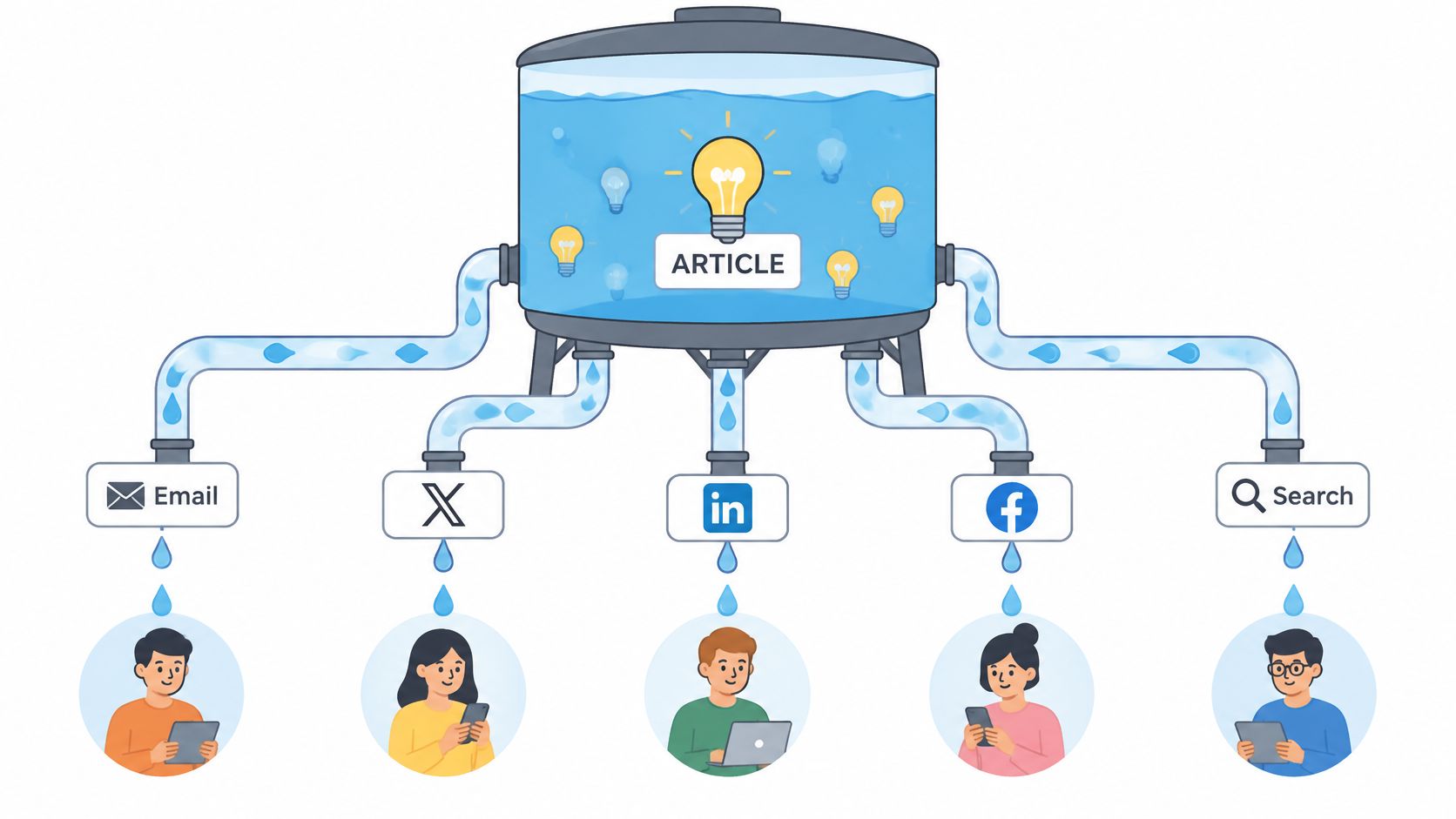
I like to think of an article as a reservoir and distribution as the pipes coming off it.
Most writers I know spend all their energy making the reservoir bigger, then only connect one pipe. No wonder so many good ideas never find readers. There was literally no route for them to flow through.
And that mismatch is only getting worse when you look at how people actually browse. DataReportal counted around 5.24 billion social-media user identities in January 2025 — that's 63.9% of the global population.
Even crazier, that audience was still growing 4.1% year over year. The average person was bouncing between 6.83 social platforms monthly and spending 2 hours 21 minutes there every day. If you publish once to a single channel, you're showing up for a tiny sliver of that routine.
The Three Jobs Writing Cannot Do Alone
Good writing creates the idea. But on its own, it just can't deliver all three types of reach you need:
- Discovery gets a brand-new reader to find your idea where they already hang out.
- Reinforcement puts that idea in front of them again, in a format that's easier to consume.
- Conversion turns that casual reader into a subscriber — someone in an audience you actually own.
A solid content and distribution setup takes one strong idea from public discovery, through repeat exposure, all the way into an owned relationship.
The Four Decisions Behind the Loop
Every week for me starts with a source asset. Usually that's one meaty Substack article.
From there I create a derivative post — not a copy-paste, but a fresh angle pulled for a different surface. Then I pick a discovery channel to meet new readers, like LinkedIn, X, or Substack Notes. And finally an owned channel, like my newsletter, where interested people can subscribe and stick around.
Here's what that looked like last Tuesday: I published the long-form piece, pulled one sharp takeaway for a Substack Note, reworked the example into a LinkedIn post, and pointed both back to the publication. Same idea, longer life. Nothing watered down.
Why One Channel Caps an Idea
If an article lives only on your site, you're betting on people already searching for it or subscribed to you.
A social post can get you further, sure. But it slides down the feed so fast there's rarely time for any real follow-up.
That's why a single-channel strategy creates a ceiling. People are split across nearly 7 platforms. You don't need seven new ideas — you need that one idea to show up in the right places, more than once.
That's the whole game. Content creates the value. Distribution gives that value repeat routes into people's attention, and eventually, into a relationship you control.
A scheduler without an engine is just a timer parked next to an empty garage. I found that out the hard way with my first weekly campaign: a queue, five social profiles, and no organized source material to draw from. Every post read like the last one, the timing felt arbitrary, and after all that effort I had learned nothing about what readers actually wanted.
The Reuters Institute's 2025 Digital News Report puts hard numbers on why this matters. Weekly social-video consumption climbed from 52 percent in 2020 to 65 percent in 2025, while weekly use of any online video rose from 67 percent to 75 percent.
In other words, most people now meet your ideas as short, platform-native fragments long before they ever sit down with a long-form piece. That reframes the job of an article: it's source material, not the finished product.
Five Connected Components
The engine I run today has five parts:
- Source asset library: One canonical article plus your core content pillars, all in one place. In my setup, a single 2,000-word Substack article feeds every derivative that follows.
- Repurposing rule set: Pull the sharpest claim, the best story, the strongest objection, and the most useful checklist. Each one becomes a native post rather than a copied paragraph.
- Channel map: Give every output a job and a destination. Mine sends insights to LinkedIn, conversations to X and Notes, and subscriptions to Substack.
- Scheduling rhythm: Batch the work and publish in sequence. My draft week ran one article, two Notes, two social posts, and one follow-up.
- Feedback layer: Track clicks, replies, and subscribers per channel. That running record told me which claim had earned a second campaign.
The diagram below shows how these five components fit together through a central connective layer to form one complete distribution system.
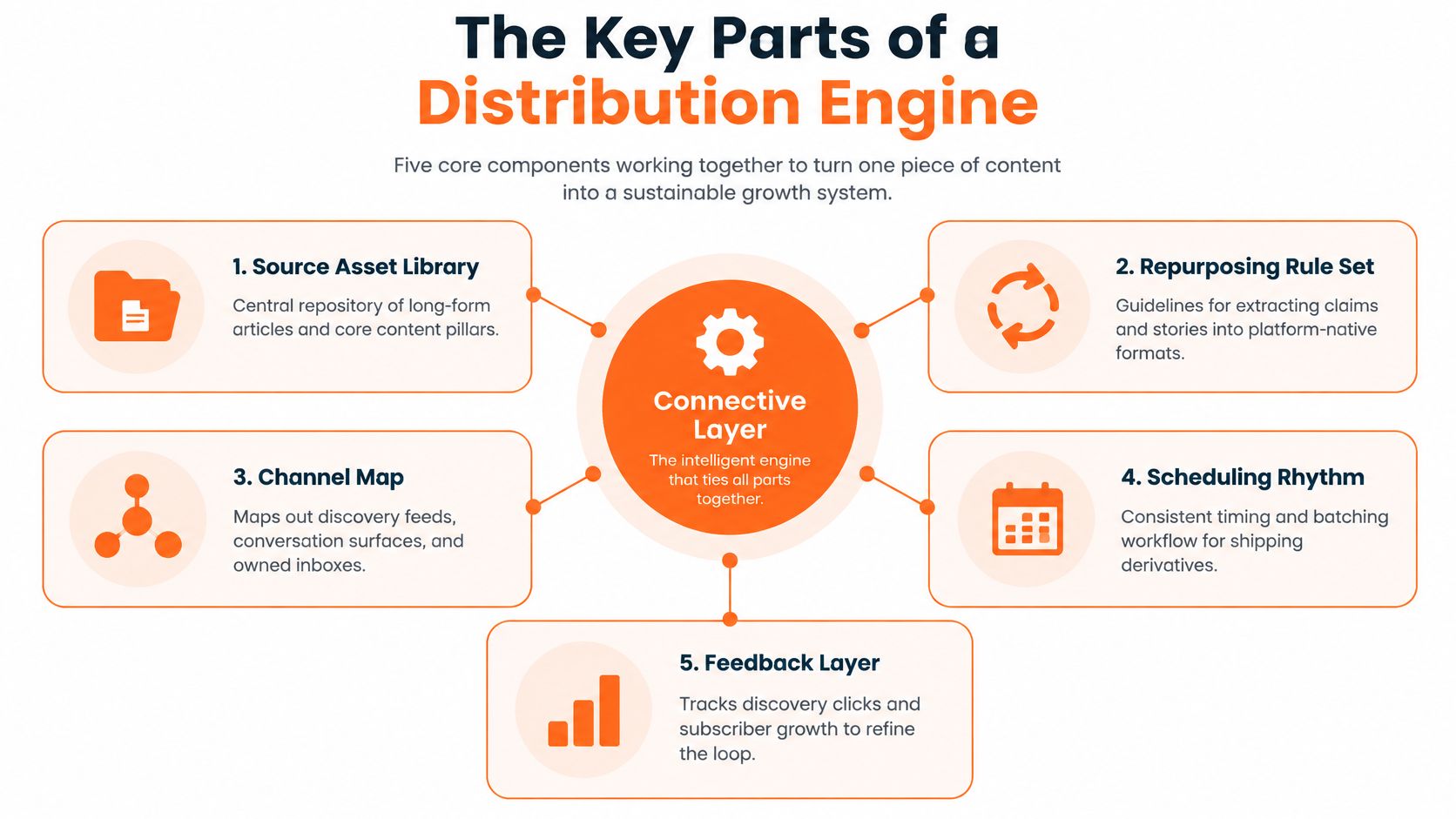
The relationship worth remembering is sequential. Weak source material produces weak derivatives, and an empty channel map leaves even excellent content with nowhere to go.
Match Every Channel to Its Job
Channels aren't interchangeable. Each one expects a different format and returns a different result.
| Channel role | Format it expects | Outcome it produces |
|---|---|---|
| Long-form home | Deep article | Trust and audience depth |
| Discovery feed | Short visual or text post | New readers |
| Conversation surface | Question, story, or take | Replies and shares |
| Owned inbox | Newsletter issue | Subscribers and return visits |
This split matters because weekly news use varies enormously by platform: Facebook 36 percent, YouTube 30 percent, Instagram and WhatsApp 19 percent, TikTok 16 percent, and X 12 percent. Treating them all the same wastes most of your effort.
Connect the Parts Without Losing Your Voice
Back in my spreadsheet days, one article turned into seven planned outputs before I published a single thing. The discipline was the point: no derivative went out without a source, a destination, a slot in the schedule, and a way to measure it.
Narrareach works as the connective layer in this system. Its intelligent content engine drafts from a writer's content pillars and the patterns behind stronger posts instead of generic templates, and it keeps approval in your hands before anything goes live.
That doesn't remove judgment, though. A rule set can carry your voice across channels, but only you can decide which idea deserves the spotlight.
If you want the channel-by-channel version of this, the content and distribution matrix lays it out. Build one source library, give every derivative a purpose, and schedule the next campaign before you fall back into manual copying.
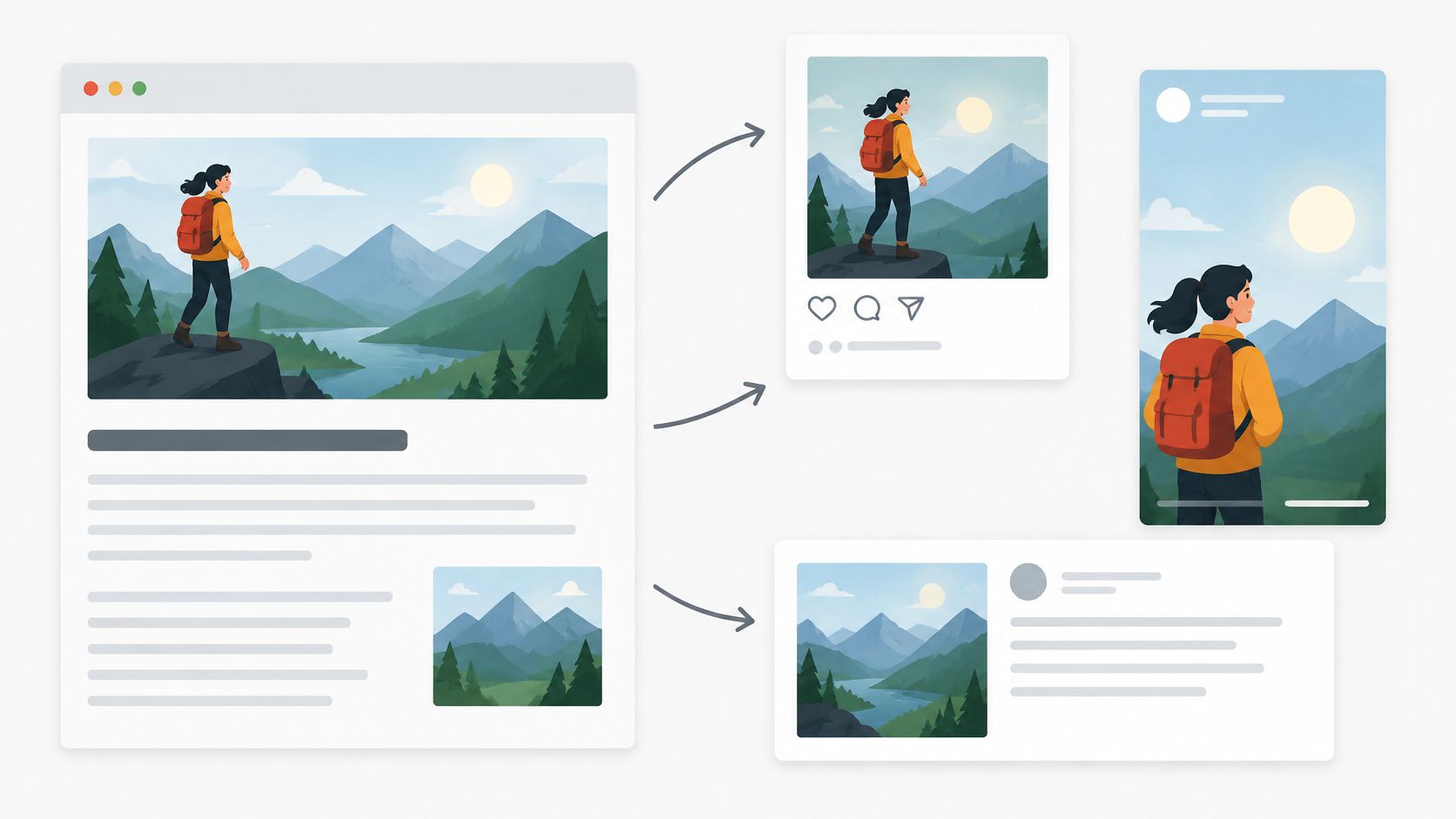
I ran a simple test with one 2,000-word Substack article and stretched it into seven derivative posts. The point wasn't to write seven more times.
It was to take one solid idea and let it show up in 7 native formats over a week.
Extract Five Building Blocks
First, I pulled five pieces out of the original:
- The sharpest claim: What do you most want the reader to believe?
- The counterintuitive number: Which result actually surprised people?
- The story opening: What made the problem feel real and urgent?
- The strongest objection: What worry might stop someone from acting?
- The practical checklist: What can they do today?
An audience-growth piece, for example, might give you “publishing is not distribution,” one surprising engagement result, a quick client story, “does repurposing feel repetitive?”, and a five-step publishing checklist.
Repurposing works when each post delivers one useful idea in the shape its platform expects.
Build Seven Native Outputs
Here's what that week looked like in practice:
| Day | Output | Extracted Idea | Native Job |
|---|---|---|---|
| Day 1 | Substack Note | Sharpest claim | Start a conversation |
| Day 2 | LinkedIn post | Story opening | Earn professional attention |
| Day 3 | X thread | Counterintuitive number | Explain through sequenced posts |
| Day 4 | Substack Note | Strong objection | Surface reader tension |
| Day 5 | Bluesky post | Practical checklist | Offer a compact resource |
| Day 6 | LinkedIn article teaser | Sharpest claim | Build curiosity |
| Day 10 | Substack follow-up Note | Best reader response | Resurface the idea |
The LinkedIn post led with the problem, shared three specific lessons, then closed with one question. The X thread ran as a numbered sequence because that's how people read connected ideas there.
On Bluesky, I squeezed the checklist into 5 short lines. The LinkedIn teaser promised the full method without giving away the entire 2,000 words.
Protect Paid Substack Work
Paid work can stay paid. A paid Substack article can stay behind the paywall while a preview, a quote, or a supporting post sends new readers to the right place.
Those supporting posts can point to LinkedIn, X, Bluesky, Threads, and other social platforms without leaking the full paid piece. Each platform's own rules and safeguards still apply.
Run the Voice Test
Before I hit publish, I read every version out loud. If anything sounded like a generic template, I rewrote it until it sounded like the original author again.
If the post sounds polished but doesn't sound like you, it isn't ready.
See more content repurposing examples for ways to use the same process on your own work.
Approve Instead of Rewriting
Narrareach takes care of the formatting lift by turning an approved article into platform-ready publishing work. You review the drafts, tweak what needs tweaking, then schedule the posts and Notes without rewriting each version by hand.
That was the breakthrough for me: one article became seven publishable assets, I kept final approval, and the paid work stayed protected. If you're ready to automate it, start free with Narrareach. If you want to keep doing it yourself for now, save the five building blocks and seven-output table for your next piece.
A queue falls apart in boring ways: drafts wander away from the approved piece, follow-ups vanish, and pasted text shows up with mangled links. Here is the weekly setup I use to schedule Substack Notes and social posts from one article without turning distribution into a second job.
Build a Realistic Publishing Week
I built the rhythm around one Tuesday article and kept every derivative on a short leash:
- Tuesday: publish the long-form piece
- Wednesday: publish the first Substack Note
- Thursday: release the LinkedIn post
- Friday: publish the second Substack Note
- Monday: release the X post
- Week two: bring back a follow-up based on the strongest response
The point is spacing, not sameness. Each post gets a distinct job, a distinct angle, and enough room to earn its own reaction.
Schedule Around Your Audience
I quit trusting generic “best time” charts after they kept pointing me at dead windows. A tidy slot on paper is useless if your readers are not actually there.
Look at reply times, engagement timestamps, and link clicks, then place posts inside the hours where people already respond. Pick one dependable window, test a second, and write down what happens for four weeks.
Schedule for the audience you have observed, not the crowd you imagined.
Use One 90-Minute Batching Session
Every Friday, I block 90 minutes for the next week:
- 20 minutes: choose the approved article.
- 25 minutes: draft two Notes and two social posts.
- 15 minutes: reshape each version for its destination.
- 20 minutes: set destinations and publish times.
- 10 minutes: check links, formatting, and calls to action.
A spreadsheet can carry this if you want the manual route. The tool is secondary; walking into Monday with every planned output already reviewed is the win.
Keep Every Campaign in One Queue
Manual workflows fail in three predictable places:
- Draft drift: the final post stops matching the approved article.
- Forgotten follow-ups: a good reply never becomes another post.
- Formatting errors: copied links, tags, and character limits get posts rejected.
A single queue keeps each derivative tied to its source, destination, time, and status. You review once, instead of trusting memory to tell you what changed.
Narrareach prepares the long-form work once, then publishes articles to every article destination at the same time. Published articles carry SEO titles and descriptions, while Notes and social posts stay scheduled as separate campaign items.
For the fuller routine, see how to schedule Notes on Substack.
Turn Your Archive Into Distribution Inventory
Fresh posts are only half the opportunity. Older writing can become a second campaign library when you import from Substack, Medium, WordPress, Ghost, Notion, Google Docs, public URLs, CSV, and Markdown.
The Revenue Writer plan covers 15 publishing destinations across 12 platform brands, including X, Bluesky, Threads, Instagram, Facebook, TikTok, and Pinterest. Platform publishing still sits inside each network's rules and safeguards.
Keep the Outcome Clear
If you want to try Narrareach, start free, import one useful article, and queue its Notes and supporting posts in one weekly session. If you would rather build manually first, run the 90-minute batching method and track audience activity before adding channels. Either way, you get steadier Substack Notes and social posts, stronger content and distribution, and wider reach without adding writing hours.
Publishing feels like progress. But likes and impressions lie.
I learned that the hard way. My follower count was climbing, but nobody was clicking through to the actual article. Nobody was subscribing. Nobody was coming back.
So I stopped checking vanity stats and started tracking 4 decision metrics every Friday:
- Derivative posts shipped: How many Notes and social posts actually went live from each article?
- Discovery-to-article clicks: Which public channels sent real readers to the long-form piece?
- New subscribers attributed to a channel: Which platform built lasting relationships?
- Repeat-engagement signals: Which topics earned replies, saves, shares, or return visits?
A useful metric changes what you publish next. If it just makes you feel good, it's vanity.
Why Email Is the Destination
Discovery platforms rent you attention. Your email list is the one asset you actually own.
That is why every content and distribution push should end in the inbox. The data backs this up too.
Across more than 3 million campaigns, global averages hit 42.35 percent open rate, 2 percent click rate, 5.63 percent click-to-open rate, and 0.08 percent unsubscribe rate. Litmus also reported an estimated $36 returned for every $1 invested in email marketing.
No, that's not a guarantee for you. But it explains why I care way more about list growth than follower totals. A public post opens the door. Email lets you walk back through it anytime.
Connect Content, Distribution, and Conversion
Keep the loop stupidly simple:
Publish long-form → create public discovery → convert interest into a subscription you control.
One Substack article from my test became 2 Notes, 1 LinkedIn post, and 1 X post. The LinkedIn version drove the most article clicks by far.
That told me something specific. That hook worked. That topic worked. That audience fit worked.
Narrareach analytics break this down by content, topic, format, channel, and timing. The team view shows what is scheduled, which platforms are selected, which articles spun off posts, and which activity drove subscribers or engagement.
A spreadsheet can log results. It can't show you those connections. You can do it manually, but linking activity to outcome makes your Friday adjustment 10x faster.
Run a 30-Minute Weekly Review
On Friday, I pull my four decision metrics. I write down my best topic, best channel, best format, and best posting window in 4 rows.
Then I make 3 decisions:
- Keep one winner and run it again.
- Adjust one weak element.
- Stop one time-suck that produced zero signals.
For example, “attention metrics” got me clicks, but “trust metrics” got me subscribers. So now I use the first for discovery and the second for conversion. Don't force one post to do both jobs.
For a deeper measurement framework, read how to measure audience engagement.
Double down on a winning topic before chasing a new one. Familiarity compounds, while constant switching resets the learning cycle.
End every review with one action: repeat, adjust, or stop. That tiny discipline is what turns content and distribution from guessing into a loop that gets better every week.
Setting up a content and distribution system shouldn't feel like a second job, but it usually does. Every post spawns another draft, another open tab, another round of second-guessing. So instead of building something elaborate, I ran a four-week experiment with nothing more than a spreadsheet and the schedulers already baked into each platform. The whole thing hinged on a single question: which surfaces actually help an idea find its audience?
Week One
I went through my archive and picked three content pillars to work from. In week two, I shipped one article and spun it into five derivatives. Week three, I added a second channel and started logging publish times. By week four, I had enough signal to review the results and drop whichever channel was underperforming.
None of this is ambitious on purpose. A sheet with columns for source, channel, publish time, clicks, and subscribers is genuinely all you need, plus whatever scheduling each platform gives you for free. The spreadsheet does the heavy lifting.
Where Most Content Systems Break Down
- Copy-pasting the same text everywhere: each platform has its own format, so reshape the idea instead of duplicating it.
- Treating distribution as a one-day event: line up a follow-up post and bring the article back around a few weeks later.
- Counting likes instead of subscribers: clicks, replies, and signups tell you what's working. Likes don't.
A Simple Rule for the First Review
Once month one wraps up, I hold onto the topic that produced subscriber signal, tweak whichever format lagged behind, and walk away from any channel that ate hours without starting real conversations. That keep-adjust-drop loop is what turns distribution from a scramble into something repeatable.
One idea becomes a campaign when every derivative has one job and one result.
There's no new platform to buy, no complicated workflow to maintain. Just one idea, a handful of surfaces that pull their weight, and the discipline to check the numbers.
Choose Your Next Step
High intent: If you're ready to build a repeatable content and distribution system, try Narrareach for free. Import one article, schedule your Notes and social posts, and grow your audience more efficiently from one approved source asset.
Low intent: If you want to stay connected and keep improving manually, grab it from Narrareach here for the weekly distribution teardown and repurposing checklist.
Goal: one idea, many surfaces, and subscribers that compound steadily.