
Social Media Management Packages: A 30-Day Test
You publish a strong newsletter, watch the first subscriber notifications arrive, and then face the part nobody puts on the editorial calendar. The article...
By Ian Kiprono
You publish a strong newsletter, watch the first subscriber notifications arrive, and then face the part nobody puts on the editorial calendar. The article needs a LinkedIn post, an X thread, several Substack Notes, and perhaps a version for Medium, but every platform wants a different length, rhythm, and format. Copying, pasting, trimming, and reformatting can take longer than the original idea deserves. Eventually, you skip distribution, and your best work stays trapped in one inbox while audience growth stalls.
The Content Distribution Trap and My 30-Day Experiment
That cycle was my normal workflow for more than a year. I'd finish a long-form article, publish it on Substack, and tell myself I'd distribute it properly later. Later usually meant opening several browser tabs, rewriting the introduction for LinkedIn, breaking the argument into an X thread, and trying to invent a useful Note that didn't sound like a truncated advertisement.
The work wasn't intellectually difficult. It was repetitive, fragmented, and badly timed. Each platform required a slightly different editorial decision, yet the tools I tested often treated cross-posting as duplication. They made it easy to send the same text everywhere, but not easy to transform one idea into native variations.
I spent 30 days testing social media management packages through the lens of an independent writer. I wasn't looking for a generic agency calendar. I wanted to know whether a package could help me preserve a distinctive voice, schedule consistently, repurpose long-form work, and learn which formats were earning attention.
Practical rule: A distribution package should reduce the number of decisions you repeat, not remove the editorial decisions that make your work recognizable.
The market context supports that shift. Social media management software was estimated at USD 19.84 billion in 2025 and is projected to reach USD 42.76 billion by 2031, with roughly 14.2% annual growth over that period, according to Mordor Intelligence's social media management software market estimate. The underlying change is operational. Creators and teams increasingly need coordinated publishing, analytics, and repurposing across several channels.
I also found it useful to read a creator's guide to distribution from Isolate Audio, because it treats distribution as a deliberate system rather than a final promotional chore. That distinction matters for writers. Publishing is the act of making an article available. Distribution is the process of giving the idea more than one opportunity to meet the right reader.
A useful starting point is a content distribution platform built for multi-channel workflows. The important question isn't whether a tool can publish. It's whether the workflow makes publishing the next suitable version of an idea easier than abandoning it.
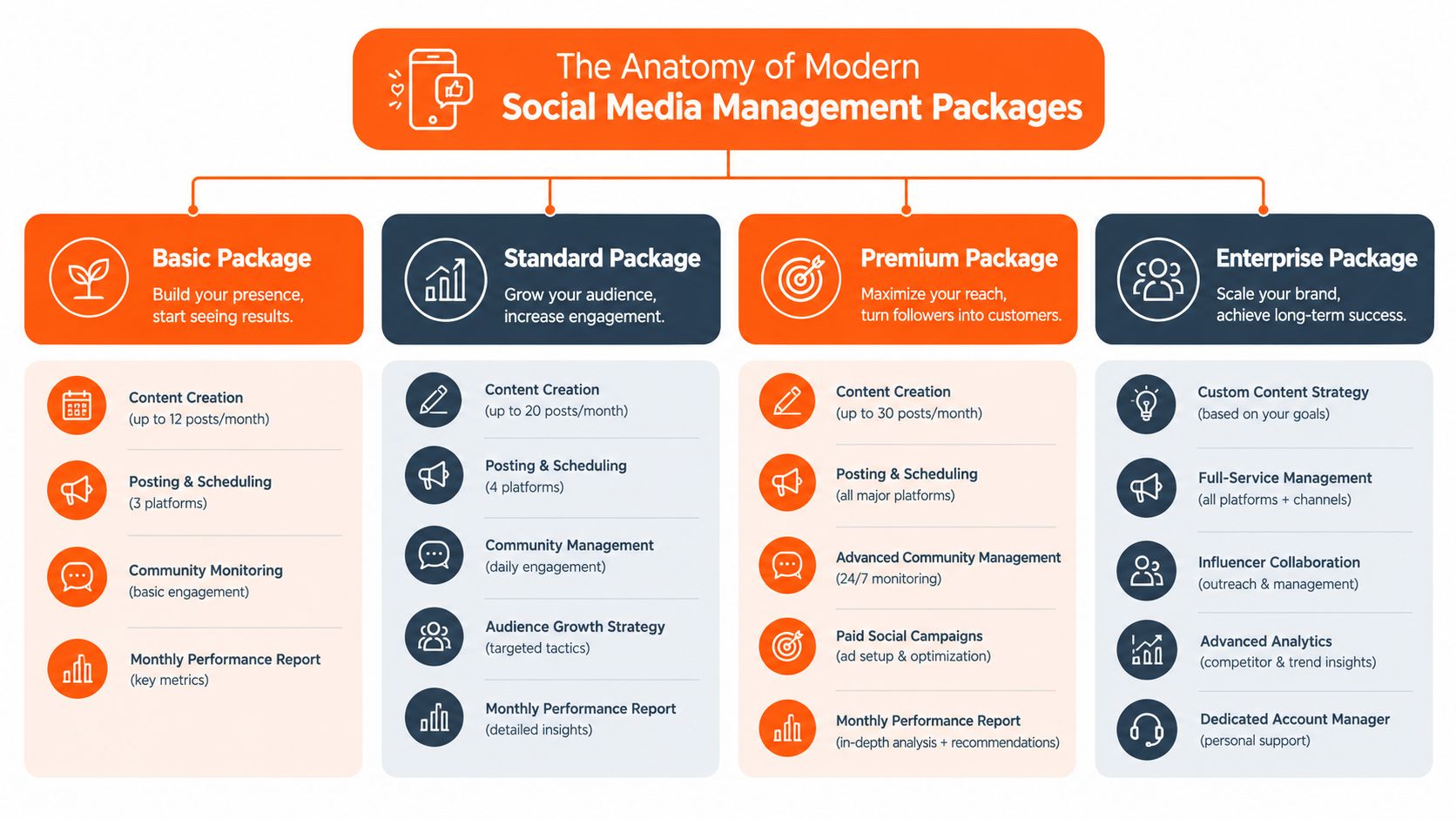
The Anatomy of Modern Social Media Management Packages
A traditional package usually meant a monthly retainer, a batch of generic posts, and a calendar showing when an agency planned to publish them. That model can work for a business that wants someone else to own execution, but it often breaks down for writers. A newsletter operator needs the package to understand the relationship between a source article, a personal observation, a discussion prompt, and a subscriber journey.
A modern package has four connected layers:
- Planning and scheduling, so posts, articles, and Notes can be prepared before the publishing window.
- Platform-native adaptation, so a LinkedIn post doesn't read like an X thread pasted into a different box.
- Measurement, so reach and engagement can be assessed by platform, topic, format, and timing.
- Repurposing, so one finished idea can produce useful derivatives without demanding a fresh writing session for every channel.
A calendar isn't a distribution engine
A blank composer and a drag-and-drop calendar solve only the final publishing step. They don't answer whether the source idea should become a question, a short argument, a thread, a Note, or a visual explanation. They also don't tell you which version deserves another run.
The market has expanded beyond simple scheduling utilities. A separate estimate placed the broader social media management market at USD 17.5 billion in 2022, with a projection to exceed USD 51.8 billion by 2027, implying more than threefold expansion and an effective 24.2% CAGR, as reported by Global Growth Insights. Those figures describe a category moving toward coordinated publishing, measurement, and multi-brand oversight.
For writers, AI assistance should sit inside that workflow, not replace editorial judgment. An AI video and ad generator from ShortGenius may be useful when a written idea needs a visual or video treatment, but the package still needs controls for tone, claims, formatting, and approval.
A practical AI social media automation workflow should therefore begin with a canonical source. From there, it can suggest a LinkedIn version, an X thread, and Substack Notes, while leaving the writer responsible for the point of view. If the output could have been written by any account in the category, the automation has saved keystrokes but weakened the distribution.
Pricing Models and the Hidden Costs of Distribution
Price comparisons become misleading when they treat every package as a list of deliverables. A monthly retainer can include strategy, copywriting, community management, paid advertising, or just scheduled posts. Those are different operating models, and they place the labor in different hands.
Coverage of small-business social media packages commonly describes agencies at $2,000 to $10,000 or more per month, freelancers at $500 to $3,000 per month, and software beginning around $79 per month, according to Sprout Social's comparison of social media package options. These figures are useful reference points, not universal quotes. The real decision is what happens to your time, control, and continuity after payment.
| Package Tier | Monthly Cost | Hidden Operational Cost | Best For |
|---|---|---|---|
| Agency | $2,000 to $10,000+ | Briefing, approvals, revisions, and the risk that the team's interpretation of your voice becomes the default | Organizations that need outsourced strategy and execution |
| Freelancer | $500 to $3,000 | Reliance on one person, limited availability, and possible gaps in process documentation | Writers who want hands-on help without a full agency relationship |
| Software | Starting around $79 | Setup, editorial review, account management, and responsibility for interpreting analytics | Creators who want control and can maintain a repeatable workflow |
The most expensive option isn't always the one with the largest invoice. It can be the package that requires you to manually turn every Substack article into a LinkedIn post because it lacks meaningful repurposing. A low-cost scheduler can also become expensive in practice if it leaves you switching between platforms, rebuilding variations, and collecting analytics in separate spreadsheets.
What the package really transfers
An agency transfers execution, but you may give up speed and voice control. A freelancer can provide judgment and accountability, but the workflow may depend heavily on one person. Software transfers execution back to you while reducing repetitive operations.
That last model works best when the tool has clear approvals, reusable source content, native scheduling, and analytics that support decisions. It works poorly when automation creates a queue of posts that still need extensive rewriting.
The relevant question is not, “How many posts are included?” Ask instead:
- Who owns the source idea?
- Who adapts it for each platform?
- Who checks the facts and voice?
- Who responds to conversations?
- Who can explain why one format outperformed another?
A package that answers those questions clearly is easier to evaluate through content distribution ROI. The right choice protects the work only a writer can do, the thinking, reporting, and perspective, while reducing the clerical work that surrounds it.
Evaluating Packages for Writers and Newsletter Creators
Most social media management packages were designed around brand campaigns, product launches, and team approvals. Writers need a different test. The source material is usually one substantial idea, and the value comes from extending that idea without making every derivative feel like a sales message.
I used the following criteria during my 30-day evaluation.
Start with platform-native adaptation
A Substack article might become a conversational LinkedIn post, a sequence of pointed X updates, and a Note that isolates one observation. Those versions shouldn't share identical openings. A package that forces one caption into every channel saves time only by lowering relevance.
Research on cross-platform creator behavior found that creators often changed subtitles, descriptions, thumbnails, sponsorship sections, and upload frequency when reposting content to another platform. The findings are described in research on cross-platform content distribution.pdf). For writers, the practical implication is straightforward: preserve the idea, but change the packaging.
Check whether the package lets you:
- Keep one canonical source, such as a newsletter or article.
- Create channel-specific drafts, rather than identical copies.
- Edit the hook and call to action, without changing the source.
- Schedule selectively, because every channel doesn't need simultaneous publication.
Then inspect the analytics
Raw engagement totals are too blunt. Industry guidance recommends choosing 3 to 5 primary KPIs and comparing them with historical performance or industry averages. One benchmark set cited median engagement rates of 0.50% on Instagram, 0.063% on Facebook, and 2.63% on TikTok, which is why Brandwatch's explanation of social media metrics supports platform-specific reporting rather than one blended average.
The package should help you separate:
- Reach, which shows exposure.
- Engagement rate, which adds context to interactions.
- Posting frequency, which helps identify cadence changes.
- Audience growth, which connects distribution to community building.
- Topic and format performance, which reveals what to repurpose.
A report that shows only total likes can't tell you whether the problem was a weak idea, an unsuitable format, or poor timing. A useful package turns those possibilities into testable editorial decisions. More practical evaluation criteria appear in this content distribution software guide for writers.
My 30-Day Distribution Experiment Results
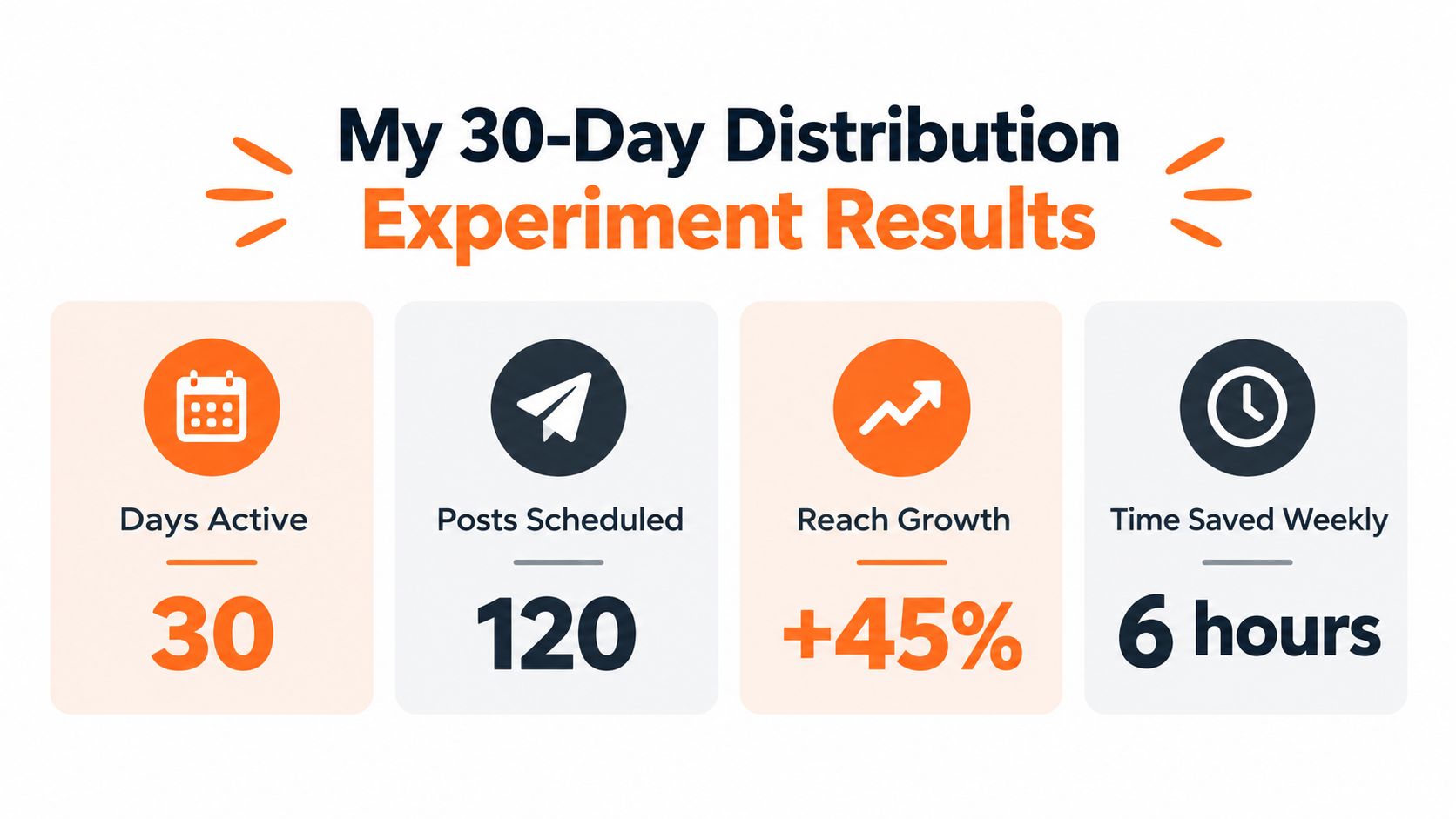
I treated the test as a workflow experiment rather than a contest between dashboards. Each long-form idea began as a source document. I then prepared versions for Substack, Medium, LinkedIn, and X, scheduled the pieces, and reviewed the response by platform and format.
The biggest change was psychological. Distribution stopped being a vague task I hoped to complete after publishing. It became a sequence of small editorial actions: identify the strongest claim, choose the right format, adapt the opening, schedule the draft, and review the resulting signal.
I scheduled Substack Notes rather than relying only on the initial article publication. Substack supports scheduled Notes on web, iOS, and Android, and saves them in the Notes Drafts tab so they can still be edited before publication, as explained in Substack's announcement about scheduled Notes. That matters because Notes can function as a continuing conversation around an article, not just a duplicate link.
Timing changed the test
I initially assumed consistency mattered more than timing. The test made that assumption harder to defend. Research summarized in Buffer's 2026 social media engagement guide clusters strong windows around weekday mornings and midday periods, including an overall 9 a.m. to 12 p.m. window from Monday through Wednesday, alongside platform-level peaks on Tuesdays and Wednesdays between 11 a.m. and 6 p.m.
Those windows aren't publishing commandments. They're starting points. Your own analytics should decide whether your readers respond during those periods, especially if your audience spans regions or works on a different schedule.
Format produced another clear lesson. Large-scale benchmarks from Emplifi's social media benchmarks report that live video generates nearly four times more engagement than links and six times more than images. That doesn't mean every writer should become a live-video creator. It means a link drop and a native experience shouldn't be treated as equivalent distribution assets.
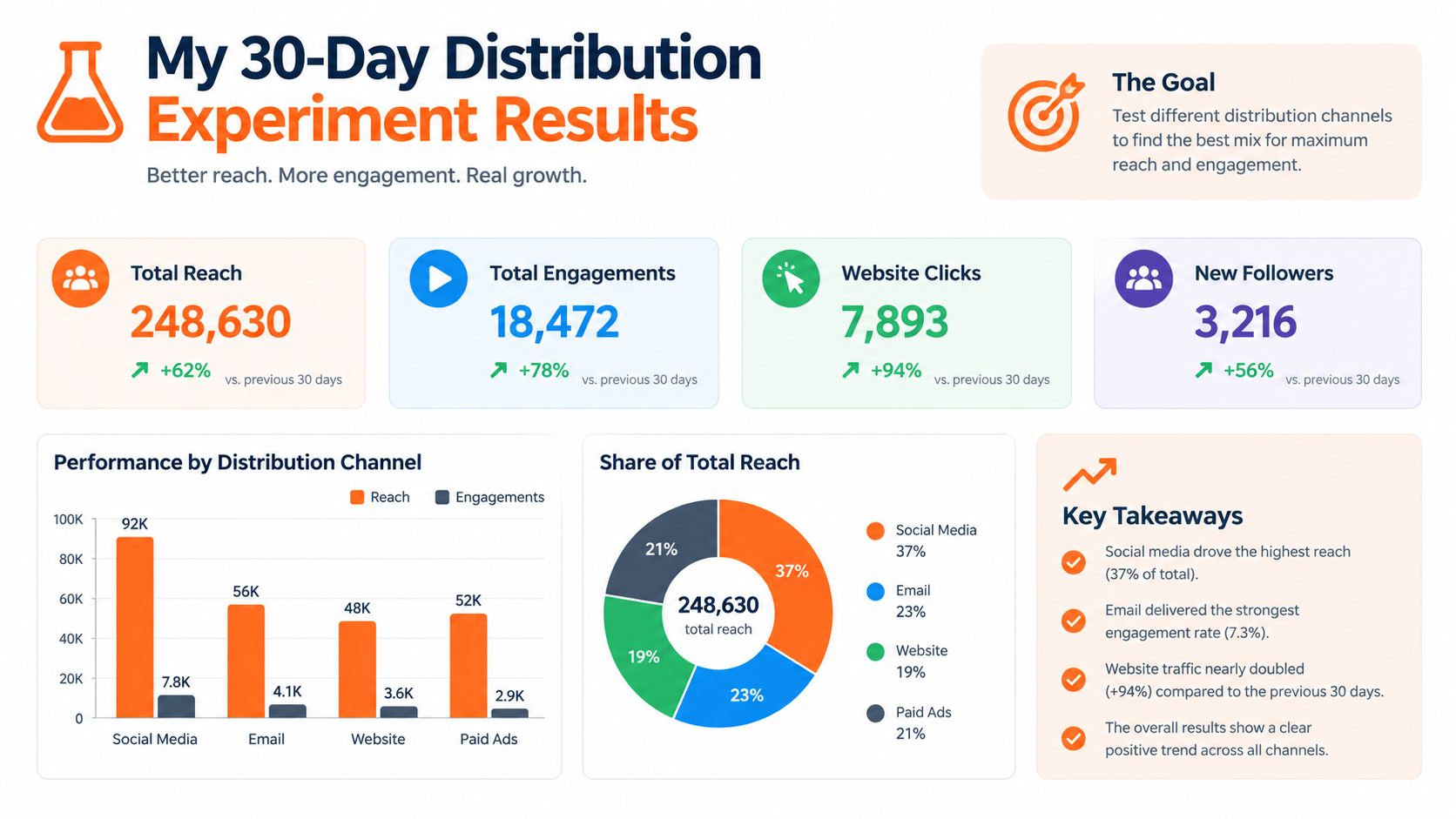
The report I found most useful tracked likes, comments, shares, saves, engagement rate, and posting time by topic. That structure follows Hootsuite's guidance on social media reports and made the review more actionable than a monthly total.
The conclusion was practical. Scheduling creates consistency, but adaptation creates fit. Analytics then tells you which ideas deserve another variation, another Note, or a deeper follow-up.
Building Your Custom Package with Narrareach
After testing agency-style workflows, freelancer support, and software-led systems, I concluded that many writers don't need a bloated retainer. They need a modular distribution engine that starts with their own long-form material and handles the repetitive steps around it.
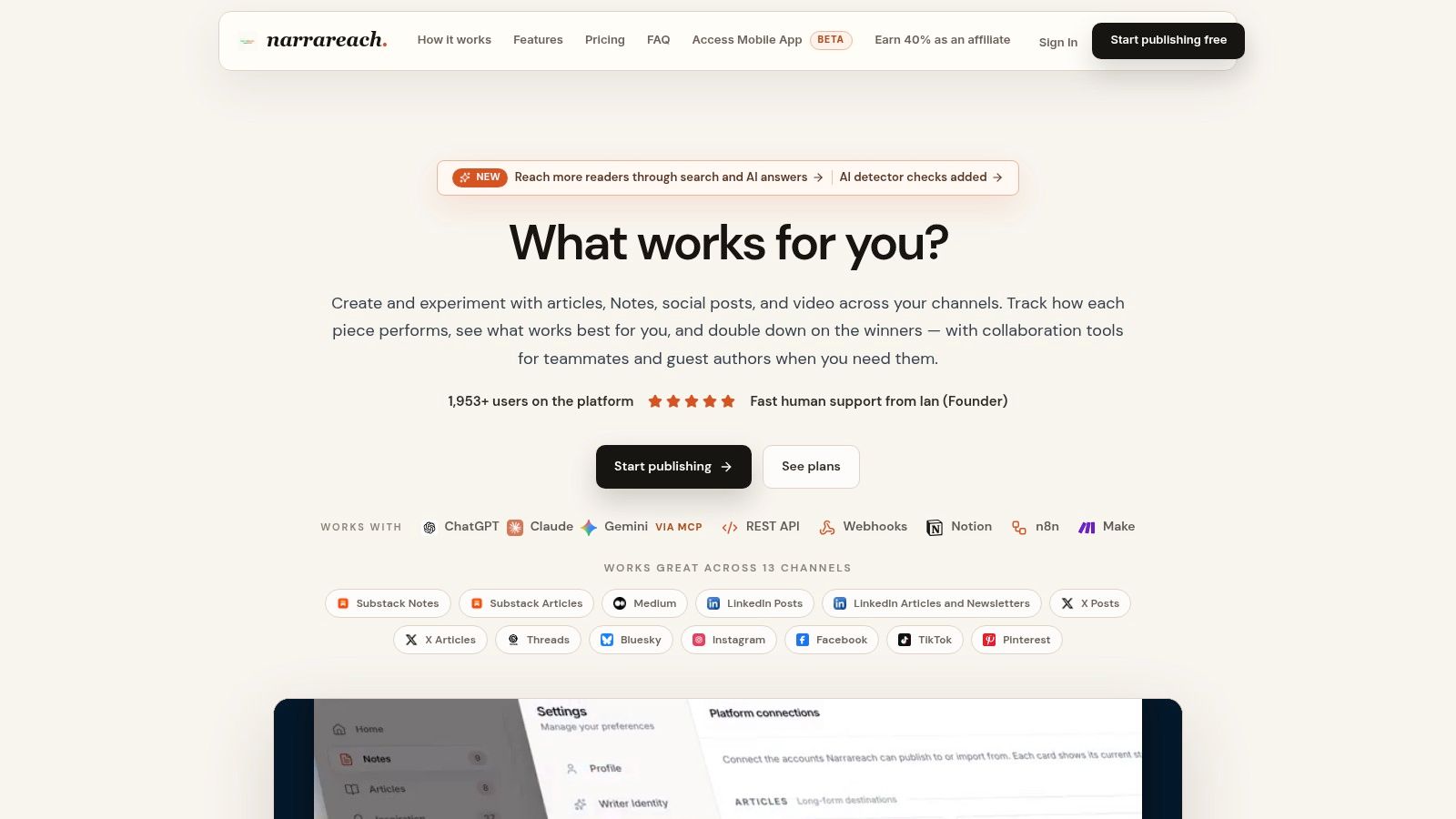
Narrareach is one option built around that operating model. It supports scheduling, tracking, and cross-platform distribution across Substack, Medium, LinkedIn, and X from one workflow. Its AI-assisted repurposing turns an article, newsletter, Note, or idea into channel-specific drafts that the writer can review before scheduling.
That distinction matters. A writer shouldn't have to choose between preserving a voice and saving time. The source remains the editorial anchor, while each output can receive its own length, structure, and call to action.
A workable writer's workflow
Start with the finished newsletter rather than a blank social composer.
- Select the source idea. Choose the argument, example, or observation with the clearest standalone value.
- Generate channel-specific drafts. Ask for a Note, a LinkedIn post, and an X thread, then edit the language that sounds too general.
- Schedule around audience behavior. Use the available timing data as a starting point, not a substitute for your own reporting.
- Review the campaign as a group. Look at which derivative earned attention and which one moved people toward the publication.
- Reuse the winner thoughtfully. Expand a strong short-form response into a follow-up article or a new discussion prompt.
Substack's own scheduling support makes this workflow more practical because Notes can be prepared on mobile or web, stored as drafts, and edited before their chosen local publication time. The tool doesn't eliminate the need for judgment. It makes the judgment easier to apply consistently.
The broader value is continuity. One article can remain active through a planned sequence of Notes, posts, and discussions instead of disappearing after its first publication window. The Narrareach workflow overview shows how that process can be organized from source content through scheduling and measurement.
Your Next Steps for Smarter Distribution
A social media management package should earn its place by protecting writing time and improving editorial reach. It shouldn't encourage you to publish more empty variations. Before choosing one, audit your current workflow and identify the step that causes you to abandon distribution.
Use this decision sequence:
- Map your source content. List whether your primary material comes from Substack, Ghost, Beehiiv, Medium, or another publishing system.
- Choose the channels that fit your readers. Don't pay for a broad package if your real workflow depends on LinkedIn, X, and Notes.
- Test adaptation before automation. Take one article and check whether the tool creates useful native drafts or merely shortens the same paragraph.
- Set a measurement baseline. Track a focused group of KPIs, then compare platforms separately instead of blending every result.
- Keep human review in the loop. Automation can suggest structure and timing, but the writer should approve claims, tone, and context.
- Review the package by operational cost. Include setup, editing, approvals, community replies, and reporting in the decision, not just the subscription price.
The strongest workflow is usually modular. Your writing remains the scarce creative input. Scheduling handles repetition, repurposing extends the idea, and analytics helps decide which direction deserves more attention.
Don't judge a package by how many posts it can queue. Judge it by whether you can turn one thoughtful article into several credible reader interactions without feeling that you've started the writing process from zero each time.
Narrareach offers scheduling, AI-assisted repurposing, cross-platform publishing, and analytics for writers and newsletter operators who want to turn long-form work into a consistent distribution system. Visit Narrareach to explore the workflow, or follow along with the practical lessons here if you're still comparing your options.