
Repurpose Content Ai
You published on Tuesday morning. By Wednesday night, the likes stopped, the comments stalled, and that piece you spent days researching sat there, done. You...
By Ian Kiprono
You published on Tuesday morning. By Wednesday night, the likes stopped, the comments stalled, and that piece you spent days researching sat there, done. You know the ideas inside it could work on LinkedIn, X, and Substack Notes. You also know what reformatting them by hand feels like. New hooks. New lengths. New tone shifts. So you close the tab and start something new instead.
That cycle is why I stopped treating distribution as an afterthought and ran a long repurposing experiment instead. One strong article each week. Several platform-specific derivatives. A simple rule throughout. I wouldn't count how many posts I produced. I'd count whether any of them brought subscribers back to the original work.
Why Your Best Article Is Stuck on One Platform
Most writers don't have an ideas problem. They have a distribution bottleneck. The article gets written, proofed, and published in one place. Then the work of adapting it for every other place your readers spend time never happens because it competes with writing the next piece.
That is exactly where I got stuck. I'd finish a long-form post, feel good about the argument, and then face the prospect of manually chopping it into a thread, a LinkedIn post, and a handful of Notes. Each version needed different pacing. I did it sporadically for a while, which meant I did it badly. The weeks I skipped, reach fell off a cliff. The weeks I forced it, my writing time shrank.
Writing Once Was Never the Hard Part
The broader shift explains why this manual approach no longer makes sense. By 2024, 72% of organizations had adopted AI in at least one business function, and 50% had adopted it in at least two functions, according to McKinsey adoption data compiled by DigitalOcean. Marketing and sales were central to that shift. 34% of organizations reported adopting generative AI in that function, and 16% identified content support as a use case.
The economics point the same way. McKinsey estimated generative AI could add up to $4.4 trillion in annual global productivity, with marketing and sales among the groups accounting for approximately 75% of that potential value, and marketing productivity gains equivalent to 5% to 15% of total marketing spending, or roughly $463 billion annually, in McKinsey's analysis of generative AI in consumer marketing. Repurposing sits squarely inside that opportunity. You're not inventing new material. You're drafting variations, adapting tone and length, and extending the life of work that already exists.
Your best article is an asset, not an event. It should keep earning readers after publish day, not retire after it.
Consistency is the mechanism that makes this pay off. Accounts that posted at least once per week for 20 or more weeks achieved more than 4 times the engagement per post of accounts that posted fewer than 5 times in the same period, based on a large-scale account analysis of social engagement patterns. That finding shaped my experiment. If I could turn one article a week into a repeatable sequence, I could sustain a streak without writing more original pieces.
If you want to think through the planning side before you touch any tool, these editorial planning content reuse tips are a useful starting point for mapping one source to multiple outputs. And if the underlying concept still feels fuzzy, it's worth grounding yourself in what content distribution actually means for writers before building a system on top of it.
What AI Repurposing Actually Does to Your Voice
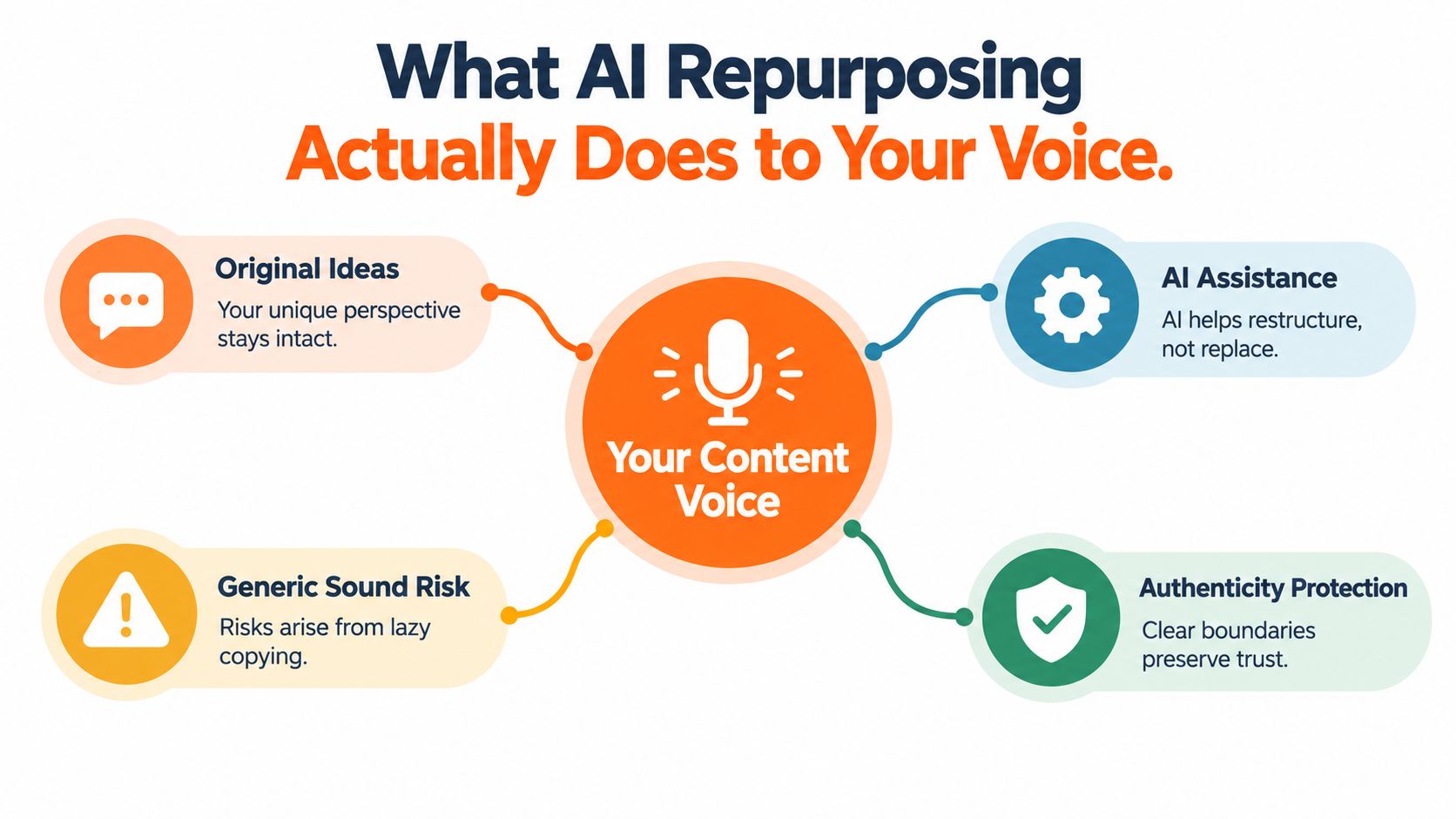
The fear is reasonable. Hand an article to a generic repurpose content AI tool, press a button, and you'll often get back fluent, empty summaries that could have been written by anyone. Your specific example becomes a vague lesson. Your hedged claim becomes a confident slogan. Readers notice, even when they can't name what's missing.
The data suggests most creators sense this risk. 72% of creators reported using AI, but only 4% used it for strategy and 1% for workflow automation, according to CreatorIQ's State of Creators report. Adoption is concentrated in brainstorming, writing, and editing, the basic tasks. The same body of research found almost 60% of creative professionals accept AI assistance, but only 6.7% consider fully AI-generated content acceptable, and it identifies specificity and individual perspective as increasingly valuable as generic content becomes abundant.
The four forces at play when AI touches your writing are worth seeing side by side before you decide how to use it.
Transformation Is Not Authorship
Here's the mental model that fixed my workflow. AI handles transformation. You handle insight and final voice. Transformation means compressing, expanding, reordering, and reformatting material you've already thought through. It doesn't mean outsourcing the point of view.
That distinction matters because most guides treat repurposing as a volume problem. Turn one article into many posts. Done. But volume without voice preservation just scales blandness. What needs protecting is identifiable in any strong source piece.
- Your thesis: The one claim you'd defend in an argument, not the topic summary.
- Your evidence: The specific numbers, names, and examples that make the claim credible.
- Your anecdotes: The moments only you can tell, which AI will happily delete as inefficiencies.
- Your language patterns: The phrases, rhythms, and degrees of certainty that make readers recognize you.
When I reviewed early AI drafts during the experiment, the failures were consistent. Generic openers like "in a fast-paced world" replaced my actual first lines. Caveats disappeared. A sentence that said "this worked for small newsletters" became "this works for everyone." None of that is a formatting error. It's a trust error, and it compounds if you publish at scale.
The practical fix is a voice-preservation pass on every derivative. Flag generic phrasing. Check that personal context survived. Ask whether the post sounds like you on that platform, not like you summarized by a stranger. There's more on building that discipline into your process in this guide to keeping brand voice consistent across platforms.
Practical rule: If a repurposed post could run under anyone's name without raising an eyebrow, it isn't ready to run under yours.
Some pieces shouldn't be repurposed at all. If the value lives entirely in a long, carefully built argument, compressing it into a hot take does your readers a disservice. Knowing when to leave a piece alone is part of the system, not a failure of it.
The Five-Stage Repurposing Workflow
One-click rewriting is where quality goes to die. What worked in my experiment was treating every transformation as a constrained evaluation problem. The AI generates candidates. Explicit checks decide whether they survive. That framing borrows from how language models themselves get evaluated. PromptBench's framework for LLM evaluation describes evaluation as requiring prompt construction, datasets, dynamic evaluation protocols, adversarial testing, and analysis tools. PromptEvals applies the same logic at scale with 2,087 prompt templates and 12,623 assertion criteria, which is a good reminder that explicit, task-specific guardrails beat one universal prompt every time.
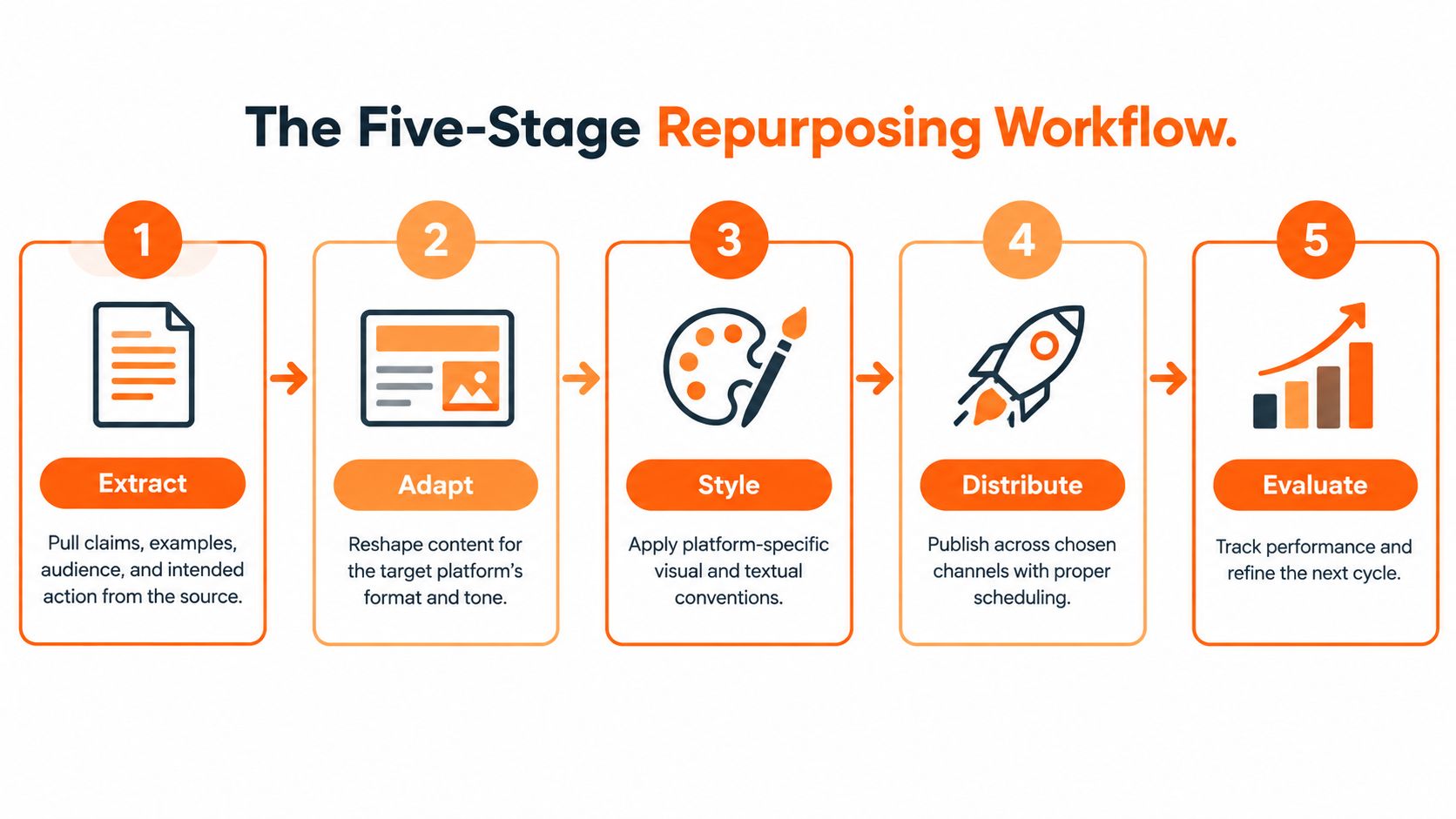
The workflow looks like this when you lay it out end to end.
The Five Stages in Practice
Stage 1, extract. Before generating anything, pull the source apart. List its claims, examples, intended audience, and the action you want readers to take. I keep this as structured notes, claim by claim, with the exact evidence attached to each one. If a claim can't be traced to evidence in the source, it doesn't travel to any derivative.
Stage 2, specify. Write a platform specification for each output before you prompt. Length. Format. Hook style. Call to action. Prohibited elements, like hashtags on a platform where you never use them, or questions you don't want to ask. Most bad AI output I produced early on traced back to skipping this stage and letting the model guess.
Stage 3, generate candidates. Ask for multiple versions, not one. Two or three candidates per platform gives you something to choose between, and choice is where editorial judgment lives. A single output tempts you to accept whatever arrived.
Stage 4, check. Run four checks on every candidate. Factuality against the source. Attribution, so quotes and data still belong to the right people. Tone, against your voice notes. Duplication, so your LinkedIn post and your Note aren't the same paragraph wearing different clothes.
Stage 5, approve. A human signs off on claims before anything publishes. That's you. There's no version of this workflow where that step gets automated away responsibly.
The Acceptance Gate That Matters Most
One gate did more for quality than everything else combined. 100% preservation of numbers, names, and causal qualifiers. If the source says a result "may" happen, the derivative can't say it "will." If a figure applies to a specific group, the derivative can't generalize it. Failed outputs go back for regeneration. They don't get patched with wishful thinking.
Watch how this kind of end-to-end repurposing pipeline operates in practice, then compare it against the checks above.
The failure modes you'll catch most often are predictable. Fabricated details that sound plausible. Weakened hedging that turns nuance into hype. Platform-inappropriate length, usually too long. And semantic drift, where compressing a long argument changes what it says. Fluency proves nothing. A smooth paragraph can be smoothly wrong, which is why I keep a small set of past articles with hand-checked derivatives as a reference. When a new output style feels off, I compare it against those known-good examples before trusting it.
Formatting and Scheduling for Each Platform
A derivative that ignores how a platform distributes content will underperform, no matter how good the writing is. Substack Notes are the clearest example. Publishing a Note doesn't automatically email every subscriber. Notes appear on your publication's Home page, your profile, and in the Substack app, and they may reach readers through digests or push notifications depending on settings, as explained in this breakdown of how Substack Notes reach readers. Treat Notes as discovery and relationship content, not email replacements. Surface one insight, example, or question. Point interested readers toward the full post.
Scheduling makes that sustainable. Substack supports native Notes scheduling on web, iOS, and Android. You compose a Note, pick a time in your local time zone, and edit it later from the Notes Drafts tab until it publishes, per Substack's announcement of Notes scheduling and post templates. That editable window matters. I batch several Notes from one article in a single sitting, spread them across days, and still get to fix the one that reads badly the next morning.
Platform Formatting Quick Reference
| Platform | Ideal Length | Hook Style | Distribution Mechanic |
|---|---|---|---|
| Substack Notes | Short, one idea | A sharp observation or question | Home page, profile, and app discovery |
| Medium, scannable paragraphs | A concrete result or contrarian claim | Feed reach driven by early engagement | |
| X | Concise posts or threads | Your strongest single line first | Fast-moving feed, replies extend life |
| Medium | Full article length | A clear promise in the opening lines | Publication and topic-based discovery |
Cadence data explains why extracting several pieces from one article beats inventing new ideas daily. In Q1 2025, businesses published an average of 18.1 posts per week on X, 5.5 on LinkedIn, and 9.3 on Instagram, and the same dataset recommends approximately 2 to 3 X posts per day and 1 to 2 LinkedIn posts per day, while cautioning that two strong posts a week can outperform 20 mediocre ones, with 6 to 7 high-quality posts per week as a practical sweet spot, according to Hootsuite's research on how often to post on social media. One good article can realistically supply that sweet spot.
If you're still deciding how all of this fits into a wider plan, it helps to find your digital content blueprint before you commit to a posting rhythm. For the tooling side, this comparison of platform-specific formatting and content schedulers lays out what to look for when one dashboard has to handle Notes, posts, and articles without copy-pasting between tabs.
My own batching rule is simple. I write derivatives the day after publication, while the argument is still fresh, and I schedule them across the following week. Writing and distributing on the same day made both worse.
Measuring What Actually Drives Subscribers
Counting derivatives is the easiest metric and the least useful one. Early in the experiment I celebrated producing more posts per article. Then I looked at which of them sent anyone to my subscription page. The overlap was embarrassingly small.
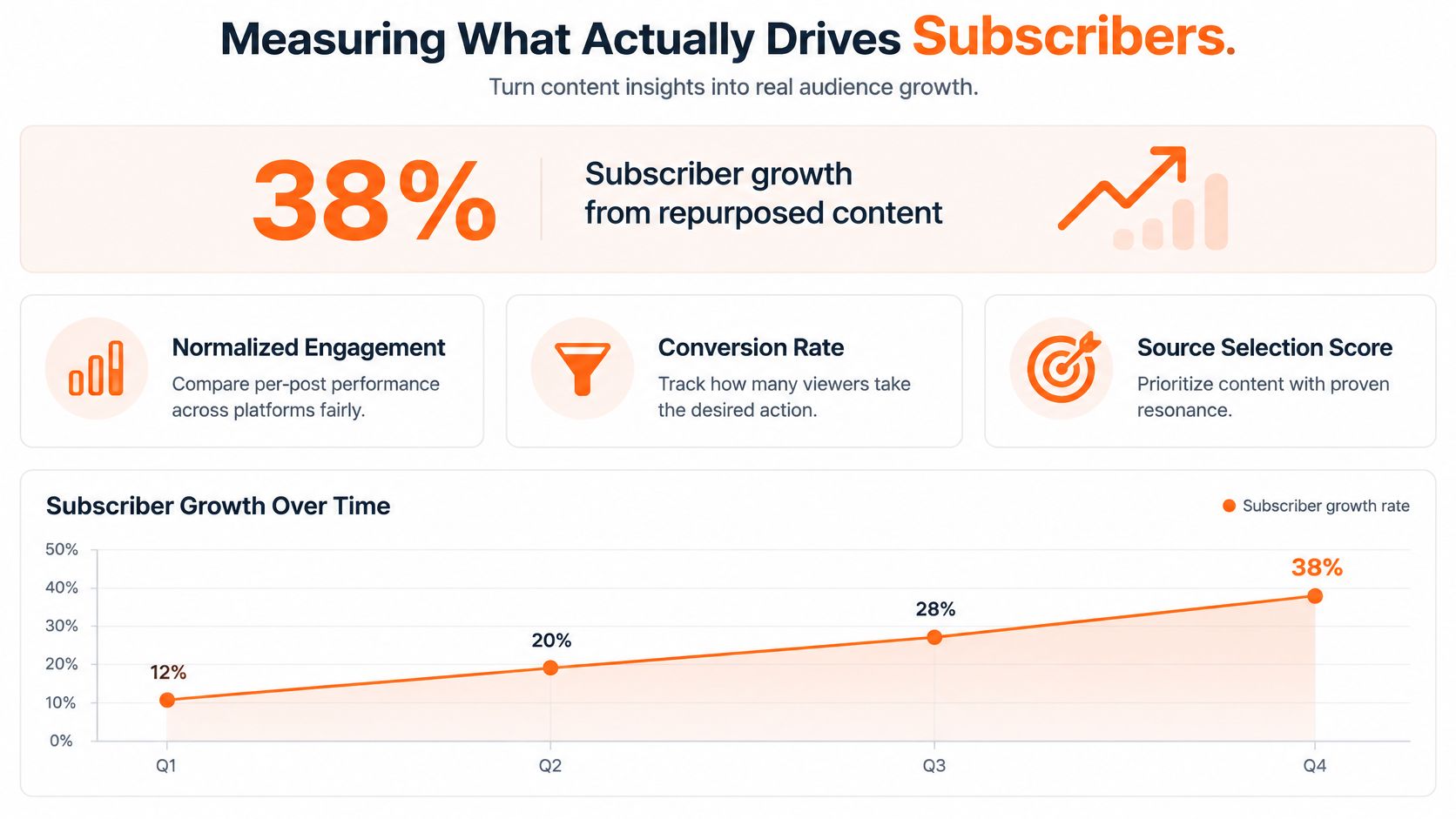
Treat repurposing as a controlled distribution experiment instead. Start by selecting source content with normalized metrics, meaning completion rate, saves, replies, clicks, or subscriber conversions, rather than raw impressions. A post with modest reach but a high save rate is often a better repurposing candidate than a viral piece nobody finished.
The dashboard view below captures the three lenses I now check before calling any derivative a success.
Run It Like an Experiment
Generate channel-specific variants while preserving the source's core claim and audience promise. Then compare three conditions across similar audience windows. Original-only posting. Lightly adapted derivatives. Platform-native derivatives with strong adaptation. Track impressions, engagement rate, qualified clicks, and conversions separately for each, because they tell different stories.
There's a published benchmark worth knowing, with caveats. An internal analysis cited by Donivo reported 114,907 average monthly social views for brands using repurposing versus 45,516 for original-only brands, a 152% visibility difference, across a sample of 258 brands, in Donivo's guide to repurposing content for social media. Treat that as a benchmark, not a causal guarantee. Visibility isn't the same as subscribers, and recycled material can underperform fresh content when it feels less relevant or fails to create curiosity.
- Holdout groups: Keep one platform or time window derivative-free so you have an honest baseline.
- UTM links: Tag every derivative so clicks and conversions trace back to a specific post.
- Multiple cycles: Compare over several posting rounds to reduce timing noise before drawing conclusions.
The feedback loop is the point. Promote the derivatives that generate downstream subscribers, not the ones that collect likes, and feed those winners into your next repurposing brief. If you need the mechanics, this walkthrough on how to track Substack subscriber conversions covers the attribution side in detail.
Reach tells you people saw it. Conversions tell you it was worth seeing. Optimize for the second number and let the first one follow.
Permission, Disclosure, and Trust Boundaries
Most repurposing guides stop at efficiency. They don't answer the question that keeps careful writers up at night. Whose material is this, what do I need to disclose, and what shouldn't leave its original context?
The concern is well founded. An Australian Society of Authors survey found nearly 85% of respondents wanted credit when their work was used to train AI tools, while 87% said neither they nor their publisher had, to their knowledge, granted permission for that use, and only 21% of respondents used generative AI, according to the ASA's 2025 survey on AI, consent, compensation, and credit. Separately, 85% of surveyed creators said audience expectations around disclosure of AI use were increasing or staying the same. Audiences aren't asking for less transparency. Plan accordingly.
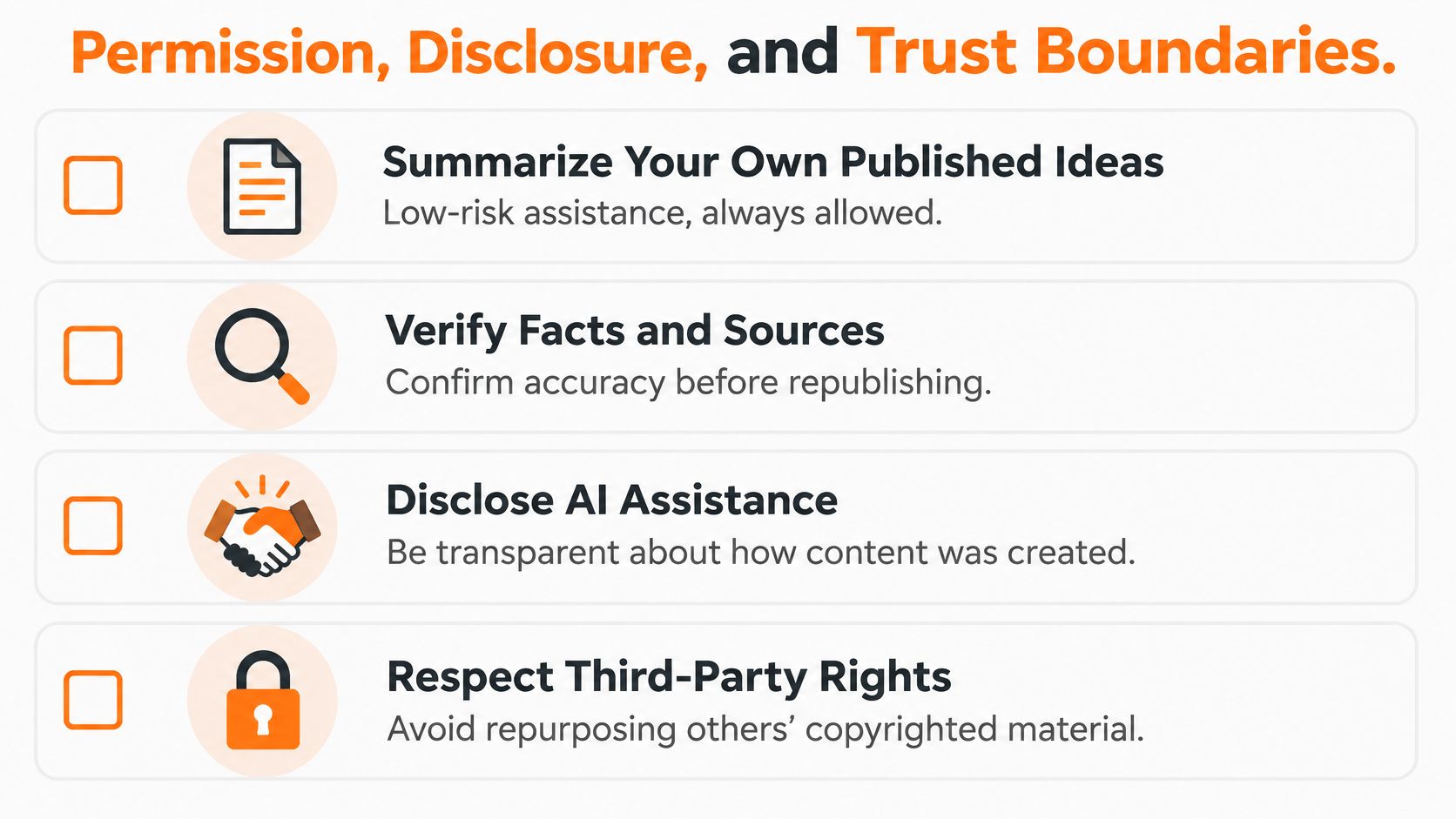
The checklist below separates the routine cases from the risky ones.
A Pre-Distribution Checklist
Low risk is summarizing your own published ideas in your own voice. That's ordinary authorship with mechanical help. Higher risk starts when you clone a living writer's style, reuse client-confidential material, reproduce third-party excerpts beyond fair quotation, or publish synthetic claims nobody verified.
Before any derivative goes out, I run six checks. Ownership, is this mine to reuse. Permissions, does anyone else hold rights in quotes, images, or commissioned work. Factual review, does every claim still match the source. Disclosure, have I been honest about AI assistance where it materially shaped the output. Privacy, does this expose subscriber messages or private details. Attribution, does each platform version credit the right people. Teams building training or enrichment pipelines face the same sourcing questions at larger scale, which is why licensed business data for AI training exists as a category at all.
This isn't just compliance. Transparent authorship is becoming a trust signal as readers grow skeptical of scaled AI content. This perspective on AI-assisted content creation and where human judgment belongs makes the same case from the production side. Writers who disclose clearly and verify carefully will look more credible, not less, as undisclosed automation floods every feed.
Your 20-Week Repurposing Experiment
Here's the whole system compressed into a plan you can start Monday. Pick one high-performing article per week, chosen by saves, completion, or conversions rather than impressions. Extract its claims and evidence. Write platform specifications. Generate candidates, run the four checks, and approve them yourself. Then schedule a repeatable sequence of Notes, LinkedIn posts, and X content across the week.
Batch the scheduling in one session so distribution doesn't fragment your writing days. At the midpoint, around week ten, stop and compare. Which derivatives produced subscribers. Which platforms rewarded deep adaptation over light edits. Which source articles kept giving, and which produced derivatives nobody wanted. Cut the formats that flopped without sentimentality. I dropped two of mine by that point and the experiment got simpler and better.
By week twenty you'll have something more valuable than a content calendar. You'll have evidence about your own audience that no generic best-practice list can give you, plus a library of derivatives that still sound like you.
Two ways to take the next step. If you're ready to run this without juggling tabs, Narrareach can handle the scheduling, tracking, and cross-platform distribution while you keep approval over every derivative. If you're not there yet, stay connected instead. Follow along for the next experiment breakdown, steal the workflow, and run it manually until the manual version hurts enough to automate.
Ready to turn your next article into a week of scheduled Notes, LinkedIn posts, and X content without rewriting it five times by hand? Narrareach repurposes your long-form work into platform-specific drafts, schedules them across Substack, Medium, LinkedIn, and X from one dashboard, and shows you which pieces drive subscribers. Start free, run your first repurposing cycle this week, and let your best ideas work on every platform where your readers already are.