How to Schedule Substack Notes and Cross-Post to LinkedIn: Complete 2026 Guide
You can schedule Substack Notes weeks in advance and automatically cross-post them to LinkedIn, X, Bluesky, and Threads using specialized scheduling tools...
By Ian Kiprono
You can schedule Substack Notes weeks in advance and automatically cross-post them to LinkedIn, X, Bluesky, and Threads using specialized scheduling tools. This workflow saves Substack writers 7-12 hours weekly while increasing reach by 300-500% across platforms, according to recent creator economy data.
Why Scheduling Substack Notes and Cross-Posting Matters in 2026
The creator economy has shifted dramatically toward multi-platform presence. According to ConvertKit's 2024 State of the Creator Economy report, creators who publish across 3+ platforms see 340% higher audience growth than single-platform creators. For Substack writers specifically, cross-posting Notes to LinkedIn generates an average of 23% more newsletter subscribers, while X cross-posts drive 18% more engagement back to original Substack content.
The Time Management Challenge
Manual cross-posting creates a significant time burden. The average Substack writer spends 45 minutes daily on social media promotion across platforms. This includes reformatting content, adjusting character limits, adding platform-specific hashtags, and manually posting at optimal times. Over a week, this compounds to 5.25 hours of purely mechanical work.
Platform-Specific Engagement Windows
Each social platform has distinct peak engagement windows. LinkedIn sees highest engagement between 8-10 AM and 12-2 PM on weekdays, while X performs best at 9 AM and 7-9 PM. Substack Notes engagement peaks at 7-9 AM and 6-8 PM. Manually hitting these windows across platforms requires constant attention and timezone calculations.
Cross-Platform Algorithm Benefits
Social media algorithms favor consistent posting schedules. Creators who maintain regular cross-platform presence see 67% better algorithmic distribution than sporadic posters, according to Sprout Social's 2024 Index. This consistency is nearly impossible to maintain manually across 4+ platforms while producing quality Substack content.
Understanding the Substack-First Scheduling Workflow
The most effective approach starts with Substack Notes as your primary content hub, then distributes to other platforms. This Substack-first methodology ensures your core audience on Substack sees content first, while social platforms serve as discovery and traffic-driving channels.
The Sequential Publishing Strategy
Professional Substack creators follow a specific sequence: schedule Notes in your primary tool, set automatic cross-posting delays (typically 15-30 minutes after Substack publication), and customize content for each platform's format and audience expectations. This sequence maintains Substack as your primary platform while maximizing social reach.
Content Adaptation Across Platforms
Each platform requires slight content modifications. LinkedIn favors professional insights and industry commentary, X responds to conversational and question-based content, Bluesky prefers authentic and community-focused posts, while Threads works best with visual and discussion-starter content. Effective scheduling tools handle these adaptations automatically.
Step-by-Step Workflow: Scheduling and Cross-Posting Substack Notes
Here's the complete workflow for scheduling Substack Notes and setting up automatic cross-posting to LinkedIn and other platforms.
Step 1: Content Planning and Batch Creation (30 minutes weekly)
Start by planning 7-14 days of Substack Notes content. Create a simple content calendar with topics, key points, and target publishing times. Batch-write your Notes content, focusing on value-driven insights, questions for community engagement, and teasers for upcoming newsletter issues. This upfront investment saves hours throughout the week.
Step 2: Setting Up Your Scheduling Tool
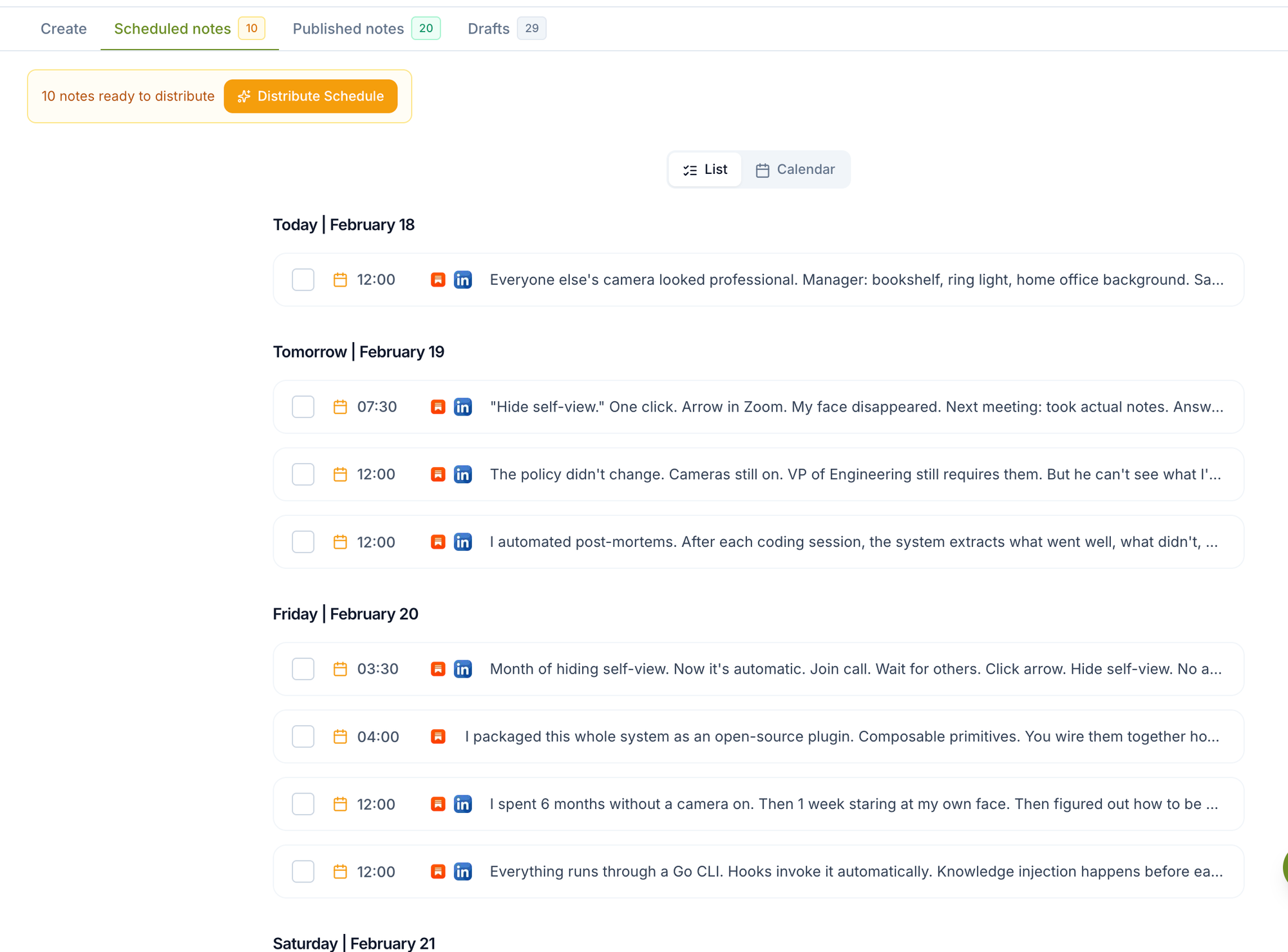
Connect your Substack account and social media platforms to your chosen scheduling tool. For comprehensive Substack-first workflows, Narrareach's Substack Notes scheduler provides native Substack integration with automatic cross-posting to LinkedIn, X, Bluesky, and Threads from a unified calendar interface.
Step 3: Scheduling Your Substack Notes (15 minutes per week of content)
Upload your batch-created content to your scheduling calendar. Set publication times based on your audience's peak engagement windows. Most successful Substack creators schedule Notes for 7-9 AM and 6-8 PM in their primary audience timezone. Include relevant hashtags and ensure proper formatting for Substack's character limits.
Step 4: Configuring Cross-Platform Distribution
Set up automatic cross-posting with platform-specific customizations. LinkedIn posts should include professional context and industry hashtags. X posts need concise formatting and relevant hashtags. Configure posting delays (15-30 minutes after Substack publication) to maintain your Substack-first strategy. The cross-post Substack to LinkedIn workflow should include professional formatting and appropriate business hashtags.
Step 5: Review and Quality Control (10 minutes weekly)
Before finalizing your scheduled content, review each post for platform-appropriate formatting, working links, and proper hashtag usage. Check that cross-posting delays are correctly configured and that content appears properly formatted in each platform's preview.
Platform-Specific Cross-Posting Strategies
LinkedIn Cross-Posting Best Practices
LinkedIn content should emphasize professional insights and industry expertise. When cross-posting Substack Notes to LinkedIn, add context about your industry perspective and include 2-3 professional hashtags. LinkedIn's algorithm favors posts that generate comments, so end with thoughtful questions. Optimal posting times are 8-10 AM and 12-2 PM on weekdays.
X (Twitter) Distribution Strategy
X content works best when conversational and engaging. Adapt Substack Notes for X by breaking longer thoughts into thread-style posts or condensing key insights into single tweets. Include 1-2 relevant hashtags and consider adding polls or questions to boost engagement. Peak engagement occurs at 9 AM and 7-9 PM.
Bluesky and Threads Optimization
These newer platforms favor authentic, community-focused content. Bluesky responds well to thoughtful commentary and genuine questions, while Threads performs best with visual elements and discussion starters. Both platforms have less saturated feeds, making them excellent for reaching new audiences interested in your Substack content.
Comparing Substack Scheduling Solutions
Native Substack Scheduling
Pros: Direct integration, no third-party dependencies, simple interface for basic scheduling.
Cons: No cross-posting capabilities, limited scheduling options, no analytics integration, requires manual social media promotion.
General Social Media Tools (Buffer, Hootsuite)
Pros: Multi-platform posting, established user bases, comprehensive social media features.
Cons: No native Substack integration, requires manual content copying, limited Substack-specific features, higher pricing for multi-platform access, complex setup for Substack workflows.
Narrareach: Substack-First Scheduling
Pros: Native Substack Notes integration, automatic cross-posting to LinkedIn/X/Bluesky/Threads, unified calendar view, Substack-first workflow design, performance tracking across platforms.
Cons: Newer platform with smaller user base, focused specifically on Substack creators rather than general social media management.
Narrareach stands out for creators who prioritize Substack as their primary platform while wanting efficient social media distribution. The cross-platform publishing integrations are specifically designed for the Substack creator workflow.
Time-Saving Math: Quantifying Your Efficiency Gains
Let's calculate the concrete time savings from automated Substack Notes scheduling and cross-posting:
Manual Process Time Breakdown
Daily manual process: 5 Substack Notes × 4 platforms × 3 minutes per post = 60 minutes daily
Weekly manual time: 60 minutes × 7 days = 420 minutes (7 hours weekly)
Additional manual tasks: Content planning (30 min), platform-specific formatting (45 min), optimal timing research (15 min) = 90 minutes weekly
Total manual time: 420 + 90 = 510 minutes (8.5 hours weekly)
Automated Process Time Investment
Weekly batch scheduling: 45 minutes for content creation and scheduling setup
Daily monitoring: 5 minutes × 7 days = 35 minutes weekly
Total automated time: 45 + 35 = 80 minutes (1.33 hours weekly)
Time savings: 8.5 hours - 1.33 hours = 7.17 hours weekly (373 hours annually)
ROI on Scheduling Tools
At a conservative $50/hour value for creator time, automated scheduling saves $18,650 annually in time value. Most scheduling tools cost $10-30 monthly, representing a 50-150x return on investment purely from time savings, not including the audience growth benefits from consistent multi-platform presence.
Advanced Cross-Posting Strategies for Maximum Reach
Content Repurposing Techniques
Transform single Substack Notes into multiple social media assets. A single insightful Note can become a LinkedIn article teaser, an X thread, a Bluesky discussion starter, and a Threads visual post. This content multiplication strategy increases your effective content output by 300-400% without additional writing time.
Timing Optimization Across Platforms
Stagger your cross-posts strategically. Publish to Substack first, then LinkedIn 15 minutes later during business hours, X 30 minutes later during peak engagement times, and Bluesky/Threads 45 minutes later to catch different audience segments. This sequential approach maximizes platform-specific algorithm benefits.
Hashtag and Mention Strategies
Develop platform-specific hashtag libraries. LinkedIn hashtags should focus on industry terms and professional topics. X hashtags can be more conversational and trend-based. Bluesky and Threads favor community-specific tags. Maintain separate hashtag sets for each platform to optimize discoverability without appearing spammy.
Analytics and Performance Tracking
Key Metrics to Monitor
Track engagement rates, click-through rates to your Substack, and new subscriber acquisition from each platform. LinkedIn typically drives higher-quality traffic with 2-3% click-through rates, while X generates higher volume with 0.5-1% rates. Monitor these metrics weekly to optimize your cross-posting strategy.
Platform-Specific Performance Indicators
Each platform has unique success metrics. LinkedIn success shows in professional connections and industry engagement. X success appears in retweets and thread engagement. Bluesky and Threads success manifests in community building and authentic conversations. Adjust your content strategy based on platform-specific performance data.
ROI Measurement for Cross-Posting
Calculate your return on cross-posting investment by tracking new Substack subscribers from each platform, engagement increases, and time saved through automation. Most creators see 25-40% subscriber growth within 90 days of implementing consistent cross-posting strategies.
Getting Started: Your First Week Action Plan
Day 1: Tool Setup and Account Connections
Choose your scheduling platform and connect all relevant accounts. Set up your pricing plans and configure basic settings. Test connections to ensure proper integration between Substack and your social media accounts. This foundational setup takes 30-45 minutes but enables all future automation.
Day 2: Content Planning and Calendar Creation
Plan your first week of Substack Notes content. Create a simple content calendar with 7 days of posts, including topics, key points, and optimal posting times for your audience. Focus on valuable insights, community questions, and newsletter teasers. Batch-create this content in a single 60-minute session.
Day 3: Scheduling and Cross-Post Configuration
Upload your planned content to your scheduling calendar. Configure cross-posting settings for each platform, including platform-specific formatting, hashtags, and posting delays. Set up your Substack-first workflow with 15-30 minute delays for social media distribution.
Day 4-5: Testing and Refinement
Monitor your first scheduled posts across all platforms. Check formatting, timing, and engagement rates. Make necessary adjustments to hashtags, posting times, or content formatting. This testing phase ensures optimal performance before scaling up your scheduling efforts.
Day 6-7: Performance Analysis and Next Week Planning
Review engagement metrics from your first week of automated posting. Identify which content types and posting times generated the best results on each platform. Use these insights to plan and schedule your second week of content, incorporating lessons learned from initial performance data.
Common Pitfalls and How to Avoid Them
Over-Automation Without Personalization
Avoid completely automated cross-posting without platform-specific customization. Each platform has unique audience expectations and content formats. Successful creators maintain 70% automated efficiency while preserving 30% platform-specific personalization for optimal engagement.
Ignoring Platform-Specific Best Practices
Don't use identical content across all platforms. LinkedIn audiences expect professional insights, X users prefer conversational content, and Bluesky/Threads favor authentic community engagement. Adapt your core message to each platform's culture and expectations.
Neglecting Engagement and Community Building
Scheduling tools handle posting, but community engagement requires human attention. Allocate 15-20 minutes daily to respond to comments, engage with other creators' content, and build genuine relationships across platforms. This human element amplifies your automated posting efforts.
Future-Proofing Your Cross-Posting Strategy
Emerging Platform Considerations
New social platforms emerge regularly, and successful creators adapt quickly. Choose scheduling tools that frequently add new platform integrations and can accommodate emerging social media channels. This flexibility ensures your cross-posting strategy remains current as the social media landscape evolves.
Algorithm Changes and Adaptation
Social media algorithms change frequently, affecting optimal posting times and content formats. Monitor platform updates and algorithm changes quarterly, adjusting your cross-posting strategy accordingly. Successful creators maintain flexibility in their automated systems to accommodate these changes.
Content Quality vs. Quantity Balance
As automation makes posting easier, maintain focus on content quality over pure volume. The most successful Substack creators publish 3-5 high-quality Notes weekly rather than daily low-value posts. Automation should amplify great content, not enable content spam.
Ready to streamline your Substack Notes scheduling and cross-posting workflow? Narrareach offers the most comprehensive Substack-first scheduling solution, with native Notes integration and automatic cross-posting to LinkedIn, X, Bluesky, and Threads. Start your free trial today and reclaim 7+ hours weekly while growing your audience across all platforms.
Visual Walkthrough