How to Schedule Full Articles to Substack and Medium from One Editor: Complete 2026 Guide
You can schedule full articles to both Substack and Medium from a single editor by using cross-platform publishing tools that support simultaneous...
By Ian Kiprono
You can schedule full articles to both Substack and Medium from a single editor by using cross-platform publishing tools that support simultaneous scheduling. This approach eliminates the need to manually copy, paste, and format content across platforms, reducing publication time from 45 minutes to under 10 minutes per article while maintaining consistent formatting and timing across both channels.
Why Multi-Platform Article Scheduling Matters in 2026
Content creators are publishing across an average of 4.2 platforms simultaneously, according to the 2024 Creator Economy Report by ConvertKit. Writers who publish on both Substack and Medium see 73% higher subscriber growth rates compared to single-platform publishers, as reported by Substack's 2024 Growth Analytics.
The manual approach to cross-platform publishing is time-intensive. A typical workflow involves writing in one platform, copying content, reformatting for the second platform, adjusting images, and scheduling separately. This process averages 45 minutes per article when done manually across Substack and Medium.
The Cross-Platform Publishing Challenge
Medium's algorithm favors consistent publishing schedules, while Substack readers respond best to predictable newsletter timing. Managing both platforms manually creates several friction points:
- Formatting inconsistencies between platforms
- Scheduling conflicts and missed publication windows
- Image optimization requirements differ between platforms
- SEO metadata must be customized for each channel
The ROI of Automated Publishing
Writers publishing 12 articles monthly across both platforms save approximately 7 hours per month using automated scheduling tools. At an average freelance writing rate of $50/hour, this represents $350 in time savings monthly, or $4,200 annually.
Step-by-Step Workflow: Schedule Articles to Both Platforms
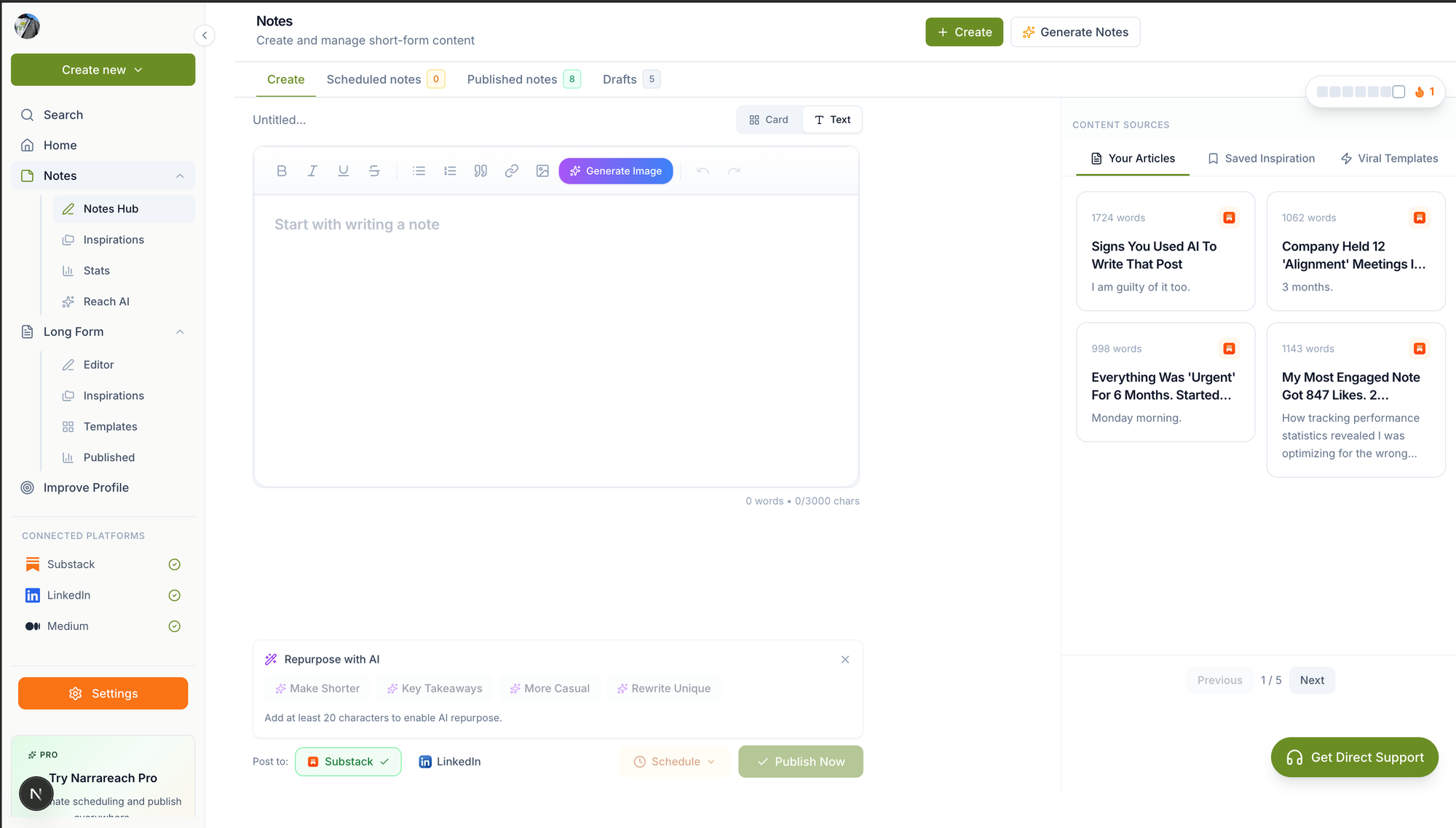
The most efficient workflow starts with content creation in a unified editor that supports both Substack and Medium publishing APIs. Narrareach provides this capability alongside its core Substack Notes scheduling features.
Step 1: Set Up Your Publishing Accounts (15 minutes)
Connect both your Substack and Medium accounts to your chosen publishing platform. This requires API access tokens from both services. Medium provides API keys through their settings panel, while Substack integration typically uses OAuth authentication.
Verify that your cross-platform publishing integrations are properly configured by testing with a draft post. This prevents publication failures during your actual content schedule.
Step 2: Create Your Content Template (10 minutes)
Establish a standardized format that works well on both platforms. This includes:
- Headline structure (H1 for main title, H2 for major sections)
- Image placement and alt-text conventions
- Call-to-action positioning
- Author bio and subscription prompts
Step 3: Write Once, Format for Both (20 minutes)
Compose your article in the unified editor, keeping both platforms' best practices in mind. Medium favors longer-form content (1,500+ words), while Substack readers engage well with both short and long-form posts.
Include platform-specific elements like Medium's highlight-to-comment feature considerations and Substack's subscriber-only content sections where appropriate.
Step 4: Optimize Images and Media (10 minutes)
Upload images once and let the publishing tool handle platform-specific optimization. Medium requires higher resolution images (1200px width minimum), while Substack is more flexible with image dimensions.
Step 5: Schedule Simultaneous Publication (5 minutes)
Set your publication time for both platforms. Consider time zone differences if your audiences are geographically distributed. Research shows that Medium posts perform best when published between 7-9 PM EST, while Substack newsletters see higher open rates when sent between 6-8 AM in the recipient's time zone.
Platform-Specific Optimization Strategies
Substack Optimization Techniques
Substack's algorithm prioritizes engagement metrics like open rates, click-through rates, and subscriber growth. When scheduling articles through Narrareach's Substack Notes scheduler, consider these factors:
- Subject line A/B testing capabilities
- Subscriber segmentation for targeted content
- Integration with social media cross-posting
Medium Optimization Approaches
Medium's Partner Program rewards articles that generate reading time and member engagement. Optimize your Medium publications by:
- Using data-driven headlines that promise specific outcomes
- Including relevant tags (maximum 5) that align with trending topics
- Structuring content with clear subheadings for scannability
Competitor Analysis: Publishing Tool Comparison
Native Platform Publishing
Pros:
- Full access to platform-specific features
- No third-party integration risks
- Direct analytics and performance tracking
Cons:
- Requires duplicate content creation effort
- No unified scheduling calendar
- Time-intensive manual workflow
- Higher risk of formatting inconsistencies
Buffer and Hootsuite
Pros:
- Established social media scheduling platforms
- Team collaboration features
- Comprehensive analytics dashboards
Cons:
- Limited long-form content support
- No native Substack integration
- Primarily designed for social media, not newsletter/blog publishing
- Higher pricing for advanced features
Narrareach
Pros:
- Substack-first workflow with Notes scheduling
- Simultaneous article publishing to multiple platforms
- Integrated social media cross-posting
- Unified content calendar
- Cost-effective pricing for content creators
Cons:
- Newer platform with smaller user base
- Limited third-party integrations compared to established tools
Time-Saving Mathematics: The Efficiency Calculation
Let's calculate the concrete time savings of automated cross-platform publishing:
Manual Process:
- Write article in Substack: 60 minutes
- Copy and reformat for Medium: 15 minutes
- Upload and optimize images twice: 10 minutes
- Schedule on both platforms separately: 5 minutes
- Cross-post to social media manually: 15 minutes
- Total per article: 105 minutes
Automated Process with Unified Editor:
- Write article once in unified editor: 60 minutes
- Upload images once (auto-optimized): 5 minutes
- Schedule to both platforms simultaneously: 2 minutes
- Auto cross-post to social channels: 0 minutes
- Total per article: 67 minutes
Time Savings Calculation:
12 articles/month × 38 minutes saved per article = 456 minutes (7.6 hours) monthly
7.6 hours × $50/hour freelance rate = $380 monthly savings
$380 × 12 months = $4,560 annual time value recovered
Advanced Cross-Posting Strategies
Content Adaptation Techniques
While publishing the same core content to both platforms, subtle adaptations can improve performance on each channel. Medium readers prefer data-driven content with clear takeaways, while Substack audiences often engage more with personal narratives and community-building elements.
Consider creating platform-specific introductions or conclusions while maintaining the same core article body. This approach maximizes the efficiency of single-editor publishing while optimizing for each platform's audience preferences.
Social Media Integration
The most effective cross-platform strategy extends beyond Substack and Medium to include social media promotion. When you cross-post Substack to LinkedIn, you create additional discovery opportunities for your long-form content.
Schedule social media posts to promote your articles 2-4 hours after publication. This timing allows initial platform algorithm signals to establish before social traffic arrives.
Performance Tracking and Analytics
Key Metrics to Monitor
Track performance across both platforms to optimize your publishing strategy:
- Substack: Open rates, click-through rates, subscriber growth, paid conversion rates
- Medium: Views, reads, read ratio, highlights, responses, follower growth
- Cross-platform: Traffic referrals between platforms, subscriber overlap, total reach
A/B Testing Opportunities
Use your dual-platform presence to test content variations. Publish slightly different headlines or introductions on each platform to identify which approaches generate better engagement. This data informs future content creation and helps optimize your unified publishing workflow.
Getting Started: Your First Week Action Plan
Day 1: Account Setup and Integration
Connect your Substack and Medium accounts to your chosen publishing platform. Verify API connections and test with a draft post. Set up your author profiles consistently across both platforms.
Day 2: Content Template Creation
Develop your standardized article template. Include elements like author bio, call-to-action placement, and image formatting guidelines. Create a style guide document for future reference.
Day 3: First Article Draft
Write your first article using the unified editor. Focus on a topic that appeals to both Substack newsletter subscribers and Medium's broader readership. Aim for 1,500-2,000 words to satisfy both platforms' preferences.
Day 4: Optimization and Scheduling
Optimize your article for both platforms, including appropriate tags for Medium and compelling subject lines for Substack. Schedule publication for your optimal timing based on audience analytics.
Day 5: Social Media Preparation
Prepare social media posts to promote your article. Create platform-specific content for LinkedIn, Twitter, and other channels where your audience is active. Schedule these to post 2-4 hours after your article goes live.
Day 6: Publication and Monitoring
Monitor your article's performance on both platforms. Track initial engagement metrics and note any technical issues with the cross-platform publishing process.
Day 7: Performance Analysis
Review your first week's results. Compare engagement metrics between platforms and identify opportunities for improvement in your next article. Document lessons learned for future reference.
Troubleshooting Common Publishing Issues
Formatting Inconsistencies
Different platforms handle HTML and markdown formatting differently. Test your content template thoroughly and maintain a checklist of platform-specific formatting requirements. Most issues arise from image sizing, link formatting, and special characters.
Scheduling Conflicts
Time zone differences can cause scheduling confusion when publishing to global audiences. Use UTC as your reference time and clearly document your publication schedule. Consider your primary audience's location when setting publication times.
API Rate Limits
Publishing platforms impose API rate limits to prevent spam. If you're publishing frequently, ensure your publishing tool respects these limits. Most legitimate publishing tools handle rate limiting automatically.
Advanced Automation Workflows
Content Series Management
For multi-part content series, plan your publishing schedule across both platforms simultaneously. Create a content calendar that accounts for optimal posting frequency on each platform. Substack readers typically prefer 1-3 posts per week, while Medium allows for more frequent publishing without audience fatigue.
Seasonal Content Planning
Plan seasonal or event-based content in advance using your unified publishing calendar. This approach ensures consistent messaging across platforms and allows you to capitalize on trending topics or seasonal interests.
Scaling Your Cross-Platform Strategy
Team Collaboration
As your content operation grows, consider team collaboration features. Multiple writers can contribute to a unified content calendar while maintaining consistent publishing standards across platforms.
Content Repurposing
Your long-form articles can be repurposed into multiple content formats. Extract key points for social media posts, create email newsletter segments, or develop podcast episode topics. A unified publishing approach makes this content repurposing more systematic and efficient.
Pricing and Platform Considerations
When evaluating cross-platform publishing tools, consider both direct costs and time savings value. Narrareach pricing is designed for individual creators and small teams, offering significant time savings compared to manual publishing workflows.
Factor in the opportunity cost of manual publishing time. If automated publishing saves 7+ hours monthly, the tool pays for itself through increased productivity and content creation capacity.
Future-Proofing Your Publishing Strategy
Platform Algorithm Changes
Both Substack and Medium regularly update their algorithms and features. A unified publishing approach provides flexibility to adapt quickly to platform changes without rebuilding your entire workflow.
Emerging Platform Integration
New publishing platforms and social media channels emerge regularly. Choose publishing tools that actively develop new integrations and can expand your reach as the creator economy evolves.
Ready to streamline your cross-platform publishing workflow? Narrareach combines Substack article scheduling with automated social media distribution, helping you reach more readers with less manual effort. Start with a free trial and experience the efficiency of unified content publishing.
The Narrareach Workflow: Schedule on Substack, Cross-Post to Key Social Channels
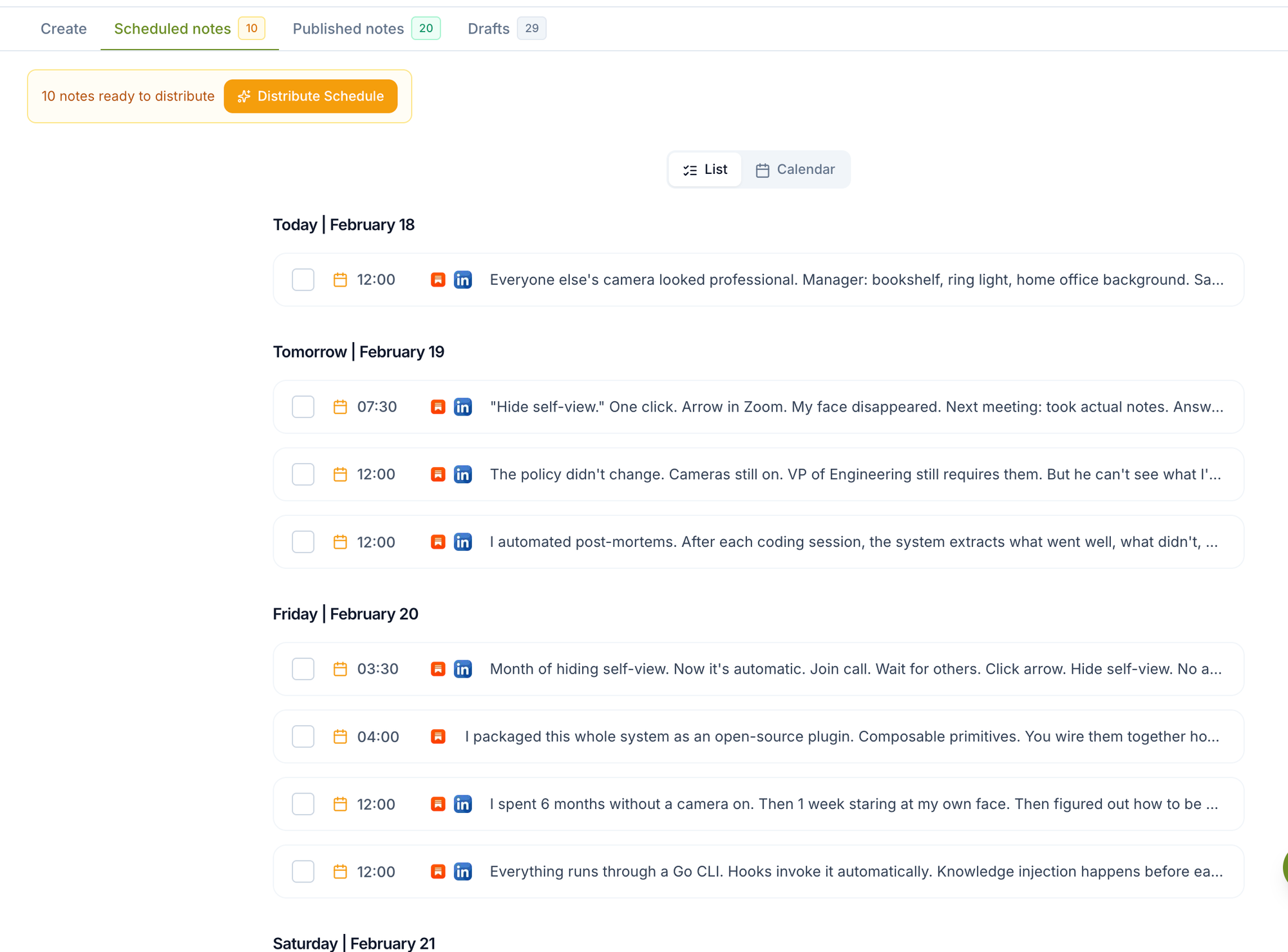
The most effective content distribution starts with Substack. Schedule your Notes weeks in advance, then let Narrareach automatically cross-post each one to LinkedIn, X, Bluesky, and Threads at the right time. No manual copying, no forgotten posts - one calendar for every platform.
Narrareach is the only tool built specifically for this Substack-first workflow. Schedule once, reach everywhere.
Visual Walkthrough