
I Spent 7 Days Systematically Destroying Writer’s Block. Here’s What Actually Worked.
It’s 10 PM. The cursor on the blank page is blinking, a tiny, relentless metronome counting down to your deadline. You had a brilliant idea in the shower...
By Ian Kiprono
It’s 10 PM. The cursor on the blank page is blinking, a tiny, relentless metronome counting down to your deadline. You had a brilliant idea in the shower this morning, but now it's gone, replaced by a dull, humming anxiety. You've been sitting in that chair for 60 minutes, your coffee is cold, and you've written exactly one sentence.
Then the questions start: Is this even a good topic? Am I just repeating what everyone else has said? Am I even a real writer? This isn't just a slow day; it feels like a total system failure. The hardest part isn't the writing—it's the crushing weight of just getting started. Your Substack subscribers and LinkedIn audience are waiting, and all you have is that blinking cursor. That was me, last week.
My 7-Day Experiment to Finally Beat Writer's Block
I hit a wall. Staring at a blinking cursor, feeling that familiar dread, I decided enough was enough. I was tired of the guessing games and the endless frustration that comes with writer's block.
So, I committed to a structured, 7-day experiment. For one week, I would methodically test seven different, highly-recommended techniques to see what actually worked. The goal wasn't just to write more; it was to build a reliable system to make writing feel less like a battle and more like a craft I could control.
Each day, I took on a new strategy—from short, intense 15-minute ‘freewriting’ sprints to completely redesigning my workspace. I tracked my word count, my mood (on a scale of 1-5), and exactly how long it took to get into that elusive state of ‘flow.’
It’s a process most writers know all too well. You start with a great idea, but it quickly spirals into anxiety, and then… nothing. Just a blank page staring back at you.
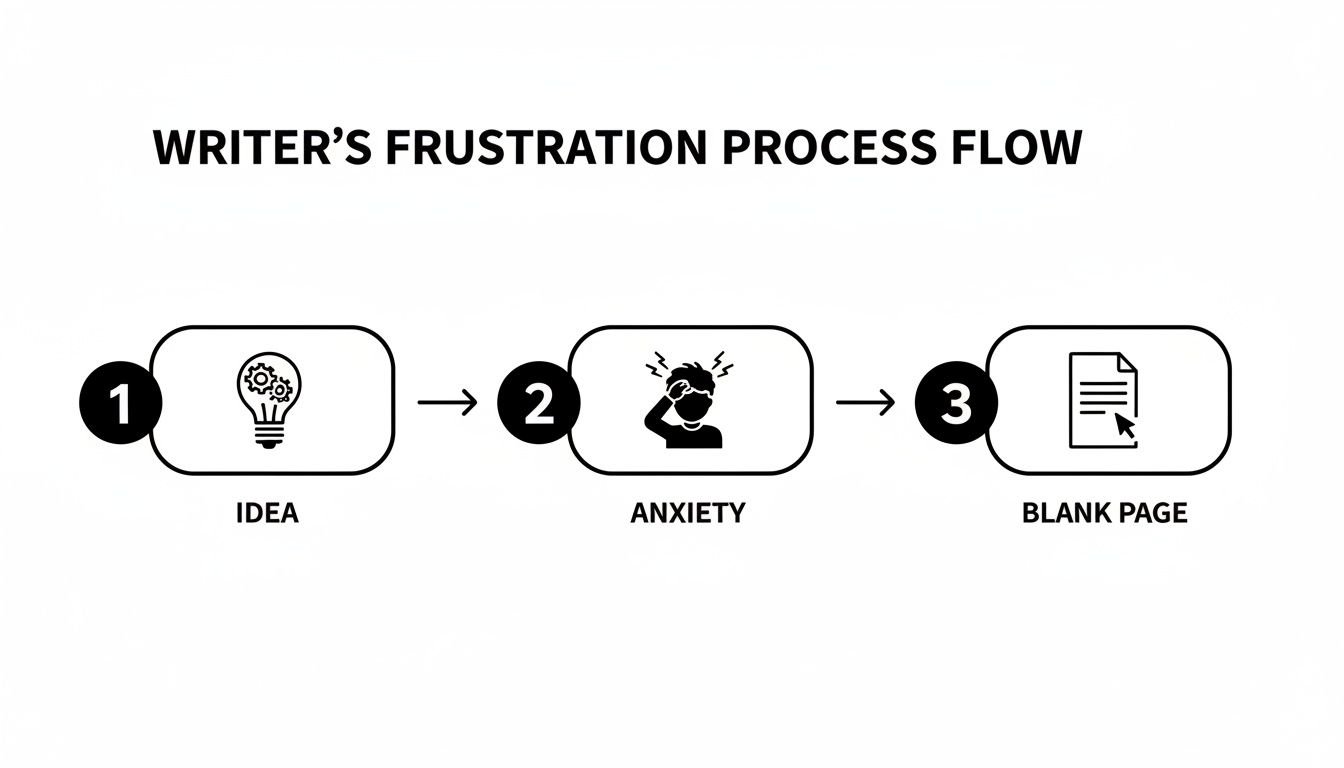
This cycle is exactly what I was trying to break. Some of the tactics I tried were surprisingly effective, while others completely fell flat. The key, I learned, is having a system not just for writing, but for publishing. If your workflow is clunky, it just adds another layer of friction. For example, if you're struggling with getting your work out there, our guide on how to publish on Medium can help you streamline that part of the process efficiently.
Building Momentum with Micro-Writing and Routines
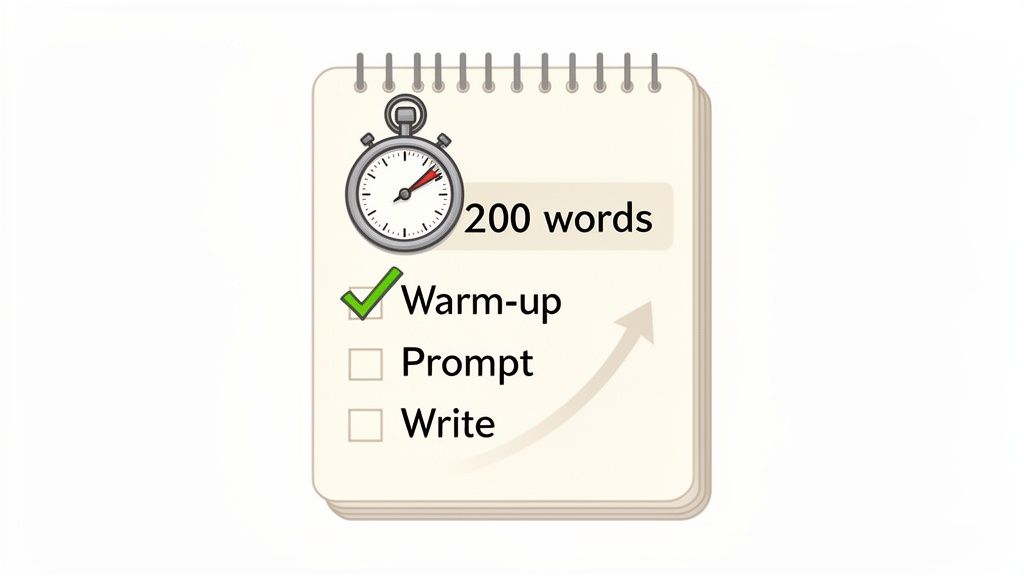
The first three days of my experiment weren't about writing anything brilliant. They were about one thing and one thing only: lowering the barrier to entry so much that it felt impossible to fail. I started with incredibly small, non-intimidating tasks designed to do nothing more than build a little positive momentum.
On Day 1, I set a timer and did two 15-minute ‘freewriting’ sessions, just dumping whatever was in my head onto the page without judgment. For Day 2, I grabbed a few writing prompts to kickstart ideas, completely removing the pressure of my main project. By Day 3, I had a strict pre-writing routine locked in.
It’s easy to feel like writer's block is a personal failing, but the reality is, it's a structural problem we all face. In fact, research shows that a staggering 94% of writers experience it at some point, making this a near-universal challenge. You can read the full research about these findings to see just how common it is.
It's a similar process I used when I documented my experiment on using social media content categories to grow my audience—it all starts with small, repeatable actions.
My 3-Day Micro-Writing Experiment Results
To show you exactly how this played out, here’s a quick look at the tactics I used over the first three days. The goal wasn't a massive word count; it was about shifting my mental state from "stuck" to "moving."
| Day | Tactic | Time Spent | Word Count | Feeling (1-5) |
|---|---|---|---|---|
| 1 | Two 15-min freewrites | 30 minutes | ~450 words | 2 (Anxious) |
| 2 | Three 10-min prompts | 30 minutes | ~520 words | 3 (Neutral) |
| 3 | Pre-writing routine | 25 minutes | ~600 words | 4 (Ready) |
As you can see, the word count wasn't the big win here. The real victory was the shift in my "Feeling" score. By Day 3, the simple act of showing up and completing tiny, manageable tasks had dramatically improved my mindset and made the real work feel much less daunting.
Designing Your Environment to Eliminate Distractions

Halfway through the week, it hit me: my environment was working against me. My desk was a mess, and my browser was a sea of open tabs. It was time for an intervention.
On Day 4, I declared war on digital noise. I performed what I call a "distraction audit"—silencing every single notification on my phone and computer and ruthlessly closing every browser tab that wasn't essential to the task at hand. The sudden, focused silence was almost startling, but the effect on my productivity was immediate.
Then, on Day 5, I turned my attention to my physical space. I cleared everything off my desk that wasn't actively being used, adjusted the lighting to be a bit warmer, and put on a playlist of instrumental music. This isn't just about feeling organized; it's about fiercely protecting your attention.
It's a well-known fact that even a single, minor interruption can completely derail your focus for over 20 minutes. You can get a deeper dive into the cognitive science of this in this detailed overview of writer's block causes. When your brain isn't constantly being pulled in a dozen different directions, the words just flow more freely.
And if you’re juggling multiple projects or platforms, the same principles apply. We actually have some great tips on minimizing digital clutter in our guide on how to manage multiple social media accounts.
Using Frameworks and Smart Tools to Publish Faster
The final piece of the puzzle was to stop reinventing the wheel and build a real system. On Day 6, I ditched the blank page entirely and leaned on a proven content template. This simple shift completely removed the usual guesswork.
This is where Narrareach came into play for me. I dropped a viral-tested framework right into its distraction-free editor, and the mental strain of figuring out a good structure just vanished. It allowed me to focus 100% on the content, knowing the formatting and flow were already handled.
Here’s a look at the clean interface. It let me just focus on getting the words down without any other noise.
Then, on Day 7, I used Narrareach’s smart scheduling to push my finished piece to Substack and LinkedIn with a single click. That move saved me the usual 90 minutes I’d spend manually reformatting and republishing everything for each platform. If you want to grow your audience faster without the burnout, automating your distribution is a game-changer. Our guide on content marketing automation tools is a great next step.
By automating the logistics, all my creative energy went into the writing itself. It was the key to finally breaking the burnout cycle while still growing my audience.
Your Next Move: Two Paths to Beat Writer's Block for Good
You've followed my 7-day experiment, which tells me you're serious about breaking the cycle of staring at a blank page. But insight without action is just entertainment. Let's not let that happen.
You can turn what you've learned into a real, working system. I've laid out two clear paths below. One is for those who are ready to grow their audience on Substack and LinkedIn more efficiently, and the other is for those who just want to keep learning.
The most important thing is to do something. Momentum is the ultimate cure for writer's block. Pick your next step and make a move. Your future readers are waiting.
Your Next Step: High Intent vs. Low Intent
| Choose Your Path | Who It's For | Next Action |
|---|---|---|
| High Intent: Grow Your Audience Faster | You're tired of the struggle and ready to implement a complete writing and publishing system to grow your Substack and LinkedIn audiences efficiently. | Start publishing for free with Narrareach and use the scheduler to publish consistently without the manual work. |
| Low Intent: Keep Learning | You're interested in the concepts but not ready to commit to a new tool. You want more tips and strategies to improve your writing and grow your audience. | Subscribe to our newsletter for weekly, actionable advice on writing, content strategy, and audience growth. |
Whether you're ready to build a full-blown content engine or just want to take the next small step, choosing one of these actions is how you start winning. Pick the path that feels right and let's get you writing.
A Few Lingering Questions
How Long Does Writer's Block Typically Last?
This is the million-dollar question, isn't it? The honest answer is: it varies wildly. It can be a frustrating afternoon or a soul-crushing few months.
In my own 7-day experiment, I found that tiny, consistent actions—like just 15 minutes of freewriting each morning—were the fastest way to break through the inertia. The duration really comes down to the root cause. If you're burnt out, you need a real break. If you're just out of ideas, an afternoon brainstorming session might be all it takes.
Can AI Writing Tools Actually Help?
Yes, but think of them as a creative partner, not a replacement for your own voice.
Tools like Narrareach are fantastic for getting you past that initial blank page paralysis. You can use it to generate 5-10 title ideas instantly or provide a proven, structured template that lowers the mental energy needed to just start. It’s like having a brainstorming assistant on call, handling the structural stuff so you can focus on pouring your unique insights and stories onto the page to grow your audience faster.