
Social Media Management AI: A Writer's Playbook
You finish a strong Substack essay, close the draft, and immediately inherit four more jobs. The idea needs a sharp Note, a useful LinkedIn post, a Medium...
By Ian Kiprono
You finish a strong Substack essay, close the draft, and immediately inherit four more jobs. The idea needs a sharp Note, a useful LinkedIn post, a Medium version, and an X thread, each adapted rather than copied. By the time you've reformatted the same argument, checked links, opened four dashboards, and scheduled the posts, the energy you had for the next essay is gone.
I ran into that loop while testing an AI-driven distribution workflow across Substack, LinkedIn, Medium, and X. AI saved real production time, but only after I stopped treating it as an autopilot publisher. The useful model is assisted distribution, where software handles repetitive transformation and scheduling while the writer protects the argument, voice, context, and reader relationship.
The Four-Platform Posting Trap Every Writer Knows
My typical publishing day started with one finished Substack article and an optimistic plan to “share it everywhere.” The first step was easy. I copied the central idea into a Substack Note, shortened it, removed the newsletter framing, and tried to make it work as a standalone thought. Then I rewrote the same idea for LinkedIn, where a little more context helped, and Medium, where the piece needed enough substance to justify another reading environment.
X created a different problem. A paragraph became a sequence of short claims, but the sequence needed a hook, a logical progression, and a final reason to click. Copying the same text everywhere was faster, yet it produced posts that felt obviously transplanted. Rewriting manually preserved quality, but it turned distribution into a second writing assignment.
A useful overview such as AdManage.ai's social media guide reinforces the operational reality: social publishing involves planning, channel adaptation, consistency, and measurement, not just generating a caption. For an independent writer, each task competes directly with reporting, research, editing, and the next original piece.
The real bottleneck: Writers rarely lack ideas. They lack a repeatable system that moves one good idea into the right formats without draining the person who created it.
The worst part wasn't any single platform. It was the context switching. I moved between editors, checked formatting, adjusted opening lines, and tried to remember which version had already been scheduled. Engagement could be quiet even when the original article was strong, which made the manual effort feel even less justified.
The workflow described in this guide to distributing written content across four platforms starts from the more useful premise: distribution should be designed as a system. That means keeping the source article, creating channel-specific variants, assigning publishing slots, and reviewing results in one loop.
AI helped with the mechanical layer. It did not solve the strategic question of what deserved to travel. That decision still depended on the article's strongest insight, the audience I wanted to reach, and whether a platform-specific version offered something useful rather than another promotional reminder.
What Social Media Management AI Actually Does for Writers
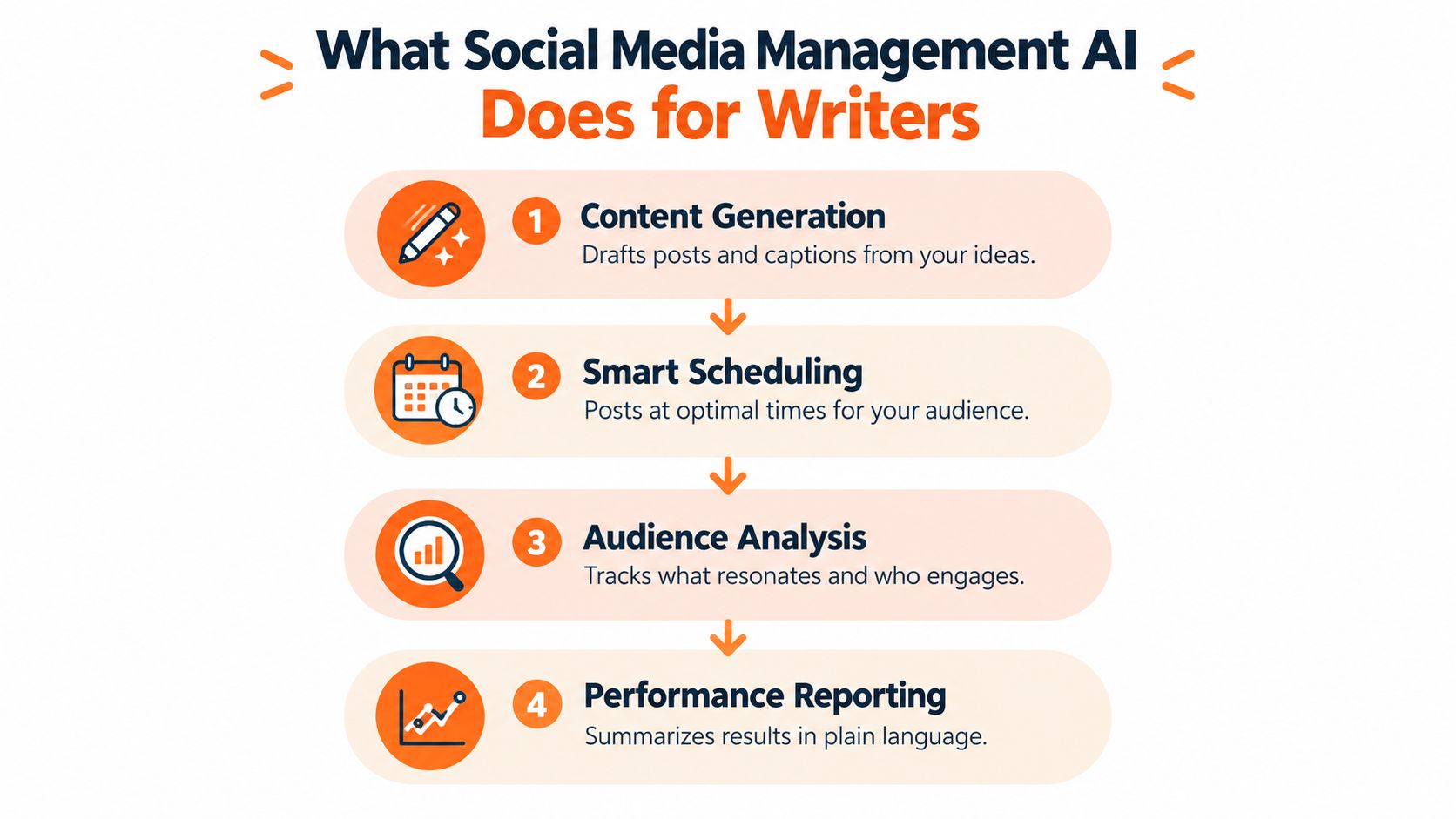
Social media management AI is broader than a text generator. For writers, it works as a distribution crew with four related responsibilities: preparing drafts, adapting formats, placing content on a calendar, and reporting what happened afterward. The writer remains the editor-in-chief.
Content generation
The first layer turns a source article, outline, or approved idea into possible hooks, summaries, questions, and calls to action. This is useful when the writer knows the argument but doesn't want to produce every short-form variation from a blank screen.
The limitation is obvious. A draft can be fluent and still flatten the insight. I used AI to generate options, then selected the version that preserved the article's actual tension. Generic praise, invented personal experience, and unsupported conclusions were removed before anything reached a queue.
Resources about AI-powered social posts can help writers understand the range of generation features available, but the evaluation standard should be practical: does the output reduce editing, or does it create another batch of polished material to repair?
Smart scheduling
Scheduling turns a collection of approved drafts into a publishing sequence. The useful system doesn't merely fill empty calendar slots. It separates formats, spaces related ideas, and lets the writer choose whether a post should go out immediately, wait for a relevant article, or remain a draft.
For Substack Notes, the native workflow supports scheduling on the web, iOS, and Android. On the web, a writer opens the Notes composer and selects the calendar icon. In the mobile apps, the scheduling control sits in the three-dot menu. The scheduled Note remains in Drafts until publication, so it can still be edited before it goes live.
Audience analysis and reporting
The final layers connect publishing to decisions. Instead of asking only whether a post received attention, a writer can ask which source produced qualified clicks, returning readers, or newsletter subscriptions. AI can summarize patterns, but it shouldn't decide what counts as meaningful growth without the creator defining that outcome.
Narrareach's AI social media automation workflow fits this category by combining approved-content repurposing, scheduling, and measurement across a writer's distribution process. The principle applies to any platform: separate ideation from approval, approval from scheduling, and scheduling from interpretation.
Five AI Capabilities That Change a Writer's Week
The first week with an AI workflow can feel productive because fewer tabs are open. The better test is whether the system removes repetitive work without lowering editorial quality. These five capabilities made the largest practical difference in my experiment.
Repurposing from a long-form source
A finished article contains several usable angles, but they aren't interchangeable. One Note may isolate the surprising claim, while a LinkedIn post may explain the professional implication. A Medium version may need a fuller introduction, and an X thread may divide the argument into a sequence.
The benefit is speed at the starting line. The trade-off is sameness. If every output repeats the article's introduction, readers encounter promotion instead of distribution.
Scheduling around a deliberate queue
A queue prevents the common pattern of publishing three variants on one day and then disappearing. It also creates room to revise drafts before they become public. Substack's native Notes scheduler supports future publication and editing in Drafts, but the documented flow centers on scheduling individual Notes rather than native bulk import, queue reordering, or topic organization.
That limitation matters. The efficient process is to maintain the content queue outside the final composer, then enter approved Notes one at a time for scheduling.
Voice-matched drafting
A useful system can draw on prior examples, recurring vocabulary, and explicit constraints. It can preserve a writer's preference for short openings, skeptical analysis, or practical examples better than a generic prompt can.
Voice matching doesn't replace the final pass. The writer still needs to add lived experience, remove bland transitions, and check whether the draft makes a claim they believe.
Comment and sentiment analysis
AI can group incoming replies by topic, urgency, or likely intent. That helps a writer find questions that deserve a response rather than scanning every notification in sequence.
The risk is over-automation. A genuine disagreement, sensitive disclosure, or confused reader may look like a routine message to a classifier. Drafting a response is safer than automatically sending one.
Cross-platform analytics
Cross-platform reporting becomes useful when it follows the reader beyond visible engagement. I would rather know which Note led to a qualified article visit or subscription than celebrate a high count of lightweight reactions with no downstream value.
For writers evaluating technical workflows, NotFair's MCP server for LinkedIn is a useful example of how platform-specific connections can fit into broader automation. The key question remains whether the integration preserves approval and attribution.
| AI Capability | Writer Benefit | Key Trade-off |
|---|---|---|
| Long-form repurposing | Produces platform-specific starting points from one article | Variants can become repetitive |
| Smart scheduling | Keeps approved content moving without manual reminders | Scheduling doesn't guarantee relevance |
| Voice-matched drafting | Reduces first-draft friction | Personal context still requires the writer |
| Comment analysis | Helps prioritize replies and questions | Classifiers can misunderstand nuance |
| Cross-platform analytics | Connects distribution to reader outcomes | Raw platform metrics can distract from subscriptions |
The capabilities compound when they work together. Repurposing creates options, scheduling gives those options structure, and analytics determines which ideas deserve another version. Shiny generation features alone don't create that loop. My longer process for evaluating AI content repurposing starts with the source and ends with measured reader behavior.
A One-Article-to-Four-Platform Workflow in Practice
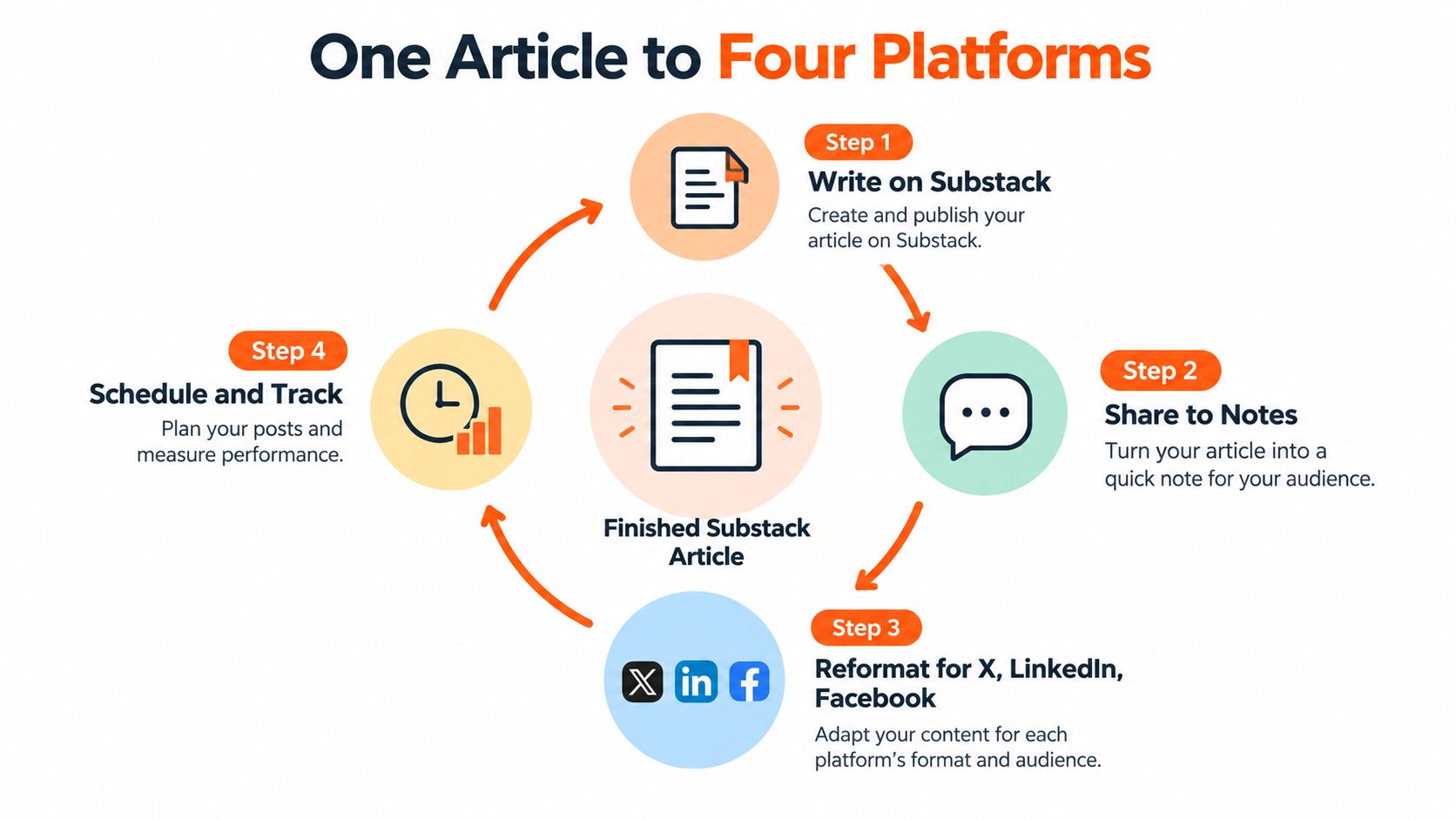
I used one finished Substack article as the source and treated each platform as a different reading environment. The goal wasn't to publish identical copy four times. It was to preserve one argument while changing the entry point, length, rhythm, and reader action.
Start with the source article
I first marked the article's central claim, strongest supporting example, useful objection, and most actionable conclusion. Those became source material, not instructions to reproduce every paragraph. I also recorded the article URL and the intended reader action, such as reading the full piece or subscribing.
This source-first step prevented the AI from inventing a new thesis for every platform. It also made review faster because every draft could be checked against a known argument.
Build the Substack Notes sequence
Notes work best as independent entries because they can appear on a writer's Substack Home, profile, or inside the Substack app. They aren't equivalent to newsletter posts, and a Note doesn't automatically send an email to every subscriber. I therefore used Notes for discovery and conversation, not as a replacement for the full article.
Each Note had one job. The first introduced the tension, another extracted a practical lesson, and a later one asked a question that could produce a useful reply. The native scheduling flow is straightforward: compose the Note on the web and select the calendar icon, or use the three-dot menu on mobile. Scheduled Notes remain in Drafts until publication.
Adapt the other three versions
For LinkedIn, I kept the business or professional implication near the top and used a compact explanation. For Medium, I expanded the article with enough context to make the piece readable on its own, while keeping the original source relationship clear. For X, I divided the idea into a thread with a clear progression, removing sentences that depended on the Substack article's surrounding paragraphs.
AI generated the first variants, but I supplied constraints such as “don't add claims,” “keep the original conclusion,” and “use a different opening from the source.” That reduced the usual copy-paste feel.
Schedule, observe, and revise
I stored each approved version with its platform, source URL, planned time, and intended outcome. A scheduling tool can handle publication, but the queue should still show why each post exists. The workflow in this practical guide to scheduling a post reflects that distinction between preparing content and placing it on a calendar.
The largest time saving came from not rewriting the same article from scratch four times. The largest quality gain came from reviewing the variants together, because repetition was obvious when the drafts sat beside one another.
Why Full Autopilot Publishing Underperforms for Writers
I tested the tempting version of the workflow: generate several posts, approve the tone at a glance, and let the system publish without further involvement. The output was clean enough to pass a superficial review, yet it felt detached from the conversations that made the original article worth sharing.
The sentences were grammatically sound. The weakness was editorial. The posts lacked the small decisions that make a writer recognizable: which detail to emphasize, where to acknowledge uncertainty, and when a reader's question deserves a direct answer instead of another scheduled asset.
A 2025 study using Instagram and Meta experiments compared fully automated AI posts with AI-generated content refined and supported by human interaction. The human-involved workflow produced significantly more interaction, including friend requests, messages, and promotional offers, while the fully automated workflow encountered low engagement and technical problems, as described by the study's publication page.
Editorial rule: Let AI prepare the material. Let the writer decide what deserves to become public.
The practical division of labor is straightforward:
- AI identifies patterns: It can surface recurring themes, suggest formats, and create bounded variations.
- The writer verifies claims: Every factual statement, example, and implication gets checked against the original work.
- AI recommends timing: It can organize the queue and support scheduling decisions.
- The writer chooses context: A timely event, sensitive topic, or reader question may change the right moment.
- The writer owns replies: Conversation carries tone, judgment, and relationship. It is not a formatting task.
The workflow improved when I stopped asking whether AI could run the whole operation. The better question was which tasks had a clear input, a repeatable transformation, and a low cost of correction. Formatting a long article into a draft Note met that test. Automatically answering a vulnerable reader did not.
The same principle applies to Narrareach, which can turn approved articles, newsletters, Notes, or ideas into channel-specific drafts for review, scheduling, and measurement. It belongs in an assisted workflow, where the writer remains responsible after uploading a source file.
Ethics, Authenticity, and Audience Trust
AI saves time only when the trust cost remains visible. In a survey of more than 1,600 social media marketers worldwide, businesses planned to use generative AI for an average of 48% of their social media content by 2026, compared with 39% in 2024, according to the 2024 survey report. The report also found that 90% of businesses using generative AI cited moderate to significant time savings. At the same time, 43% named authenticity as their leading challenge, and 94% expressed concern about misinformation.
Authenticity needs an operational definition
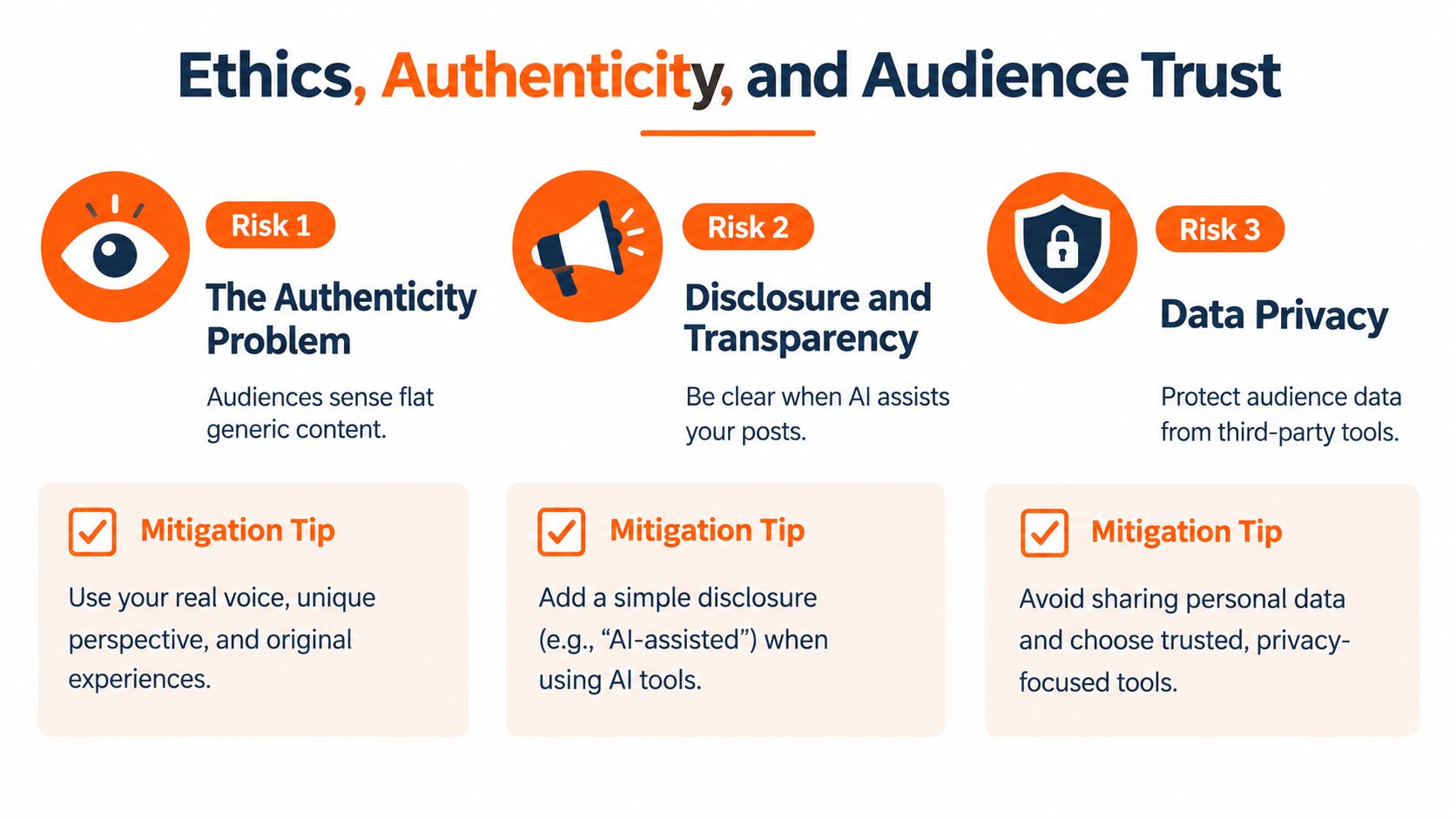
“Be authentic” is too vague for an editorial workflow. A usable standard is more specific: do not claim personal experience the writer did not have, turn uncertainty into confidence, or remove the observations that separate the source from generic advice.
The final human review should ask whether the draft still sounds like the person who wrote the article. If it does not, add a sharper opinion or a real example instead of sending another tone prompt. That judgment matters most when the goal is qualified readers and subscribers rather than a larger pile of posts.
Provenance affects trust
AI-assisted transformation has a different risk profile from AI-generated invention. Converting an original essay into a Note or thread preserves a clear relationship to the source. Asking a system to invent an experience, quote, image, or claim without verification creates a provenance problem.
AI Forensics found that AI-generated imagery represented 25% of TikTok's top search results examined across 13 hashtags in Spain, Germany, and Poland. Its research also found that only about half of TikTok AI content in the study was properly labeled, compared with 23% on Instagram, as documented in its analysis of generative AI content. These figures cover the platform results examined, not every post online. They still show why creators should retain original sources and disclose meaningful AI assistance when it could affect how an audience interprets the content.
Moderation requires escalation paths
AI moderation is more useful for triage than final enforcement. A cross-community evaluation of GPT-3.5 for rule-based moderation reported median accuracy of 63.7%, median precision of 83%, and median recall of 39.8% across subreddits, according to the ICWSM evaluation. The evaluation also reported an out-of-distribution F1 decline from approximately 0.8 to 0.6, showing how performance can deteriorate when the data changes.
A practical guardrail has four parts:
- Classify first: Apply platform and brand rules to incoming content.
- Attach context: Record confidence and the reason for each flag.
- Escalate sensitive cases: Send borderline, high-impact, or vulnerable-topic decisions to a person.
- Measure the right outcome: Track qualified clicks, returning readers, subscriptions, and source attribution alongside visible engagement.
Creators also need to examine ownership. In a global Adobe and Harris Poll survey of more than 16,000 creators across eight major markets, 69% expressed concern about content being used to train AI without permission, as reported in the Adobe and Harris Poll creator survey. Tool selection should therefore cover what audience and source data enters the system, how long it is retained, and whether the creator can preserve a usable record of where each published idea came from.
Your 14-Day AI Distribution Plan and Next Step
Start with one article, not an entire archive.
Days 1 through 7
- Choose a proven source: Select one article with a clear argument, useful example, and reader action.
- Map four formats: Draft a Substack Note sequence, LinkedIn version, Medium adaptation, and X thread.
- Create review rules: Require factual checks, voice review, source links, and a decision about whether AI assistance needs disclosure.
- Build the queue: Store each variant with its platform, purpose, status, and intended publication slot.
Days 8 through 14
- Schedule carefully: Use Substack's calendar control on the web or its mobile scheduling menu, then keep drafts available for revision.
- Publish with participation: Reply to meaningful comments and use reader questions to improve later variants.
- Measure conversion: Compare qualified clicks, returning readers, and subscriptions by source instead of treating likes as the final result.
- Keep the winner: Expand the idea that attracts the right readers, not merely the post that produces the loudest surface response.
A focused content distribution strategy gives this process a repeatable home. The objective isn't to publish more material indiscriminately. It's to help one strong idea find the readers who are most likely to return.
Narrareach helps writers turn approved Substack, Medium, LinkedIn, and X content into channel-specific drafts, schedule posts and Notes, and track which distribution paths drive subscribers and qualified readers. If you're ready to reduce copy-paste work, visit Narrareach to start free without a credit card, or follow along for more writer-first experiments in assisted distribution.