Do Substack Notes Bring Subscribers? 2026 Data From 11,889 Notes
A typical writer gets 4.5 free subscribers per 100 Substack Notes, and most Notes bring none. Benchmarks by list size from 80 writers and 11,889 Notes.
By Ian Kiprono
Quick answer: A typical Substack writer gets about 4.5 free subscribers per 100 Notes. That is the median across 80 writers and 11,889 Notes posted between January and November 2026, counting the subscriptions Substack itself credits to each Note. Most Notes bring no one. For the typical writer, about 1 Note in 22 brings at least one subscriber. A quarter of writers get 12.6 or more per 100 Notes, and a tenth get 27 or more. Writers with 250 or more subscribers get 11.6 per 100.
Many published figures on Notes come from writers sharing their best Notes. This page uses the free and paid subscriptions that Substack attributes to each Note, collected from writers who publish their Notes through Narrareach. Every figure below comes from at least 20 separate accounts.
How many subscribers a Substack Note brings in
| Writers' list size | Median per 100 Notes | Middle half | Top 10% above | Writers |
|---|---|---|---|---|
| Under 250 | 2.9 | 1.1–6.5 | 13.7 | 47 |
| 250 or more | 11.6 | 3.4–25.0 | 41.7 | 30 |
| All writers | 4.5 | 1.6–12.6 | 27.1 | 80 |
What the numbers show
Most Notes bring no subscribers
For the typical writer, 4.5% of Notes brought at least one free subscriber, and the rest brought none. Of the Notes that did convert, 70% brought exactly one. At the median rate, a writer posting 12 Notes a week, which is typical in this data, gains about 0.6 free subscribers a week from Notes, or roughly 2 to 3 a month.
Writers with bigger lists get more from each Note
Writers with 250 or more subscribers got a median of 11.6 subscribers per 100 Notes, four times the 2.9 of writers under 250. They also converted more often: 8.0% of their Notes brought someone in, against 2.9%.
Posting more Notes brought more subscribers each week
We compared writers with fewer than 250 subscribers by how often they posted. Writers posting around 21 Notes a week (24 writers) gained a median of 0.61 free subscribers a week from Notes. Writers posting around 8 a week (23 writers) gained 0.23. Their Notes converted at almost the same rate, 2.6 subscribers per 100 Notes against 3.1. These are different writers, so the comparison can't show that posting more causes growth. It does show that the higher-volume writers kept nearly the same return per Note.
Averages would mislead, so this page uses medians
Two accounts in the sample produced two-thirds of all the subscribers credited to Notes. An average would mostly describe those two accounts. The medians hold up under other samples. Leaving out the three largest contributors keeps the median at 4.5 per 100 Notes, and measuring only Notes with at least 14 days of data gives 3.9.
Paid subscriptions from Notes were rare
Only 8 of the 80 writers had any paid subscription credited to a Note. Paid conversions from Notes were too rare to benchmark.
What made a difference, and what didn't
We also compared each writer's Notes with their own other Notes, to see which kinds converted better. A pattern counts here only if at least 20 writers had 10 or more Notes on each side.
- Posting time made no consistent difference. Morning, evening and weekend Notes converted at about the same rate as each writer's other Notes.
- Length and questions didn't either. Notes longer than a writer's usual length, and Notes that asked a question, converted about as often as the rest.
- Notes that linked to a post brought fewer credited subscribers. Across 23 writers, the median was 2.2 per 100 Notes with a post link against 5.4 for their other Notes, and 65% of those writers did worse with the link. Part of the gap may come from how Substack credits a reader who clicks through and subscribes on the post, so check the post's numbers before giving up on link Notes.
- Images were too rare in this data to say anything.
How this compares with other figures
We searched for published figures on subscribers from Substack Notes since 2023 and kept the ones that state what they measured. Only one other source measures subscribers per Note across many writers.
| Source | What it measured | Sample | Result |
|---|---|---|---|
| This page (Narrareach), January–November 2026 | Free subscribers Substack credited to each Note | 11,889 Notes, 80 writers | Median 4.5 per 100 Notes. About 1 Note in 22 converted. 70% of converting Notes brought 1. |
| Write Build Scale, using WriteStack data, May 2026 | Free subscribers per Note, for Notes posted in April 2026 | 9,641 Notes, 689 writers | The median converting Note brought 1. The best brought 111. |
| Substack, April 2024 | Subscriptions from Notes across the platform in 30 days | Every writer on Substack | More than 230,000 free and 3,000 paid. |
| Substack, October 2024 | Subscriptions the app drove in one month | Every writer on Substack | 3 million from the app and 2 million from recommendations. Notes not reported separately. |
| Finn Tropy, December 2024 | Notes posted per month, by bestseller tier | 1,360,173 Notes, 13,534 writers | Top-tier bestsellers averaged 30 or more Notes a month. No subscriber figures. |
| Timo Mason, January 2026 | One writer's 7-day test | 75 Notes | 5 subscribers from Notes, about 6.7 per 100. |
Where the sources overlap, they agree. Write Build Scale and this page both find that a converting Note usually brings one subscriber and that a few outliers carry the totals. Timo Mason's week of 75 Notes came out at about 6.7 subscribers per 100, close to the 4.5 median here, though it's one writer and one week. He also credited most of his other new subscribers that week to readers who visited his profile after seeing his Notes. Substack's per-Note count misses those readers, so Notes' full effect is probably larger than any of these figures.
Substack's own numbers are platform totals. They show that Notes and the app bring in many subscribers across Substack, but they don't say what one writer's Note brings.
We left some figures out. Claims that writers get 30 to 50% of their subscribers from Notes came without data behind them. Subscription totals said to come from a Substack event in October 2025 haven't been published by Substack. Posts about a single Note that brought hundreds of subscribers are real, but writers tend to share their best results, so those posts describe the exception.
What is a good number of subscribers per Note?
Count the free subscribers your last 100 Notes brought in and compare with writers of a similar size:
- Under 250 subscribers: around 3 per 100 Notes is typical, above 6.5 is the top quarter, and above 13.7 is the top tenth.
- 250 or more subscribers: around 12 per 100 Notes is typical, above 25 is the top quarter, and above 41.7 is the top tenth.
A low number may still be normal for your list size. Before posting less, look at which of your Notes did convert. For the time cost of that volume, see whether you can grow on Substack without living on Notes. Once readers arrive, compare your open rate and paid conversion rate with publications of your size.
How to see which of your Notes bring subscribers
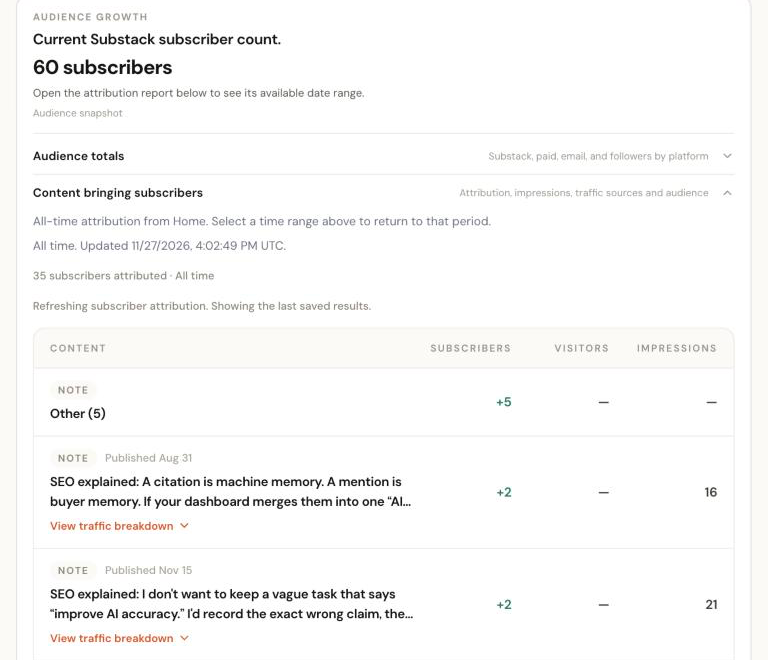
Substack shows subscriptions on each Note's stats, and Notes as a source under Growth in your publication dashboard. Narrareach collects those numbers for every Note it publishes, so you can see which Notes brought free and paid subscribers across weeks and write more like them. To compare your own Notes fairly, use this attribution method.
Methodology
- Source: free and paid subscriptions that Substack attributes to each Note, for Notes that writers published through Narrareach. The figure for each writer is free subscriptions per 100 Notes.
- Sample: 11,889 Notes from 80 writers, posted between January 3 and November 20, 2026. 58 of the 80 writers posted Notes in the last 90 days.
- Included: writers with at least 20 Notes. Each Note's most recent reading, taken at least 7 days after it was posted. Narrareach's own accounts were excluded.
- List size: the writer's most recent Substack subscriber count. Three writers without one count only in the "All writers" row. Each size band includes at least 30 accounts.
- Statistics: medians and percentiles of each writer's rate, so a writer with many Notes or one viral Note can't pull a figure up.
- Privacy: figures are aggregated and de-identified under the Narrareach privacy policy. No writer, publication or Note is identified.
- Limits: this measures Substack's attribution, which credits a subscription to the Note a reader came from. Readers who saw a Note and subscribed later through another route aren't counted, so Notes' full effect is likely larger. The sample is writers who publish Notes through a scheduling and analytics tool, not a random sample of Substack writers. Follows credited to Notes were too rare to report.
- Updates: refreshed monthly. Last updated November 27, 2026.
Frequently asked questions
How many subscribers does a Substack Note bring?
Usually none. The typical writer gets 4.5 free subscribers per 100 Notes, and about 1 Note in 22 brings in anyone at all. Writers with 250 or more subscribers get a median of 11.6 per 100 Notes.
Do Substack Notes help you get subscribers?
Yes, slowly. The typical writer in this data gained about 0.6 free subscribers a week from Notes. Paid subscriptions from Notes were rare: 8 of 80 writers had any.
How often should I post Substack Notes?
Among writers with under 250 subscribers, those posting about 21 Notes a week gained 0.61 subscribers a week from Notes, against 0.23 for those posting about 8. Notes converted at about the same rate at both volumes, 2.6 and 3.1 per 100.
Does the time of day matter for Substack Notes?
Not in this data. Compared with their own other Notes, writers' morning, evening and weekend Notes converted at about the same rate.
Do Substack Notes get sent to subscribers by email?
No. Notes appear in the Substack app and on the web, not in subscribers' inboxes.
Can I use these figures?
Yes. Quote them or reuse the chart with a link to this page. The CSV has the benchmark figures by list size.