
Buffer vs Typefully vs Hypefury for Writers: What I Found Testing 7 Tools for a Month
I ran my real articles and Notes through Buffer, Typefully, Hypefury, Publer, Later, WriteStack and Narrareach in July 2026. Here is what each one could...
By Ian Kiprono
In July 2026 I was spending around seven hours a week getting my writing out. That meant articles and Notes across Substack, Medium, LinkedIn, X, Threads, and Bluesky. I spent the month running that same work through seven tools to find out which of them could take it over.
Summary
- I tested Buffer, Later, Publer, Hypefury, WriteStack, Typefully, and Narrareach from July 1 to July 31, 2026, using my real articles and Notes.
- Buffer, Later, Publer, and Hypefury scheduled short posts well. None of them could publish a full article to Substack, Medium, or LinkedIn.
- WriteStack was good for basic Substack Notes. Typefully handled short posts well and added Substack Notes on July 27. Neither published my full articles to Substack, Medium, or LinkedIn.
- Narrareach was the one tool that published the full articles and the Notes and posts around them from one place, with the formatting intact.
- By my estimate, distribution went from around seven hours a week to about three.
What I tested and how
I did not build a lab test. I used the month's actual publishing: the articles I was writing anyway, the Notes that went with them, and the short posts for each social channel. The comparison came down to one question. Could this tool take a finished article and everything around it, and get all of it published where it belonged?
| Tool | Short posts and Notes | Full articles |
|---|---|---|
| Buffer | Scheduled short posts well | Could not publish one to Substack, Medium, or LinkedIn |
| Later | Scheduled short posts well | Could not publish one to Substack, Medium, or LinkedIn |
| Publer | Scheduled short posts well | Could not publish one to Substack, Medium, or LinkedIn |
| Hypefury | Scheduled short posts well | Could not publish one to Substack, Medium, or LinkedIn |
| WriteStack | Good for basic Substack Notes | Did not publish full articles to Substack, Medium, or LinkedIn |
| Typefully | Handled short posts well; added Substack Notes on July 27 | Did not publish full articles to Substack, Medium, or LinkedIn |
| Narrareach | Published Notes and posts alongside the article | Published the full articles, formatting intact |
The social schedulers stopped at short posts
Buffer, Later, Publer, and Hypefury are built for social publishing, and for that part of my week they worked.
The article was the gap. None of the four could publish a full article to Substack, Medium, or LinkedIn, so the article had to go out somewhere else while its supporting posts sat in the scheduler. One release ended up split across two places.
Can Buffer post to Substack?
Partly. Buffer added Substack Notes in September 2026, after my test, and that integration publishes Notes only. Long-form posts and newsletter issues still go out from Substack's own editor. In July, Buffer scheduled my short posts and could not publish a full article to Substack, Medium, or LinkedIn. If Notes and social posts are all you send, Buffer can now cover that. If the article itself has to go out, you need a tool that publishes articles.
The Notes tools stopped at Notes
WriteStack and Typefully fit a writer's routine more closely. WriteStack was good for basic Substack Notes. Typefully handled short posts well and added Substack Notes on July 27, near the end of my test, so I did not use it for Notes.
My week also included full articles on Substack, Medium, and LinkedIn, and neither tool published those. Typefully does publish X Articles, which is a different format from a Medium story or a Substack issue.
Formatting broke whenever an article left its editor
Whenever an article went through another tool or had to be pasted in by hand, I ended up fixing it. Headings, paragraph breaks, and links were the usual repairs, and they repeat for every destination.
Narrareach published the whole release
Narrareach was the only one of the seven where the full articles and the Notes and posts around them were published from one place. The articles kept their headings, links, and structure, because Narrareach adapts the formatting for each destination.
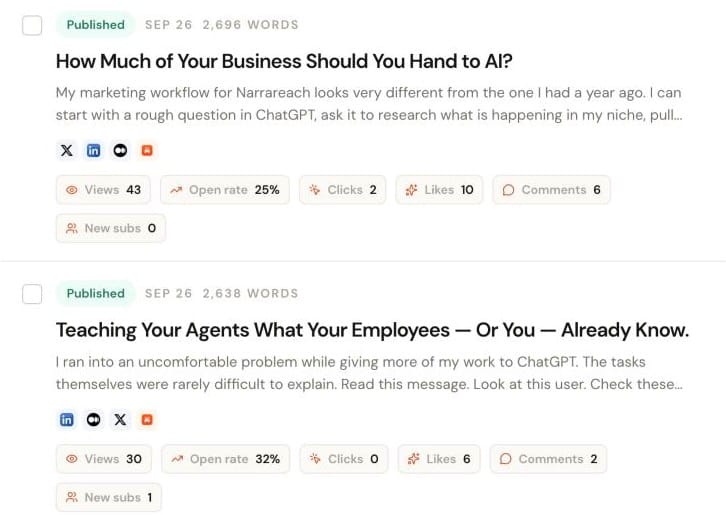
Full articles go to Substack, Medium, and LinkedIn. X Articles need an X account with the required subscription and permissions.
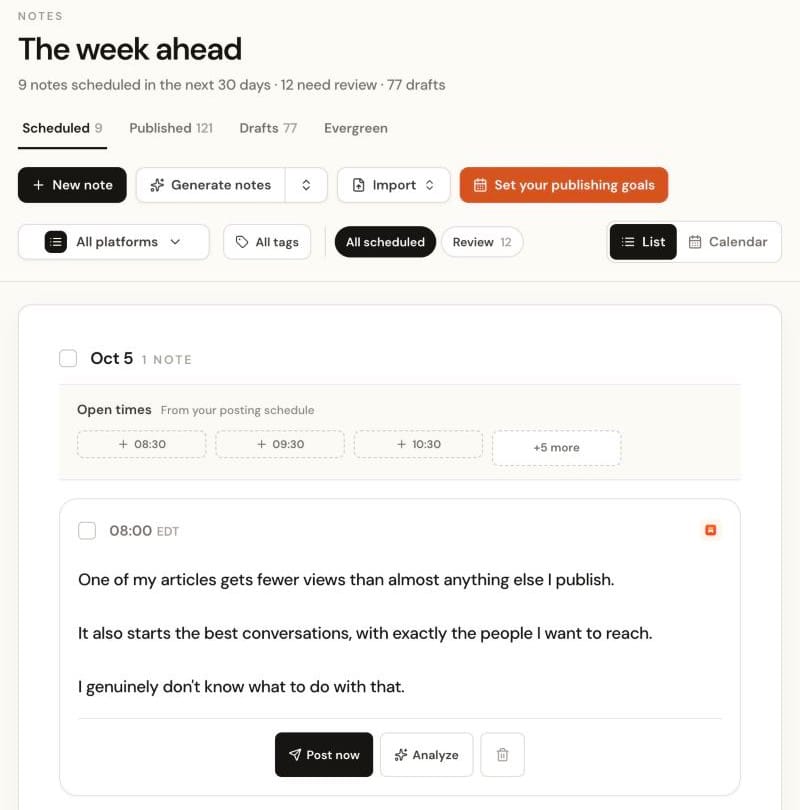
I also scheduled articles through Claude
Part of the month ran through Claude. Narrareach has an MCP connection, so I could ask Claude to schedule an approved article through Narrareach. The guide to scheduling Medium articles with Claude covers the setup.
What it saved
Before July, distribution took me around seven hours a week. With Narrareach it took about three. Both figures are my estimates from living with each routine. I did not time them, so treat them as one writer's experience.
Two things changed. The article no longer went out separately from its posts, and I stopped repairing formatting. If you want to measure your own switch, the guide to measuring distribution automation shows how to set a fair baseline.
The results chose my next topics
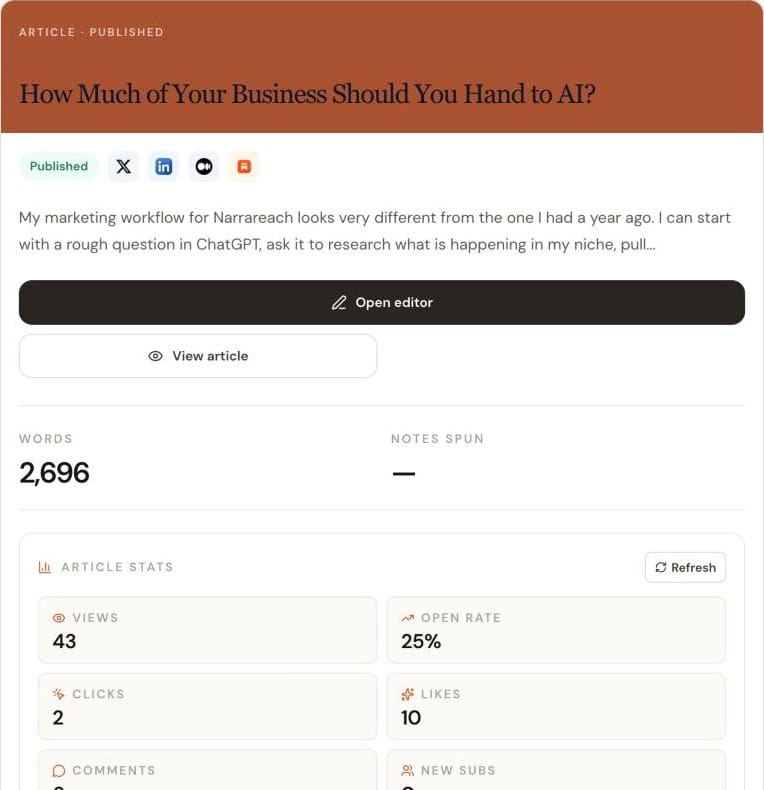
Once everything was published from one place, the results sat in one place too. I used them, along with Narrareach's suggestions, to choose what to write next. Those suggestions draw on your niche, real-time searches, and how your content pillars have performed.
Which tool I would choose for which job
If short social posts are your whole job, a social scheduler will do it, and you may not need to move. If basic Substack Notes are the job, WriteStack covers them, and Typefully now supports Notes too.
I recommend Narrareach when your week starts with an article. It was the one tool in my test that published the article, the Notes, and the posts together, and it gave me back about four hours a week.
To run the same comparison on your own work, follow how to test a cross-platform scheduler. To see the Hypefury comparison in more detail, read Hypefury alternatives for writers.