
Competitor Content Analysis for Writers: A 30-Day Plan
You publish a thoughtful essay, check it twice, and wait. A competitor posts a looser version of the same idea, then collects replies, shares, and new...
By Ian Kiprono
You publish a thoughtful essay, check it twice, and wait. A competitor posts a looser version of the same idea, then collects replies, shares, and new subscribers while your piece disappears after launch day. You start questioning the writing, even though the problem may be elsewhere: your idea stayed on one platform while theirs travelled.
That frustration is common among newsletter writers and solo creators. You can spend days improving a headline while another writer wins through timing, format, repetition, and distribution. The useful question isn't only, “What did they publish?” It's, “Which idea moved, where did it move, and what happened after people saw it?”
Why Your Best Posts Keep Losing to Competitors
I spent months reverse-engineering newsletters that grew faster than mine. At first, I compared writing quality. That was the wrong comparison. The stronger signal was usually the path an idea took: a Substack article became Notes, a LinkedIn post, an X thread, and a discussion in another community.
The competitor's original article wasn't always more insightful. It was just easier to discover, easier to share, and present in more places when the audience was ready for it. A polished essay with no distribution plan has one chance. A strong idea adapted across platforms gets several.
That distinction changes the meaning of competitor content analysis. It isn't just an SEO exercise for teams with large tool budgets. It helps an independent writer answer three practical questions:
- Who is competing for attention? This includes newsletters, publishers, and creators who target the same reader.
- What ideas travel? Look beyond article topics and inspect hooks, formats, timing, and calls to action.
- Where does the idea convert? A post may earn attention on X but generate subscriptions through Substack Notes or LinkedIn.
A site that outranks you for a relevant query can compete for your audience even if it doesn't sell the same product. Databox's 2024 survey found that 47% of respondents identified their actual business competitors as their main search competitors, while 40% defined primary competitors as companies outranking them for relevant keywords (Databox's content marketing and SEO survey). For writers, the broader lesson is straightforward: your competitor may be a newsletter, a magazine, a consultant, or a creator with a different business model.
The useful unit of analysis isn't the competitor. It's the idea and the route it takes to the reader.
I also stopped treating algorithms as mysterious judges. Distribution systems respond to observable behaviour, including engagement, consistency, and audience fit. Narrareach's explanation of how content algorithms work is useful background, but you don't need a specialist tool to start. A spreadsheet containing posts, formats, platforms, dates, reactions, comments, shares, clicks, and subscriber clues will reveal more than a vague list of “top competitors.”
The goal for the next month isn't to copy the writer who is ahead. It's to find the repeatable mechanics behind their reach and turn those mechanics into experiments you can run with your own voice.
The Five-Pass Audit That Maps Your Real Competition
A useful audit starts with your own audience, not a list of famous names. I use five passes because each one removes a different source of bad assumptions.
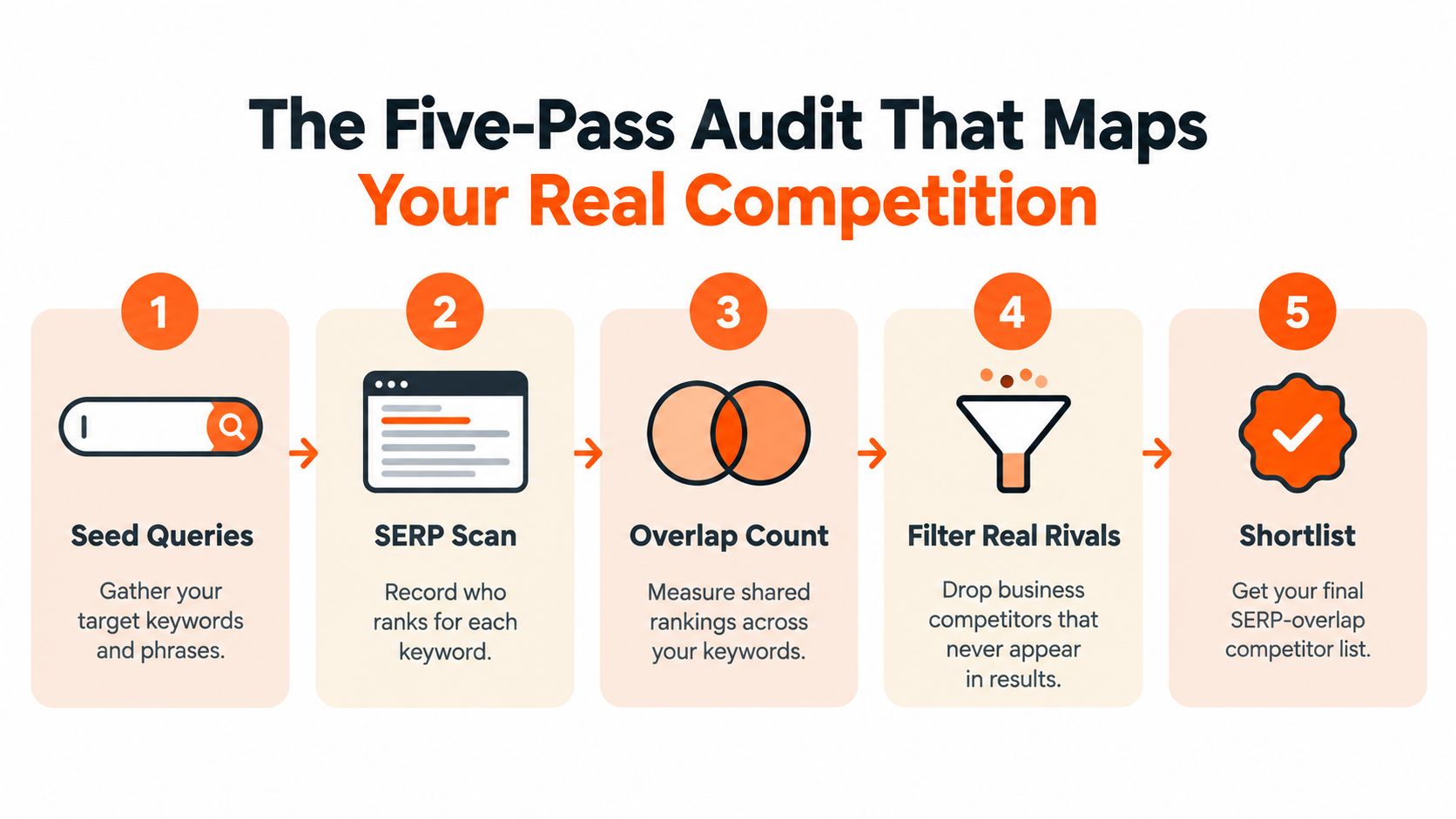
Pass 1 defines the query universe
Export queries from analytics, Google Search Console, and your rank tracker. Add questions readers ask in replies, onboarding forms, and newsletter responses. Record the query, intent, your current rank, page type, and whether a featured snippet or another SERP feature appears.
Don't begin with every keyword you can find. Start with queries connected to your actual themes and audience. A writing newsletter might include queries about publishing cadence, newsletter growth, audience research, and repurposing. The point is to create a universe you can interpret, not a giant export nobody reviews.
Pass 2 identifies SERP overlap
Search the query set and record recurring domains. These are your SERP-overlap competitors, whether or not you consider them commercial rivals. A business competitor that never appears for your audience's questions may be strategically irrelevant to this audit.
For a deeper explanation of audit mechanics, the SEO audit guide for Melbourne businesses offers useful context on examining visibility and site health without confusing an audit with a keyword list.
Pass 3 maps the overlap into clusters
Group competitor-dominant queries by the problem they solve. Then compare the number of relevant pages in each cluster with your own coverage. A cluster with many competitor pages and no useful page from you may indicate a gap, but it isn't automatically an opportunity. Check intent and format first.
Pass 4 reviews the page, not just the keyword
For each important result, capture:
- Structure: headings, examples, tables, media, and navigation.
- Evidence: original research, citations, expert input, and concrete demonstrations.
- Depth: whether the page answers the underlying problem or only mentions the keyword.
- Freshness: publication and update dates, especially for changing subjects.
- SERP fit: whether the page matches the format searchers appear to prefer.
Watch the results over a 4 to 12-week observation window where possible, as recommended in this competitor content analysis workflow. A single search can reflect a temporary ranking shift, news cycle, or publishing anomaly.
Pass 5 creates a ranked backlog
Turn findings into briefs with an owner, target query, hypothesis, required evidence, distribution channel, and one primary metric. Score each opportunity using expected impact, confidence, production effort, and measurement readiness.
The output shouldn't be a folder of competitor URLs. It should be a short queue of experiments you can publish and evaluate. For practical guidance on distinguishing missing topics from weak opportunities, use this guide to identify content gaps.
The video below adds a visual walkthrough of the process and can help you adapt the audit to your own publishing system.
Measuring What Actually Resonates Beyond Vanity Numbers
A large audience makes a competitor visible. It doesn't prove that their content is effective for your goals. I once dismissed a smaller newsletter because its posts attracted fewer visible reactions than a major account. Later, I noticed that its replies were more specific, its calls to action were clearer, and its ideas appeared repeatedly in private recommendations.
The first correction is normalization. Export roughly 3 to 6 months of competitor posts into a consistent dataset, as outlined in this cross-platform competitor research method. Keep the platform, format, topic, hook, length, call to action, publication time, impressions, reactions, comments, shares, clicks, and follower count at posting.
Raw likes are a poor comparison when audiences differ. Calculate engagement per post divided by impressions when reach is available. If it isn't, use follower-normalized engagement. Also calculate engagement per day when publishing cadence affects how often an audience encounters an idea.

Separate patterns from outliers
Rank posts within each competitor and split them into performance tiers, such as the top 10 to 15% and the remaining posts. Inspect the outliers separately. One viral post can make a weak strategy look repeatable, particularly when the post benefited from news, a large mention, or an unusual collaboration.
Survivorship bias creates another trap. If you study only successful posts, you'll assume every visible feature caused the result. Include low-performing content so you can see which topics, formats, and hooks fail consistently.
A study of 473,405 Substack Notes found that creators publishing at least 3 Notes per week had approximately 20% breakout odds per Note, compared with about 18% for creators posting less than weekly (analysis of Substack Notes performance). The difference per post is modest, but cadence changes the number of opportunities an idea gets.
Compare a small creator's normalized response with a large creator's raw totals. The former often tells you more about repeatability.
Add the influence signals you can't see
Public distribution isn't the same as commercial influence. Competitor-facing tools can't reliably observe private newsletter reads, direct visits, dark social, assisted conversions, or subscriber-to-customer journeys. Industry data reports that 63% of enterprise marketers struggle to attribute content ROI and 66% have difficulty tracking customer journeys across touchpoints (content marketing ROI attribution data).
Use an evidence ladder instead:
- Public reach: impressions, rankings, shares, and visible reactions.
- Audience response: qualified replies, questions, and repeat commenters.
- First-party clues: subscriber growth, referrals, clicks, and conversions.
- Self-reported influence: customer interviews, surveys, or replies mentioning the asset.
Track these in a scorecard rather than pretending the competitor's traffic estimate is precise. A practical guide to content performance metrics can help you choose fields that connect attention with subscriber outcomes.
Turning Competitor Insights Into Repurposed Content
Research earns its keep only when it changes what you publish. Treat each promising observation as a testable brief with a clear reason for existing, a distribution route, and one outcome that can confirm or reject the idea.
| Field | What to write |
|---|---|
| Hypothesis | Why this idea or format may work for your audience |
| Target query or reader problem | The specific demand you're addressing |
| Required evidence | Sources, examples, screenshots, or original analysis |
| Distribution path | Substack, Medium, LinkedIn, X, or a sequence across them |
| Primary metric | One outcome that determines whether the experiment worked |
Start with a better version of an idea that already travels. Add stronger evidence, answer an ignored question, replace stale examples, or make the structure easier to scan. Better rarely means longer. It means helping the reader make the relevant decision with less uncertainty.
A second route is a different format. Turn one argument into a Substack Notes series, a LinkedIn post, or an X thread. Keep the central point, then rewrite the opening, pacing, and proof for the platform. A Note should read as a complete thought rather than a paragraph copied from an article.
A third route is a different audience. An essay for independent writers can become a tactical post for a startup content lead or a reflective thread for a creator. The subject remains related, while the stakes, examples, and call to action change.
One idea, four legitimate adaptations
Suppose your audit shows that a competitor's argument about publishing consistency attracts strong responses. Use the underlying demand, not the wording. Build a distinct package:
- Substack: publish the full argument with your own evidence and a clear reader exercise.
- Medium: expand the process into a searchable guide with explanatory headings.
- LinkedIn: frame the idea around an operator's decision, then show a compact example.
- X: break the argument into a sequence in which each post earns the next one.
One idea can support a Notes series, Medium article, LinkedIn carousel, and X thread without becoming repetitive when every version has a separate job. For a full walkthrough of turning one idea into platform versions, see this content repurposing workflow. For practical ways to save hours with smarter repurposing, use a repeatable process for adapting the core argument without copying it mechanically.
Rank experiments before production
Give every brief a practical priority. Put high-impact, high-confidence, low-effort experiments first. An idea with strong audience evidence but heavy research requirements may belong later in the calendar, while a format adaptation can ship quickly and reveal whether the concept has distribution potential.
Narrareach is one option for writers who want to schedule Substack Notes, Medium articles, LinkedIn posts, and X content from one dashboard, while tracking cross-platform signals and adapting long-form work into platform-specific posts. The tool can reduce coordination work, but it cannot decide whether an idea deserves publication.
Keep the original insight visible in every brief. Inspiration identifies the opportunity. Your experience, evidence, and point of view create the asset. That distinction protects your voice and gives readers a reason to subscribe instead of consuming another imitation.
A Real 30-Day Publishing Rhythm Built Around What Already Works
A backlog earns its place when it controls what ships next. A 30-day cycle gives writers enough time to spot distribution patterns while preserving pressure to publish. Each week needs one anchor idea, several platform-specific adaptations, and one measurement question that can change the next decision.
Substack offers a useful cadence benchmark. Reported launch-week data indicates that writers who published at least 3 Notes during launch week gained 50% more subscribers than writers who did not reach that frequency (Substack Notes launch-week benchmark). Treat that result as a comparison point, not a universal publishing rule. Add launch cadence to the competitor dataset and check whether the same pattern appears among writers in your category.
The schedule below treats Notes as distribution with a job to do. One Note can introduce the anchor idea, challenge an assumption, answer a reader question, or direct readers to the full piece. Adapt the argument for each platform instead of copying the same promotion everywhere.
| Week | Anchor | Short-Form Outputs | Cadence Target | Primary Metric |
|---|---|---|---|---|
| Week 1 | Publish the strongest backlog experiment on Substack | 3 Substack Notes, 2 LinkedIn posts, 1 X thread | At least 3 Notes during launch week | New subscribers |
| Week 2 | Adapt the anchor for a Medium audience | 3 Notes, 2 LinkedIn posts, 2 X posts | 3 Notes across the week | Qualified replies |
| Week 3 | Publish a contrasting angle or audience-specific version | 3 Notes, 1 LinkedIn carousel, 1 X thread | 3 Notes across the week | Clicks to the anchor |
| Week 4 | Repackage the best-performing argument | 3 Notes, 2 LinkedIn posts, 2 X posts | 3 Notes, then review results | Subscriber conversion |
Use a repeatable weekly sequence
Publish the anchor on the first day, then write a Note stating its sharpest claim. Follow with a practical example the next day. Midweek, answer the objection that appeared most often in replies. Later, share a different excerpt or counterpoint. Repeating the headline rarely adds distribution value.
Prepare the sequence in one sitting. Keep the source paragraph, platform version, planned date, and target metric together. That small operating habit prevents a common failure: publishing the article, then abandoning distribution while the next idea takes over.
Research on more than 9,000 Instagram posts from five major U.S. and U.K. news organizations during 2023 found associations between posting frequency, mentions, consistent thematic hashtags, and user interaction. The study also found that a larger audience did not automatically produce higher relative engagement. The practical takeaway is to schedule consistently and compare normalized outcomes, rather than copying the biggest account in the dataset.
A 2026 peer-reviewed study reported positive relationships between posting consistency and follower engagement, including average monthly likes with β = 0.326, p < 0.01 and comments with β = 0.234, p < 0.01 (study of creator consistency and engagement). Use those coefficients to justify a test, not to forecast your account's result. Instagram findings can inform a distribution hypothesis, while Substack, Medium, LinkedIn, and X still require platform-specific measurement.
At month-end, retain ideas that generated qualified replies, subscriber action, or repeatable normalized engagement. Archive weak performers without treating one result as a final judgment on the writing. The next cycle should promote the arguments that travelled, then test a new variation against the same metric.
Checking If Your Ideas Survive AI-Mediated Discovery
Search ranking no longer tells the whole discovery story. A competitor may rank well but never appear when a reader asks an AI assistant for a direct recommendation. Another creator may own the underlying claim because their explanation is thorough, current, and easy to summarize.
A meta-analysis covering 19 studies and more than 10,000 AI-generated responses found a strong correlation between in-depth content and AI-search visibility, estimated at about 94%. At the same time, only 15 to 33% of Google's top-five results also appeared in AI-generated answers (analysis of AI search visibility). The figures don't make search rankings irrelevant. They show why rankings alone are an incomplete competitor benchmark.
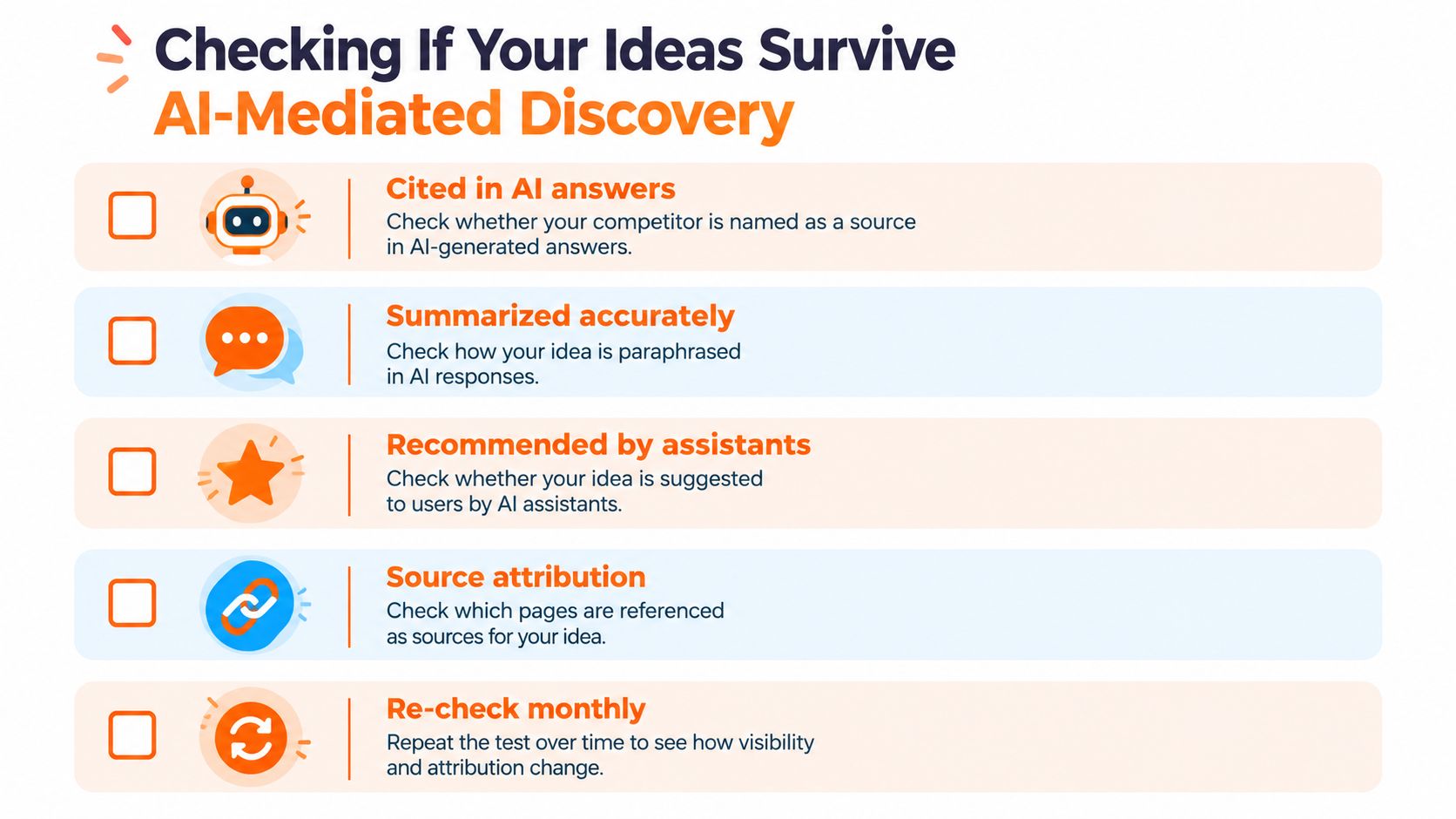
Run a small monthly test with the same prompts:
- Which competitor is cited? Record the named source and linked page.
- Is the idea summarized accurately? Compare the assistant's wording with the competitor's actual claim.
- Does the assistant recommend the source or idea? Note whether it appears as a reference, explanation, or suggested next step.
Build a distribution-resilience record
For each important idea, record citation frequency, claim ownership, source freshness, platform-specific engagement, and the path from discovery to subscription. Then test whether the core point survives adaptation into a Substack Note, Medium article, LinkedIn post, or X thread.
A compact guide to getting cited by AI assistants can help you think about source attribution without reducing the work to keyword placement. Your own text analytics workflow can add another layer by comparing recurring claims, themes, and language across the content you audit.
The habit matters more than the tool. Recheck monthly, preserve the prompt, and record what changed. A ranking can fluctuate. A repeatedly cited claim indicates that your idea has become easier for answer engines to retrieve and explain.
What I Would Actually Do Next and How to Stay in Touch
I wouldn't run a massive audit and wait for certainty. I'd choose a focused set of SERP-overlap competitors, collect a manageable observation window, and publish the first experiment before the research feels complete.
Each month, I would track only five numbers:
- Qualified replies
- New subscribers
- Clicks from distribution posts
- Normalized engagement
- Publishing cadence
Those measures won't reveal every influence path. Private recommendations, direct visits, newsletter reads, and assisted conversions remain difficult to observe from the outside. That's why competitor content analysis should produce hypotheses, not false precision.
For the next 30 days, choose one winning idea, adapt it for Substack, Medium, LinkedIn, and X, and schedule the versions before you start another long-form draft. If the idea earns a meaningful response, build the next cycle around its argument rather than abandoning it because the first article's likes were modest.
Narrareach helps writers turn competitor and content-performance signals into a practical distribution plan, with scheduling for Substack Notes, Medium articles, LinkedIn posts, and X in one place. If you're ready to reduce manual repurposing and publish the next 30-day experiment consistently, visit Narrareach to start free, or follow along for more practical audience-growth experiments before choosing a tool.