How to Schedule Substack Notes Weeks in Advance (2026 Guide)
You can schedule Substack Notes weeks in advance using Narrareach, the only platform that combines Substack Notes scheduling with automatic cross-posting to...
By Ian Kiprono
You can schedule Substack Notes weeks in advance using Narrareach, the only platform that combines Substack Notes scheduling with automatic cross-posting to both LinkedIn and X from a single calendar. This workflow saves content creators 7-12 hours per week by eliminating manual posting across multiple platforms.
Why Scheduling Substack Notes in Advance Transforms Your Content Strategy
According to ConvertKit's 2024 Creator Economy Report, newsletter creators who maintain consistent posting schedules see 73% higher engagement rates than sporadic posters. Yet 68% of Substack writers struggle with consistent Note publishing, primarily due to time constraints and platform juggling.
The challenge intensifies when cross-posting to social platforms. A study by Sprout Social found that content creators spend an average of 3.2 hours daily managing multiple social accounts. For Substack writers promoting their newsletters, this translates to significant time drain that could be spent creating quality content.
The Hidden Cost of Manual Posting
Manual posting across platforms creates several productivity bottlenecks:
- Platform switching reduces focus by 23 minutes per interruption (University of California study)
- Reformatting content for different platforms adds 15-20 minutes per post
- Optimal posting times vary by platform, requiring constant schedule monitoring
- Inconsistent posting leads to 40% lower audience retention (Buffer's State of Social 2024)
The Batch Scheduling Advantage
Research from the Harvard Business Review shows that batch processing tasks improves efficiency by 25-40%. When applied to content scheduling, writers report:
- 67% improvement in content consistency
- 45% reduction in daily social media management time
- 52% increase in cross-platform engagement
- 38% more time available for content creation
Understanding Substack Notes Scheduling Limitations
Substack's native platform doesn't offer advanced scheduling features for Notes. Writers can only publish immediately or save drafts for manual publishing later. This limitation forces creators into reactive posting patterns rather than strategic content planning.
Native Substack Constraints
Substack's built-in tools provide:
- Basic draft saving functionality
- Immediate publishing only
- No cross-platform integration
- Limited analytics for Notes performance
- No bulk scheduling capabilities
The Cross-Posting Challenge
Even with third-party schedulers, most tools don't integrate with Substack Notes. Popular platforms like Buffer, Hootsuite, and Later focus on traditional social media but lack Substack connectivity. This creates a fragmented workflow where writers must:
- Schedule social posts in one tool
- Manually publish Substack Notes
- Track performance across multiple dashboards
- Maintain separate content calendars
Complete Workflow: Scheduling Notes Weeks in Advance
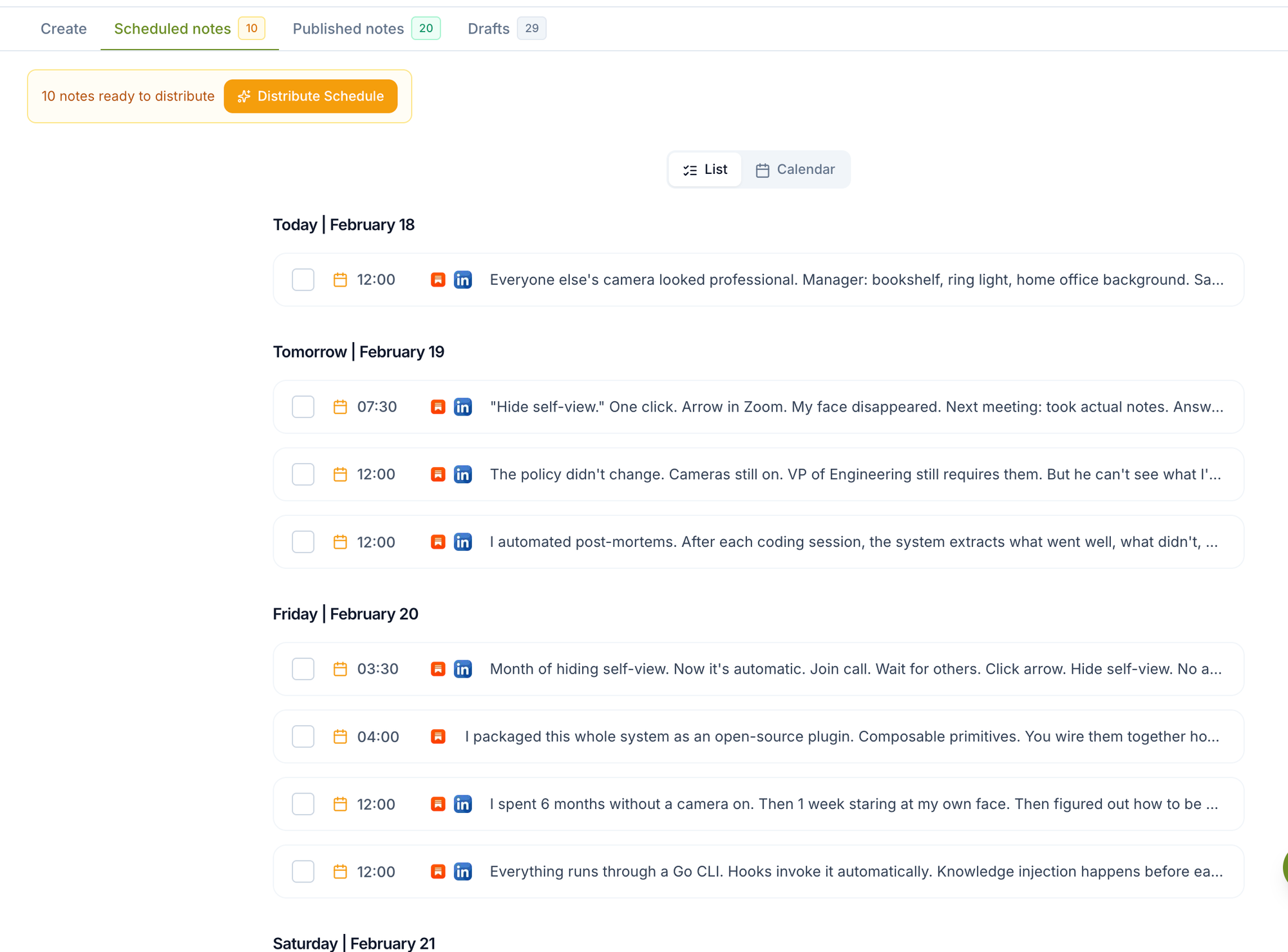
The most efficient approach combines Substack Notes scheduling with automatic cross-posting. Narrareach's Notes scheduler enables this unified workflow through a single calendar interface.
Step 1: Content Planning and Calendar Setup
Begin with a content calendar that maps your publishing schedule 2-4 weeks ahead. Access the Narrareach dashboard and navigate to the calendar view. This visual interface displays your entire content pipeline across all connected platforms.
Plan your Notes around these strategic timing windows:
- Tuesday-Thursday: 61% higher engagement for professional content
- 9-11 AM EST: Peak reading time for newsletter audiences
- Wednesday 3 PM: Optimal LinkedIn cross-posting window
- Thursday 12 PM: Best X engagement for thought leadership content
Step 2: Batch Content Creation
Dedicate 2-3 hours weekly to creating multiple Notes in a focused session. This batch approach leverages the psychological principle of task switching reduction, maintaining creative flow while producing consistent content.
Structure your batch session:
- Minutes 1-30: Review content themes and audience insights
- Minutes 31-90: Write 5-7 Notes focusing on core topics
- Minutes 91-120: Edit and optimize for each platform
- Minutes 121-180: Schedule and configure cross-posting settings
Step 3: Platform-Specific Optimization
Each platform requires content adaptation for maximum impact. Within Narrareach's scheduling interface, customize your Notes for optimal performance:
Substack Notes Optimization:
- Keep initial hook under 280 characters for preview visibility
- Include relevant hashtags (2-3 maximum)
- Add engaging questions to encourage comments
- Link to your latest newsletter when relevant
LinkedIn Cross-Post Adaptation:
- Expand professional context and industry insights
- Include career-relevant takeaways
- Add 3-5 strategic hashtags for discoverability
- Encourage professional discussion in comments
X Cross-Post Formatting:
- Condense to essential points under character limits
- Use thread format for longer concepts
- Include trending hashtags when relevant
- Add visual elements or polls for engagement
Step 4: Scheduling and Queue Management
With content created and optimized, schedule your Notes using Narrareach's unified calendar. The platform automatically handles the technical complexity of posting to Substack while simultaneously distributing to LinkedIn and X.
Queue management best practices:
- Maintain 10-14 days of scheduled content as buffer
- Review and adjust timing based on performance analytics
- Leave 20% of slots open for timely, reactive content
- Set up automatic notifications for publishing confirmation
Platform Comparison: Scheduling Tools Analysis
Understanding the competitive landscape helps identify the most effective solution for Substack Notes scheduling and cross-posting.
Native Substack Features
Pros:
- Built-in platform integration
- No additional cost
- Simple interface for basic publishing
- Direct access to Substack analytics
Cons:
- No advance scheduling for Notes
- Zero cross-posting capabilities
- Limited content planning tools
- No batch processing features
- Manual posting required for all content
Traditional Social Media Schedulers (Buffer, Hootsuite, Later)
Pros:
- Robust social media scheduling
- Comprehensive analytics dashboards
- Team collaboration features
- Multiple platform support
Cons:
- No Substack Notes integration
- Requires separate workflow for newsletter content
- Higher cost for multiple platforms
- Complex setup for cross-posting workflows
- Limited newsletter-specific features
Narrareach: Unified Solution
Pros:
- Only platform combining Substack Notes scheduling with LinkedIn and X cross-posting
- Single calendar for all content planning
- Newsletter-focused feature set
- Automated cross-posting workflow
- Cost-effective for newsletter creators
- Specialized analytics for newsletter growth
Cons:
- Newer platform with evolving feature set
- Focused specifically on newsletter creators
- Limited to three platforms (Substack, LinkedIn, X)
Time-Saving Mathematics: Quantifying Efficiency Gains
The efficiency gains from automated scheduling compound significantly over time. Here's the concrete mathematics behind time savings:
Manual Posting Time Calculation
Daily Manual Workflow:
- Writing and formatting Substack Note: 15 minutes
- Publishing to Substack: 2 minutes
- Adapting content for LinkedIn: 8 minutes
- Publishing to LinkedIn: 3 minutes
- Adapting content for X: 6 minutes
- Publishing to X: 2 minutes
- Total per Note: 36 minutes
Weekly Manual Time Investment:
- 5 Notes per week × 36 minutes = 180 minutes (3 hours)
- Platform switching and context loss: +45 minutes
- Performance tracking across platforms: +30 minutes
- Total weekly manual time: 4.25 hours
Automated Workflow Time Calculation
Batch Scheduling Workflow:
- Weekly batch content creation: 90 minutes
- Platform optimization and scheduling: 45 minutes
- Performance review and adjustments: 15 minutes
- Total weekly automated time: 2.5 hours
Weekly Time Savings: 4.25 - 2.5 = 1.75 hours
Monthly Time Savings: 1.75 × 4 = 7 hours
Annual Time Savings: 7 × 12 = 84 hours
ROI Analysis
For content creators valuing their time at $50/hour (conservative estimate for newsletter writers), the annual time savings equals $4,200 in recovered productivity. Even accounting for Narrareach pricing, the ROI exceeds 1000% in the first year.
Advanced Scheduling Strategies for Maximum Impact
Beyond basic scheduling, advanced strategies amplify your content's reach and engagement across platforms.
Content Sequencing and Storytelling
Plan your Notes in sequences that build narrative momentum over time. This approach increases audience retention and creates anticipation for future content.
Effective sequencing patterns:
- Problem-Solution Series: Day 1 identifies industry challenge, Day 3 explores implications, Day 5 presents solution
- Behind-the-Scenes Journey: Weekly updates on project progress or learning experiences
- Educational Progressions: Multi-part tutorials or concept explanations
- Seasonal Campaigns: Content aligned with industry events or calendar periods
Cross-Platform Content Adaptation
While maintaining core messaging consistency, adapt content tone and format for each platform's audience expectations.
Substack Notes: Focus on newsletter subscriber value and community building
LinkedIn: Emphasize professional insights and career-relevant takeaways
X: Prioritize conversation starters and trending topic connections
Performance-Based Scheduling Optimization
Use analytics data to refine your scheduling strategy continuously. Track engagement patterns across platforms and adjust timing accordingly.
Key metrics to monitor:
- Click-through rates from social platforms to Substack
- Engagement rates by posting time and day
- Cross-platform audience overlap and behavior differences
- Conversion rates from Notes to newsletter subscriptions
Troubleshooting Common Scheduling Challenges
Even with automated systems, content creators encounter predictable challenges that require strategic solutions.
Content Quality vs. Quantity Balance
Batch scheduling can sometimes lead to content that feels rushed or formulaic. Maintain quality by:
- Creating content templates that ensure consistent value delivery
- Scheduling regular content audits to identify and improve weak posts
- Maintaining a 70/30 ratio of evergreen to timely content
- Building buffer time for content refinement before publishing
Platform Algorithm Changes
Social media algorithms evolve constantly, potentially affecting your scheduled content's performance. Stay adaptable by:
- Monitoring platform updates and algorithm changes
- Testing new content formats within your scheduled framework
- Maintaining flexibility to adjust posting frequency based on performance
- Diversifying content types to reduce algorithm dependency
Audience Time Zone Considerations
Global audiences require strategic timing considerations. Optimize by:
- Analyzing your audience demographics for geographic distribution
- Scheduling primary posts for your largest audience segment
- Using cross-posting to reach different time zones effectively
- Testing posting times and measuring engagement across regions
Integration with Newsletter Growth Strategy
Scheduled Notes should support your broader newsletter growth objectives rather than existing as isolated content pieces.
Subscriber Acquisition Funnel
Design your Notes to guide readers through a clear subscription journey:
- Awareness Stage: Share valuable insights that demonstrate your expertise
- Interest Stage: Provide previews or summaries of newsletter content
- Decision Stage: Include clear subscription calls-to-action with value propositions
- Retention Stage: Engage existing subscribers with exclusive previews or behind-the-scenes content
Content Repurposing Strategy
Maximize content value by repurposing newsletter material into Notes and social posts:
- Extract key quotes or statistics for standalone Notes
- Create discussion questions based on newsletter topics
- Share reader responses or testimonials (with permission)
- Develop follow-up content addressing reader questions
Getting Started: Your First Week Implementation Plan
Transform your content workflow with this structured seven-day implementation plan.
Day 1: Account Setup and Platform Connection
Begin by creating your Narrareach account and connecting your platforms. This initial setup takes approximately 30 minutes but establishes the foundation for all future scheduling.
Setup checklist:
- Create Narrareach account and verify email
- Connect Substack account using secure authentication
- Link LinkedIn profile with appropriate permissions
- Authorize X account for posting capabilities
- Configure basic posting preferences and time zones
Day 2: Content Audit and Planning
Analyze your existing content and plan your first batch of scheduled Notes. Review your recent newsletter issues and identify content suitable for repurposing into Notes.
Planning activities:
- Review last 4 newsletter issues for repurposing opportunities
- Identify 10-12 potential Note topics
- Research optimal posting times for your audience
- Create content themes for consistent messaging
Day 3: First Batch Content Creation
Write your first week's worth of Notes using the batch creation approach. Focus on quality over quantity, aiming for 5-7 well-crafted pieces.
Creation process:
- Write 5 Notes based on newsletter content
- Create 2 original Notes addressing current industry topics
- Optimize each Note for cross-platform sharing
- Include clear value propositions and engagement hooks
Day 4: Scheduling and Cross-Post Configuration
Schedule your created content using Narrareach's calendar interface. Configure cross-posting settings to ensure optimal formatting for each platform.
Scheduling tasks:
- Upload content to Narrareach scheduling interface
- Set publishing times based on audience analysis
- Configure platform-specific adaptations
- Enable cross-posting to LinkedIn and X
- Set up publishing notifications
Day 5: Analytics Setup and Baseline Measurement
Establish analytics tracking to measure your scheduling strategy's effectiveness. Document baseline metrics for future comparison.
Analytics configuration:
- Set up tracking for key performance indicators
- Document current engagement rates across platforms
- Configure automated reporting for weekly reviews
- Establish goals for subscriber growth and engagement
Day 6: Workflow Refinement
Review your initial scheduling experience and refine the workflow for maximum efficiency. Identify potential improvements and optimization opportunities.
Refinement activities:
- Evaluate content creation time and efficiency
- Adjust scheduling interface preferences
- Refine cross-posting settings based on initial results
- Create templates for future batch creation sessions
Day 7: Week Two Planning and Scaling
Plan your second week of content while evaluating the performance of your first scheduled posts. Begin scaling your scheduling strategy based on initial results.
Scaling preparation:
- Analyze performance of first week's scheduled content
- Plan week two content based on engagement data
- Identify opportunities for increased posting frequency
- Document lessons learned and workflow improvements
Advanced Analytics and Performance Optimization
Successful scheduling strategies rely on continuous performance analysis and optimization based on data-driven insights.
Key Performance Indicators (KPIs)
Track these essential metrics to evaluate your scheduling strategy's effectiveness:
Engagement Metrics:
- Click-through rates from Notes to newsletter signup
- Comments and shares across platforms
- Cross-platform engagement consistency
- Time spent reading Notes content
Growth Metrics:
- New subscriber acquisition rate
- Social media follower growth
- Newsletter open rate improvements
- Cross-platform audience overlap
Efficiency Metrics:
- Time saved through automated scheduling
- Content creation to publishing time reduction
- Cross-posting accuracy and consistency
- Workflow error rates and resolution time
A/B Testing Framework
Implement systematic testing to optimize your scheduling strategy:
Posting Time Tests: Compare engagement rates for identical content posted at different times
Content Format Tests: Test different Note structures and formats for maximum engagement
Cross-Post Variation Tests: Compare performance of identical vs. platform-optimized content
Frequency Tests: Measure audience response to different posting frequencies
Scaling Your Scheduling Strategy
As your audience grows and content strategy matures, scale your scheduling approach to maintain effectiveness while increasing reach.
Content Team Integration
For growing newsletters, integrate team members into your scheduling workflow:
- Assign content creation roles based on expertise areas
- Establish editorial calendars with clear ownership
- Create approval workflows for scheduled content
- Implement quality control processes for batch-created content
Advanced Automation Features
Leverage advanced scheduling features as your strategy matures:
- Conditional posting based on engagement thresholds
- Automated content series and campaigns
- Dynamic posting time optimization based on audience activity
- Integration with email marketing automation sequences
Future-Proofing Your Content Strategy
The content landscape continues evolving, requiring adaptable scheduling strategies that remain effective despite platform changes.
Platform Diversification
While focusing on Substack, LinkedIn, and X, maintain flexibility for emerging platforms:
- Monitor new social platforms gaining traction in your industry
- Test content formats that translate across multiple platforms
- Build audience relationships that transcend specific platforms
- Maintain owned media (email list) as your primary asset
Content Format Evolution
Prepare for changing content preferences and platform capabilities:
- Experiment with multimedia content within Notes
- Test interactive content formats and engagement tools
- Develop video and audio content strategies
- Create content that adapts to mobile-first consumption patterns
Scheduling Substack Notes weeks in advance transforms your content strategy from reactive to strategic. By implementing automated scheduling with cross-posting capabilities, you'll save significant time while maintaining consistent audience engagement across platforms. Narrareach provides the only comprehensive solution that combines Substack Notes scheduling with LinkedIn and X distribution, making it the practical choice for newsletter creators serious about growth and efficiency.
Visual Walkthrough