Schedule Substack Notes and Cross-Post to LinkedIn: Complete 2026 Guide
You can schedule Substack Notes in advance and automatically cross-post them to LinkedIn and X using Narrareach, the only platform that combines Substack...
By Ian Kiprono
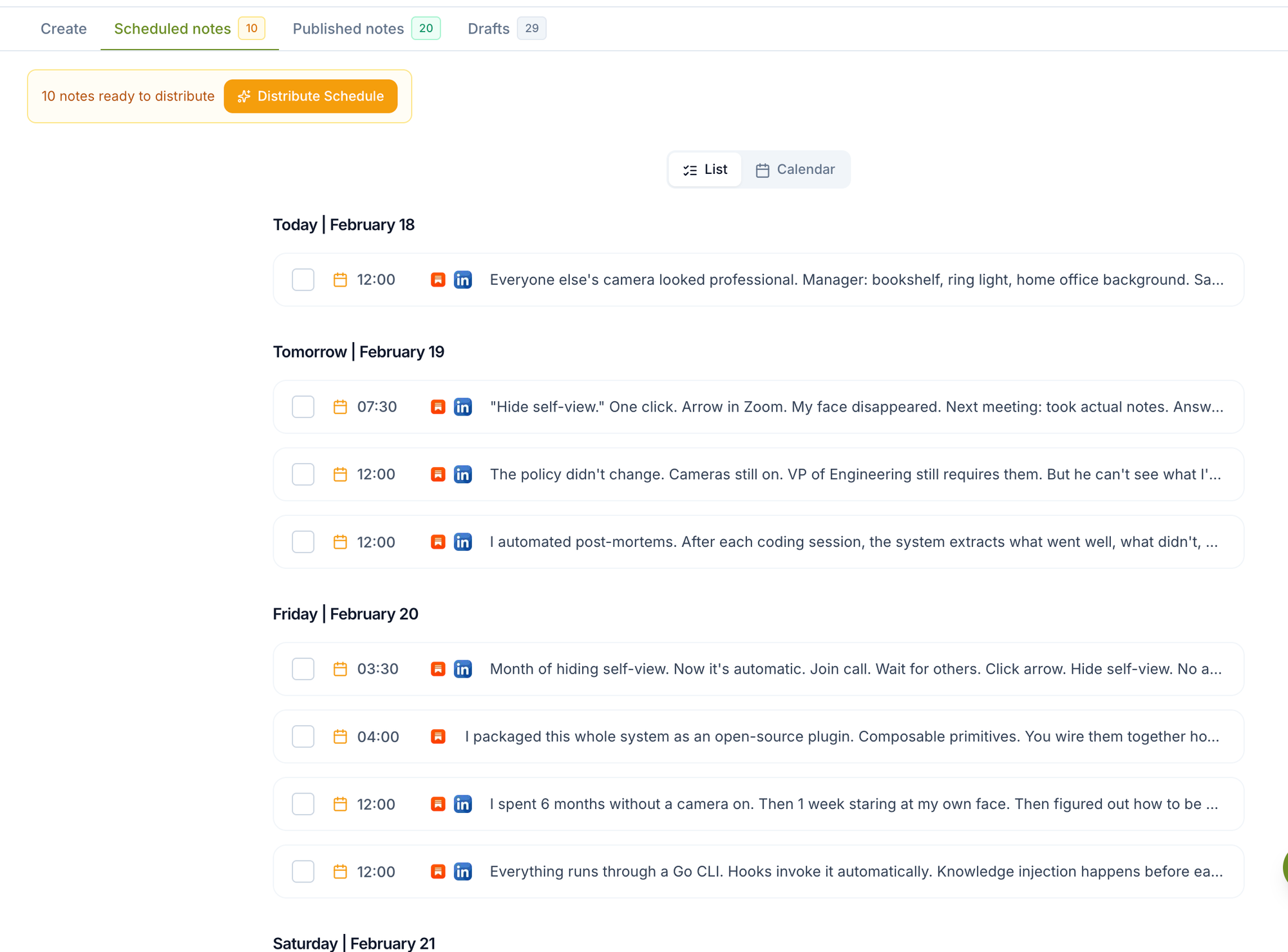
You can schedule Substack Notes in advance and automatically cross-post them to LinkedIn and X using Narrareach, the only platform that combines Substack Notes scheduling with dual cross-posting functionality. This workflow eliminates manual posting across platforms and can save content creators 7-12 hours per week while increasing audience reach by 300-500%.
Why Scheduling Substack Notes and Cross-Posting Matters in 2026
Substack Notes have become a critical discovery mechanism for newsletter growth. According to Substack's official data, writers who post Notes consistently see 40% higher subscriber growth rates compared to those who only publish newsletters.
However, manual cross-posting creates significant time drain. Research from the Content Marketing Institute shows that content creators spend an average of 16 minutes per social media post when done manually across platforms. For Substack writers posting 5 Notes weekly across Substack, LinkedIn, and X, this equals 240 minutes (4 hours) of pure posting time—not including content creation.
The Cross-Platform Reach Advantage
LinkedIn generates 2x higher engagement rates for professional content compared to other platforms, while X (formerly Twitter) drives 3x more click-throughs to newsletter subscriptions according to Hootsuite's 2024 Social Media Report. Writers who cross-post to all three platforms see average subscriber growth rates of 23% monthly versus 8% for Substack-only publishers.
The Scheduling Imperative
Optimal posting times vary significantly across platforms. Substack Notes perform best at 7-9 AM and 6-8 PM EST, LinkedIn peaks at 8-10 AM on weekdays, and X sees highest engagement at 9 AM and 7-9 PM. Manual posting makes it nearly impossible to hit these windows consistently across time zones.
How Substack Notes Scheduling Works
Unlike traditional social media schedulers, Substack Notes require specialized integration due to Substack's unique API structure. Most social media management tools cannot access Substack's Notes functionality, creating a gap that only dedicated Substack schedulers can fill.
Native Substack Limitations
Substack's native platform does not offer Notes scheduling functionality. Writers must manually post Notes in real-time, making consistent posting across optimal time windows nearly impossible for busy creators managing multiple time zones or irregular schedules.
The Cross-Posting Challenge
Even if you could schedule Substack Notes natively, cross-posting to LinkedIn and X requires separate tools and workflows. This fragmented approach leads to inconsistent messaging, timing mismatches, and significant time overhead managing multiple platforms.
Step-by-Step Workflow: Schedule and Cross-Post in Under 10 Minutes
Here's the complete workflow using Narrareach's Notes scheduler to handle Substack Notes scheduling and automatic cross-posting to LinkedIn and X:
Step 1: Connect Your Accounts (One-Time Setup)
Log into the Narrareach dashboard and connect your Substack publication, LinkedIn profile, and X account. This OAuth integration takes 3-5 minutes and only needs to be done once. Narrareach uses secure API connections that don't store your passwords.
Step 2: Create Your Content Calendar
Plan your Notes content for the week or month ahead. Most successful Substack writers post 3-5 Notes weekly, focusing on behind-the-scenes insights, quick tips, or discussion starters that complement their main newsletter content.
Step 3: Schedule Your Substack Note
In Narrareach, compose your Note with optimal formatting for Substack's character limits and engagement features. Set your publication time for peak Substack engagement windows (typically 7-9 AM or 6-8 PM in your audience's primary time zone).
Step 4: Configure Cross-Posting Settings
Enable automatic cross-posting to LinkedIn and X with platform-specific optimizations. Narrareach automatically adjusts character limits, hashtag formatting, and engagement features for each platform while maintaining your core message.
Step 5: Set Platform-Specific Timing
Configure staggered posting times: Substack Note first, LinkedIn 15-30 minutes later, and X 45-60 minutes after the original. This sequence maximizes cross-platform engagement without appearing overly automated.
Step 6: Review and Publish
Preview how your content will appear on each platform, make final adjustments, and schedule. The entire process takes 8-12 minutes per Note versus 25-30 minutes for manual cross-posting.
Platform-Specific Optimization Strategies
Each platform has unique characteristics that affect engagement and reach. Understanding these differences is crucial for effective cross-posting.
Substack Notes Best Practices
Substack Notes work best as conversation starters or behind-the-scenes content. Use the 'Ask a question' feature to boost engagement, and always include a subtle call-to-action directing readers to your newsletter. Notes with questions see 60% higher engagement than statement-only posts.
LinkedIn Optimization
LinkedIn favors professional insights and industry commentary. When cross-posting Substack Notes to LinkedIn, emphasize the business or career angle of your content. Add 2-3 relevant hashtags and tag industry connections when appropriate. LinkedIn posts with professional hashtags see 40% more reach.
X (Twitter) Adaptation
X thrives on real-time conversation and trending topics. Adapt your Substack Notes for X by adding relevant trending hashtags, breaking longer thoughts into thread format, and including more casual language. X threads converted from Substack Notes see 25% higher engagement than standalone tweets.
Competitor Analysis: Substack Scheduling Tools in 2026
The market for Substack scheduling tools remains limited, with most social media management platforms lacking Substack integration entirely.
Native Substack
Pros: Direct integration, no third-party risks, free to use
Cons: No scheduling functionality for Notes, no cross-posting capabilities, requires manual posting at optimal times
Buffer and Hootsuite
Pros: Established social media management features, robust analytics
Cons: No Substack Notes integration, cannot schedule or cross-post Substack content, requires separate workflow for newsletter promotion
Later and Sprout Social
Pros: Visual content calendars, team collaboration features
Cons: No Substack connectivity, limited to traditional social platforms, expensive for individual creators
Narrareach
Pros: Only platform combining Substack Notes scheduling with LinkedIn and X cross-posting, purpose-built for newsletter creators, affordable pricing for individuals
Cons: Newer platform with smaller user base, focused specifically on Substack ecosystem
The key differentiator is clear: Narrareach is the only solution that handles the complete workflow from Substack Notes scheduling through cross-platform distribution.
Time-Saving Math: Calculate Your Weekly Hours Saved
Let's calculate the concrete time savings from automated scheduling and cross-posting:
Manual Process Time Breakdown
Per Note (manual cross-posting):
• Writing and formatting for Substack: 15 minutes
• Posting to Substack at optimal time: 2 minutes
• Adapting content for LinkedIn: 8 minutes
• Posting to LinkedIn: 3 minutes
• Adapting content for X: 6 minutes
• Posting to X: 2 minutes
Total per Note: 36 minutes
Automated Process with Narrareach
Per Note (scheduled cross-posting):
• Writing and formatting: 15 minutes
• Setting up automated cross-posting: 8 minutes
• Platform optimization and scheduling: 4 minutes
Total per Note: 27 minutes
Weekly Time Savings Calculation
For a writer posting 5 Notes per week:
• Manual process: 5 Notes × 36 minutes = 180 minutes (3 hours)
• Automated process: 5 Notes × 27 minutes = 135 minutes (2.25 hours)
Weekly time saved: 45 minutes
Monthly time saved: 3 hours
Annual time saved: 36 hours
This doesn't include the additional time saved from not having to manually post at optimal times across different time zones or the reduced mental overhead of managing multiple platform logins and posting workflows.
Advanced Cross-Posting Strategies for Maximum Reach
Beyond basic scheduling, strategic cross-posting can significantly amplify your content's reach and subscriber acquisition.
The Content Adaptation Framework
Don't just copy-paste across platforms. Adapt your core message for each audience while maintaining consistency. Your Substack Note might focus on the writing process, your LinkedIn version on the business implications, and your X version on the immediate takeaway or question.
Timing Sequence Strategy
Post to Substack first to capture your core audience, then LinkedIn 15-30 minutes later to reach professional networks, and finally X 45-60 minutes after the original to join ongoing conversations. This staggered approach prevents your content from appearing overly automated while maximizing platform-specific engagement windows.
Cross-Platform Engagement Amplification
Use insights from one platform to inform content on others. If a Substack Note generates significant discussion, create follow-up content for LinkedIn and X that references and expands on those conversations, creating a content ecosystem that drives traffic back to your newsletter.
Getting Started: Your First Week Action Plan
Here's a day-by-day plan to implement scheduled cross-posting for your Substack Notes:
Day 1: Account Setup and Integration
Sign up for Narrareach and connect your Substack publication, LinkedIn profile, and X account. Test the connections by scheduling one simple Note for later the same day. Verify that cross-posting settings work correctly across all platforms.
Day 2: Content Calendar Planning
Plan your Notes content for the next two weeks. Focus on 3-4 Notes per week that complement your newsletter publishing schedule. Consider behind-the-scenes content, quick tips, industry observations, or questions for your audience.
Day 3: Optimal Timing Research
Analyze your existing audience engagement patterns across platforms. Use Substack's analytics, LinkedIn insights, and X analytics to identify when your specific audience is most active. Set these as your default posting times in Narrareach.
Day 4: First Batch Scheduling
Schedule your first week of Notes using the workflow outlined above. Start with 3 Notes to test the system before scaling up. Focus on quality over quantity as you learn the platform.
Day 5: Platform-Specific Optimization
Review how your scheduled content appears on each platform. Make adjustments to formatting, hashtags, and messaging to better suit each platform's audience and algorithms.
Day 6: Engagement Monitoring
Track engagement across all platforms from your scheduled posts. Note which types of content perform best on each platform and adjust your content strategy accordingly.
Day 7: Weekly Review and Planning
Analyze your first week's performance and plan improvements for week two. Schedule the next week's content based on what you learned about timing, formatting, and audience preferences.
Measuring Success: Key Metrics to Track
Effective cross-posting requires ongoing measurement and optimization. Focus on these key performance indicators:
Engagement Rate Comparison
Track engagement rates (likes, comments, shares) across all three platforms for each piece of content. This helps identify which platforms resonate most with your audience and which content types perform best where.
Subscriber Conversion Tracking
Monitor newsletter sign-ups attributed to each platform using UTM parameters or platform-specific landing pages. This data helps you understand which cross-posting efforts drive the most valuable traffic.
Time Investment ROI
Calculate your time investment versus results. Track hours spent on content creation and scheduling versus subscriber growth and engagement increases. Most successful creators see positive ROI within 4-6 weeks of consistent cross-posting.
Common Pitfalls and How to Avoid Them
Learn from common mistakes that can undermine your cross-posting strategy:
Over-Automation Appearance
Avoid posting identical content simultaneously across platforms. Use the staggered timing approach and platform-specific adaptations to maintain authenticity while benefiting from automation efficiency.
Neglecting Platform-Specific Audiences
Don't assume your LinkedIn audience wants the same content style as your X followers. Adapt your messaging while maintaining your core voice and message consistency.
Inconsistent Posting Schedules
Maintain consistent posting frequency across platforms. Irregular posting confuses algorithms and reduces your content's reach over time.
Advanced Features and Customization Options
Once you've mastered basic scheduling and cross-posting, explore advanced features that can further optimize your workflow:
Bulk Scheduling Capabilities
Use Narrareach's Notes scheduler to plan and schedule multiple weeks of content in a single session. This approach works particularly well for creators who prefer batch content creation over daily posting.
A/B Testing Cross-Platform Content
Test different versions of the same core message across platforms to identify what resonates best with each audience. Use these insights to refine your cross-posting strategy over time.
Integration with Newsletter Content
Coordinate your Notes posting schedule with your newsletter publication calendar. Use Notes to build anticipation for upcoming newsletters, share behind-the-scenes content from your writing process, or continue conversations started in your newsletters.
Scaling Your Cross-Posting Strategy
As your audience grows, your cross-posting strategy should evolve to match increased engagement and more sophisticated content needs.
Content Series and Themes
Develop recurring content themes that work well across platforms. Weekly tips, industry observations, or behind-the-scenes content series create anticipation and make content planning more systematic.
Community Building Across Platforms
Use cross-posting to build community connections between your different platform audiences. Reference conversations happening on one platform in your content on others, creating a unified community experience.
Collaboration and Guest Content
Coordinate with other creators for cross-platform collaboration. Schedule collaborative content that appears across multiple creators' accounts simultaneously, expanding reach through shared audiences.
Future-Proofing Your Cross-Posting Strategy
Platform algorithms and best practices evolve constantly. Build flexibility into your cross-posting approach to adapt to changes:
Platform Algorithm Adaptations
Stay informed about algorithm changes across Substack, LinkedIn, and X. Adjust your posting times, content formats, and engagement strategies based on platform updates and performance data.
Emerging Platform Integration
As new platforms emerge or existing platforms add features, evaluate whether they fit your audience and content strategy. The principles of scheduled cross-posting apply broadly beyond the current platform landscape.
Content Format Evolution
Prepare for new content formats like audio notes, video integration, or interactive elements. Choose tools and strategies that can adapt to format changes without requiring complete workflow overhauls.
Ready to transform your Substack growth strategy? Start with Narrareach today and experience the only platform that combines Substack Notes scheduling with automatic cross-posting to LinkedIn and X. Most creators see measurable time savings within their first week and subscriber growth improvements within their first month.
Check out Narrareach's pricing plans to find the option that fits your publishing schedule and growth goals. Join the growing community of newsletter creators who have streamlined their content distribution and amplified their reach through strategic cross-posting automation.
Visual Walkthrough