
How to Grow an Instagram Account from Zero in 2026
You post consistently, polish every caption, and still watch your Instagram account move by a few followers at a time. A Reel gets views but no profile...
By Ian Kiprono
You post consistently, polish every caption, and still watch your Instagram account move by a few followers at a time. A Reel gets views but no profile visits. A carousel earns saves from people who never follow. Your best idea disappears after one afternoon, while you spend the next day wondering whether the problem is your niche, your visuals, or some invisible algorithm penalty.
I know that feeling. During a 90-day experiment, I kept a simple record of what I published, where it appeared, and what happened afterward. The uncomfortable conclusion came early: I didn't have an effort problem. I had a distribution problem.
Why a Stalled Instagram Account Is a Distribution Problem
For months, I treated Instagram like a shelf. I made a post, placed it on the grid, and waited for the right people to walk past. The photos looked consistent, the captions were thoughtful, and I added Stories when I remembered. The account still crawled forward.
Then one post broke the pattern. It explained a common writing mistake in terms people recognized immediately. Saves and thoughtful comments followed, but I had published the idea only on Instagram. By the next morning, its useful life had ended. I had not turned it into a Reel, a Notes thread, a LinkedIn post, or a Medium article.
That result changed the question I was asking. Instead of “How do I grow an Instagram account?” I asked, “How many useful places can this idea travel?”
One idea needs more than one chance
A single Instagram post creates one distribution attempt on one platform. A strong idea can take several connected forms:
- A Reel demonstrates the problem quickly.
- A carousel breaks the solution into saveable steps.
- A Notes thread turns the sharpest point into a short conversation starter.
- A LinkedIn post adds professional context.
- A Medium article gives the idea a durable home.
These versions should not be identical copies. Each platform needs its own treatment, while every version reinforces the same underlying insight. One writing lesson can therefore become a small distribution system instead of a post that disappears after one afternoon.
The practical shift: Stop judging an idea by its first Instagram post. Judge it by how well you can distribute and reuse it without making the audience feel they have seen the same thing repeatedly.
Instagram's current attention pattern makes this approach more useful. In the United States, Reels accounted for 46% of time spent in the Instagram app in 2025, compared with 37% in 2024, while daily active users rose 2% year over year, with that increase led by greater Reels usage, as reported by CNBC's coverage of Instagram's 2025 data. Every idea does not need to become a Reel. Your strongest idea should have more than one format and more than one path to an audience.
Before I built the workflow, I reviewed the fundamentals in this Instagram guide from AIDictation, particularly the profile and content choices that help a new visitor understand an account quickly. Distribution cannot compensate for an unclear promise.
The account began to change when I stopped trying to invent more ideas and started giving each useful idea several doors into the audience. Narrareach can serve as the engine for that loop, helping writers schedule and repurpose content across channels. The same system can also run with a spreadsheet, a calendar, and a consistent naming convention.
Why Reels and Carousels Are the Only Formats Worth Defaulting To
I used to choose formats based on what was easiest to make that day. If I had a clean photograph, I published an image. If I had more time, I made a carousel. Video became something I postponed until I had better lighting, a better script, and a more interesting location.
The benchmark data pushed me toward a simpler default. In 2025, average brand engagement on Instagram was 0.48% per post, while the all-industry median was 0.30%, down from 0.36%. Carousels averaged 0.55% engagement, Reels 0.52%, and image posts 0.37%, according to the benchmark summary from Colorlib.
Those figures don't promise that your next carousel will outperform every Reel. They do give you a rational starting point. Carousels and Reels deserve the first test because the available benchmarks place them ahead of single-image posts.
The format decision I use
| Format | Median reach rate | Median save rate | Best use case |
|---|---|---|---|
| Reels | Not reported in the verified benchmark data | Track saves per play yourself | Discovery, demonstrations, stories, and new-audience reach |
| Carousels | Not reported in the verified benchmark data | Track saves per post yourself | Frameworks, tutorials, checklists, and comparisons |
| Single images | Not reported in the verified benchmark data | Track saves per post yourself | Portfolio moments, announcements, and visual proof |
| Static text posts | Not reported in the verified benchmark data | Track saves per post yourself | Short opinions when the visual format adds little |
I won't fill those blank benchmark cells with invented percentages. The verified sources provide engagement rates by format, not the median reach and save rates requested in the table. That distinction matters because reach, saves, and engagement are different measurements.
Reels are useful when the first few seconds can create curiosity or show a transformation. Carousels work when the audience needs to pause, swipe, save, or send the post to someone else. Single images still have a place, but I stopped treating them as the default growth format.
A separate benchmark set placed overall Instagram engagement at about 0.45% in Q2 2026, with Reels at 0.48% and carousels at 0.50%, both declining quarter over quarter, according to Socialinsider's Instagram benchmarks. The useful lesson isn't that one format has won forever. It's that engagement is structurally limited, so a growth plan needs repeatable distribution rather than a fantasy of one viral post.
For a detailed format comparison and practical publishing decisions, Instagram Reels versus posts is a useful companion resource. My own default is simple: start with a Reel or carousel, then earn the right to use a static image when the image itself carries the message.
Defining Your Niche and Content Pillars Before You Post Anything
My worst captions began with broad subjects. “Tips for creators.” “Thoughts on writing.” “Advice for small businesses.” Those labels sounded reasonable, but they gave me no clear person to help and no reason for that person to return.
I now run a short niche audit before creating a new content batch. It takes about 30 minutes, and the output is one audience statement, three to five pillars, and a decision about what not to publish.
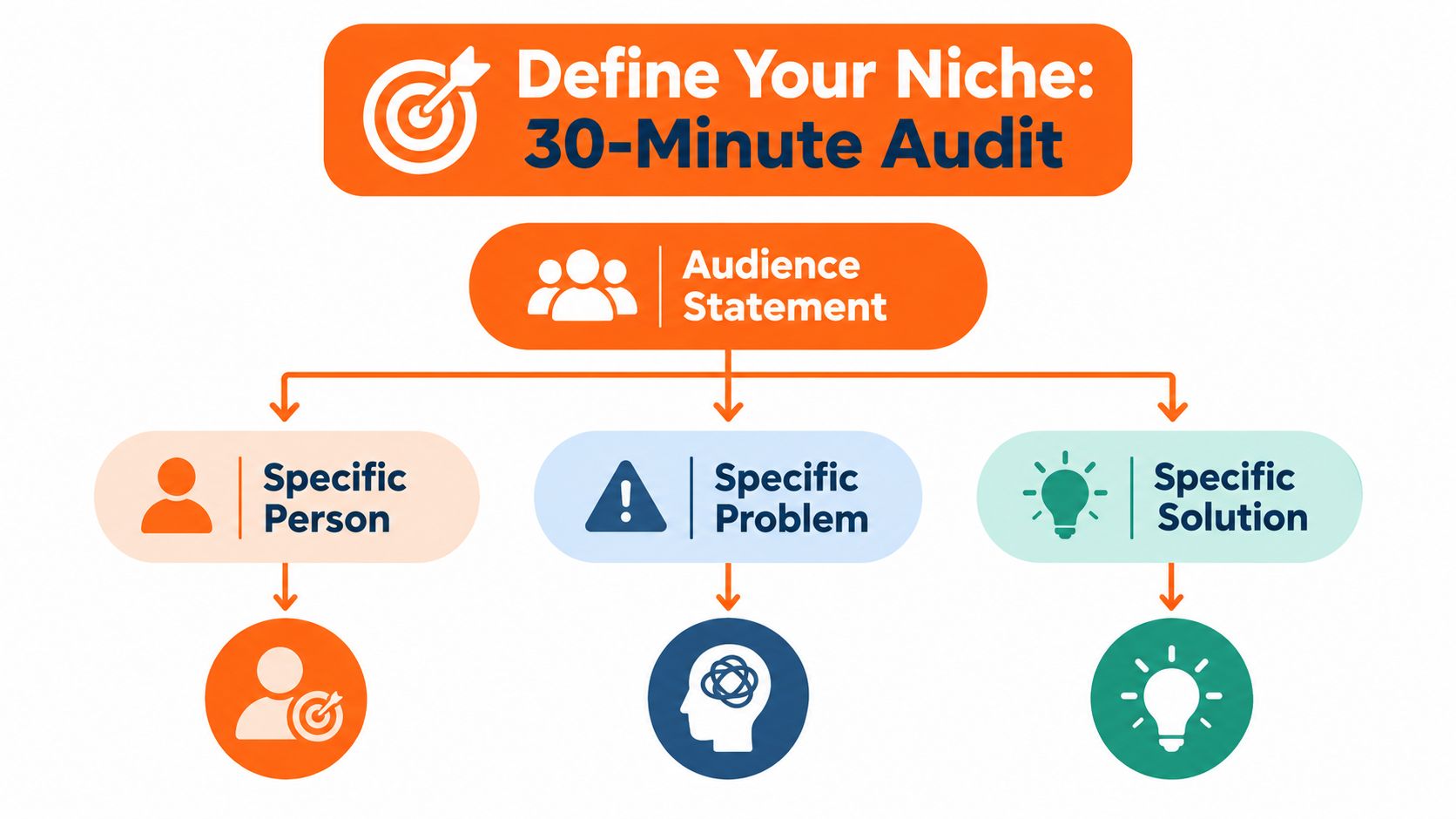
Start with one person and one problem
Write this sentence:
I help [specific person] solve [specific problem] so they can achieve [specific outcome].
“Creators” is too broad. “Freelance writers who publish a newsletter but struggle to turn one article into consistent social content” is specific enough to guide a Reel, a carousel, and a call to action.
Next, review your existing posts and place each one into a theme. Don't create pillars because they sound strategic. Use the themes that appear repeatedly in your strongest work, then remove anything that attracts the wrong audience.
For a freelance writer becoming a content strategist, the structure might look like this:
- Hero pillar: Turning long-form ideas into useful distribution, used for roughly half of the planned posts.
- Supporting pillar: Writing clearer hooks and openings.
- Supporting pillar: Building a sustainable publishing rhythm.
- Experimental slot: Testing a new audience question, format, or point of view.
The test is straightforward. If a stranger saw only one pillar, could they describe what the account helps people do? If the answer is no, the theme is probably too loose.
Let the pillars make publishing easier
A pillar isn't a prison. It's a filter. When an idea arrives, I ask which audience problem it addresses, whether it belongs to an established pillar, and which format gives it the clearest expression.
That filter also prevents a common mistake: publishing whatever happened during the day. Personal context can make an account more human, but it should support the reader's reason for following rather than replace it.
Once the audience and pillars are clear, a scheduling system can prioritize which idea to distribute first, which channel should receive a shortened version, and whether the caption needs a quick prompt or a deeper explanation. The more precise the input, the less generic the output.
A Production Workflow That Turns One Idea Into a Week of Content
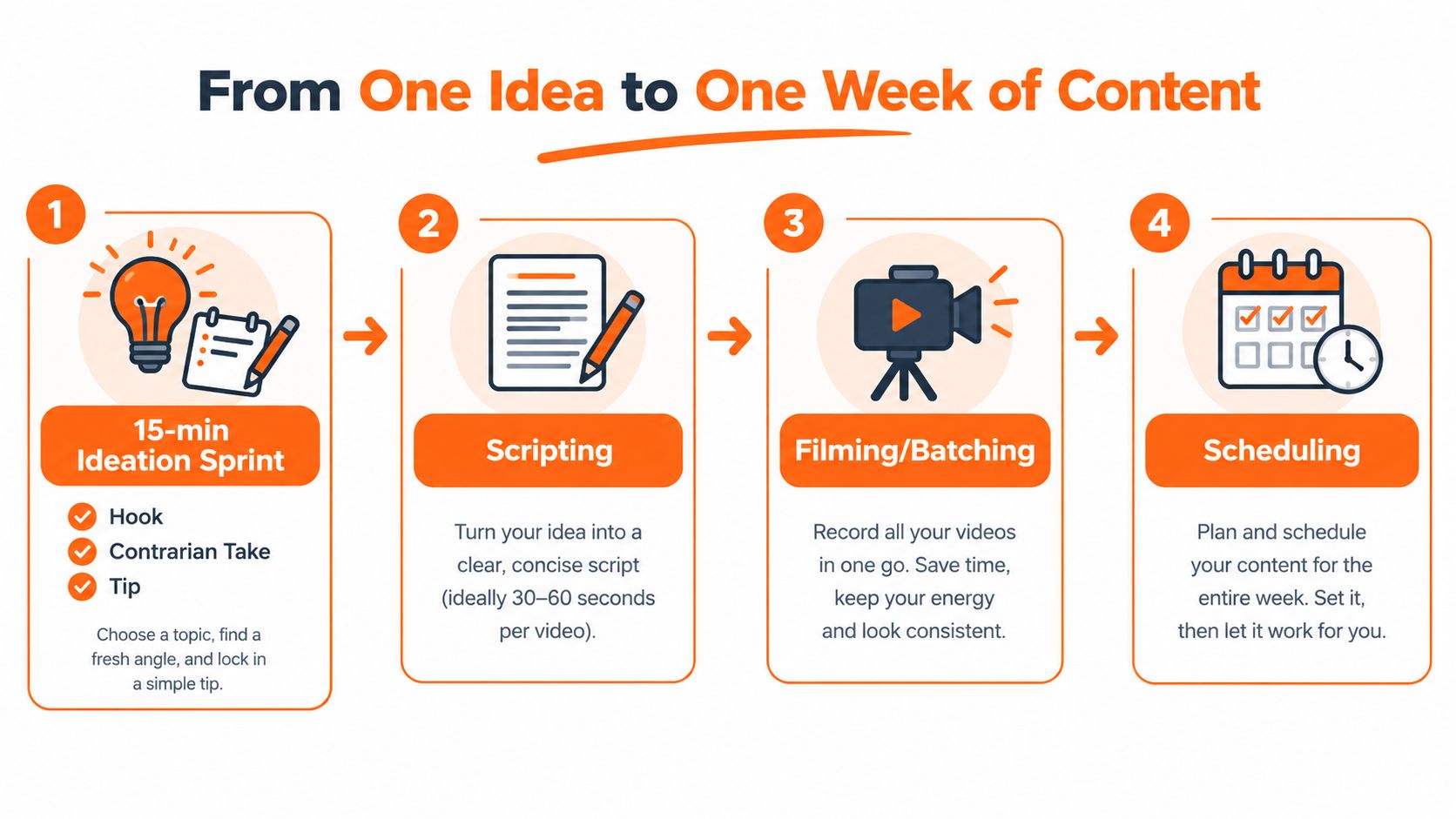
The most productive content session I ran started with one sentence, not a blank calendar.
The source idea was: A newsletter doesn't need more topics. It needs a repeatable way to develop the topics that already resonate. I gave myself a 15-minute ideation sprint and wrote three things:
- One hook: “Your content calendar may be full because your ideas are too shallow.”
- One contrarian take: “Publishing more topics can make a newsletter harder to remember.”
- One tactical tip: “Keep a list of reader questions and turn each question into a problem, example, and next step.”
That was enough material for a week.
Build the Reel first
I wrote a 20 to 30 second script with a pattern interrupt in the first three seconds. The opening on-screen text said, “More topics won't fix a forgettable newsletter.” The next lines showed the problem, explained why topic volume wasn't the issue, and ended with one practical action.
The caption followed a simple structure:
- Hook: Repeat the tension in a more conversational sentence.
- Explanation: Give one example of a topic being developed instead of discarded.
- CTA: Ask readers what question their audience keeps repeating.
I recorded several clips in one sitting, including a direct-to-camera opening, a screen recording of a notes list, and a closing shot. Batching made the process less fragile because I didn't need to rebuild the setup for every post.
Turn the same idea into a carousel
The carousel used seven slides:
- The problem, stated plainly.
- Why a crowded topic list can weaken a newsletter.
- The difference between a topic and a reader question.
- A worked example.
- The three-part development pattern.
- A prompt the reader could copy.
- A save and share invitation.
Each slide carried one standalone insight. Someone who saw only slide four could still understand the example, while someone who swiped through the whole sequence got a complete argument.
A good repurposed post keeps the idea and changes the experience. Don't paste a Reel transcript into a carousel. Rebuild the same point for the way people consume that format.
I then shortened the idea into a Substack Note, shaped the contrarian argument into a LinkedIn post, and expanded the example into an X thread. Narrareach's content repurposing workflow describes the broader logic of creating platform-specific versions instead of relying on copy and paste.
Substack also supports native Notes scheduling on web, iOS, and Android. Scheduled Notes remain editable in Drafts, and the publishing time uses the user's local time zone, as described in Substack's scheduling update. That matters when a writer wants the short-form conversation to support the Instagram post without manually checking every platform.
I reserve roughly 90 minutes for this chain when the source idea is already clear. The point isn't to force every idea onto every network. The point is to give a proven idea more than one useful expression before moving on.
The Posting Schedule That Actually Fits a Writer's Week
A writer's best publishing schedule is usually the one that protects writing time. I tried reacting to every open moment, and the result was predictable: half-finished scripts, rushed captions, and no reliable connection between an article and the posts promoting it.
My current rhythm uses two production blocks. Sunday evening is for choosing the source ideas and preparing the week's assets. Wednesday evening is for reviewing early signals, writing the next batch, and adjusting the second half of the schedule.
| Day | Primary content | Suggested working window |
|---|---|---|
| Monday | Reel | Midday or afternoon |
| Tuesday | Carousel | Midday or afternoon |
| Wednesday | Reel | Midday or evening |
| Thursday | Carousel | Midday |
| Friday | Reel | Morning or afternoon |
| Saturday | Replies, DMs, and review | Flexible |
| Daily | Relevant Stories | When the audience is active |
This is a starting rhythm, not a universal rule. Buffer's analysis of 9.6 million posts identified Thursday at 9 a.m., Wednesday at 12 p.m., and Wednesday at 6 p.m. as strong posting times, while Sprout Social highlighted different weekday windows in its Instagram timing analysis. Brandwatch also notes that performance often rises around 7 to 9 a.m., 11 a.m. to 1 p.m., and 6 to 8 p.m., but emphasizes that audience behavior and local time zone matter, as summarized in its Instagram posting-time guidance.
Let the audience change the schedule
For a consumer audience, I test lunch breaks and early evenings. For a business audience, I test workday windows. I don't assume that a published industry window beats the times shown in the account's own Insights.
Batching three Reels at once also reduces the creative cost of video. I can keep the camera, lighting, and background ready, then change only the hook and example. Carousels fit the second production block because they require more deliberate editing but less filming.
I use Stories for context, replies, and behind-the-scenes material, not as a second feed that demands constant production. The schedule stays useful when it leaves enough attention for comments, DMs, and the work that creates the next strong idea.
For a deeper timing workflow, see when to post on Instagram. The useful test is not whether you can follow a perfect timetable. It's whether your schedule helps you publish consistently enough to learn.
The 10-Minute Engagement Routine That Compounds
On day 18 of a 90-day experiment, two similar posts showed me why engagement is distribution work. I replied to one with a specific example, then asked a useful follow-up. The other received quick, generic responses. The first kept attracting discussion. The second disappeared.
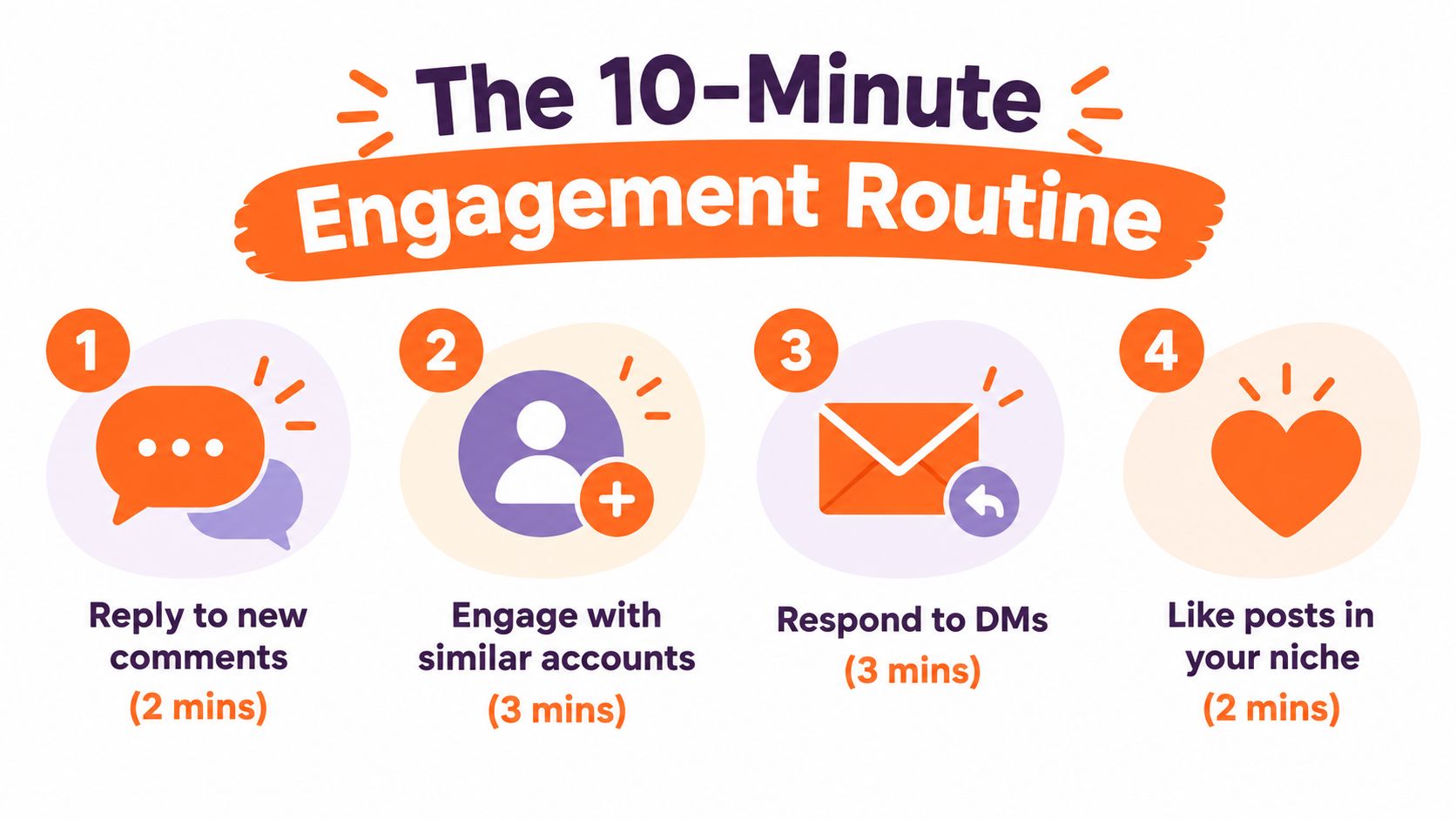
I now spend ten minutes after checking notifications:
- Two minutes replying to new comments. I answer the question, add an example, or ask what the reader tried.
- Three minutes commenting on five relevant accounts. Each comment names a specific idea or extends it. An emoji does neither.
- Three minutes sending personalized DMs. I message people who saved or shared a useful post, without turning the conversation into a pitch.
- Two minutes replying to Story reactions. A short, human response keeps the exchange open.
Smaller accounts can build momentum faster because each useful interaction reaches a larger share of the audience. I watch that early momentum closely instead of assuming larger accounts have an automatic advantage. A thoughtful reply can bring someone back to the profile, into a DM, or toward the next piece of content.
Make replies part of the content
A comment can supply the next idea. One reader asked how to adapt a newsletter topic for a small audience. I answered in the thread, saved the question, and later turned the explanation into a carousel. The same idea then became a Reel, a Notes thread, a LinkedIn post, and a Medium article. Narrareach helps keep that loop running, so engagement informs distribution instead of ending with the reply.
One post-level analysis reported that replying to comments increased engagement by 21%, while Reels earned 36% more reach and carousels drove 12% more engagement in its dataset, as summarized by Influencer Marketing Hub. I use those figures as context, not as a forecast for my account.
The routine stays small on purpose. Ten focused minutes are easier to repeat than a networking block that vanishes during a busy week. After three months, the conversations gave me sharper hook language, clearer evidence about reader concerns, and more source material for the next round of posts.
For more ways to turn interaction into a repeatable practice, see how to increase engagement on Instagram. I keep the human part manual. Tools can organize publishing and repurposing, but the response should still sound like it came from me.
Measuring What Matters and Iterating Without Burning Out
During a 90-day experiment, follower count rose in some weeks and stalled in others. The more useful clues appeared elsewhere: a Reel earned saves without many new followers, a carousel sent readers to my profile, and one post produced qualified clicks days after publication. A growing number matters only when it reflects attention from people who may return, subscribe, share, or follow the next idea.
Each week, I review four signals:
- View-based engagement rate: For Reels, calculate (likes + comments + saves + shares) / plays and track it against your own weekly baseline.
- Save rate: Compare saves with reach or plays, using the same denominator each week.
- Share rate: Track whether readers pass the idea to someone else.
- Follower conversion: Calculate follows divided by profile visits.
I also record new follows, unfollows, net growth, profile visits, link activity, and the content that generated each action. That record separates attention from useful attention. A post with fewer views can still matter if it brings the right reader to the profile or sends a qualified visitor to the next piece.
| Metric | What it measures | Healthy benchmark for growth |
|---|---|---|
| View-based engagement rate | Interaction quality relative to Reel plays | Rising relative to your own baseline |
| Save rate | Practical or reference value | Improving on educational posts |
| Share rate | Relevance to another person's problem | Increasing when the idea is specific |
| Follower conversion | Profile clarity and audience fit | Stronger after clearer hooks and bio |
| Net growth | Acquisition minus loss | Positive and consistent over time |
| Cross-platform activity | Whether one idea travels beyond Instagram | More qualified visits and conversations |
A broad industry average cannot set the right target for every account. Audience, format, topic, and distribution all change the result. I use outside benchmarks as context, then compare my own formats and trends. The question is whether a specific idea performs better than the account's recent baseline and whether that performance creates a useful next action.
Run a 20-minute weekly review
On Sunday, I pull the last 14 days of Reel and carousel data. I sort posts by saves relative to reach, tag the three strongest patterns, and choose one pattern to test again. My labels might be “specific mistake,” “before and after,” or “reader question.”
Then I write one sentence for the next experiment:
Keep the topic, change the hook.
Keep the hook, test a carousel.
Keep the format, use a sharper audience problem.
That limit keeps the work manageable. A 30-day rolling view shows whether the system is consistent, while a planned break protects the quality of the ideas behind it. One quiet post should not trigger five changes at once.
I review distribution beyond Instagram as well. A strong idea may appear as a Reel, a Notes thread, a LinkedIn post, and a Medium article, with each version sending useful attention toward the others. The MyMentions AI visibility tracker offers a practical way to examine how content is discovered beyond traditional platform metrics. I track where an idea appears and what action follows, not only how many followers sit on the profile.
Use this one-page Sunday template:
- Best post: What topic, format, and opening did it use?
- Strongest action: Did people save, share, visit, follow, or click?
- Weakest step: Did the problem begin with the hook, format, profile, or CTA?
- Next test: What single variable will change?
- Distribution plan: Which Instagram format, Note, LinkedIn post, X thread, or article will carry the idea?
- Burnout check: Can this schedule survive the next month?
For a deeper framework, see content performance metrics. Narrareach helps writers turn one strong idea into scheduled Instagram content, Substack Notes, Medium articles, LinkedIn posts, and X content while tracking distribution across channels. Visit Narrareach to start free without a credit card, or run the workflow manually. For the engagement side of the process, see how to increase engagement on Instagram.