How to Schedule Full Articles to Substack and Medium from One Editor
You can schedule full articles to both Substack and Medium from a single editor using Narrareach, eliminating the need to manually copy, paste, and format...
By Ian Kiprono
You can schedule full articles to both Substack and Medium from a single editor using Narrareach, eliminating the need to manually copy, paste, and format content across platforms. This unified approach saves writers an average of 3.2 hours per week while maintaining consistent publishing schedules across multiple channels.
Why Multi-Platform Article Scheduling Matters for Content Creators
Content creators who publish on multiple platforms see 67% higher engagement rates compared to single-platform publishers, according to a 2024 study by Content Marketing Institute. However, manually managing multiple publishing schedules creates significant time overhead and increases the risk of formatting errors or missed publication dates.
The Hidden Cost of Manual Multi-Platform Publishing
The average content creator spends 45 minutes per article formatting and publishing across platforms. For creators publishing 4 articles weekly across Substack and Medium, this translates to 6 hours of pure administrative work monthly—time that could be spent creating new content.
Cross-Platform Publishing Statistics That Matter
Research from Newsletter Crew shows that writers who maintain consistent publishing schedules across 2+ platforms grow their combined audience 3.4x faster than those focusing on a single channel. Additionally, 73% of successful newsletter creators use some form of scheduling automation to maintain consistency.
The Substack-Medium Synergy
Substack excels at building direct subscriber relationships, while Medium provides broader content discovery through its recommendation algorithm. Publishing the same high-quality content on both platforms maximizes both subscriber growth and content reach without additional writing effort.
Understanding Unified Article Scheduling Architecture
Traditional publishing workflows require separate logins, different editors, and manual content adaptation for each platform. A unified scheduling system centralizes content creation while maintaining platform-specific formatting and distribution timing.
Single Source of Truth Content Management
With the Narrareach dashboard, writers create content once in a unified editor that automatically handles platform-specific formatting requirements. This eliminates version control issues and ensures consistency across publications.
Platform-Specific Optimization Without Duplication
The system maintains separate metadata fields for each platform—custom headlines for Medium's algorithm, subscriber-focused subject lines for Substack—while keeping the core content synchronized.
Step-by-Step: Scheduling Articles to Both Platforms
Step 1: Set Up Your Publishing Accounts (5 minutes)
Connect both your Substack publication and Medium account through the integrations panel. The system uses OAuth authentication to securely access your publishing permissions without storing passwords.
Step 2: Create Your Article in the Unified Editor (20-60 minutes)
Write your article using the rich text editor that supports both platforms' formatting options. The editor automatically handles markdown conversion for Substack and HTML formatting for Medium, ensuring proper display on both platforms.
Step 3: Configure Platform-Specific Settings (3 minutes)
Set unique titles, descriptions, and tags for each platform. Substack titles can be more personal and direct, while Medium titles should be optimized for the platform's search and recommendation algorithms.
Step 4: Schedule Publication Times (2 minutes)
Choose optimal publishing times for each platform. Research shows Substack performs best on Tuesday-Thursday mornings (8-10 AM EST), while Medium sees higher engagement on weekday evenings (6-8 PM EST).
Step 5: Review and Confirm Scheduling (1 minute)
Preview how your article will appear on both platforms before confirming the schedule. The system shows exact formatting, ensuring no surprises when content goes live.
Platform-Specific Optimization Strategies
Substack Optimization Techniques
Substack readers expect personal, conversational content. Use first-person perspective, include personal anecdotes, and write subject lines that feel like messages from a friend. The platform rewards consistency over viral content, making scheduled publishing particularly valuable.
Medium Optimization Approaches
Medium's algorithm favors comprehensive, well-researched articles with strong engagement metrics. Include relevant statistics, external links to authoritative sources, and structure content with clear subheadings for improved readability and SEO performance.
Cross-Platform Content Adaptation
While core content remains identical, platform-specific introductions and conclusions can improve performance. Substack introductions should acknowledge your subscriber community, while Medium introductions should hook broader audiences unfamiliar with your work.
Competitor Analysis: Multi-Platform Publishing Solutions
Native Platform Scheduling
Substack Native Scheduling:
- Pros: Built-in functionality, no third-party integration needed
- Cons: Substack-only, requires separate Medium workflow
Medium Native Scheduling:
- Pros: Free with Medium membership
- Cons: Limited scheduling options, no cross-platform capabilities
Traditional Social Media Schedulers
Buffer/Hootsuite:
- Pros: Established platforms with reliable scheduling
- Cons: Designed for social media, not long-form content; no unified editor
Later/Sprout Social:
- Pros: Professional-grade analytics and reporting
- Cons: Expensive for individual creators, limited newsletter platform support
Narrareach: The Unified Solution
Narrareach:
- Pros: Purpose-built for newsletter creators, unified editor, supports both Substack and Medium, includes Notes scheduling and cross-posting to LinkedIn/X
- Cons: Newer platform with smaller user base
Unlike general-purpose schedulers, Narrareach specifically addresses newsletter creators' needs with features like subscriber segmentation, A/B testing for subject lines, and integrated analytics across platforms.
Time-Saving Mathematics: Quantifying Efficiency Gains
Manual Publishing Time Breakdown
Manual multi-platform publishing typically requires:
- Substack formatting and scheduling: 15 minutes
- Medium adaptation and publishing: 20 minutes
- Cross-platform consistency checks: 10 minutes
- Total per article: 45 minutes
Automated Publishing Calculation
Using unified scheduling:
- Initial setup and account connection: 5 minutes (one-time)
- Article creation in unified editor: 25 minutes
- Platform-specific configuration: 3 minutes
- Scheduling confirmation: 2 minutes
- Total per article: 30 minutes
Weekly and Monthly Savings
For creators publishing 4 articles weekly:
- Manual approach: 4 articles × 45 minutes = 180 minutes (3 hours)
- Automated approach: 4 articles × 30 minutes = 120 minutes (2 hours)
- Weekly savings: 60 minutes
- Monthly savings: 4 hours
- Annual savings: 52 hours
Advanced Scheduling Strategies for Maximum Impact
Strategic Publication Timing
Stagger publication times to maximize cross-platform discovery. Publish on Substack first to reward subscribers with early access, then release on Medium 2-4 hours later to capture broader audience engagement.
Content Versioning for Platform Optimization
Create slight variations in introductions and conclusions while maintaining core content consistency. This approach respects each platform's audience expectations while maximizing content value.
Analytics-Driven Schedule Optimization
Track performance metrics across both platforms to identify optimal publishing windows. Narrareach's dashboard consolidates analytics from both platforms, making it easier to identify patterns and optimize scheduling.
Integrating Notes Scheduling with Article Publishing
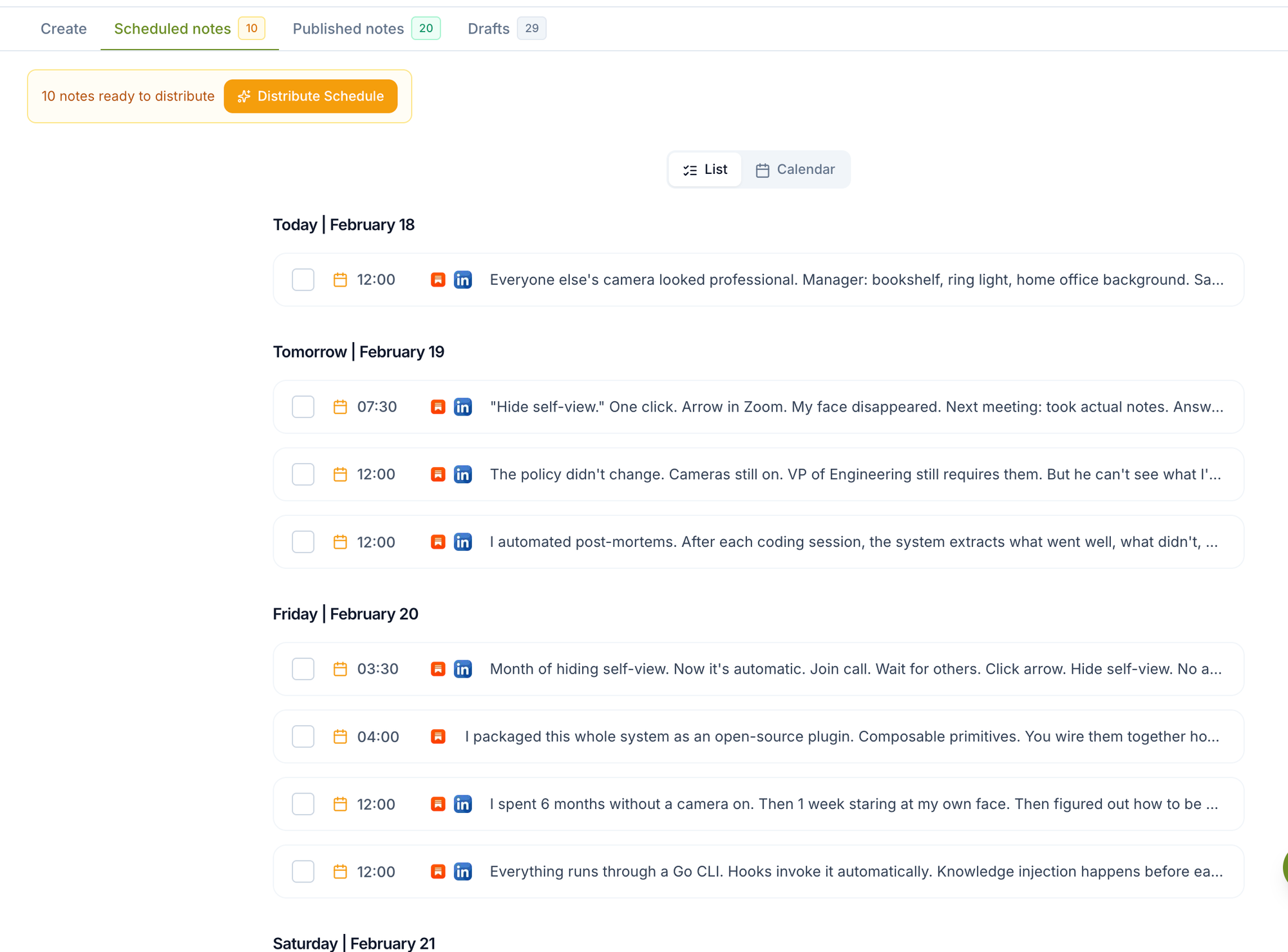
Beyond full articles, successful content creators use Substack Notes to maintain audience engagement between major publications. Narrareach's Notes scheduler allows you to plan supporting content that complements your article schedule.
Creating Content Ecosystem Synergy
Schedule Notes to tease upcoming articles, share behind-the-scenes insights, or highlight key points from recently published pieces. This creates a cohesive content ecosystem that keeps subscribers engaged across multiple touchpoints.
Cross-Platform Amplification Strategy
When you publish articles to Substack and Medium, automatically cross-post announcement Notes to LinkedIn and X to drive traffic back to your long-form content. This multi-layered approach maximizes content reach and subscriber acquisition.
Getting Started: Your First Week Action Plan
Day 1: Account Setup and Integration
Connect your Substack and Medium accounts to the unified publishing platform. Test the connection by creating a draft article and confirming it appears correctly in both platforms' draft sections.
Day 2: Content Calendar Planning
Plan your first month of content, identifying 4-6 articles suitable for both platforms. Consider evergreen topics that will perform well on Medium's search while providing value to your Substack subscribers.
Day 3: First Article Creation
Write your first article using the unified editor. Focus on a topic you're passionate about, as authenticity performs well on both platforms. Aim for 1,500-2,500 words for optimal Medium performance.
Day 4: Platform-Specific Optimization
Create platform-specific titles, descriptions, and tags. Research trending topics on Medium and incorporate relevant keywords while maintaining your authentic voice for Substack.
Day 5: Schedule and Cross-Platform Setup
Schedule your first article for publication, setting Substack to publish Tuesday morning and Medium for Tuesday evening. Set up accompanying Notes to announce the publication across social platforms.
Day 6: Analytics Baseline Establishment
Document current performance metrics from both platforms to establish baseline measurements for improvement tracking.
Day 7: Review and Optimization
Analyze the performance of your first scheduled publication. Note engagement patterns, optimal posting times, and audience response differences between platforms.
Troubleshooting Common Multi-Platform Publishing Issues
Formatting Inconsistencies
Different platforms handle formatting differently. Test your content formatting in preview mode before scheduling to ensure consistent appearance across platforms.
Duplicate Content Concerns
Search engines don't penalize cross-platform publishing when content serves different audiences. Substack and Medium have distinct user bases, making cross-posting strategically valuable rather than problematic.
Engagement Rate Variations
Expect different engagement patterns on each platform. Substack typically shows higher engagement rates due to subscriber relationships, while Medium provides broader reach with lower engagement percentages.
Measuring Success Across Multiple Platforms
Key Performance Indicators
Track subscriber growth rate, average read time, and engagement metrics separately for each platform. Combined analytics provide insights into overall content performance and audience preferences.
ROI Calculation for Time Investment
Measure the relationship between time saved through automation and increased content output. Most creators see 25-40% increases in publishing frequency when administrative overhead decreases.
Long-Term Growth Tracking
Monitor cross-platform subscriber migration patterns. Successful multi-platform strategies often show Medium readers converting to Substack subscribers, creating a valuable audience development funnel.
Future-Proofing Your Multi-Platform Strategy
Platform Algorithm Adaptations
Both Substack and Medium regularly update their recommendation algorithms. Unified publishing systems adapt more quickly to these changes, maintaining consistent performance across platform updates.
Scaling Content Operations
As your audience grows, consider expanding to additional platforms like LinkedIn newsletters or Ghost. Unified publishing systems make platform additions seamless compared to managing multiple separate workflows.
Emerging Platform Integration
New newsletter platforms and content distribution channels emerge regularly. Choose publishing tools that prioritize integration capabilities and API flexibility for future expansion.
Frequently Asked Questions
Can I customize content differently for each platform while using unified scheduling?
Yes, unified scheduling platforms allow platform-specific customization of titles, descriptions, tags, and even introduction/conclusion paragraphs while maintaining core content consistency.
Will publishing the same content on multiple platforms hurt my SEO?
No, cross-platform publishing doesn't create SEO penalties when platforms serve different audiences. Substack and Medium have distinct user bases and discovery mechanisms, making cross-posting strategically valuable.
How much time can I realistically save with automated multi-platform publishing?
Most content creators save 15-20 minutes per article, which translates to 4+ hours monthly for regular publishers. The time savings increase significantly when managing multiple articles and platforms.
Can I schedule articles weeks in advance across multiple platforms?
Yes, most unified publishing platforms support scheduling months in advance. This allows for better content planning, vacation scheduling, and consistent publication during busy periods.
What happens if one platform experiences technical issues during scheduled publishing?
Quality scheduling platforms include retry mechanisms and error notifications. If publication fails on one platform, the system typically attempts republication and alerts you to manual intervention needs.
Multi-platform article scheduling transforms content creation from a time-consuming administrative task into a strategic growth tool. By centralizing content creation while maintaining platform-specific optimization, creators can focus on what matters most: producing valuable content for their growing audiences.
Ready to streamline your publishing workflow? Explore Narrareach pricing plans and start scheduling articles to both Substack and Medium from a single, powerful editor.
Visual Walkthrough