
Managing Multiple Brands: A 2026 Playbook for Editors
You're answering three Slack threads about the same LinkedIn post, but each brand owner wants a different voice. Your inbox contains approval requests with...
By Ian Kiprono
You're answering three Slack threads about the same LinkedIn post, but each brand owner wants a different voice. Your inbox contains approval requests with no clear decision-maker, your calendar has duplicate topics competing for the same audience, and Friday's reporting meeting is approaching before anyone can explain which work drove a useful outcome. The publishing tool isn't the problem. The problem is that nobody knows who owns the decision, where each brand's territory begins and ends, or what should happen when two brands want the same idea.
The Multi-Brand Reality Most Guides Skip
On a typical Tuesday, the editorial lead for a B2B SaaS brand, a consumer wellness line, and a nonprofit program starts with three separate priorities. The SaaS team wants a product education post. The wellness team wants a lighter, more personal story. The nonprofit needs a careful update that avoids overstating impact. All three requests arrive through the same inbox, from the same agency, often with overlapping deadlines.
By mid-morning, Slack is full of small questions that look operational but aren't. Which logo belongs on the graphic? Should the LinkedIn post sound authoritative or conversational? Can the wellness brand comment on the same topic as the SaaS brand? Who approves the claim? Nobody has enough context to answer quickly, so the editorial lead becomes the human routing layer.
The practical diagnosis: A calendar problem usually appears after an ownership problem has already been ignored.
The afternoon brings another failure. A writer has adapted one idea for all three brands, but the versions are too similar. The SaaS post sounds strangely consumer-focused, the wellness copy borrows technical language, and the nonprofit version has been delayed because nobody knows whether its evidence needs an additional review. The team has produced content, but not a coherent portfolio.
Why adding tools rarely fixes the root issue
Publishing platforms can centralize scheduling, approvals, analytics, and account access. That helps once the team has agreed on the rules. It doesn't decide whether Brand A or Brand B should own a topic, whether a shared audience represents an opportunity or a cannibalization risk, or who can reject a draft.
Research on brand portfolio strategy and market coverage describes the central trade-off clearly. More brands can expand coverage and create capability synergies, but they can also dilute investment and weaken loyalty when brands compete internally. The right portfolio depends on the objective, whether the company is optimizing for reach, loyalty, or market share.
That trade-off shows up in editorial work as duplicated research, competing keywords, inconsistent claims, and unclear distribution priorities. A half-finished post shipped only because the deadline was visible, while the harder governance decision remained invisible.
The Friday ROI scramble
On Friday, the team opens a dashboard and compares unlike outcomes. One brand is judged on impressions, another on subscriber growth, and the nonprofit is asked to justify engagement against a campaign objective that was never documented. The report becomes a defense of activity rather than an explanation of performance.
Managing multiple brands requires more than keeping posts on time. It requires decision rights, portfolio boundaries, and measurement rules that let people act without escalating every detail. Once those are explicit, scheduling becomes useful. Before that, a unified calendar only makes confusion easier to find.
Portfolio Governance Before Publishing Workflows
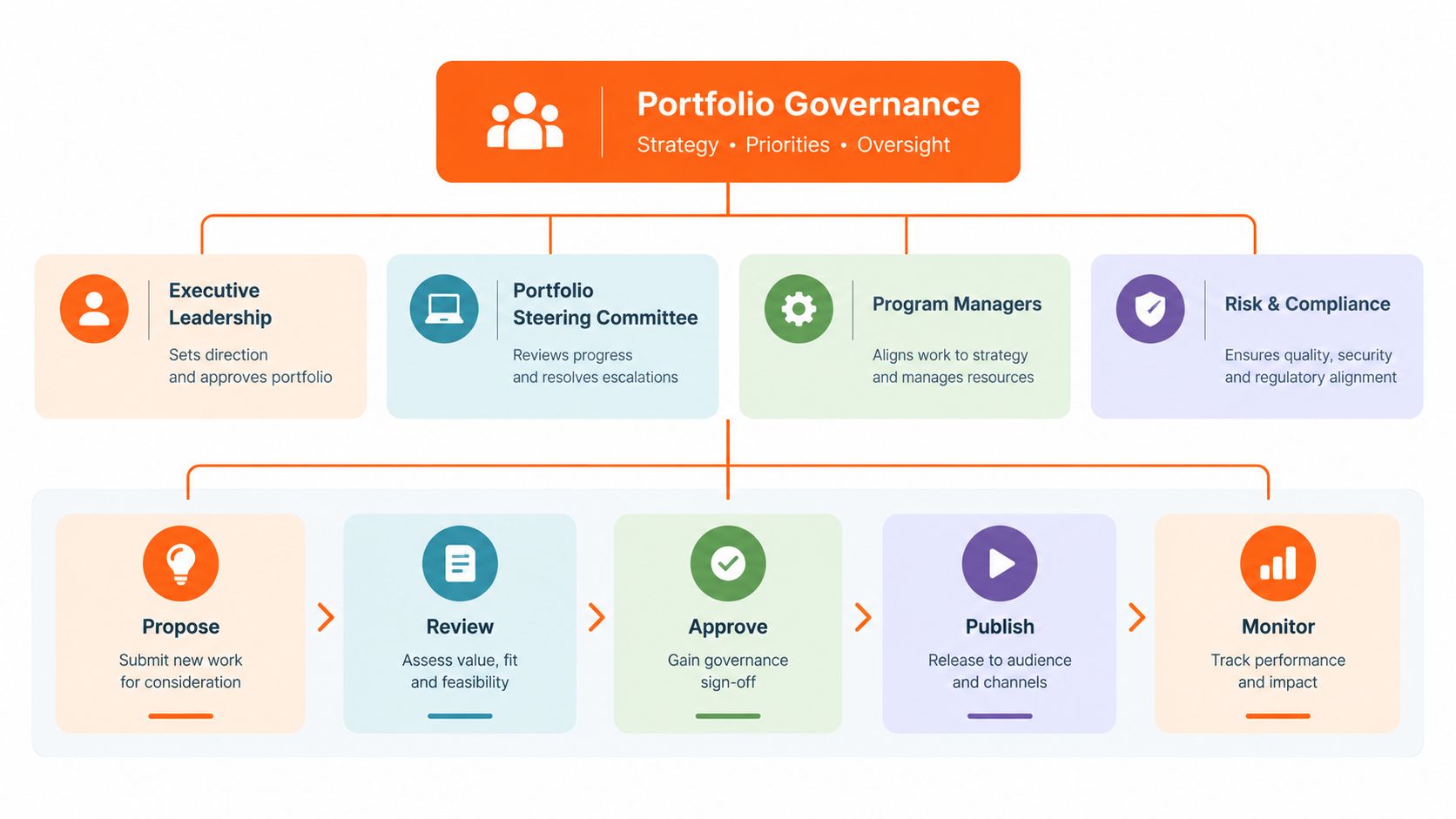
Governance should be built as a working document, not delivered as a strategy presentation that nobody opens again. Start with a single page for every brand and make the decisions visible to the people who create, review, and publish content.
Start with the portfolio inventory
Record each brand's:
- Audience: Who the brand serves, including the audience it deliberately doesn't serve.
- Promise: The specific value or change the brand offers.
- Position: The space it should occupy in the customer's mind.
- Forbidden territory: Topics, claims, tones, offers, and competitors it must not own.
- Business role: Whether it creates awareness, supports conversion, protects a relationship, or tests a new market.
Don't begin with content pillars. Begin with distinct jobs. A B2B SaaS brand might own operational education and category expertise. A wellness brand might own practical routines and consumer confidence. A nonprofit program might own public education, participation, and transparent impact updates.
The distinction matters because multiple brands in one market can create coverage, but unmanaged overlap creates duplicated effort and internal competition. McKinsey's brand portfolio guidance recommends defining each brand's role and relationship, giving managers latitude inside those rules, and maintaining a single portfolio-level owner.
Assign decision rights, not just owners
A name in a project-management field isn't ownership. An owner needs authority over specific decisions.
Document one accountable person for:
- Voice and positioning, including what the brand can say and how it says it.
- Resource allocation, including priority when two brands request the same writer or designer.
- Approval escalation, including claims, legal risk, and reputational issues.
- Kill dates, meaning when a campaign or content line stops receiving resources.
- Portfolio conflicts, meaning who decides when two brands want the same audience or topic.
A one-page governance sheet for three brands might list the editorial director as portfolio owner, a growth lead for the SaaS brand, a brand manager for wellness, and a program director for the nonprofit. Each brand owner can approve routine work inside their scope, while the portfolio owner resolves overlap and reallocates shared resources.
Set boundaries before you audit content
Create a boundary map with three fields: owned topics, shared topics, and restricted topics. Shared topics need a lead brand, a supporting brand, and a rule for amplification. Without that assignment, the same subject will appear as three competing articles with slightly different headlines.
Then audit what already exists. Look for duplicate pages, near-identical social posts, overlapping keyword targets, repeated campaign claims, and assets that were adapted without a clear parent idea. A defined content approval workflow can help formalize the handoffs, but it won't replace the portfolio decision about who owns the subject.
Use the audit to merge, redirect, retire, or reassign work before adding new tasks. Governance earns its keep by removing decisions from the calendar. It tells the team what belongs where, who can approve it, and when a brand should step aside.
The video below provides another perspective on structuring portfolio oversight and strategic workflows.
Naming, Voice, and Approval Conventions That Stick
A naming system fails when it reflects how leadership thinks instead of how the team searches for files at the end of a long week. The same applies to voice guides. A forty-page document may be thorough, but a one-page profile with usable examples is more likely to shape a draft.
Build conventions backward from real work
Use a campaign code that remains readable in a crowded archive:
BRAND-Q2-TYPE-NUMBER
For example, SAAS-Q2-LAUNCH-01 identifies the brand, planning period, campaign type, and asset sequence without relying on a folder hierarchy. Add the channel and status as fields, not as a growing filename, so a designer can update status without creating a new naming variation.
Your voice snapshot should fit on one page. Include:
| Voice element | Brand example |
|---|---|
| Primary impression | Clear, practical, and technically confident |
| Do | Explain the decision, show the consequence, use direct verbs |
| Don't | Use inflated claims, unexplained jargon, or empty urgency |
| Sentence pattern | Short lead sentence followed by useful context |
| Proof standard | Link to the source or identify the approved evidence |
Create one snapshot per brand, then add a short comparison strip showing how the brands differ. The SaaS brand may explain systems. The wellness brand may focus on approachable action. The nonprofit may prioritize clarity, dignity, and evidence. The point isn't to make every brand sound polished in the same way. It's to make the differences deliberate.
For practical guidance on keeping those differences intact across contributors, use a brand voice consistency framework.
Approve by risk, not by channel
A LinkedIn post isn't automatically low risk, and a blog article isn't automatically high risk. A routine opinion post may need one approver, while a casual social caption containing a health or financial claim may require specialist review.
| Risk Tier | Content Type | Approvers Required | SLA |
|---|---|---|---|
| Low | Routine social post using approved messaging | Brand owner | Same business day |
| Medium | Campaign asset, customer story, or new positioning angle | Brand owner and editorial lead | Agreed review window |
| High | Product, health, financial, legal, or impact claim | Brand owner, subject specialist, and legal where required | Scheduled review before production |
| Critical | Crisis response, regulatory issue, or reputational statement | Executive owner, legal, and communications lead | Immediate escalation path |
The approval record should show the decision, not just a green status. Require a short reason for rejection and a named person responsible for the next edit. That prevents circular feedback such as “make it more on brand” without explaining which part crossed the boundary.
Conventions should change when the work exposes a failure. If contributors repeatedly misclassify customer stories, update the risk matrix. If filenames become unreadable, simplify the code. A living system reduces friction because it reflects the work people do.
Building a Unified Content Calendar Without Spreadsheet Chaos
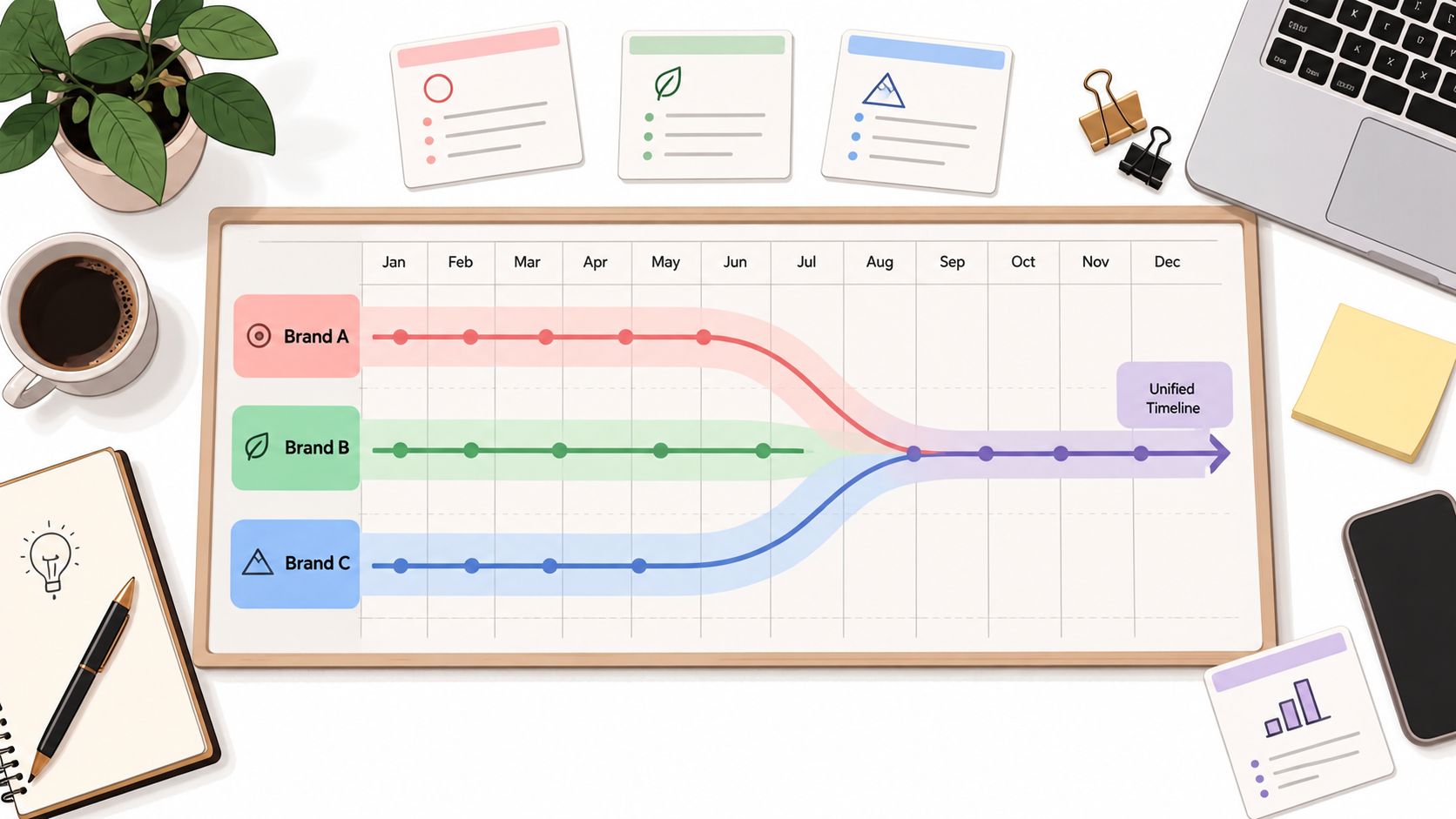
A unified calendar should answer four questions immediately: what is publishing, for which brand, who owns it, and what state is it in. Anything beyond those fields belongs in a brief, an idea bank, or a campaign document.
Start by defining each brand's operating rhythm. Record its usual publishing cadence, campaign windows, launch dependencies, review requirements, and blackout periods. These baselines don't need to force identical activity. A nonprofit may publish around program milestones, while a SaaS brand may build around product releases and customer education.
Use one view with separate rhythms
Color-code the shared weekly view by brand, but keep the underlying records structured. Every publish-ready item needs:
- Brand and channel
- Working title or approved hook
- Parent campaign or pillar
- Owner and approver
- Status
- Publish date and time
- Destination or asset link
- Primary success measure
Keep brainstorms and raw ideas out of the publishing calendar. Mixing unapproved thoughts with ready-to-publish assets is how teams lose trust in the schedule. Store ideas separately and promote them into the calendar only after an owner, audience, and next action exist.
Anchor the view to campaign pillars rather than isolated posts. A quarterly theme about operational efficiency can produce a product launch for Brand A, a thought leadership thread for Brand B, and a customer story for Brand C. Those assets can share a strategic relationship without competing for the same message.
A worked week across three brands
A Monday calendar review might show the following:
- Brand A, SaaS: Product launch announcement supported by a technical explainer.
- Brand B, thought leadership: A point of view on the problem the launch addresses, without repeating product language.
- Brand C, customer program: A customer story focused on the human outcome, with its own evidence and approval path.
The lead brand owns the launch topic. Brand B interprets the category issue. Brand C demonstrates the broader consequence. The team can coordinate timing, links, and visual production while preserving distinct roles.
A calendar view such as Narrareach's content calendar management workflow can bring these records into one operational view, but the governance sheet still decides which brand gets priority.
Protect accuracy with a short weekly ritual
Run a Monday triage that takes 10 minutes as a deliberate operating target, not as a universal performance claim. Review only changes that affect publication:
- Remove anything without an owner.
- Resolve collisions between brands or channels.
- Move blocked assets out of the publish-ready view.
- Confirm approvals and dependencies.
- Check that every item still serves its assigned brand role.
Scheduling should follow audience activity rather than personal availability. Metricool's scheduling guidance describes using each network's audience activity to identify suitable publishing moments across time zones. Use those recommendations as inputs, then override them when a campaign, event, or audience expectation requires a different time.
The calendar is accurate when people trust it enough to update it. That trust comes from strict inclusion rules, visible ownership, and a weekly habit that removes stale work before it creates another Friday scramble.
Repurposing Fewer Ideas More Deeply Across Platforms
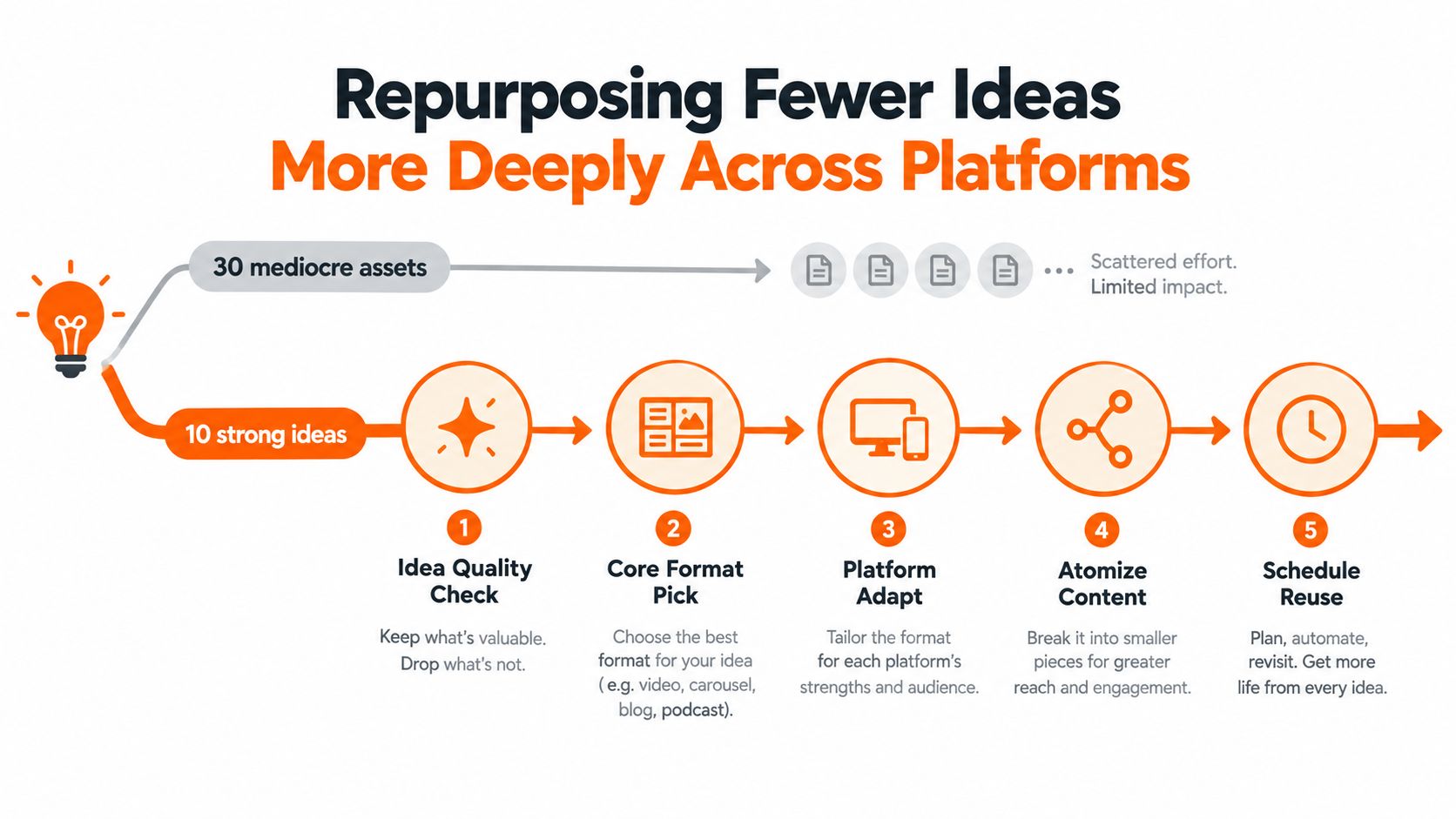
The volume trap is easy to recognize. A team produces 30 mediocre assets because the calendar has empty spaces, while a stronger idea receives one publication and disappears. A more disciplined system starts with 10 strong ideas and asks whether each one deserves expansion, adaptation, or retirement.
This isn't an argument for publishing less without a strategy. It's an argument for protecting editorial judgment. A strong idea has a clear audience problem, a useful point of view, and enough substance to survive changes in format.
Start with a parent asset
Choose one primary format first. It might be a research report, a Substack article, a customer interview, or a long-form video. Then branch into derivatives only when the source contains a distinct claim, example, or action that can stand alone.
A practical format map looks like this:
| Platform | Native derivative | Editorial change |
|---|---|---|
| Carousel and short post | Lead with a business tension, then make the lesson scannable | |
| X | Thread and quote card | Break the argument into sequential claims and a memorable line |
| Reel script and carousel | Translate the idea into visual steps, spoken language, or prompts | |
| Blog | Long-form article and newsletter excerpt | Expand evidence in the article, reserve the excerpt for one useful takeaway |
| YouTube | Long video and Shorts | Build the long explanation first, then isolate self-contained moments |
Copy-pasting fails because each platform has different reading behavior and expectations. Rewrite the opening, shorten the argument where necessary, and remove references that only make sense in the parent asset. Keep the brand's point of view, but change the shape of the explanation.
For creators extending written work into video, resources on short-form video content from old posts offer useful prompts for identifying moments that can become standalone clips.
Keep the chain traceable
In one illustrative week, a research report could become nine distinct assets across three brands. The SaaS brand might publish the core finding and a technical interpretation. The wellness brand could use a relevant behavior insight in a practical format. The nonprofit could adapt a public-interest implication, provided the evidence and role boundaries support it.
Those assets should not live as unrelated entries. Tag every derivative with the parent asset, original topic, brand, format, and intended audience. Without parent-asset links, analytics can show that nine things performed, but not whether one idea created the momentum.
Use a decision tree:
- Quality check: Does the parent idea solve a recognizable problem?
- Format pick: Which channel can explain it most clearly?
- Platform adaptation: What must change for the audience and interface?
- Atomization: Which claims can stand alone without distortion?
- Reuse schedule: When can the idea return without feeling repetitive?
A unified distribution workflow can help teams schedule Substack Notes, Medium articles, LinkedIn posts, and X content from one place, including adaptations that preserve the source voice. The tool doesn't decide whether an idea deserves reuse. The editorial lead still has to make that call.
Use Narrareach's content repurposing workflow when you need to connect a high-performing source idea to channel-specific derivatives, then review every version for brand ownership and audience overlap. Repurposing becomes efficient when the team creates fewer source ideas, adapts them deliberately, and measures the entire chain instead of isolated posts.
Tracking Performance and Iterating Without Cannibalizing Brands
A portfolio dashboard can hide as much as it reveals if every brand reports a different definition of success. Awareness work should not be judged against direct revenue in the same column as conversion content, and a nonprofit participation campaign shouldn't be dismissed because it has fewer clicks than a product launch.
Assign each brand a role before assigning its KPIs. An awareness brand may prioritize qualified reach, engaged attention, and audience growth. A conversion brand may prioritize click-through behavior, sign-ups, or attributable actions. A relationship or impact brand may track participation, return engagement, and completed actions.
Use guardrails instead of vanity comparisons
The exact floor depends on the brand's baseline and objective. The important point is to document it before a review, then trigger an audit when performance crosses it.
| Brand Role | Primary KPI | Guardrail Floor | Review Cadence |
|---|---|---|---|
| Awareness | Qualified reach and engaged attention | Sustained decline from the approved baseline | Weekly signal review, monthly portfolio review |
| Conversion | Qualified clicks or completed actions | Material deterioration against the campaign baseline | Weekly |
| Relationship | Returning engagement or participation | Drop below the program's established baseline | Weekly during campaigns |
| Portfolio support | Assisted actions across brands | Declining contribution without a clear role change | Monthly |
The content analytics dashboard approach is useful when each brand has separate views but the portfolio owner can inspect shared topics, formats, and audience signals.
Run two reviews, not one giant meeting
The weekly review should take about 20 minutes as a practical target. Pull the top and bottom performers for each brand, tag them by format and topic, and write one observation per brand. Don't turn the meeting into a debate about every post. The output should be a short list of hypotheses.
The monthly review asks a harder question: Is Brand B gaining attention because it found an underserved audience, or because it is taking the audience and keywords that Brand A was meant to own? Compare topic clusters, search intent, audience overlap, branded demand, and assisted actions. If two brands repeatedly attract the same people with nearly identical promises, revisit the boundary map before increasing output.
Portfolio-cohesion measurement can make this drift more visible. A 2025 article introducing the Portfolio Brand Cohesion Metric describes a 0 to 100 scale, where 0 represents a fragmented portfolio and 100 represents perfect cohesion. Treat that metric as a diagnostic signal, not a target to maximize. Distinct brands need differentiation, while the overall system still needs enough coherence to feel intentional.
Turn observations into controlled tests
Suppose the portfolio dashboard shows an illustrative 2x CTR drop for Brand C during a sprint. Don't immediately change the entire calendar. Trace the decline through the chain:
- Observe: Identify the affected formats, topics, and dates.
- Hypothesize: Check whether the copy drifted from the approved voice or targeted the wrong audience.
- Test one variable: Change the opening, format, audience, or call to action, but not all four.
- Measure: Compare against the brand's own baseline and role.
- Lock in: Turn a confirmed winner into a template with a clear owner.
This process catches voice drift before the team mistakes it for audience fatigue. It also stops one brand from borrowing another's successful format without understanding why it worked.
Strong multi-brand operations don't reward constant expansion. They grow when leaders know what each brand owns, when to amplify a shared idea, and when to leave a topic alone. The portfolio becomes easier to manage because every performance signal leads to a decision, not another content request.
Narrareach gives editorial teams one workflow for scheduling Substack Notes, Medium articles, LinkedIn posts, X content, and other supported channels, while tracking cross-platform performance and turning proven ideas into voice-aligned derivatives. Visit Narrareach to start free without a credit card, or keep using your existing stack and apply the governance, calendar, and measurement rules above first.