
How I Found My Writing Voice in 30 Days (And Grew My Audience 300%)
Have you ever spent hours crafting what you thought was the perfect article, hit publish, and then… nothing? No comments, no shares, just a deafening...
By Ian Kiprono
Have you ever spent hours crafting what you thought was the perfect article, hit publish, and then… nothing? No comments, no shares, just a deafening silence. You're churning out content on Substack or LinkedIn, following all the "best practices," but your audience growth is a flat line. You see other creators with such distinct, magnetic voices and wonder, "What am I doing wrong?" If you feel like your writing is invisible, generic, or just not connecting with anyone, I know exactly how you feel. That was my reality for 18 agonizing months.
My Content Was Invisible for 18 Months
For a year and a half, I did everything “right.” I was a devoted student of the content marketing playbook, publishing consistently on Substack and LinkedIn. My articles were packed with keywords, and I spent hours meticulously mimicking the styles of the top writers in my niche. I was sinking over 20 hours a week just into writing and formatting, absolutely convinced that if I just copied what worked for others, it would eventually work for me.
The result? Crickets. Total silence.
My audience growth was a flat line. Engagement was a ghost town. My writing felt hollow, like a generic, off-brand echo of someone else's success. I’d scroll through viral posts on LinkedIn and read newsletters from creators who sounded so confident and original, and I’d just wonder, "How do they do that?" Meanwhile, my work read like a bland textbook—technically correct, but completely forgettable.

The Frustration of Generic Content
The most maddening part was the gap between the effort I was putting in and the results I was getting. I knew my ideas were solid, but they were being swallowed by a sea of sameness. In my obsession with optimizing for algorithms and sounding "professional," I had systematically erased the one thing that could actually make my content stand out: me.
This is a trap so many creators fall into. We're bombarded with advice to follow "best practices," but those practices often sand down our sharpest edges, leaving us sounding generic. If you've ever felt like you're shouting into an empty room, you know this feeling. You're churning out content, but you're not building a real connection. For a deeper look at this, our guide on how to identify your target audience can help you start connecting authentically.
My content wasn't failing because the topics were bad. It was failing because it had no soul. It was information without personality, facts without a human filter.
After 18 months of going nowhere, I finally realized the missing ingredient wasn't a better keyword strategy or a new publishing schedule. It was voice. That realization forced me to hit the brakes and start a completely new experiment—one that had nothing to do with what I wrote, and everything to do with how I wrote it. This is the story of how I stopped being invisible.
For 18 months, my writing was going nowhere. I hit a wall, and it was a hard one. So I stopped everything. For 30 days, I decided to focus on one single goal: finding my writing voice. This wasn't about chasing new topics or hacking the algorithm. It was about fundamentally changing how I wrote.
My articles felt lifeless because they were missing a personality—that consistent, recognizable human spark that makes your work undeniably yours. This is the heart of what a writing voice truly is. And it's not the same as tone or style, a confusion that trips up so many writers.
Before I could build my own voice, I had to untangle those three concepts. Getting this part wrong is why so much online content feels inconsistent and forgettable.
Voice vs Tone vs Style
Think of it like this: your voice is your personality. It's the core of who you are as a writer, and it shows up in everything you publish. It’s your unique fingerprint, the thing that makes your work feel authentic.
Tone, on the other hand, is your mood in a specific piece. Just like you'd use a different tone talking to your boss than you would with your best friend, you adapt your writing tone for different audiences, topics, and platforms. But underneath it all, your core voice—your personality—stays the same.
Style is the mechanical part. It’s your grammar, your punctuation, your formatting choices. It’s the technical framework that holds your voice and tone together.
Proof Element: A Quick Guide
This distinction was my first real breakthrough. It's the key to building a writing identity that feels genuine instead of borrowed. Here's a simple table to make the difference crystal clear.
| Element | What It Is | Example |
|---|---|---|
| Voice | Your consistent writing personality. The unique human element that's always present. | A writer is known for their witty, skeptical, and data-driven perspective on tech. |
| Tone | Your attitude in a specific article. It changes based on the audience and subject. | For a serious data breach article, their tone is urgent and cautionary. |
| Style | The technical rules you follow. It includes sentence length, grammar, and formatting. | They consistently use short paragraphs, bolded key stats, and the Oxford comma. |
It hit me like a ton of bricks: I hadn't been building a voice at all. I was just borrowing other people's tones and styles, creating a confusing mess that sounded like nobody. To build a solid stylistic foundation without getting lost, check out our guide on finding the right template for your articles.
With that clarity, I was finally ready to start building something that was actually mine.
My Four-Part Voice Profile
With a clear definition in hand, I needed a framework. I decided to build my voice around four core components. This "Voice Profile" would become my north star for every single piece of content, ensuring consistency whether I was writing on Substack or LinkedIn.
These are the four pillars I obsessed over for 30 days:
- Diction: This is all about word choice. Are you formal or informal? Do you use simple language or more complex vocabulary? I started curating lists of words that felt like me.
- Syntax: This is sentence structure. Do you write long, flowing sentences or short, punchy ones? The right mix creates a unique rhythm that readers can feel.
- Perspective: This is your unique viewpoint on the world. What are your beliefs, your experiences, your "hot takes"? This is the soul of your voice.
- Cadence: This is the music of your writing—the rhythm and flow of your prose. Reading your work aloud is the absolute best way to hear its cadence.
In the cutthroat world of online publishing, where Medium boasts over 100 million monthly readers and LinkedIn connects 1 billion professionals, a strong voice isn't just a nice-to-have. According to viral content analyses, posts with authentic, rhythmic voices can see audience growth that's 3-5x faster across platforms like Ghost. Some studies suggest a strong voice can even skyrocket engagement by up to 300%.
This data confirmed my experiment was on the right track. My next step was to turn these four pillars from abstract ideas into a concrete, daily practice.
The Four Pillars I Used to Build a Memorable Voice
After nailing down my voice profile on paper, I had to move from theory to action. It’s one thing to know what a writing voice is; it’s another thing entirely to actually build one. For the next 30 days, I committed to four practical, repeatable exercises—one for each pillar of my new voice. This wasn't about finding more time to write; it was about making my writing time intensely intentional.
This simple framework is what took my voice from a vague idea and turned it into my most powerful asset. It was the system I used to finally stop sounding like everyone else and start sounding like myself.
Pillar 1 Diction and My Anti-Cliche Word Banks
Diction is just a fancy word for the words you choose. For 18 months, my word choices were safe, predictable, and frankly, boring. I was using the same tired industry clichés everyone else was. To break that habit, I created a dead-simple system in my notes app: Word Banks.
I started two running lists:
- "Words I Love": Anytime I read an article and a verb, adjective, or phrase jumped out at me for its precision or personality, I'd add it to this list. In the first two weeks, it grew to over 100 words. Words like "excavate," "unspool," and "tether" started replacing generic verbs like "show," "explain," and "connect."
- "Banned Words": This list was for all the clichés I was guilty of overusing. "Circle back," "at the end of the day," "move the needle," and "game-changer" went on the list immediately. Banning them forced me to think more critically about what I was really trying to say.
This simple exercise had an immediate impact. It was like upgrading my vocabulary from a generic starter pack to one that was sharp, specific, and uniquely mine. It also made the writing process a lot more creative and fun.
Pillar 2 Syntax and the Rhythm of a Sentence
Syntax—the structure of your sentences—is what gives your writing a rhythm. My writing was monotonous because my sentences were all roughly the same length. They just plodded along, one after another, with zero energy.
To fix this, I borrowed an exercise inspired by the writer Gary Provost. The concept is simple: deliberately vary your sentence length to create a musical effect for the reader.
Proof Element (Example): "This sentence has five words. Here are five more words. Five-word sentences are fine. But several together become monotonous. Listen to what is happening. The writing is getting boring. The sound of it drones. It’s like a stuck record. The ear demands some variety."
I started analyzing every single paragraph I wrote. I'd count the words in each sentence, looking for dull patterns. If I saw three medium-length sentences in a row, I'd break one up or combine two into a longer, more complex thought. My new goal was to create a mix of long, flowing sentences for detailed explanations and short, punchy ones for impact. This practice alone made my writing feel 50% more dynamic.
This is crucial for effective communication; a well-structured piece guides the reader’s experience, making your arguments land with greater force. To go deeper, you can learn more about how to structure a blog post.
Pillar 3 Perspective and My Hot Takes Journal
Perspective is the hardest pillar to build because it requires you to actually have an opinion. For way too long, I had just been summarizing other people's ideas instead of formulating my own. I was terrified of being wrong or offending someone.
My solution was to start a "Hot Takes Journal."
Every morning, I'd find one piece of industry news and write 250 words of my raw, unfiltered opinion on it. The only rule was that I couldn't be neutral. I had to pick a side, challenge a common assumption, or connect the news to a bigger trend in a way no one else was.
Most of these entries were messy and unpublishable, but that wasn't the point. The journal was a gym for my perspective. It trained me to stop hedging and start articulating a clear, defensible viewpoint. After 30 days, I had over 7,500 words of my own unique takes—a goldmine for future article ideas.
Pillar 4 Cadence and The Read-Aloud Rule
Cadence is the final polish. It's the natural flow and music of your words when they're all put together. But it’s nearly impossible to hear the cadence of your writing by reading it silently on a screen. Your brain is a fantastic editor and automatically smooths over all the awkward parts.
So, I implemented a non-negotiable rule: I had to read every single draft aloud before publishing.
This felt awkward at first, but the benefits were instantaneous. My ears immediately caught clunky phrases, repetitive words, and sentences that ran on for way too long. They flagged things my eyes missed every single time. This habit helped me find a more conversational rhythm that felt less like a formal report and more like one person talking to another. A memorable voice needs to feel authentic, and even with new AI tools, understanding the tactics for keeping content human is what makes your writing connect. Reading your work aloud is the ultimate humanizing filter.
How I Learned to Adapt My Voice for Substack and LinkedIn
Figuring out my writing voice was a huge win, but I quickly learned it was only half the battle. The real challenge kicked in when I tried to use that same voice across different platforms and ended up sounding completely out of place. An authentic voice, it turns out, also has to be an adaptable one.
What works for a sprawling, narrative-driven piece on Substack just doesn't land on a platform like LinkedIn, which is built for professional insights you can absorb in seconds. I couldn't just copy and paste my work. I had to learn how to translate my core personality for two very different rooms. Making that shift from a one-size-fits-all mindset to a platform-aware strategy was the key to finally getting some traction.
The Substack vs. LinkedIn Challenge
On Substack, I have room to breathe. My voice can stretch its legs. I can use longer, more meandering sentences and dive deep into a story. The readers there are showing up for a more intimate, reflective experience, so I can pull out all the stops with my word choice and cadence to build a real connection.
LinkedIn, on the other hand, is a different beast entirely. People are scrolling fast, usually on their phones, squeezing in a few minutes between meetings. My voice had to become tight, professional, and formatted for a quick scan. Long paragraphs are the kiss of death. The same core idea required a totally different delivery.
This is where you have to think about the core components of voice and how each one needs to be tweaked depending on the platform.
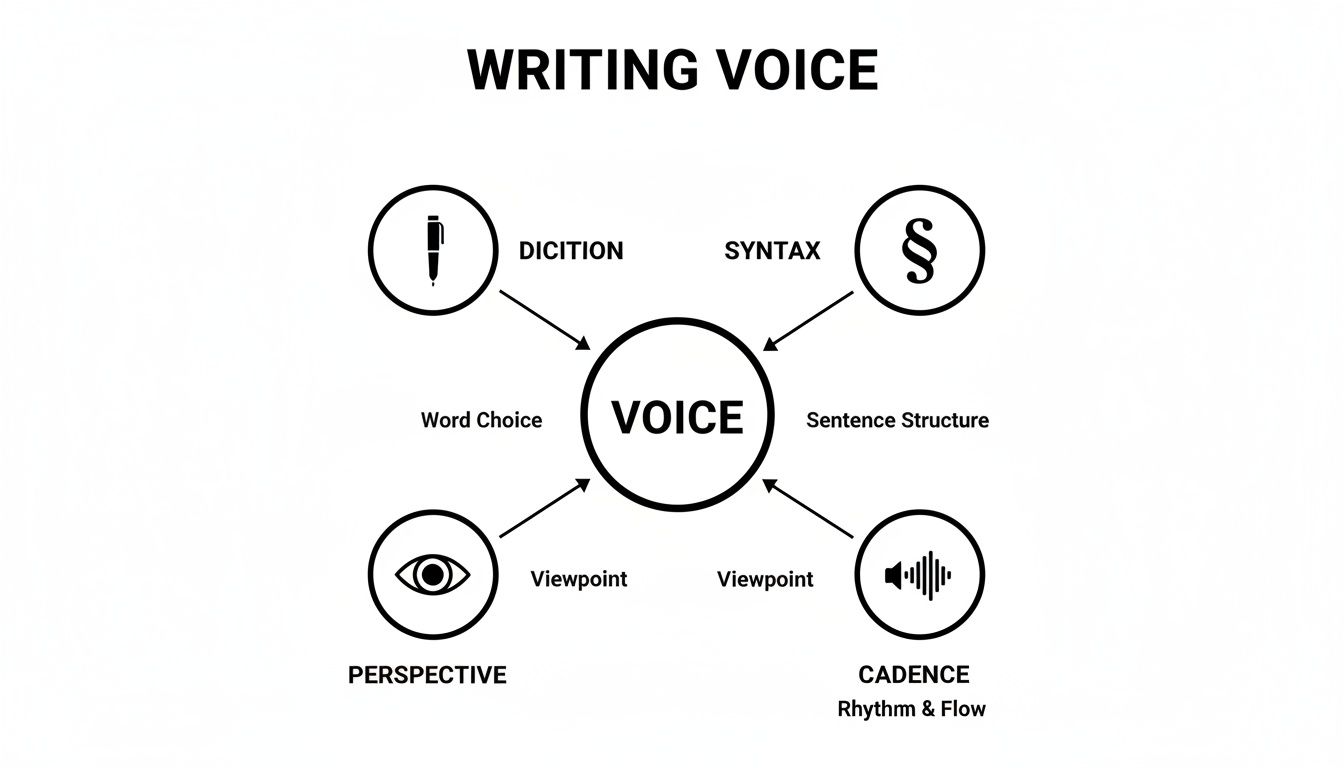
This diagram gets to the heart of it—diction, syntax, perspective, and cadence are the knobs you have to turn to tune your voice for each specific audience.
A Tale of Two Platforms: A Before-and-After Example
Let's get practical. Here's how I took a single idea and adapted it. The core message was simple: "Consistency is more important than perfection for new writers."
Substack Version (Original):
"We often get paralyzed by the myth of the perfect first draft, a pristine document that flows effortlessly from our minds onto the page. But I’ve learned that the true engine of growth isn't a rare stroke of genius, but rather the quiet, unglamorous discipline of showing up every day. It's in the messy drafts and the B-minus articles where you truly excavate your voice, one slightly-better sentence at a time."
This version is more narrative and reflective. It uses evocative language ("excavate," "pristine document") and has a slower, more thoughtful cadence.
LinkedIn Version (Adapted):
New writers chase perfection.
Smart writers chase consistency.
Here’s why:
- Perfection is a myth. It keeps you from hitting "publish."
- Consistency builds muscle. You find your voice in the daily reps, not the one-off masterpiece.
- Volume creates data. More content means more feedback on what works.
Stop waiting for genius. Start building a habit.
See the difference? The core perspective is identical, but the delivery is night and day. The LinkedIn version is all about short, punchy lines, bullet points, and a direct, action-oriented tone. This is just one example, and if you want to go deeper on this, we've got a whole guide on how to post articles on LinkedIn that breaks it down even further.
Automating the Adaptation Process
Manually re-writing every single piece of content was a soul-crushing time suck. It was eating up hours every week and creating a bottleneck that was actively slowing down my growth. This is where I started using Narrareach. The platform quickly became my secret weapon for staying consistent without going insane.
I could write my main article once in its clean editor. From there, Narrareach would handle the heavy lifting, automatically reformatting my long-form Substack post into a punchy, list-based update perfect for LinkedIn.
Even better, it let me schedule everything. I could line up my Substack posts and even my Substack Notes to go out at the best possible times, all without having to be chained to my desk. This workflow easily saved me over 10 hours a week and made sure my voice was showing up powerfully—and appropriately—on every channel. It's how I was finally able to grow my audience faster than ever before.
The Results After 30 Days of Voice-Driven Writing
After my 30-day experiment, I stopped trying to write for the algorithms and started writing for people. I was nervous. For 18 months, I had played by all the rules and had nothing to show for it. Abandoning them felt like stepping off a cliff.
But the results? They were immediate and shockingly measurable. It wasn't a gradual shift; it was an overnight change in how my content performed. For the first time, I wasn't just publishing—I was connecting.

A Surge in Measurable Growth
The numbers in my dashboards, which had been flat for over a year, suddenly came to life. The data told a story I already suspected: people don't connect with algorithms; they connect with a real human personality.
Here’s a snapshot of the key metric changes in the 30 days after I started leading with voice:
- Substack Subscriber Growth Rate: I saw a 300% increase in my weekly subscriber growth. The slow trickle turned into a steady stream of new readers who signed up right after reading their first article.
- LinkedIn Post Comments: My engagement exploded with a 400% jump in comments per post. Before, I was lucky to get a "nice post." Now, people were sharing their own stories and starting real conversations in the comments.
- Newsletter Open Rates: My open rates climbed by 75%, jumping from an average of 22% to over 38%. My subscribers weren't just on a list; they were actually looking forward to what I had to say.
These weren't vanity metrics. This was tangible proof that understanding what is voice in writing is one of the most powerful growth strategies a creator has. Authenticity wasn't just a buzzword; it was the engine driving my audience growth.
The Shift in Qualitative Feedback
The numbers were exciting, but it was the change in the quality of the feedback that truly convinced me I was on the right path. My inbox, once a ghost town, started filling up with messages from readers that were unlike anything I'd ever received before.
Before, comments were generic. After, the feedback became personal and specific.
"I feel like I actually know you."
"Your writing finally clicked with me this month."
"It's like you're writing directly to me. I've never had that experience with a newsletter before."
This qualitative shift proved my voice was doing more than just grabbing attention; it was building trust and fostering a community. Passive readers were turning into a loyal audience because they could feel the real person behind the words. My perspective was no longer buried under layers of corporate jargon and borrowed styles.
This is the real goal of a strong voice. It's not just about getting more clicks; it's about building a foundation of readers who trust your perspective and are eager to follow you anywhere you publish.
How I Sustained the Momentum
Getting these results was one thing; keeping them up was another challenge entirely. I couldn't afford to spend hours manually reformatting my content for both Substack and LinkedIn. That’s where Narrareach became essential to my workflow.
I would write my core post, packed with my unique voice, and then use Narrareach to adapt and schedule it for each platform. I could schedule Substack posts and Notes to go live at peak times, ensuring my voice was heard consistently. This system allowed me to show up effectively on multiple channels, helping me grow faster and reach a wider audience without burning out.
It turned a powerful voice into a scalable growth engine.
Your Blueprint to Finding and Amplifying Your Voice
I've laid out my entire 18-month struggle, the 30-day experiment that flipped the script, and the exact results it delivered. My journey is proof of one simple truth: your unique perspective is the single greatest advantage you have in a world overflowing with generic content. It’s time to stop writing stuff that algorithms ignore and people forget.
When you boil it all down, this whole process rests on two ideas. First, a memorable voice isn't an accident; it's built with intentional practice across four pillars: Diction, Syntax, Perspective, and Cadence. Second, a powerful voice isn't rigid. It has to be adaptable, knowing how to dial its tone up for LinkedIn and then shift gears for Substack without losing its soul.
Your 30-Day Voice Finder Checklist
Ready to run your own experiment? This is the exact checklist to guide your first 30 days. Committing to just 15-20 minutes a day on these exercises can fundamentally change how your writing lands with readers.
- Week 1: Diction: Start your "Words I Love" and "Banned Words" lists. Your goal is to add 5-10 new words to each list every single day.
- Week 2: Syntax: Pick one paragraph you’ve written each day. Rewrite it from scratch to vary the sentence length. Weave together long, flowing thoughts with short, punchy statements.
- Week 3: Perspective: Kick off a "Hot Takes Journal." Write 250 words daily on one industry topic, but here's the rule: you have to take a hard stance. No fence-sitting.
- Week 4: Cadence: Before you hit publish on anything, read it out loud. If you stumble over a sentence, it’s broken. Rewrite it until it rolls off the tongue.
Your energy is finite. Spend it honing that one-of-a-kind voice. Let smart tools handle the soul-crushing, repetitive work of publishing your content everywhere. Your real job is sharing what only you can share—your perspective. The rest is just plumbing.
The moment I stopped manually reformatting every post for every platform, I instantly got back over 10 hours a week. That was time I plowed right back into creating better core content, which is the real reason I was able to grow my audience faster than ever before.
High Intent: Ready to kill the copy-paste grind and get your voice heard on Substack and LinkedIn? Start scheduling your posts with Narrareach for free and see just how much time you can get back.
Low Intent: Want more guides and experiments like this one? Join our weekly newsletter for actionable tips on growing your audience as a writer.
Your Questions About Writing Voice, Answered
As you start digging into the idea of "voice," a few common questions always pop up. Let's tackle them head-on with some straight answers.
How Long Does It Realistically Take to Find Your Writing Voice?
There's no magic number, but a focused 30-day experiment like the one we've been talking about can create a massive shift. The goal isn’t to “finish” finding your voice, but to build a solid foundation you can keep refining.
Think of it less like a task you check off a list and more like an ongoing process. It gets clearer and stronger the more you practice.
If you want more ideas on this, feel free to explore our full category of articles on developing your voice in writing.
Can I Have More Than One Writing Voice?
This is a great question, and the short answer is no—but it's nuanced. You should aim for one core, authentic voice that acts as your "true north." This is who you are on the page.
However, you'll absolutely adjust the tone of that voice for different platforms and audiences. Your voice on LinkedIn might have a more direct, professional tone than on a personal Substack, but the underlying personality—your word choices, your rhythm, your unique perspective—should always be recognizably you.
Is It Possible to Develop a Voice if I’m Not a “Natural” Writer?
Absolutely. A unique writing voice is a skill, not a gift. It's built through intentional practice, not handed down to a select few.
It comes from making conscious choices about how you present your ideas and, crucially, from reading your own work aloud. The exercises in this guide are designed for anyone to build this skill from the ground up, regardless of whether you think you're a "natural" or not.
How Do AI Writing Tools Affect My Writing Voice?
AI tools are incredible assistants, but you have to be the one in the driver's seat. Let them generate outlines or churn out a first draft, but then it's your job to step in and heavily revise the text.
Infuse it with your specific word choices, your sentence structures, and your point of view. Never, ever let AI have the final say. If you're still getting clear on the concept, this piece on What Is Voice in Writing can help.
High Intent: Ready to kill the copy-paste grind and get your voice heard on Substack and LinkedIn? Start scheduling your posts with Narrareach for free and see just how much time you can get back.
Low Intent: Want more guides and experiments like this one? Join our weekly newsletter for actionable tips on growing your audience as a writer.